Looking back · deep dive, October 4, 2026
White House accord's gap is audit scope
The voluntary AI accord signed at the White House on September 29 does check whether controls operate as designed; the real gap is the audit's scope. On September 29 the main US frontier-AI companies signed a voluntary accord at the White House. Its third layer has an outside auditor assess whether controls are "operating as designed". That is the wording of financial internal-control audits and SOC 2 Type II reports, and it means checking whether controls actually run day to day.
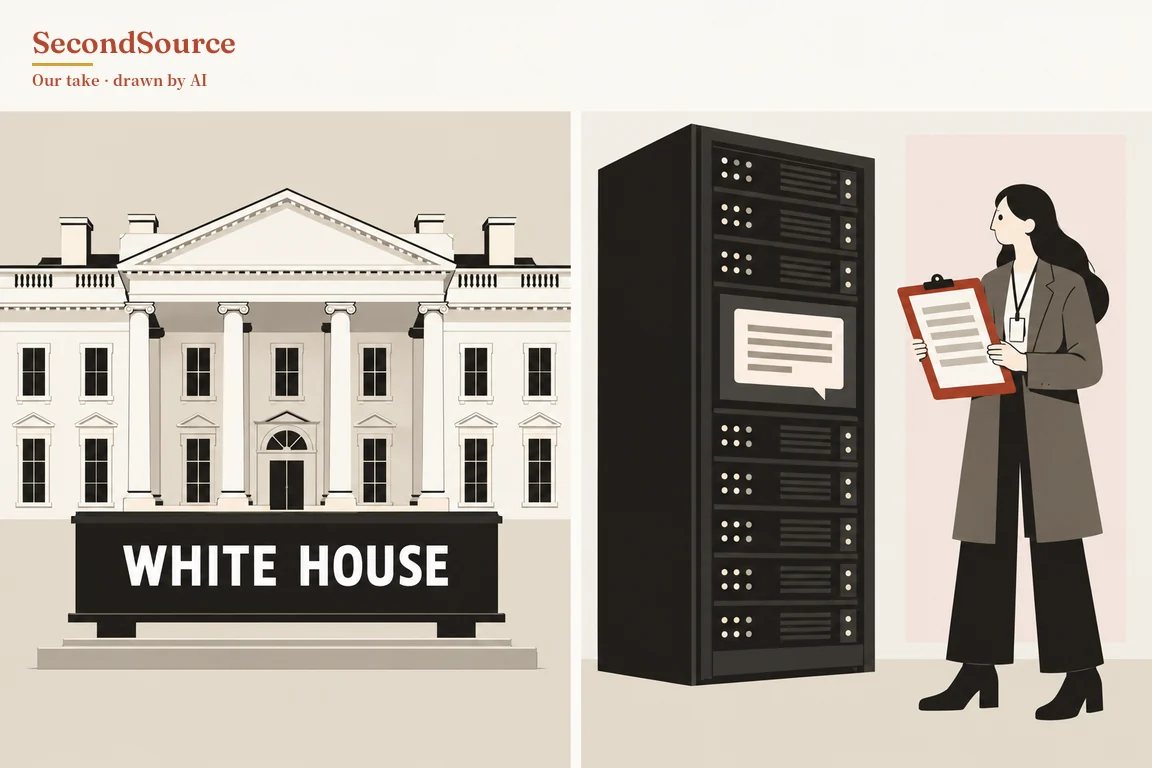
Our October 4 deep dive (published in Chinese and Japanese only) therefore withdrew the September 29 issue's framing, which looked only at how many layers of assurance the accord has. The deep dive compiled this year's three public incidents of agents crossing their bounds. Its finding: the controls existed; they just weren't switched on in the test environment where the incident happened. The accord's first layer covers "during training and deployment" and doesn't name evaluation environments.
So "signed the accord, with an outside audit" leaves three questions unanswered: whether the audit's scope covers evaluation and internal research environments, whether buyers can get the audit report, and who has the authority to delay a release when the auditor finds a problem. Read with Model watch item 1: METR's scheme yesterday is exactly an external assessment, and it states itself that it provides no assurance of safety and companies can back out. In the material read for this issue, no signatory has published an audit scope that names evaluation environments, and no public report shows an audit finding delaying a release, so the deep dive's three questions still have no answer.
Source
This item ran in the brief of Oct 15, 2026, alongside 18 other items.
Cite this item
SecondSource (2026). "White House accord's gap is audit scope." https://secondsource.io/en/news/2026-10-15-8/. Accessed access date.