Research & models Oct 14, 2026
Today · October 13
DeepMind says Argon tops ERQA at 87%; no one else reran it
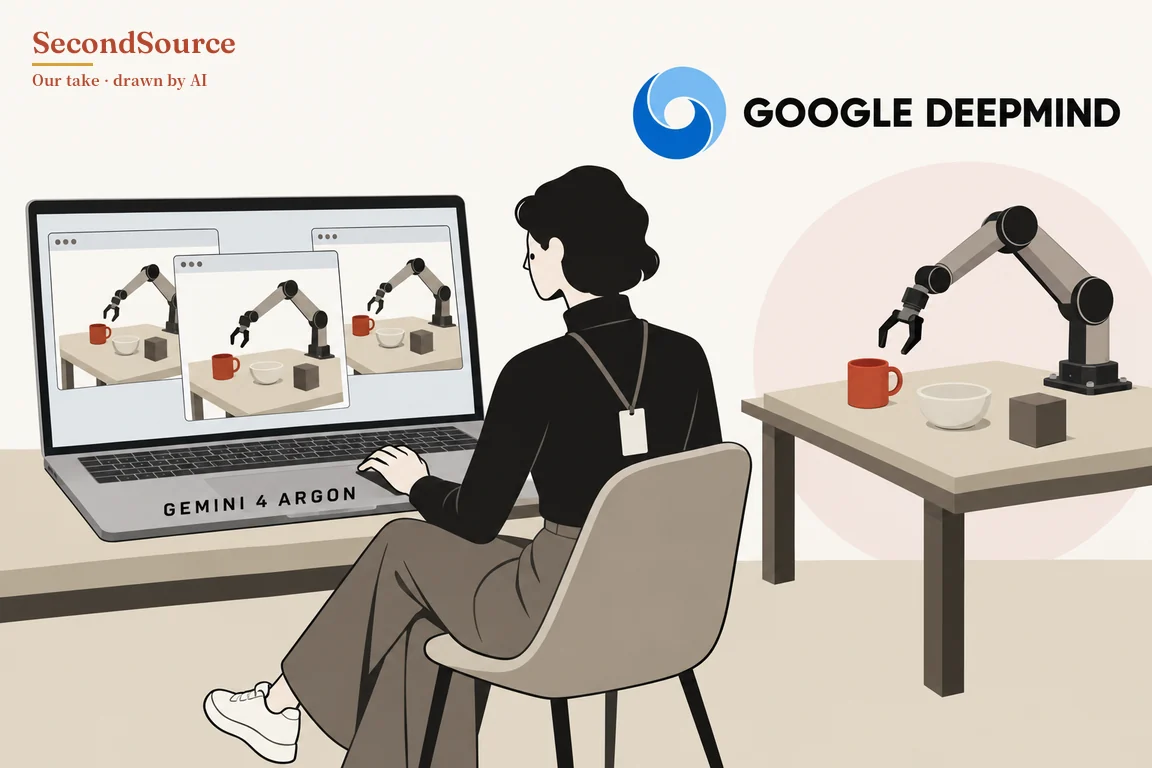
Google DeepMind reports that Gemini 4 Argon scores 87% on ERQA, an embodied-reasoning benchmark, "outperforming every other frontier model," and that more than 4,500 data items it synthesized from one tabletop photo raised a real robot's success rate from 56% to 75%. The original: "Using pure reasoning, Argon scores 87%, outperforming every other frontier model." The demo built a simulation environment from a single photo of a tabletop and synthesized the training data there. The demo section says the synthetic data was "boosting real-world physical robot Success Rate from 56% to 75%", with completion time falling from 35 seconds to 24 seconds (Google DeepMind, 2026-10-13). The 87% is a benchmark score. The 56% to 75% is a before-and-after on a single tabletop task with a real robot. The two numbers measure different things. No third party has rerun the cross-model comparison, and the post doesn't give the number of trials. We hold an unsettled judgment that competition in industrial and robotics AI turns on proprietary data, hardware and software tuned together, and inference inside the factory, rather than on model scale. It rests mainly on an interview with an executive at the robotics company Standard Bots. Today's DeepMind demo cuts against it on one point: a general-purpose model can synthesize training data in simulation. The demo covers a single task, which isn't enough to show that proprietary data no longer matters. The interview and the demo are both self-reported, so we keep both views on record. We'll adjust that judgment only when a third party replicates the synthetic-data effect beyond a single task. How we checked →
Source and checks
This item ran in the brief of Oct 14, 2026, alongside 14 other items. How we checked it, the quote checks and what was still missing that day are on that issue's How we checked page.
Cite this item
SecondSource (2026). "DeepMind says Argon tops ERQA at 87%; no one else reran it." https://secondsource.io/en/research/2026-10-14-2/. Accessed access date.