Deep Dive Oct 31, 2026
AI video training looks capped; profit depends on who pays
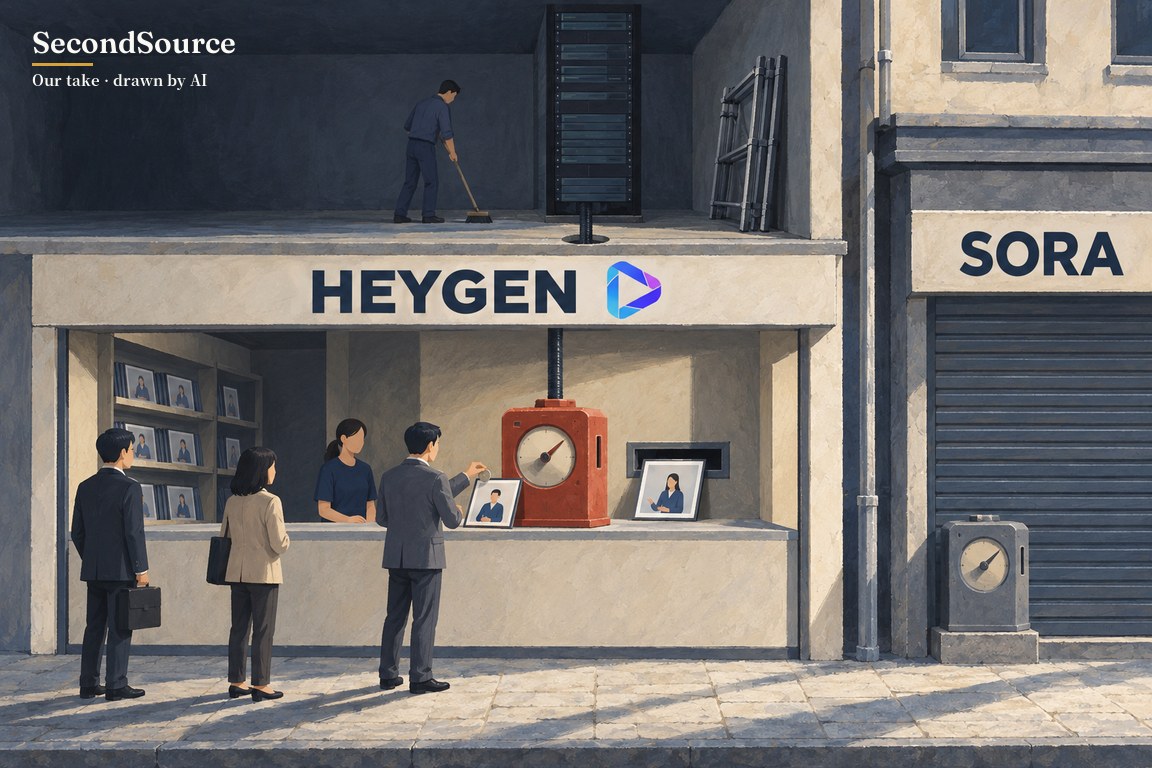
This report crosses: video generation technology, startup funding and revenue, cloud computing costs, consumer app economics. Primary documents read: 8.
Published October 31, 2026.
Key takeaways
In late October HeyGen, maker of talking AI-presenter videos, launched its first in-house video model. HeyGen says the model tops a silent-video blind test by Artificial Analysis, an independent evaluator.
That news makes AI video look like another spending race, like language models.
Does each new generation cost more to train, as with language models, or does the cost stop once pictures look real?
Our call, not an established fact: that cost may stop rising at a level video apps can afford. Once viewers cannot tell generated pictures from real ones, more money buys nothing visible: that is the ceiling. Profit turns on who pays the compute bill, the electricity and chip rent behind every video. Apps that charge customers and train their own model could run like software companies. Apps using other firms' models and absorbing that bill would fare worst.
The report checks training cost, then quality, then who pays: HeyGen, whose customers pay, against Sora, OpenAI's app that has shut down.
A company that raised US$74 million built a near-top video model, but a lasting training ceiling is still our reading
Video appears to have a finish line that language models lack. Gaurav Misra runs Captions, an app that helps people edit and generate videos of someone talking. Misra went on the investor interview show Invest Like the Best in January 2025, and the highlights Misra listed set "Bounded problems (video)" against unbounded ones. The source is an application founder discussing that founder's own business. That is one phrase in a list, so what it means here is this report's reading: "bounded" is the ceiling in Key takeaways. Language models have no such end point. Each gain in reasoning lets them take on harder, better-paid work, so model companies raise their spending every generation.
Public figures show that training is within reach today. None of them compares one generation's bill with the next. HPC-AI Tech, a startup that makes software to speed up AI training, says in the Open-Sora 2.0 paper that about US$200,000 of compute trained a video model. Human raters scored it level with 2024 models from Tencent and from Runway, a video-generation company. The US$200,000 covers only the final training run, and the figure is self-reported by the authors.
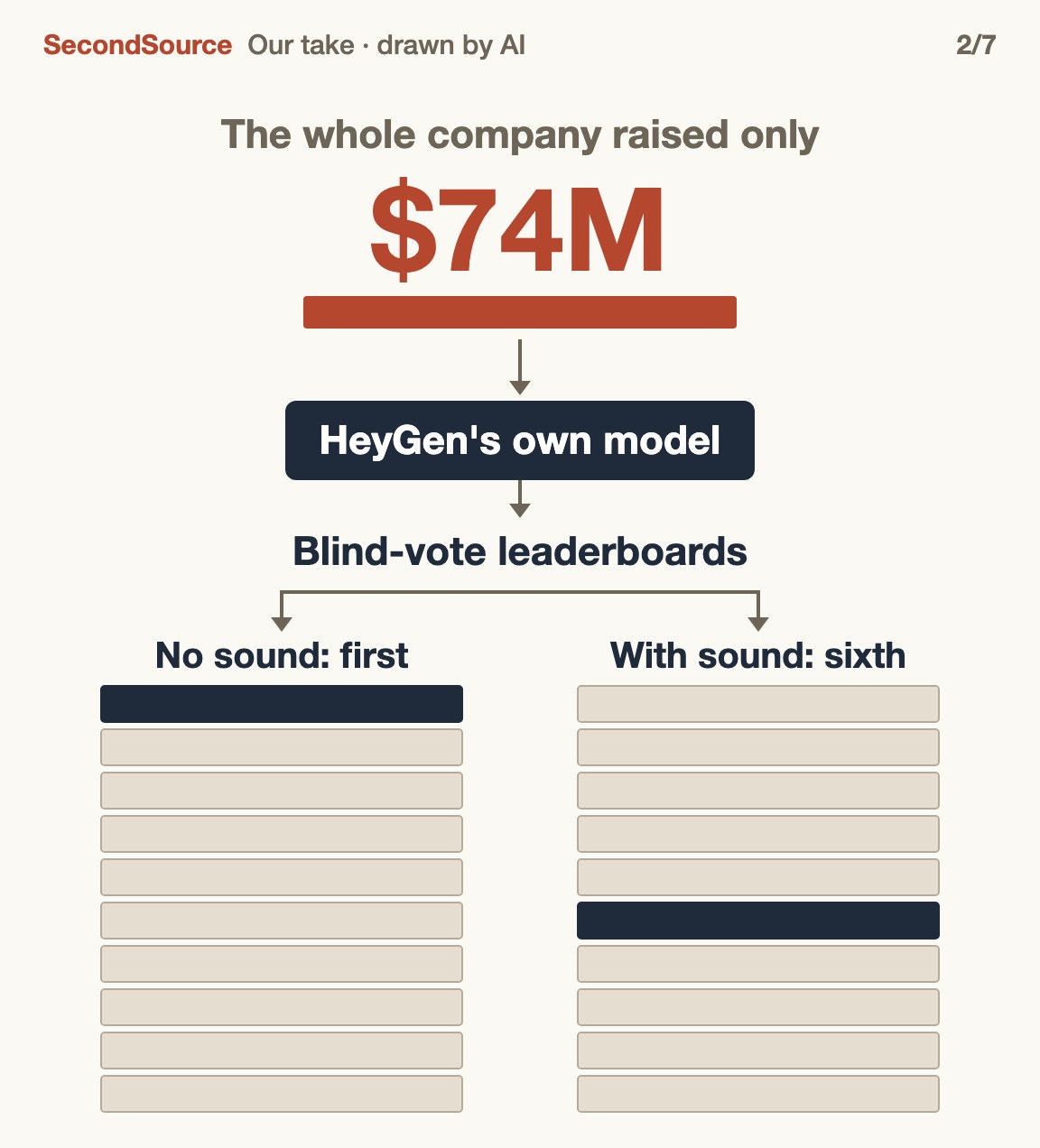
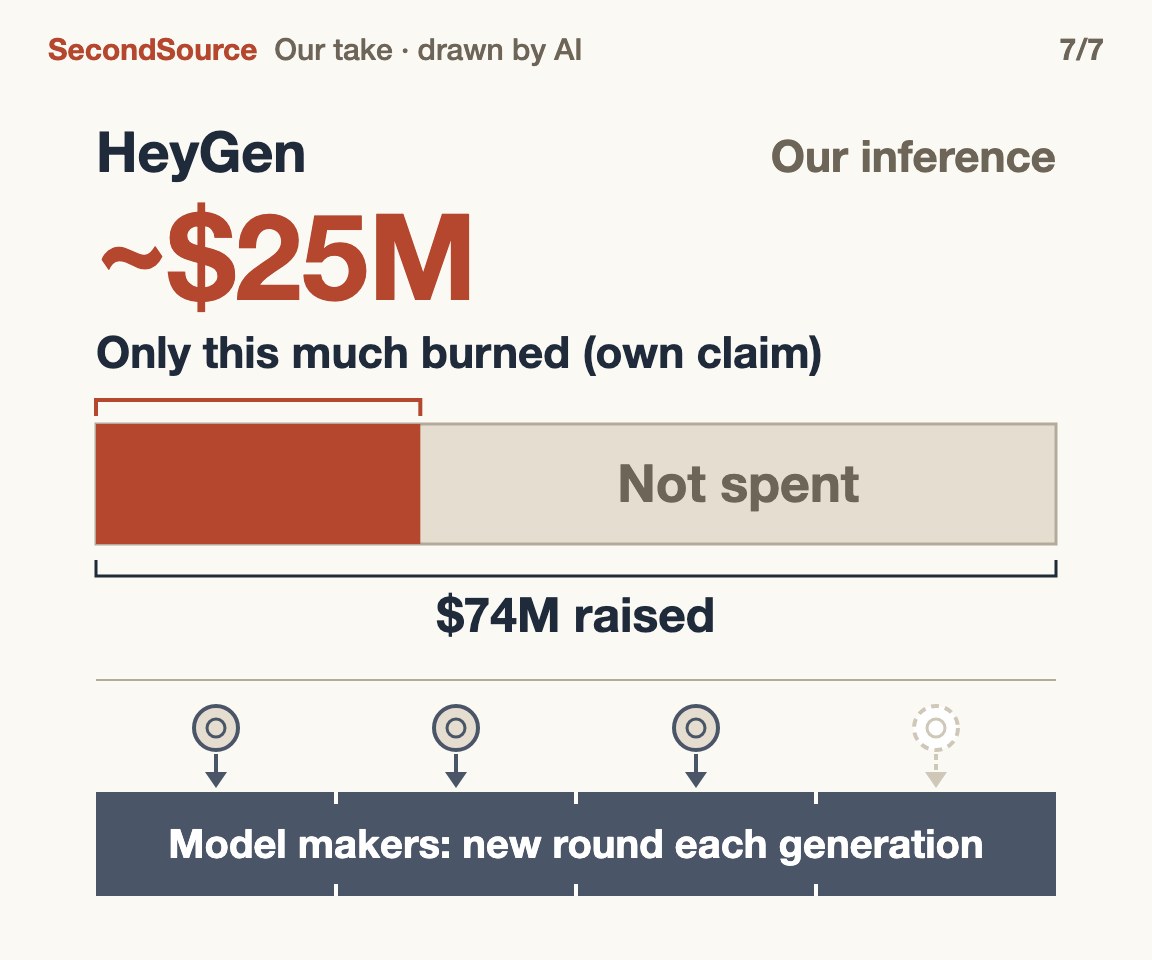
HeyGen is the newer case. According to Upstarts, a business publication, HeyGen had raised only US$74 million in total as of June. Four months later came a model that, by HeyGen's account, ranks first on the silent leaderboard and sixth on the one with sound. Artificial Analysis runs both leaderboards from blind tests. HeyGen has not published the model's training cost. The US$74 million is what the whole company raised, so it works only as an upper limit.
The caution comes from Ethan He, who formerly led video models at NVIDIA. Ethan He says storing and moving video data is a major hidden expense, and that training a video model now costs about as much as training a language model. If that estimate holds, the US$200,000 run says little about today's bill. The ceiling is a different claim, and this report's reading of Misra's remark: once the picture tops out, no generation needs a bigger bill than the last. A bill can be large and still stop growing.
So a company with US$74 million in funding can build a near-top model, and the next question is whether models still pull apart.
The leading models look almost the same, yet their prices differ by more than ten times
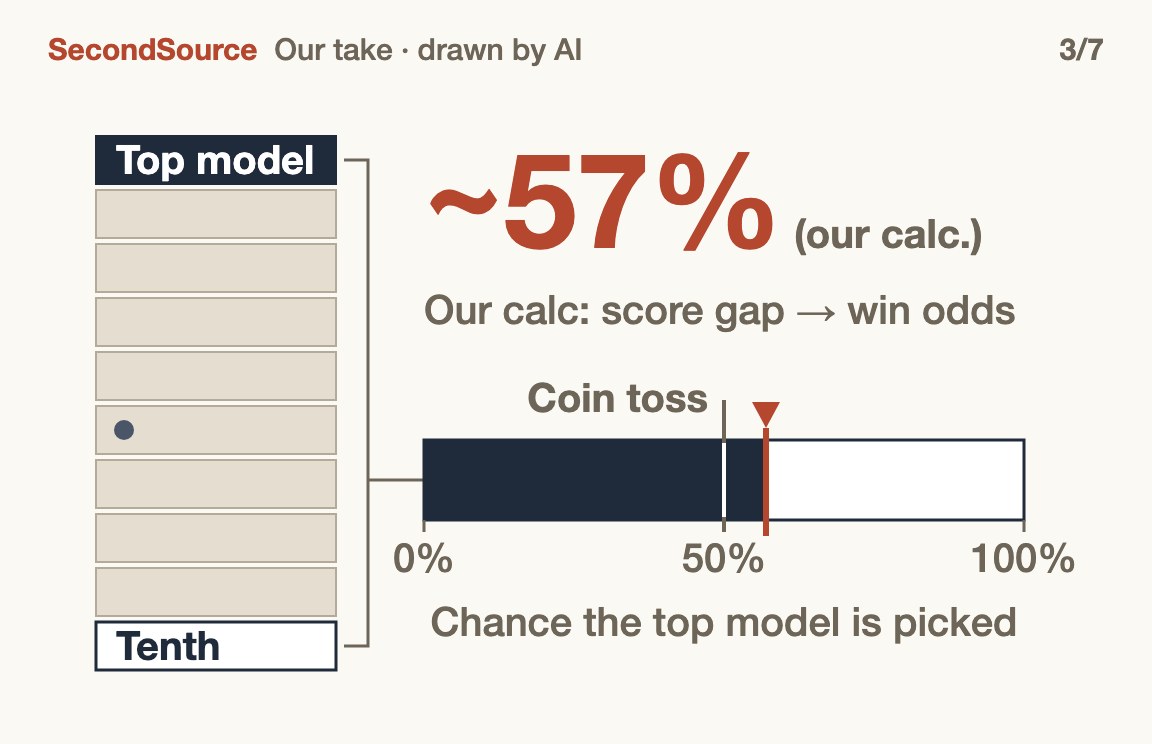
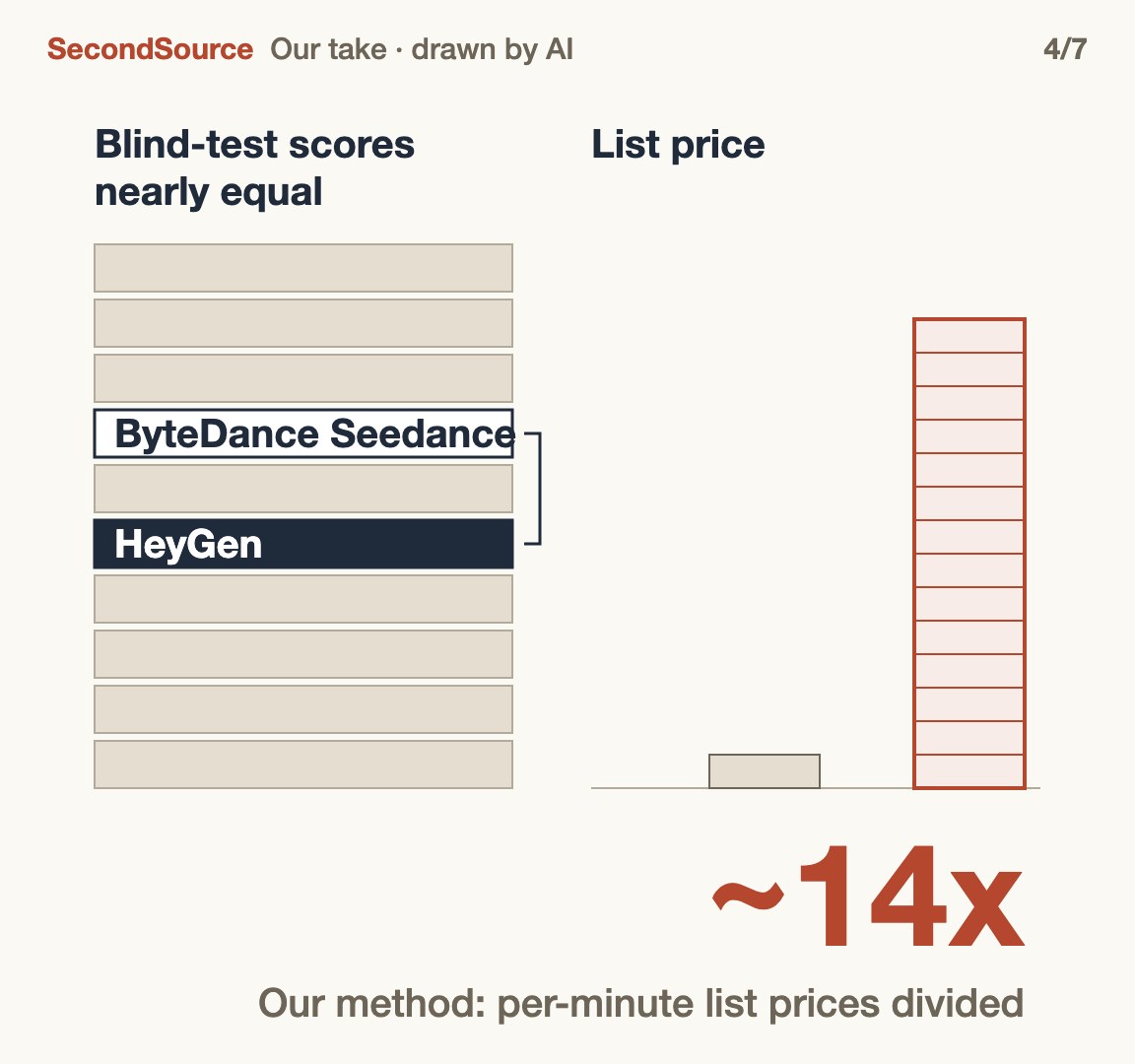
The second step is quality, and the leading video models have bunched up on it. Artificial Analysis turns wins and losses in blind public votes into scores. On its text-to-video leaderboard with sound, the gap between first and tenth place is measurable but small. Voters would pick first place over tenth about 57% of the time, only a little better than a coin toss (our calculation; method in the Appendix). Several of the top ten are too close to rank: their scores differ by less than the margin of error, about 14 to 18 points either way.
Prices have not bunched up with quality. In the same top ten, the list price for a minute of high-definition video differs about 14-fold between HeyGen and ByteDance's Seedance 2.5 (US$2.40 against US$34.12; our calculation, method in the Appendix), while the two blind-test scores are nearly equal. This is one pair, and the gap may come from clip length, specifications or pricing strategy.
So once quality tops out, profit depends on where the money comes from.
Every generated video costs money again, and who pays helps decide profit or loss
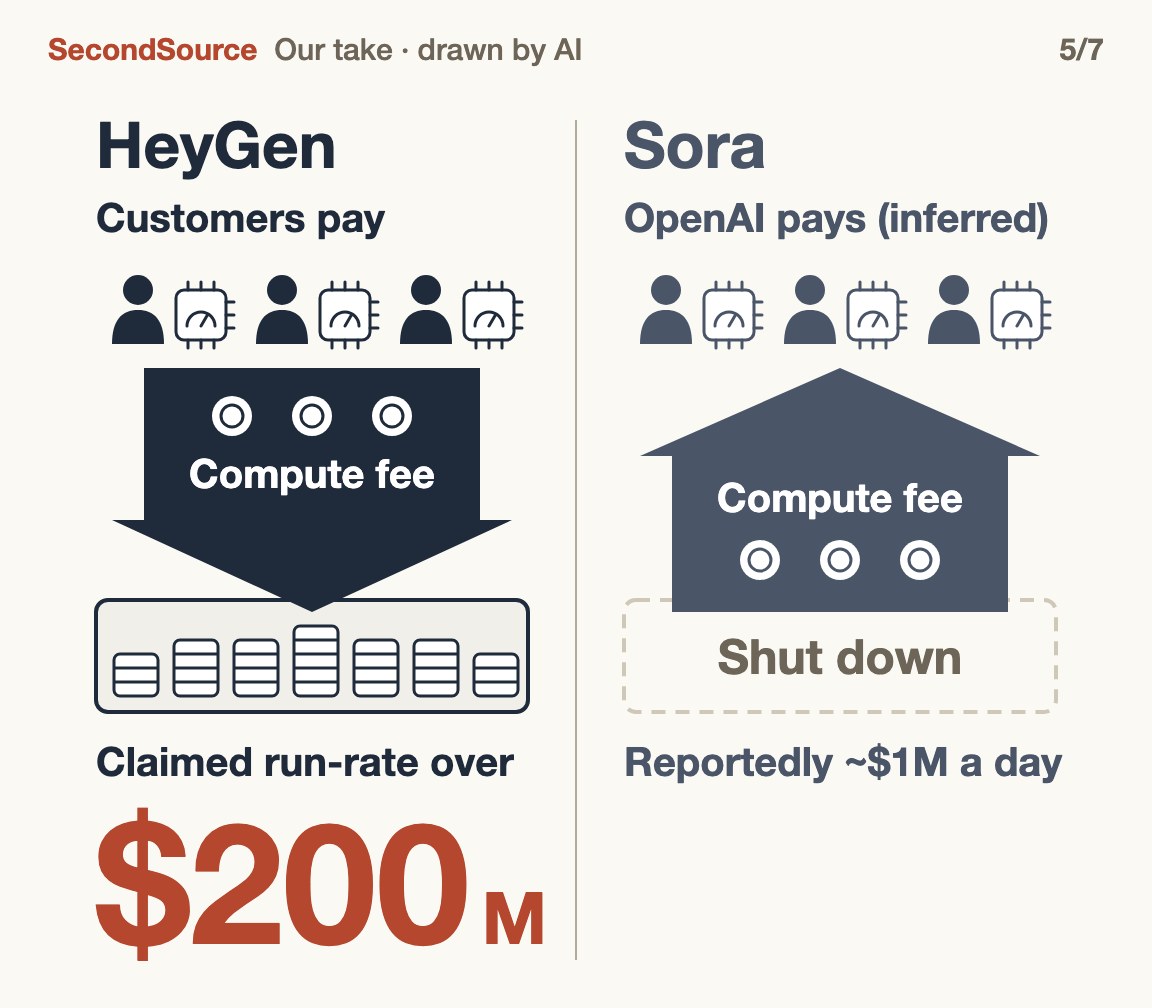
Training is a one-time bill, while generation is paid for on every video. Running a model to produce a video for a user is called inference. This report says "generating" for that, and keeps "inference" for its own conclusion. Each second of video has dozens of frames that the model must compute together, so generating is far heavier for video than for text. Ordinary software costs almost nothing extra to serve one more user. Each extra video adds electricity and chip rent, which together make up the compute bill.
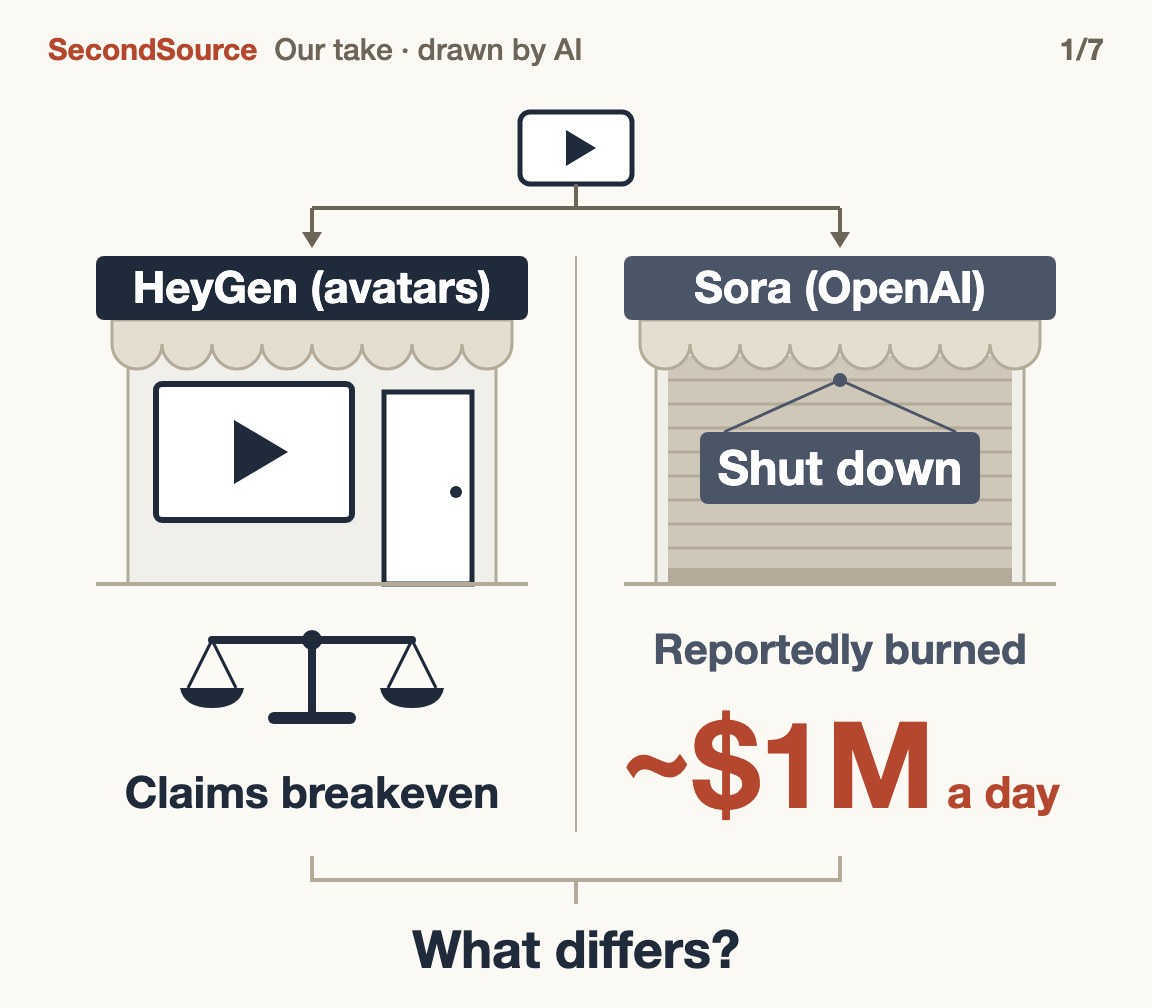
OpenAI's Sora shows the wrong party paying. OpenAI announced on March 24, 2026 that it would shut the Sora video app, and the app closed on April 26. OpenAI gave no reason. According to a Wall Street Journal investigation, as relayed by TechCrunch, Sora burned about US$1 million a day while users fell by more than half from their peak. That one investigation is the only source for the figure, and OpenAI has not confirmed it. Our read: most of that money was probably the compute bill for generating videos, largely absorbed by OpenAI and not recovered from users. Other causes remain possible.
HeyGen shows the right party paying. HeyGen's revenue comes from paying customers. HeyGen's June announcement put annualized revenue above US$200 million, double the level of eight months earlier. Upstarts' June interview reported cash flow at break-even for the year so far, before HeyGen's own model existed. Kling is the video-generation product that Kuaishou, a Chinese platform company, sells to creators and businesses. Kling has also grown revenue quarter by quarter (figures in the Appendix). Both companies report these numbers themselves, and neither publishes gross margin. As long as a customer pays more than the compute bill for each video, more use brings in more money. Without margin figures, outsiders cannot tell whether customers do pay more than that bill.
This comparison cannot separate two differences: who pays the compute bill, and how much computing each video takes. HeyGen mainly makes videos of people talking, which may be lighter to compute than Sora's general-purpose video. Neither company publishes its compute cost per second. So this pair suggests that who pays matters, but cannot prove it.
So a small training bill does not by itself make a video company profitable, and the three steps have to be read together.
Our call: video apps may run like software companies if customers pay and the model is in-house
Our inference: AI video training may have become a capped expense, so a video application company that charges paying customers and trains its own model can probably run like an ordinary software company. A video product whose company absorbs the compute bill may lose more as more people use it. Sora is the only visible case, and its figure is unconfirmed.
The inference combines three steps: training may have a ceiling, quality does not separate the leaders, and every video costs money to generate. Without the first, application companies could not afford their own model and would buy one, with model companies taking the margin. The priciest model might be worth its price if quality did separate the leaders. The third step matters most. If each video cost nothing to make, a capped training bill would mean high margins, and Sora's closure would need another explanation. Two links are weakest. The ceiling rests on one founder's remark and this report's reading. The revenue and cash-flow figures are self-reported, with no gross margin. So this report goes only as far as "can afford to operate", not "margins as high as an ordinary software company's".
Two things outside this comparison could still break the inference, with all three steps intact. A large model company could put video generation free into a product that already has hundreds of millions of users, paying for the compute with profit from other businesses. That could push the going price below an application company's compute bill per video. Or customers could start asking for interactive video that keeps people and scenes consistent over long stretches. The finish line would then move from "the picture looks real" to "the model understands how the world moves", and no one can state a ceiling for that stage.
So if the inference holds, some investors and apps gain and others lose.
One level up: video companies that train in-house and charge paying customers need not keep raising big money
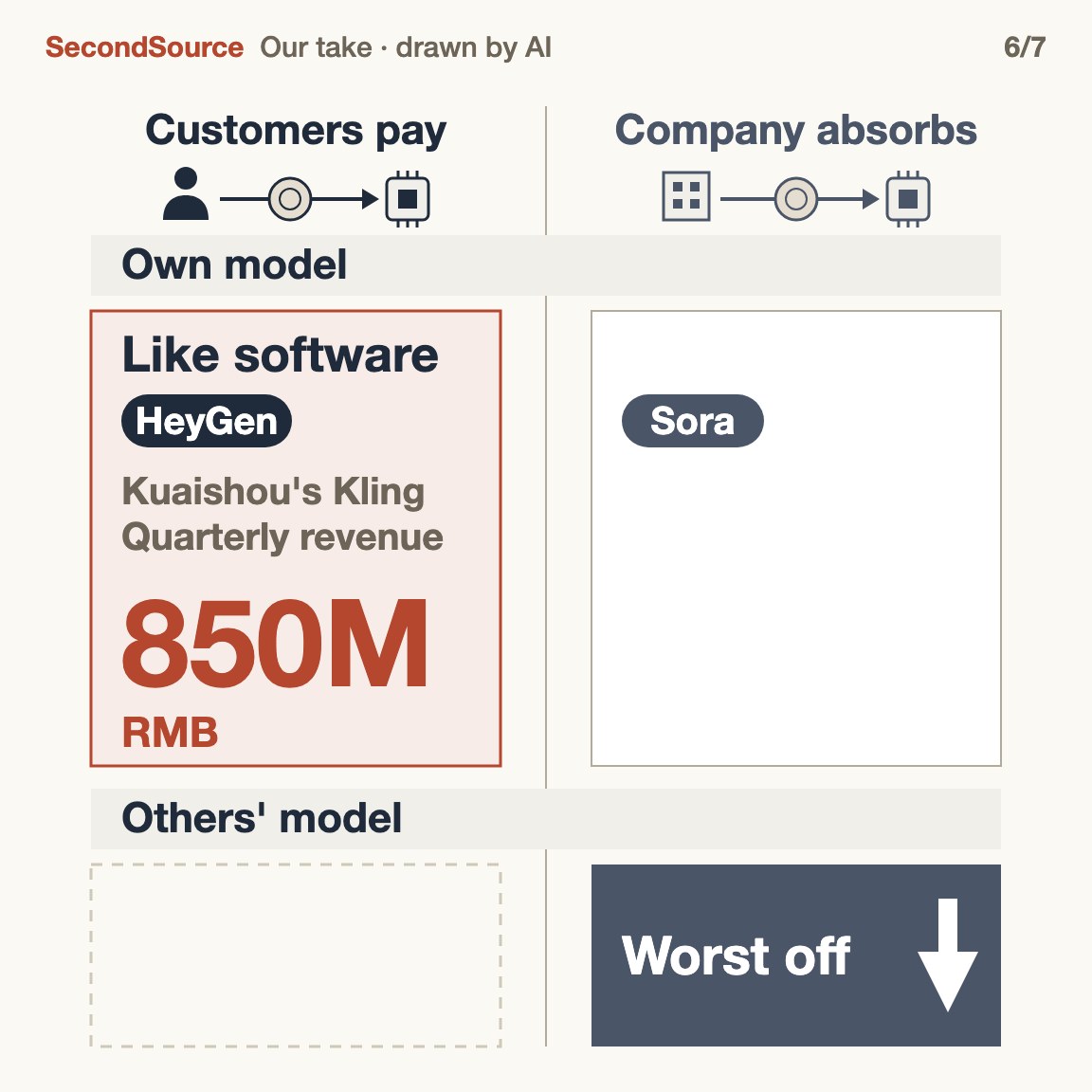
Our read: if HeyGen's self-reported funding and cash-flow figures hold, shareholders in companies like HeyGen need not be diluted by a new funding round every generation, the way model-company shareholders are. The likely losers are video apps that run other firms' models and absorb users' compute bills. No such app appears in this report's figures, so this part is inference.
What to watch next
The first thing to watch is Kuaishou's third-quarter results in November, and whether Kling's revenue tops the second quarter's RMB 850 million. The second is the startup founded by Bill Peebles, who formerly led Sora, and the Hollywood producer Jeffrey Katzenberg. According to The Information, that startup is in talks with OpenAI to rework Sora and sell it to film studios. If the deal closes, Sora would also move to charging paying business customers.
What would prove this wrong:
The dates and thresholds below are SecondSource's own.
- By March 31, 2027, Kuaishou reports Kling's fourth-quarter revenue below the second quarter's RMB 850 million: the step on who pays the compute bill is wrong.
- By June 30, 2027, a public source shows a company spent US$5 billion or more training a video model for picture quality (not a world model), and that model reaches the top three of the Artificial Analysis leaderboard with sound: the step on the training ceiling is wrong.
- By June 30, 2027, the gap between first and tenth place on that leaderboard widens to 150 points or more: the step on bunched-up quality is wrong.
- By June 30, 2027, HeyGen or Kuaishou reports video gross margin below 40% with the video business still losing money: the step on who pays and the main inference are wrong.
- By June 30, 2027, Google or OpenAI offers video generation free in its main product, while HeyGen's reported annualized revenue or Kuaishou's reported Kling revenue falls for two quarters running: the main inference is wrong.
The strongest counterargument this report found: Luma AI, a video-generation company, said when it announced a US$900 million funding round in November 2025 that training and serving "world models" takes far more data than today's language models, by many orders of magnitude (Luma press release, Business Wire).
Appendix
① Numbers and statements in the main line, row by row
| Item | Source | Limit |
|---|---|---|
| HeyGen Video 1 ranks first on the Artificial Analysis silent text-to-video leaderboard | HeyGen model page; Kompozy, 2026-10-25 | First place only on the silent leaderboard; the chart HeyGen issued at launch uses HeyGen's own test set, not the Artificial Analysis leaderboard |
| Top ten on the text-to-video leaderboard with sound (AA-Video-T2V v2.1): Wan 3.0 (Alibaba) 1175, Utopai X 1166, MiniMax H3 (768p) 1161, Seedance 2.5 (ByteDance) 1157, FLUX 3 Max 1157, HeyGen Video 1 1156, MiniMax H3 Max 1149, FLUX 3 1144, Seedance 2.0 1136, Gemini Omni Flash 1.1 (Google) 1128; 95% margin of error about plus or minus 14–18 points | Artificial Analysis text-to-video leaderboard (as of 2026-10-31) | The leaderboard changes constantly; blind-test preference is not the same as commercial usability |
| List price per minute at 1080p: HeyGen Video 1 US$2.40, Seedance 2.5 US$34.12, Wan 3.0 US$12.00 | Same | API list prices, not prices actually paid |
| The paper's abstract says about US$200,000 trained a commercial-level video model; human ratings and VBench, a video-model test suite, level with HunyuanVideo and Runway Gen-3 Alpha | Open-Sora 2.0, arXiv 2503.09642 | Self-reported by the authors; covers only compute for the final training run; compared with 2024 models |
| HeyGen raised US$74 million in total and has burned only about a third, about US$25 million; cash flow at break-even for 2026 so far (stated in June, before the in-house model of late October) | Upstarts Media (Alex Konrad), 2026-06-25 | A company statement in an interview, not audited |
| HeyGen annual recurring revenue above US$200 million, doubled in eight months; about US$2.70 of annualized revenue per US$1 of equity capital | HeyGen announcement (Joshua Xu), 2026-06-25 | Self-reported; no gross margin |
| Kling revenue above RMB 650 million in the first quarter of 2026, annualized revenue about US$500 million in March; above RMB 850 million in the second quarter | Kuaishou second-quarter 2026 results release; BigGo Finance on the first-quarter results, 2026-05-27 | Kuaishou does not break out Kling's gross margin or compute cost |
| Sora's shutdown announced 2026-03-24, app closed 2026-04-26, API closed 2026-09-24; no official reason given | Wikipedia entry (citing the OpenAI Help Center) | — |
| The app burned about US$1 million a day ("roughly 1 million every day"); global users peaked at about 1 million, then fell below 500,000 | TechCrunch (Connie Loizos), 2026-03-29 | Relays a Wall Street Journal investigation; all coverage traces to that one piece, and OpenAI has not confirmed it |
| Mirage received US$75 million of non-dilutive growth funding from General Catalyst's customer value fund, bringing total funding above US$175 million; users have made more than 250 million videos | Mirage announcement, 2026-03-24 | Revenue not public; the fund says only that its investees have "proven distribution and strong unit economics", which is not a Mirage financial figure |
| Misra's listed show highlights include "Bounded problems (video)" against unbounded ones | Gaurav Misra on X, 2025-01 | An application founder on the outlook for that founder's own business |
| Ethan He: training cost of video models "comparable to language models"; a billion videos take about 5PB of raw storage; the open video model LTX already has 19 billion parameters | Ethan He, Latent Space show, 2026-06-01 | One engineer's estimate |
| Midjourney "has fallen off the traffic rankings completely" but "is back" on the paid rankings | a16z Podcast, The Current State of Consumer AI, 2026-10-05 | Spoken comment |
| Luma raised US$900 million and became a customer of HUMAIN's 2GW supercluster in Saudi Arabia, to "train and serve frontier multimodal World Models" | Luma press release, Business Wire, 2025-11-19; Middle East AI News | 2GW is the whole cluster; Luma is the first customer of the initial 100MW phase |
| The Peebles and Katzenberg startup is in talks with OpenAI to rework Sora and sell it to studios | Stephanie Palazzolo on X, summarizing The Information, 2026-10-12 | In talks, not closed; The Information is the only outlet reporting it |
② SecondSource's calculations
- First over tenth place, about 57%: blind-test scores convert by the chess Elo rule. With a score gap of d, the higher-scoring side is chosen with probability 1 ÷ (1 + 10^(−d/400)). Wan 3.0 at 1175 minus Gemini Omni Flash 1.1 at 1128 gives d = 47, which works out to about 0.567.
- Price, about 14 times: Seedance 2.5 at US$34.12 per minute ÷ HeyGen Video 1 at US$2.40 per minute ≈ 14.2. The two scores are 1157 and 1156.
- HeyGen's stated "about US$2.70 of annualized revenue per US$1 of equity capital" matches US$200 million ÷ US$74 million ≈ 2.70.
③ Statements and terms
- According to Olivia Moore, a partner at the Silicon Valley venture firm a16z, speaking on the show in October, Midjourney, which specializes in image generation, has dropped off the traffic rankings but has come back on the revenue rankings.
- "Bounded" in this report refers only to computing a picture until viewers cannot tell it from a real one. Treating video as a world model that simulates the physical world falls outside it.
- "Run like a software company" in this report means training is a one-time outlay and revenue can then exceed the compute bill for each generation. It does not mean gross margin has reached an ordinary software company's level. No video company publishes gross margin.
- The company behind Captions renamed itself Mirage in September 2025. Captions remains the app's name.
- Four kinds of company or team build video models: large model companies such as Google, Chinese platform companies such as ByteDance and Kuaishou, application companies that began with video tools such as HeyGen, and open-source teams that publish trained model parameters for anyone to download and use.
- On October 31, 2026, Alibaba's Wan 3.0 led the Artificial Analysis leaderboard with sound.
Sources
- Open-Sora Team, Open-Sora 2.0 technical report (training a commercial-level video model for about US$200,000), arXiv 2503.09642
- HeyGen (Joshua Xu), announcement of US$200 million annualized revenue, 2026-06-25
- HeyGen, HeyGen Video model page
- Mirage, announcement of US$75 million growth funding with General Catalyst, 2026-03-24
- Luma AI press release, US$900 million Series C and HUMAIN 2GW supercluster, Business Wire, 2025-11-19
- Kuaishou Technology, unaudited second-quarter and interim 2026 results
- Text to Video Leaderboard from Artificial Analysis, an independent evaluator, scored from public blind votes between two videos
- Upstarts Media (Alex Konrad), interview report on HeyGen's US$200 million annualized revenue without heavy burn, 2026-06-25
- TechCrunch (Connie Loizos), Why OpenAI really shut down Sora, 2026-03-29
- Wikipedia, Sora (text-to-video model)
- TechCrunch, Mirage raises US$75 million to continue building models for Captions, 2026-03-24
- BigGo Finance, report on Kuaishou's first-quarter revenue and Kling's annualized revenue of nearly US$500 million, 2026-05-27
- Kompozy, HeyGen Video general purpose model, 2026-10-25
- Middle East AI News, report on Luma AI's US$900 million Series C
- a16z Podcast, The Current State of Consumer AI, 2026-10-05
- Gaurav Misra on X (Invest Like the Best show highlights), 2025-01
- Stephanie Palazzolo on X (summary of The Information's report), 2026-10-12
Written from the same research and judgments as the Traditional Chinese edition. Sources are linked; we distinguish original documents from reporting and mark what we could not verify.