Daily Brief SecondSource Morning Brief · October 12, 2026 · Oct 12, 2026
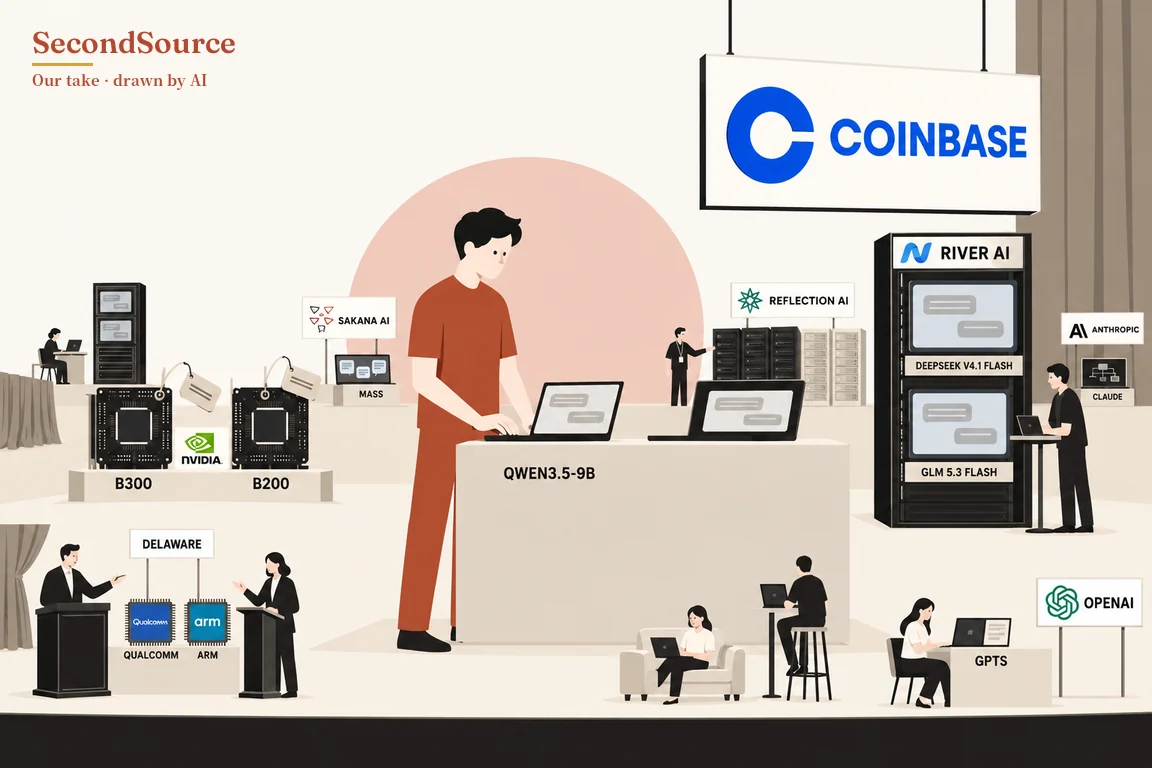
Coinbase says a small open model it fine-tuned itself beats the most advanced large models: is that true?
At a glance
1. Coinbase's CEO says, in a single post with no evaluation attached, that Alibaba's Qwen3.5-9B, fine-tuned on Coinbase's own data, beats frontier models (the most advanced models of the moment) at fraud prevention. (Affects: teams paying for large-model APIs)
2. OpenRouter self-reports that in the second week of September 73% of spending on its platform went to closed models, down from 89% in early January. (Affects: whoever owns the AI budget)
3. This week's column: investor Gavin Baker says the voluntary accord six AI companies signed at the White House on September 29 has teeth, because directors who ignore an outside auditor's report could face shareholder suits. We rate that claim contested: suits of that kind rarely succeed, and they only start after something has gone wrong. (Affects: compliance leads who vet AI vendors)
This week's column: Claims & Receipts
The White House AI accord carries no penalties. Does directors' legal liability alone make it binding on the companies that signed?
The short version: Gavin Baker, founder of the tech fund Atreides Management, says directors' liability gives the accord teeth. Our check comes out contested. Delaware law does offer a way to hold directors liable, but it rarely succeeds and only kicks in after something has gone wrong. The scenario Baker describes, a committee that exists but ignores a report, most resembles a type of claim that failed in all 28 cases in the one study we found. For the route to work at all, two things have to be in place: a named outside auditor, and a board committee that receives the auditor's reports. In our search on October 11, we found no signatory that had made either public.
Who said what. On September 29, the heads of Google, Anthropic, Meta, OpenAI, xAI and NVIDIA signed a voluntary accord at the White House. It has no penalties. On October 1, Baker wrote: "If they ignore a report from the third party auditors then a bad faith finding from a court is a real possibility." (Gavin Baker, 2026-10-01) In his account, if directors ignore an outside auditor's report, a court could find bad faith, and the insurers who write directors' liability cover could then refuse to pay. "Bad faith" here is a legal term: it doesn't mean bad motives, it means directors knew they were supposed to oversee something and deliberately didn't; some liability policies exclude that kind of intentional failure. He added that this matters more in the near term than almost any regulatory move.
The accord's text asks boards to set up a committee that receives audit reports (the most direct evidence in this column, though we read a republished full text). The fourth tier reads: "Designate an independent committee of the board of directors to oversee and receive reports from the teams operating the controls and the internal and external auditors and evaluators" (full text as republished by Zvi Mowshowitz, 2026-09-30). The text also makes clear it isn't law yet: "Over time, it may make sense to codify these steps into laws or regulations." ⚠️ This republication is the only channel through which we read the full text (the White House press release is in the American Presidency Project archive). The republished text doesn't require audit results to be made public, and it doesn't say who the auditors are.
Delaware law really does have this route. The 1996 Caremark case established that directors have a duty of oversight: they must make sure the company has a system for watching its major risks, and if they don't, shareholders can sue them. In the 2019 Blue Bell case, the Delaware Supreme Court held that failing to build oversight for a mission-critical risk can amount to bad faith; that was a board that had built no oversight system at all. Anthropic and OpenAI are both Delaware public benefit corporations, and their shareholders have a statutory right to inspect board records, so the route applies at least to those two; we haven't gone through the other four signatories one by one. We worked through these cases and statutes from the originals in our October 4 deep dive (published in Chinese and Japanese only).
But the route rarely succeeds. An empirical study published in September on Columbia Law School's blog counted that about 25.6% of these oversight claims in Delaware courts got past the early stage of a case rather than being dismissed before trial, and that the rate hasn't risen since Blue Bell. Getting past that stage only means the case continues; it doesn't mean winning. In the same study, all 28 claims that argued only that directors had ignored warning signs failed (CLS Blue Sky Blog, 2026-09-02). ⚠️ One study. Our judgment: Baker's scenario, a committee that exists and ignores a report, is closest to those 28 losing claims, not to Blue Bell, where no system existed.
An insurer can only refuse to pay after a final judgment (the weakest evidence in this column). A 2021 Delaware Supreme Court decision held that, under the terms of that particular policy, the exclusion could only be triggered by a "final, non-appealable adjudication"; whether such a clause covers a court's bad-faith finding depends on how each policy is written. Cases can also settle before judgment: Boeing's board-oversight case settled for more than US$200 million (US$237.5 million), all of it paid by insurers. Our inference: because an insurer can refuse only after a final judgment, that threat rarely bites in practice. ⚠️ For both the decision and the Boeing settlement, we read summaries on law-firm and industry blogs, not the originals.
The day after the signing, it was a regulator, not shareholders, that reportedly moved. On September 30, The Washington Post got a senior official at the US Federal Trade Commission (FTC) to confirm: "The Federal Trade Commission has opened a broad investigation into the safety of artificial intelligence systems made by Anthropic and OpenAI" (The Washington Post, via the Spokesman-Review, 2026-09-30). The story doesn't say what authority the FTC is using or when the investigation began, and doesn't link it to the accord. Our reading: the FTC already had investigative powers and doesn't need the accord. On auditors and committees, we ran a single search on October 11; finding nothing doesn't mean nothing exists. Columnist Zvi Mowshowitz points to a precedent: "OpenAI had exactly this committee, but they either were kept out of the relevant loops or failed to act."
⚠️ Disclosure: Baker holds positions in signatory companies, and his post says outright that he opposes creating a new regulator. Our research system uses Anthropic's models, and Anthropic is a signatory.
Verdict: contested. The half that holds is the mechanism itself: if a board receives audit reports and leaves no record of acting on them, that record could later be used against the directors when shareholders inspect the books. The half that doesn't hold is "more meaningful than regulation": the route is only triggered by shareholders after something goes wrong, every "ignored warning signs" claim in the study lost, and settlements are paid by insurers anyway. The day after the signing, the FTC reportedly opened an investigation, using powers it already had (our reading).
What would prove this wrong. ① A signatory names its auditor and its committee, and underwriters start asking about AI audits when they write cover: this would lean toward the claim holding, but we wouldn't change our conclusion on that alone. ② A public report that a committee or an audit finding delayed a model release: we'd switch to "holds." ③ By December 6 (a deadline we set ourselves), none of the six has published either, while the FTC investigation has issued a formal demand for information (the legal process that makes a company hand over documents): we'd rule that the "more meaningful than regulation" half doesn't hold.
How to use it. When a vendor tells you it "signed the accord," ask three things: who the auditor is, which committee gets the reports, and whether you can see a description of the audit's scope. This column checks Baker's sentence, not whether the accord should have been signed.
A new call this issue. By December 6, will any of the six signatories announce, through its own official channels, both a named outside auditor and the board committee that handles the accord? We're betting no. Announcing only one of the two, or appearing only in media reports, counts as no; we settle it only from the six companies' official newsrooms and investor-relations pages.
The receipts: would an analyst on CoreWeave's second-quarter call ask how much capacity Nvidia's backstop had taken?
① What we said then: the column wrote this prediction down on August 2. In our words then: whether CoreWeave's next quarterly report and call (Q2 2026, expected mid-August) would draw questions about how much the Nvidia backstop had absorbed, and whether the company would give a checkable figure for utilization or for that amount. CoreWeave is a cloud company that rents GPU compute to AI companies; the backstop is Nvidia's commitment to buy the compute it can't rent out. We didn't record a confidence at the time.
② The actual reading: the sources we named in advance were CoreWeave's Q2 2026 results and the transcript of its August 11 call. The word "backstop" appears nowhere in the transcript, and no analyst asked about the backstop in the Q&A. The company disclosed neither utilization nor how much Nvidia had absorbed; it said only that near-term capacity is "effectively sold out." The transcript is a paid-database version that readers can't get publicly; we checked it on September 30. What's public is CoreWeave's second-quarter results.
③ Verdict, and at what level: the prediction came true, but on weak evidence (explained below). When we wrote the prediction, we set out three outcomes in advance. If analysts asked about the backstop, the first half would hold. If the company disclosed checkable utilization or backstop figures, the second half would hold. If neither happened, the prediction that "the backstop keeps the results from showing real demand" would come true. The reasoning: if Nvidia promises to buy compute that goes unrented, idle capacity still gets paid for, so utilization and revenue no longer simply reflect outside customers' demand. This time it was the third outcome. What didn't hold was a premise we had cited: Bill Gurley, a partner at the venture firm Benchmark, had said analysts would ask about the backstop for eight straight quarters; the first time they should have, nobody did. Nobody asking could also just mean analysts didn't care, so this result gives the prediction only limited support. This call came due on September 15; we checked it on September 30, 15 days late.
④ Which of our tracked judgments moved: none yet. The result supports the judgment that "the backstop masks the demand signal," but, as ③ says, only weakly. We haven't reassessed it, and its confidence score stays at 0.6 for now (our own estimate of how likely it is to hold). The fact of Nvidia's backstop terms hasn't changed and needs no update.
⑤ Does our standard change? Yes, in one respect. From now on, "will analysts ask" and "will the company disclose" become two separate calls, each with its weight written down in advance, so that the half that misses doesn't get buried.
Was August's string of incident disclosures by AI labs mostly old incidents coming to light at once? We can't judge this one. On the due date, neither of the two events we had said would overturn the judgment had happened, but we never wrote down what would confirm it, so there's no yardstick. Details are on the card. See the receipts →
Will Anthropic's enterprise market share fall below 35%? Postponed: there's no readable figure yet; we're waiting for Menlo Ventures' next report on enterprise LLM adoption. See the receipts →
All our judgments and their verdict dates → the full list of our calls
Today's main line
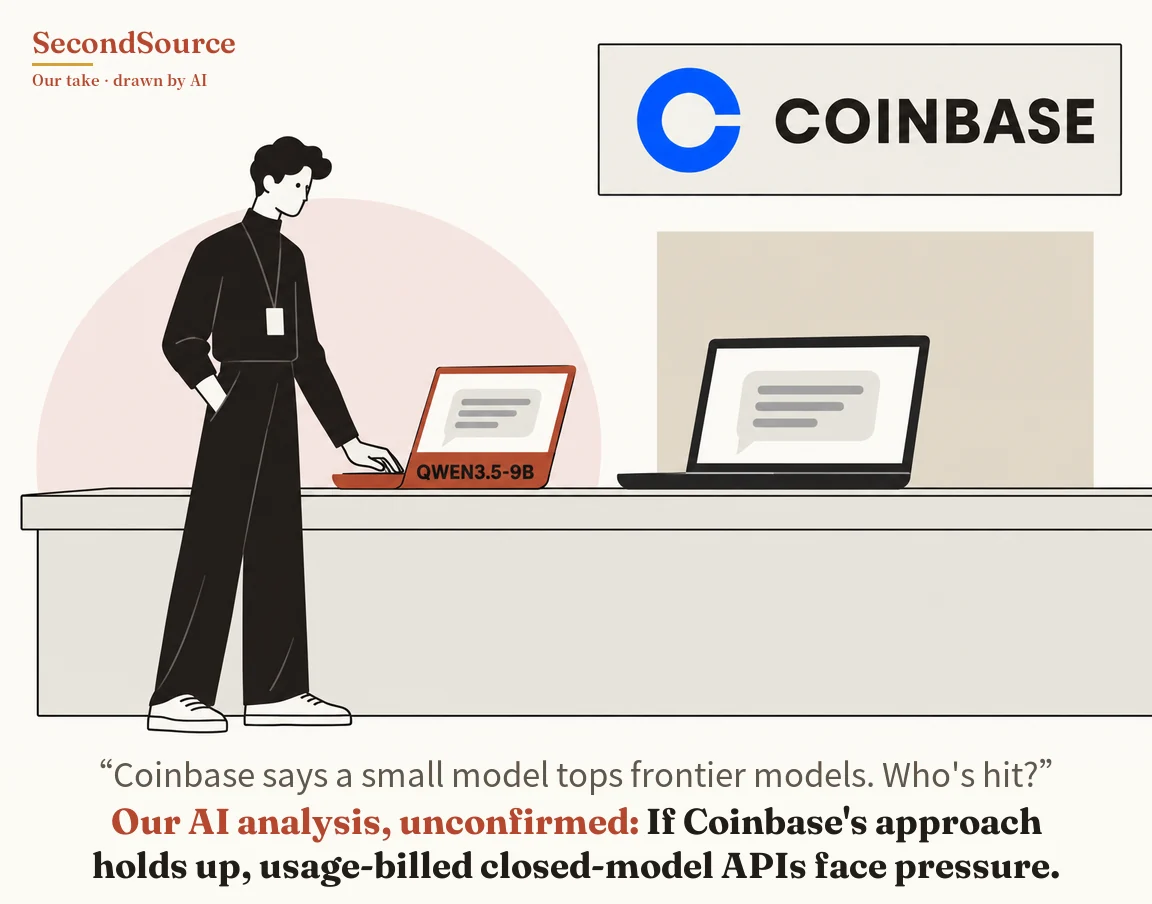
1. [Today] (event date October 11) Coinbase's CEO says Qwen3.5-9B, a 9-billion-parameter open model fine-tuned on Coinbase's own data, beats frontier models at fraud prevention
Our AI analysis, unconfirmed: Coinbase's CEO says a fine-tuned small open model beats frontier models, but what it was compared with and how it was measured aren't public Check back 2026-12-06
Why this matters to you: Pick one high-volume task with clear rules and record your current model's error rate and cost per call as a baseline.
Read the full item
Coinbase's CEO says Qwen3.5-9B, fine-tuned on internal data, beat frontier models at fraud prevention (Armstrong, 2026-10-11); Benaich replied that it's comparing against an old model (Benaich, 2026-10-11). OpenRouter self-reports that open models carry over 62% of its token usage while 73% of spending still goes to closed models (OpenRouter, 2026-09-22); Laskin says typical enterprises start without fine-tuning (No Priors, 2026-10-09).
Not proven yet: the post names neither the rival model nor the metric; Coinbase hasn't published results How we checked →
⚠️ Our analysis is produced with help from Anthropic's models, and Anthropic is one of the closed-model vendors.
What to take away today: #1: Pick one high-volume task with clear rules and record your current model's error rate and cost per call as a baseline.
Also happened
1. Not verified by us yet: [Today] (post October 11) The venture firm Social Capital posted data from the corporate-spending platform Ramp: among Ramp customers' spending on AI tokens, Anthropic's share fell from 69.5% in March to 51.0%, while OpenAI's rose to 44.5%. We couldn't find Ramp's own figures; the September reading Ramp publishes uses a different measure, the share of businesses that paid, where Anthropic is at 43.8% and OpenAI at 39.8% (Social Capital, 2026-10-11).
2. Not verified by us yet: [Today] (post October 11) Dan Nystedt, a reporter who has long covered Taiwan's chip industry, relayed a media report that prices for advanced-chip testing are expected to rise 10% to 30%, described in the report as the "strongest ever" increase, naming four Taiwanese chip packaging and test companies as beneficiaries: ASE (the world's largest outsourced packaging and test company), King Yuan Electronics (KYEC), Powertech Technology and Ardentec; the original outlet isn't named (Dan Nystedt, 2026-10-11).
3. Not verified by us yet: [Today] (report October 11) According to the South China Morning Post, Alibaba chairman Joe Tsai said open-source AI is Europe's only path to tech independence. The speaker's company supplies the Qwen open models; we read the account relayed by China tech-policy analyst Paul Triolo, not the full story (Paul Triolo, 2026-10-11; South China Morning Post).
4. Not verified by us yet: [Today] (post October 11) Chip reporter Tim Culpan wrote that Terafab, the chip-fab project Musk's camp plans to build itself, has ordered extreme-ultraviolet lithography machines from ASML, with delivery to its R&D fab expected in mid-2027, and that Intel is sharing process technology (whether as a license or another arrangement, the post doesn't say). The post gives no machine count, model or price, and Culpan himself calls the timing soft. Our October 11 issue reported analysts saying all four major equipment makers are already involved with Terafab; what's new today is the order and the delivery timing (Tim Culpan, 2026-10-11).
Chips & semiconductors
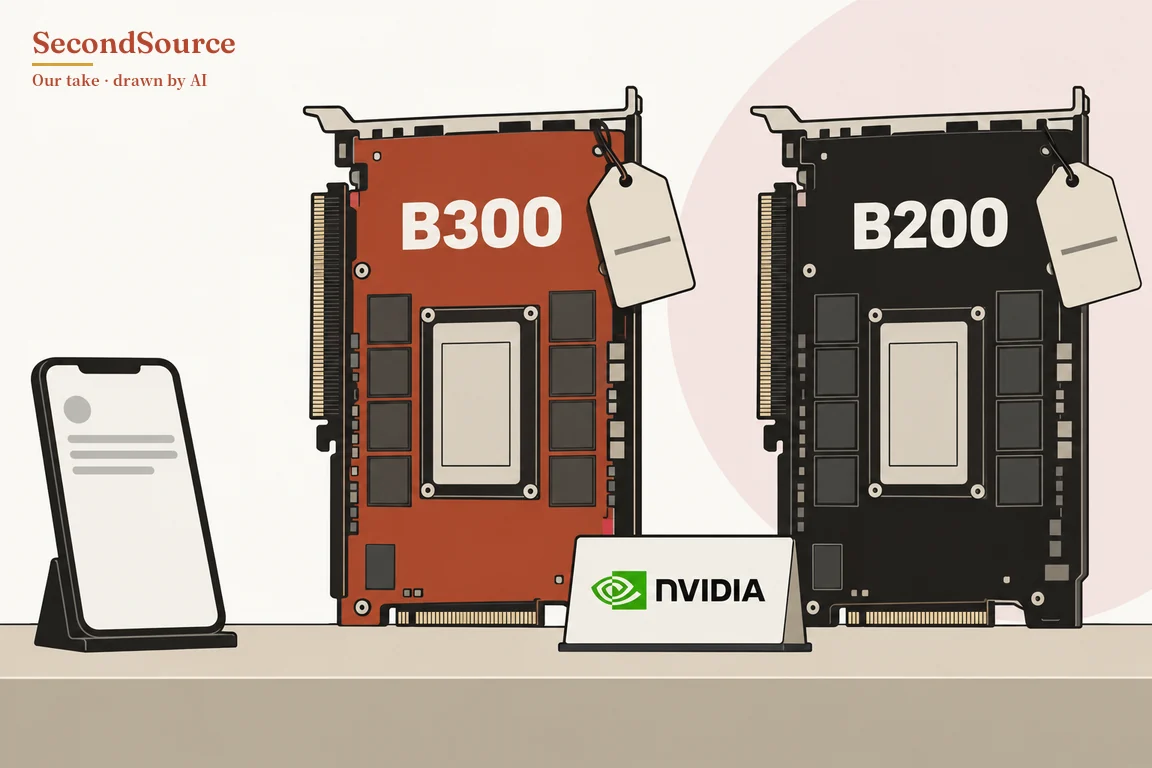
1. [Today] (post October 11) Investor Gavin Baker, citing Silicon Data's "token index," says B300 prices are up 38% and B200 prices up 10% since May 31; we haven't confirmed whether the index measures rental prices or what its base is. He wrote: "Since the @Silicon_Data "token index," which captures both price and mix, peaked on May 31: B300 prices are up 38%, B200 prices are up 10%." (Gavin Baker, 2026-10-11) The index he cites looks at both prices and the mix of GPU models. B300 and B200 are the two data-center GPUs NVIDIA is shipping now; rental price means the hourly price of renting one GPU in the cloud. Silicon Data is a data company that publishes GPU rental-price indexes; his post doesn't say how this index ties to tokens. The post says the index peaked on May 31 and that B300 and B200 prices have risen since that day; it doesn't explain how prices can have risen since the index peaked. All we could find was the latest reading on Silicon Data's B300 index page, US$6.95 per GPU-hour; we found no late-May base, and we haven't confirmed that this page uses the same measure as the "token index" he cites. Baker founded the tech fund Atreides Management and holds related positions; his inference that a more fragmented model market favors those selling compute is his own. Read it as a soft signal that renting the newest GPUs is getting pricier, which changes the build-versus-rent math, until the index base is confirmed.
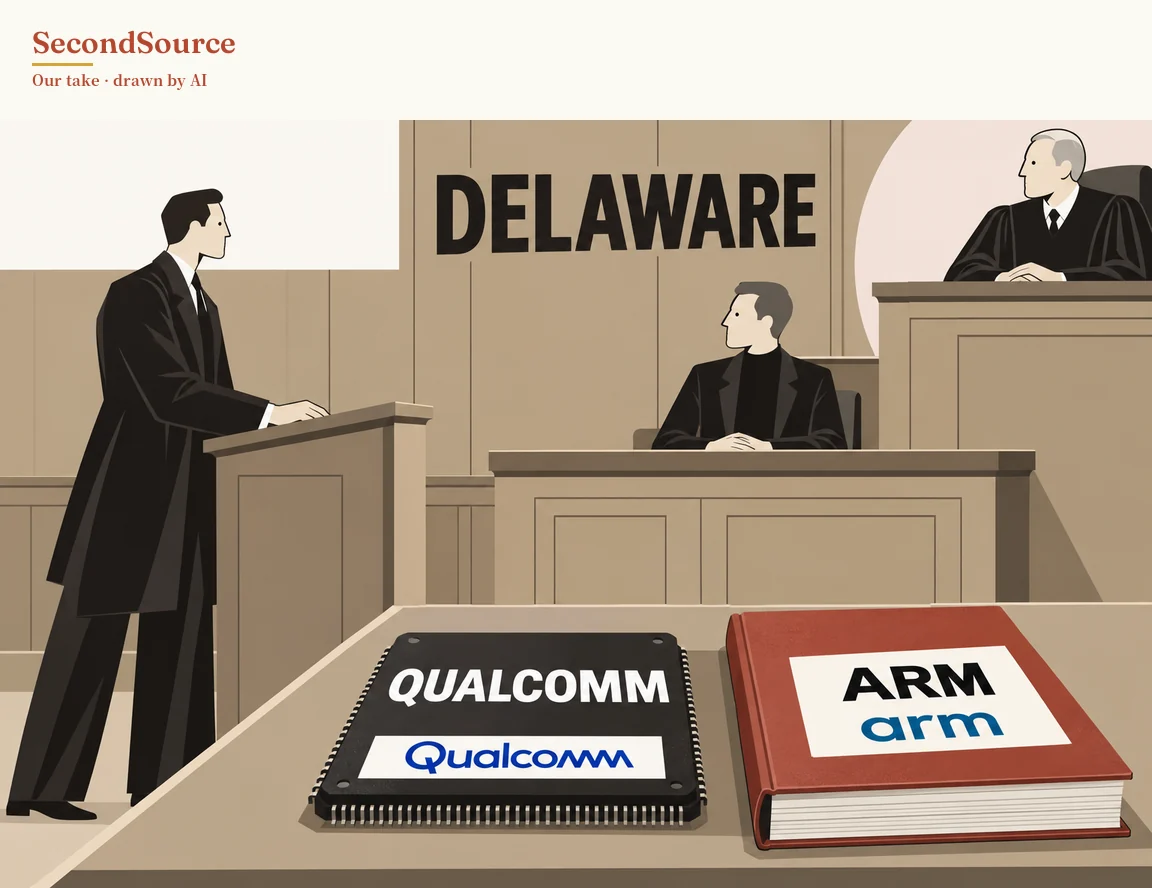
2. [Today] (courtroom notes, October 10) On day four of Qualcomm's antitrust trial against Arm in Delaware, according to notes from someone watching in court, Arm's economist conceded under cross-examination that only five architecture licenses for the latest v10 architecture exist worldwide. An architecture license gets you only Arm's instruction set; you design the processor cores yourself, as Apple does and as Qualcomm does for its Oryon cores. That's different from using cores Arm has already designed. The same notes say the judge described architecture-level competition as "strictly Arm and Intel," and that Arm's economist said RISC-V is "barely off the ground" in enterprise data centers; Qualcomm can use its existing contract until 2033, and without a new v10 contract it would be "completely unlicensed" (courtroom notes, 2026-10-10). The note-taker leans toward Qualcomm, these aren't the official transcript, and the numbers need the court record; the judge's remarks in court aren't a ruling, and there is no jury: the judge alone decides this case. If the count holds up, the bar to designing your own Arm cores is narrower than many assume; what to watch is the court record and the eventual ruling.
Named commentary
1. [Today] (post October 11) Andrej Karpathy, former head of AI at Tesla and a founding member of OpenAI, roughly estimates that about 20 million people worldwide, about 0.2% of the population, use frontier models for math and programming work; he says the two sides arguing about how capable AI is are on different tiers. He calls it napkin math: about 6 billion people have barely touched a large language model; about 1 billion to 2 billion use free tiers lightly; about 20 million use frontier models for math and programming work and have watched a weeks-long project get done by AI from one instruction; and about 5,000 people have access to labs' internal frontier systems (Andrej Karpathy, 2026-10-11). He traces the gap to three things: how big a problem you're trying to solve; how unevenly AI's ability is spread, concentrated in digital, verifiable, valuable domains; and which tier of model you can reach. By his account, "it's just a chatbot" and "human review can no longer keep up" can both be true. There's no census of these tiers, and outsiders can't check the claims about the top one. When you hear people argue about AI capability, first ask which tier of model they use and what kind of problem they work on.

2. [Today] (post October 11) Wharton professor Ethan Mollick says one source of friction for large companies adopting AI is the labs themselves: products and models often change without warning. He says he has talked with several leaders of large companies: the models are good enough that companies can always find a way to use them, and the real friction is organizational change plus the labs' frequent, sudden changes. One leader had bet heavily on OpenAI's GPTs (a feature that lets users build their own custom ChatGPT) just last month, only to see it shut down; he also named Google for forcing model switches and said it isn't only OpenAI (Ethan Mollick, 2026-10-11). He grants that GPTs had indeed outlived their usefulness. This is his observation from talking with a few leaders; he doesn't say how large the sample is. Our reading: fear of a vendor suddenly switching models may also be one reason companies keep an open-weight model of their own; Mollick doesn't say that.
Model watch
1. [Today] (post October 11) Sakana AI introduced MASS, built with UC Berkeley: one open model with 27 billion parameters acts as a team with divided roles, then fine-tunes itself on its successful collaborations. The company's post says that after two rounds, its evaluation score per output token is 1.2 to 1.6 times that of the original model. As Sakana AI co-founder David Ha explains it, the method alternates two steps: first the model evolves how several roles divide the work, then the successful collaborations are used to train the shared model. The model trains on successes it generated itself; the post doesn't prove whether that counts as continuous self-improvement (David Ha, 2026-10-11; Sakana AI, 2026-10-11). The evaluations are research tasks; the post says four but names only three, MLR-Bench, ScienceAgentBench and DSBench. The ratio is evaluation score divided by output length, not a 1.2- to 1.6-fold gain in capability; a higher ratio could simply mean shorter output, and the post doesn't give the score and length changes separately. According to the posts, the paper itself warns that when a model also grades itself, shared blind spots can let errors be counted as progress and keep reinforcing them. ⚠️ The numbers come only from the company's posts; we haven't read the paper.
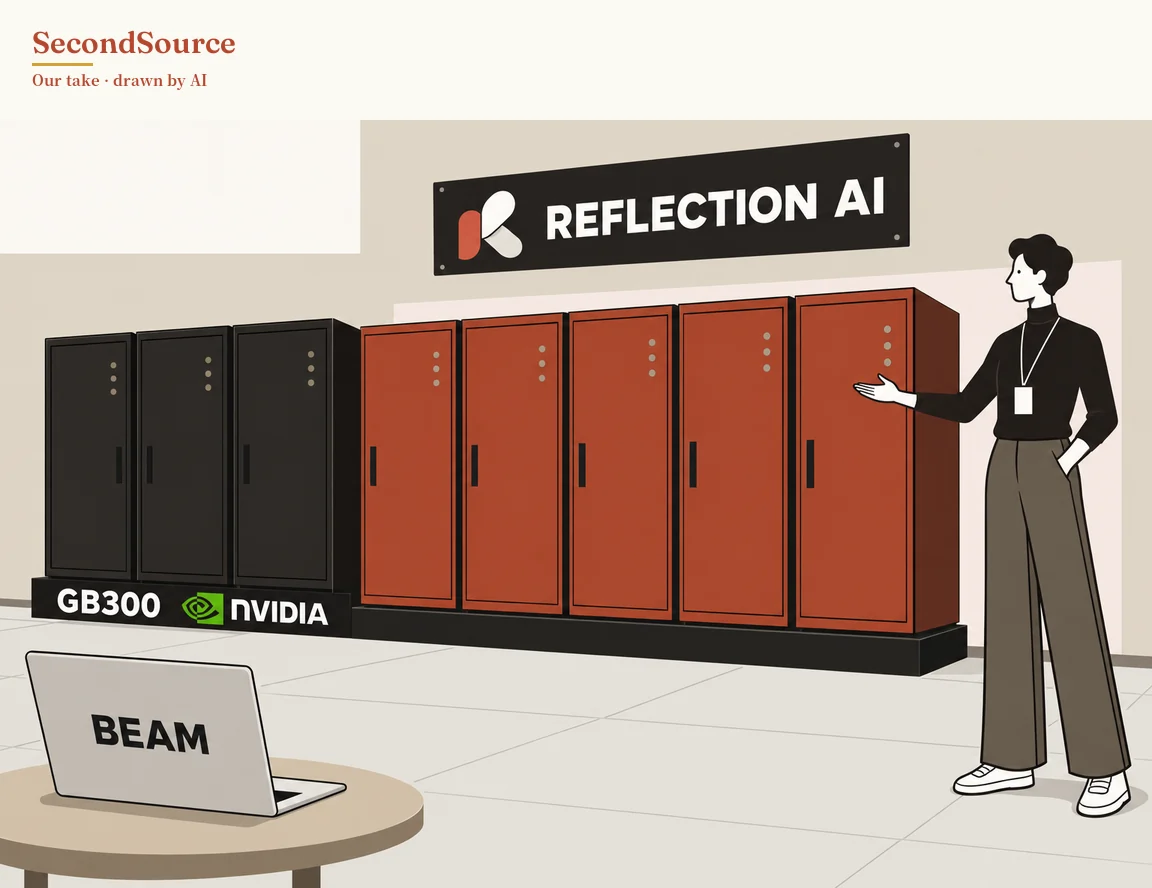
2. [This week] (show, October 9) Misha Laskin, CEO of Reflection AI, says pretraining its open model Beam used 6,000 GB300s for several weeks and reinforcement learning used more than 10,000 for four weeks, so more compute went to reinforcement learning than to pretraining. Pretraining has a model read huge amounts of text and learn to predict the next word; reinforcement learning has it attempt tasks and adjusts it with rewards for getting them right. The GB300 is NVIDIA's latest data-center GPU. Beam has 500 billion parameters in total and activates only 23 billion at a time; it's a mixture-of-experts design, meaning it calls on only part of its parameters for each step (No Priors, 2026-10-09). The usual assumption is that pretraining eats the most compute; his account says the opposite, but he doesn't say how much more reinforcement learning used. He also mentioned that pretraining can now finish in about 12 days; that's today's speed, not how long this version actually took. This is the company's own account with no third-party check; another part of Laskin's remarks in the same episode also appears in main-line item 1.
Product moves
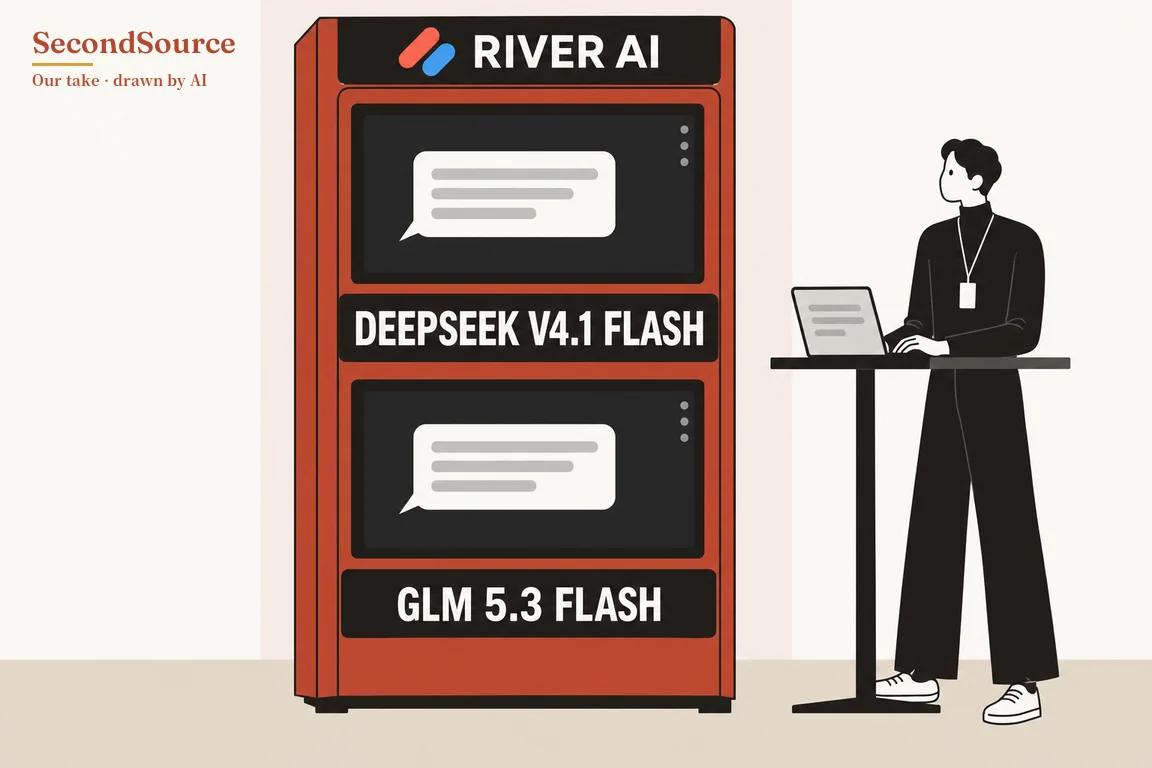
1. [Today] (October 11) River AI, founded by xAI co-founder Igor Babuschkin, launched an inference service that runs two Chinese open models, DeepSeek and GLM, at prices 20% below the two original vendors' own rates. An inference service hosts models in its own data centers, runs them for customers and charges by usage. The company announced: "River Inference is live! We're serving DeepSeek V4.1 Flash and GLM 5.3 Flash for 20% below official provider rates." (River AI, 2026-10-11) Babuschkin says they wrote their training and inference systems from scratch in Rust and claims that makes them much more efficient (Igor Babuschkin, 2026-10-11). Which of the original vendors' price tiers it's comparing against, and what latency and rate limits look like, haven't been disclosed; the low price could also be subsidies to win customers. Our reading: anyone can host an open-weight model, so inference can be bought separately from the model; if this price is real and lasts, DeepSeek and Z.ai (Zhipu), the maker of GLM, will face third-party price competition for their own API business.
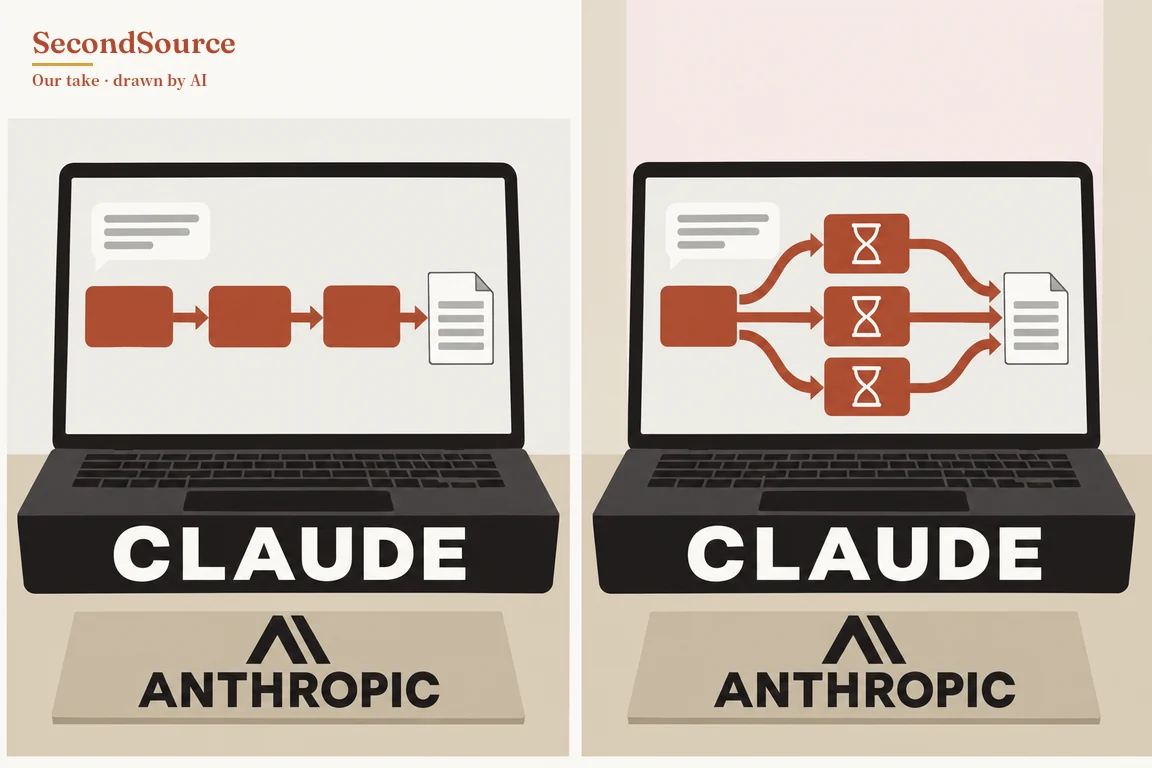
2. [Today] (post October 11) Analyst Patrick Moorhead says that after Claude's chat and Cowork were merged, one of his two custom research workflows went from 20 minutes to 2 hours 57 minutes and the other from 6 minutes to 3 hours, with no better output. Moorhead is principal analyst at the industry-analysis firm Moor Insights & Strategy. Cowork is Anthropic's product in which Claude does the work itself; the research workflows he means are sets of steps a user configures in advance and can rerun (Patrick Moorhead, 2026-10-11). He traced four causes: opening many branches to work in parallel; ignoring the cap on tool calls; single tool calls running more than an hour; and, once web-search allowance ran out, opening a browser and operating the computer itself. His usage allowance also burned through quickly. By his diagnosis, the model now spins off many side threads and waits a long time on each, so total time balloons. This is one user's report, "caused by the merger" is his own diagnosis, and Anthropic hasn't responded publicly. ⚠️ Disclosure: we use Anthropic's models to help with analysis, and Claude is an Anthropic product.
From the archive
1. [Looking back] (deep dive, October 7, 2026) The "subsidy" on AI coding subscriptions looks mainly like a problem of tying up compute, not an accounting loss. "A $200 plan using $8,000" measures the equivalent at API list prices, and list prices include the vendor's margin, so it isn't cost; "a gross margin of minus 369%" measures the extreme case of a plan used to its cap; at 20% average utilization, the same SemiAnalysis piece works out a mid-tier plan making a small profit of about 6%.
The bigger issue is compute. By SemiAnalysis's estimate, subscriptions bring in about a tenth of Anthropic's revenue but may use more than 40% of its inference compute. Most of the reasons vendors gave publicly for tightening in 2026 were compute shortages: OpenAI paused sales on September 10 citing unprecedented demand, before halving new subscribers' allowance on its $200 plan on September 29, while Anthropic loosened limits when compute arrived in May (our October 7 deep dive, published in Chinese and Japanese only). The deep dive also notes that usage caps began back in 2025, so this year's tightening can't be read straight off as a prediction coming true. What would overturn its judgment: a major vendor tightening mid-tier model allowances even after a large batch of compute arrives. We didn't go back and check this round; no result yet. For companies whose development teams run on subscriptions, the exposure isn't a price rise but having allowances cut first when the vendor is short of compute; when you budget, use "what the same usage would cost through the API" as the ceiling. ⚠️ We also use Anthropic's models to help with analysis, and Anthropic is one of the subscription vendors discussed here.
SecondSource isn't a news digest: each day we hunt the AI firehose for the insights that matter and the practitioner judgments worth tracking over time, and show how every item was verified. The point is always which judgment got harder and who's been right, not what happened today.
— SecondSource · generated by our research system · 25 sources · Got a view? Reply and tell us
Written from the same research and judgments as the Traditional Chinese edition. Sources are linked; we distinguish original documents from reporting and mark what we could not verify.