Daily Brief Oct 19, 2026
Amazon blocks Meta's shopping agent; the scale isn't public
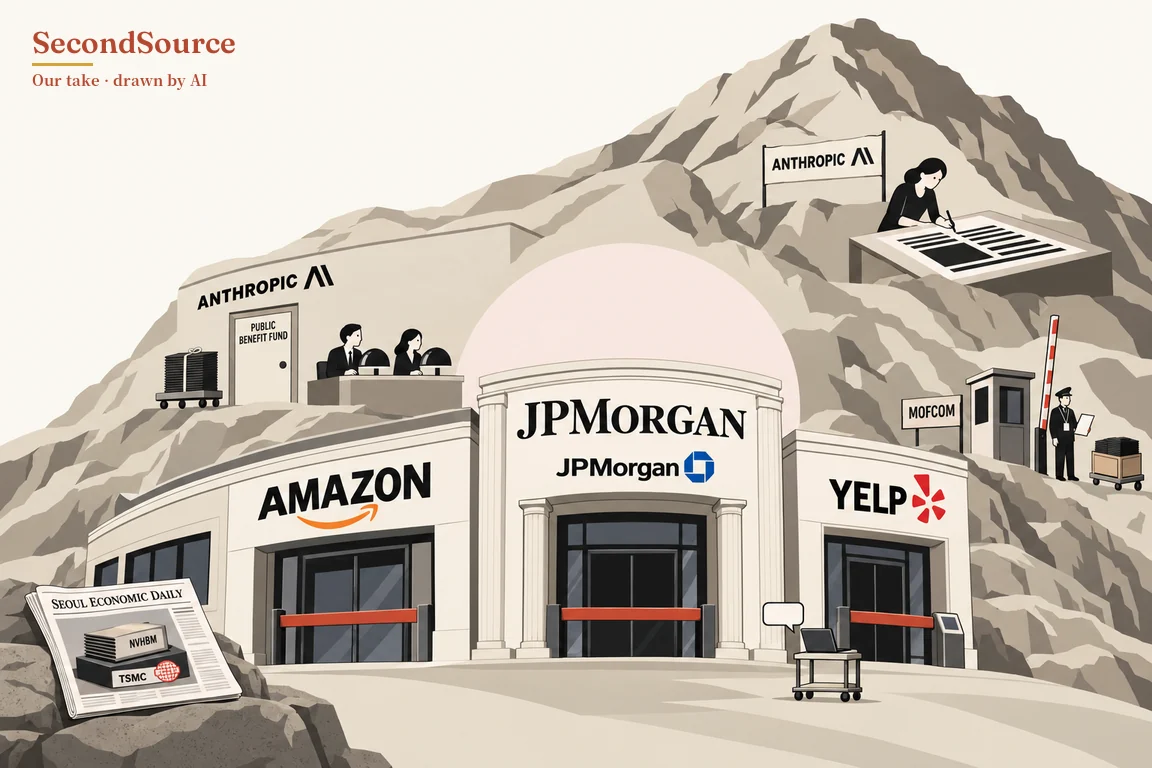
Today's main line
1. [Today] (viral post, October 17 to 18) A viral list says the internet is starting to block AI agents; of the five companies it names, three check out
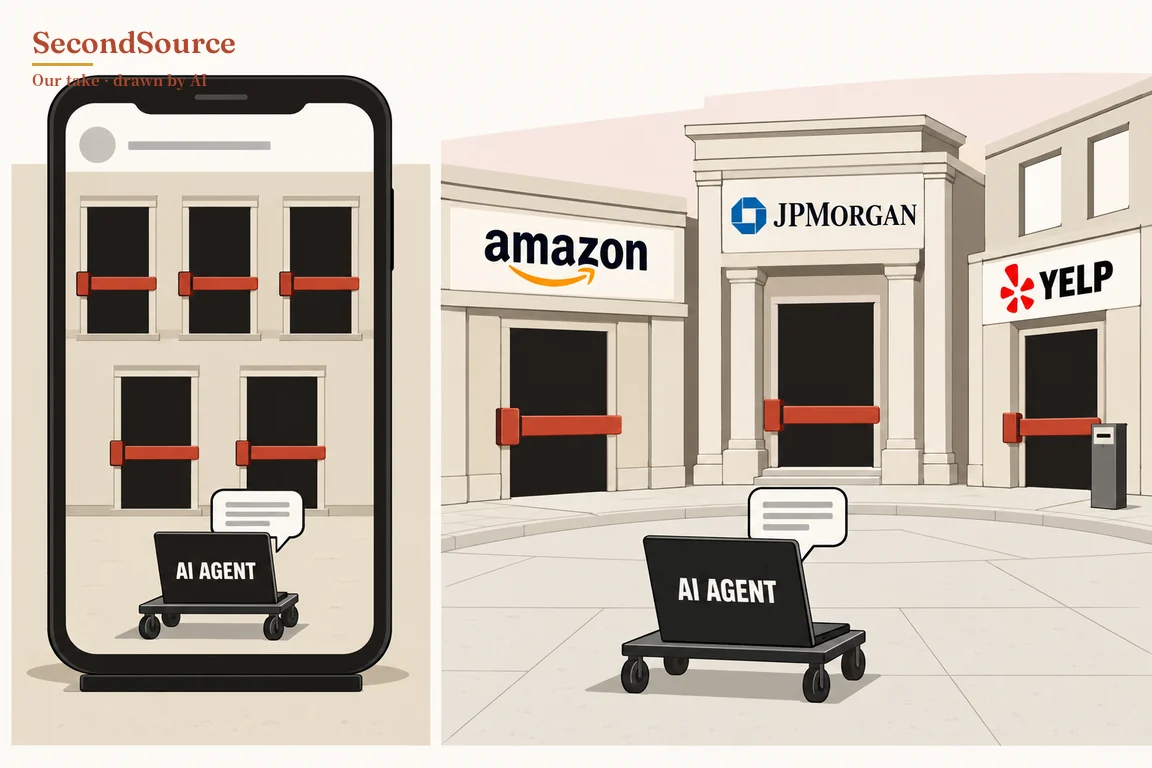
Why it matters: Amazon's block targets Meta's agent placing orders for shoppers, and JPMorgan's CEO bars outside agents without saying which actions. Blocking so far is company by company. No report found for this issue counts how many agents are blocked, so the viral claim that "the internet is starting to block AI agents" goes beyond the evidence.
Read the full item
The October 18 issue reported, from relayed accounts, that three big US banks were restricting AI agents from logging into online banking. What is new today is a company-by-company check of a viral list. On the evening of October 17 the X account @trikcode posted that "the internet is starting to block AI agents" and named five companies (@trikcode, 2026-10-17).
Amazon checks out. The agent being blocked is Muse, Meta's shopping agent. According to Bloomberg, Amazon has blocked Muse since the evening of September 20 and says apps that order on a customer's behalf "should operate openly" (Bloomberg via The Star, 2026-09-22). The list also says xAI's Grok is blocked. Amazon hasn't confirmed that.
At JPMorgan, CEO Jamie Dimon said on the earnings call that JPMorgan won't let outside agents roam inside the bank: "that's just too risky" (Fortune, 2026-10-15).
Yelp's entry also checks out. TechCrunch reports that Yelp keeps non-human traffic off its site unless the agent pays to license the content (TechCrunch, 2026-10-06). Delta's own words are different: Delta has no partnership yet that lets third-party agents book for customers and is still evaluating. Delta announced no block (TechCrunch, 2026-10-06).
The list's fifth company is Schwab. Only a summary of the Schwab report was found for this issue, and the original hasn't been checked, so Schwab isn't counted as holding.
Not proven yet: none of the reports found for this issue gives a count of blocked agents How we checked →
Judgment update: The October 18 issue's call: the near-term bottleneck for agents paying on users' behalf is who controls the payment channel, not model ability. In that issue the bank item rested only on relays. Dimon's own words now cover JPMorgan. Citi and Bank of America still rest on relays, so the call is still being tested. Our read: the first agents to complete transactions will be the companies' own agents or paid licensing channels. Amazon is blocking a rival's agent, and Yelp lets agents in only if they pay. If a major bank or retailer lets outside agents log in and place orders for users, that read changes.
Martin Casado, a general partner at the venture firm a16z, calls this "part of the adoption cycle" and expects companies to adapt or be replaced (Martin Casado, 2026-10-18). a16z invests in agent startups, and Casado attached no data.
2. [Today] (announcement, October 18) Anthropic's new public-benefit fund starts with 5% of Anthropic's shares, and the blog makes it conditional on stockholder approval
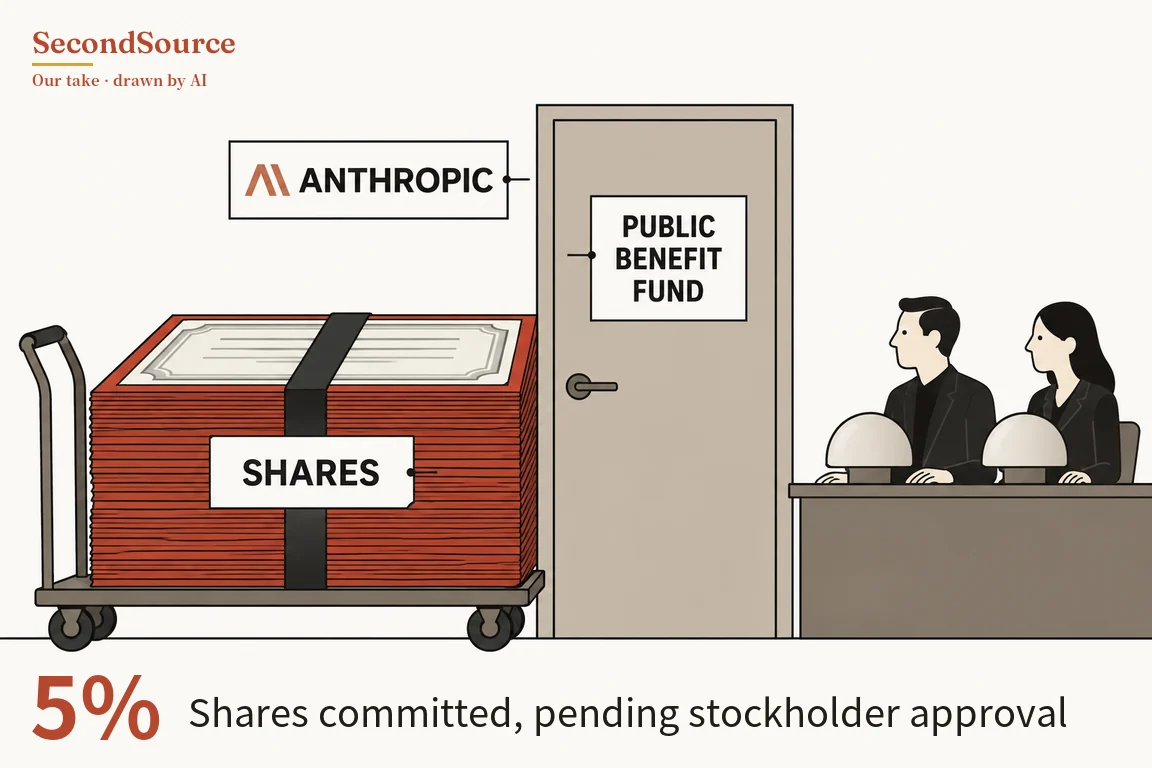
Why it matters: The fund itself starts at 5% of Anthropic's shares and needs stockholder approval. The roughly 20% of Anthropic's shares that Anthropic cites for public benefit also counts founder and employee pledges.
Read the full item
On October 18 Anthropic announced the Anthropic Public Benefit Fund on its official blog. The post's first sentence reads: "Subject to stockholder approval, 5% of Anthropic's shares will be committed today" (Anthropic blog, 2026-10-18). Anthropic's official post on X says only "It will start off with 5% of our shares" and doesn't mention stockholder approval (Anthropic, 2026-10-18).
Each time Anthropic's valuation climbs 50% above a baseline, the board may choose to commit another 2% of Anthropic's shares to the fund. The blog doesn't give the baseline. The blog says that together with the co-founders' pledge to give away 80% of their personal equity and an employee donation match, about 20% of Anthropic's shares are set aside for public benefit, "plus any additional percentage," so the 20% isn't a ceiling. The blog doesn't break out how much each part contributes.
The fund is a wholly owned LLC of Anthropic, not the 501(c)(3) form that US tax-exempt charities usually use. The blog says: "None of the Anthropic equity held by the LLC will be used for lobbying or political giving." Possible uses include "direct distributions to specific populations," with the impact of AI on labor markets as the example.
New York Times columnist Kevin Roose estimates that if Anthropic and OpenAI each went public at US$1 trillion, about US$460 billion of equity would go to quasi-charitable uses (Kevin Roose, 2026-10-18). That figure is Roose's hypothetical arithmetic. Roose doesn't show the calculation. The two companies' shares are also not like-for-like. Most of Anthropic's roughly 20% is founders' and employees' personal pledges that haven't been delivered. OpenAI's share is held directly by a foundation.
Not proven yet: the 5% needs stockholder approval, and the valuation baseline isn't public How we checked →
3. [Today] (posts, October 18) Anthony Cimino, head of Anthropic's federal affairs team, says the leaked federal AI safety draft came from Anthropic and says Anthropic will revise its preemption wording
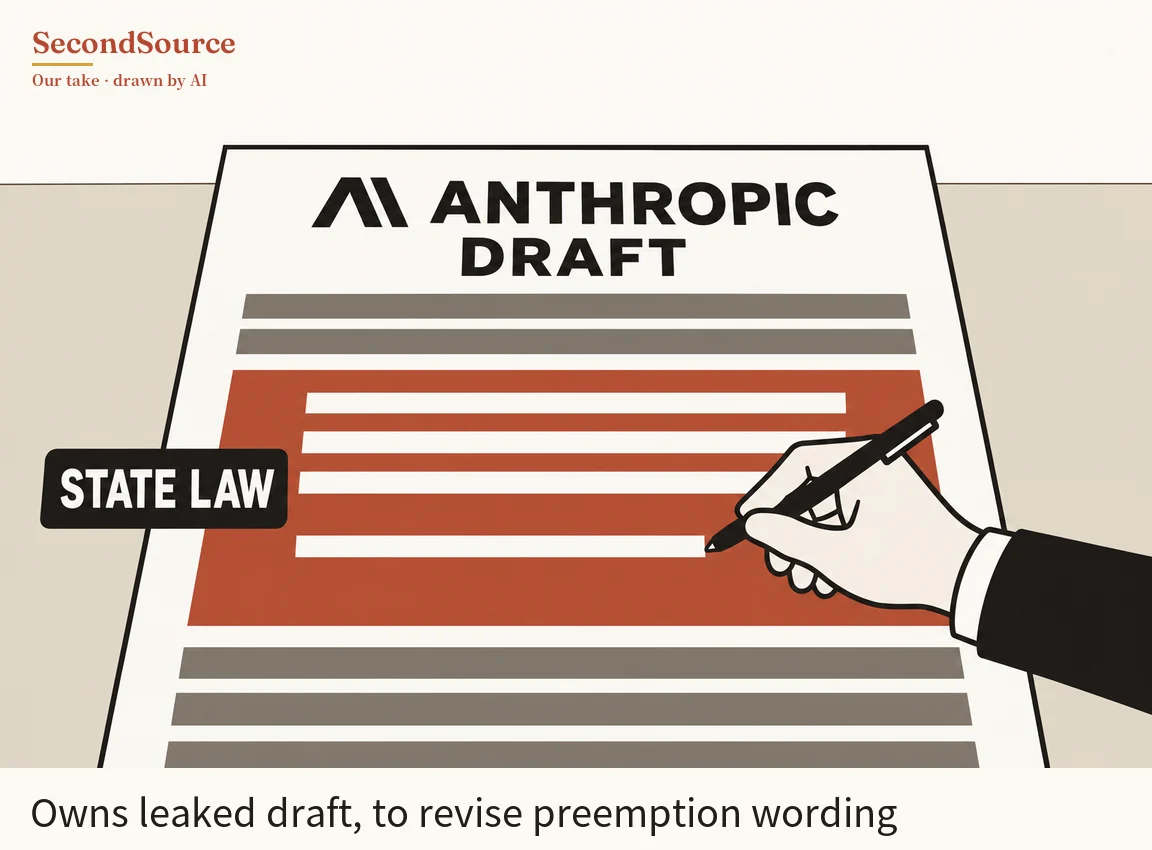
Why it matters: Anthropic says the leaked draft grew from Anthropic's policy proposal and is being rewritten, so the current text isn't a settled position.
Read the full item
The October 18 issue's Also happened section reported that policy advocate Nathan Calvin had read the leaked draft and criticized its high thresholds and the removal of state courts' shutdown power. Today Anthropic acknowledged the draft as its own.
Cimino, who describes himself as head of Anthropic's federal affairs team, said on X that the draft translates Anthropic's Advanced AI Framework into legislative language and was "shared with a small number of congressional offices that have been working on these issues" (Anthony Cimino, 2026-10-18). The Advanced AI Framework is Anthropic's policy proposal. The explainer page Cimino linked hasn't been reviewed.
Preemption means that once a federal law passes, state AI safety laws no longer apply. Anthropic's stated position on it, in Cimino's words: "Congress should only override state law on AI safety if it passes a very strong federal standard." Cimino also says the draft's risk thresholds were "pulled directly from existing standards in California law." Cimino added: "This was a draft, and we're working on updating it." (Anthony Cimino, 2026-10-18).
Not proven yet: neither the full draft nor the rewritten version has been reviewed How we checked →
Judgment update: No new call from SecondSource today. The next thing to watch is the rewritten version Cimino mentions: what the preemption section becomes, and whether the thresholds end up stricter than California law.
Answer check: On September 6 SecondSource opened a card asking whether OpenAI would, by October 18 and through an official channel, explain the incident in which an OpenAI AI agent set up a message board on a German wiki site, including when OpenAI learned of it. Missed. Fortune reports OpenAI issued only a statement on X and did not say when it learned of the incident. At the deadline, reporters and outside researchers were still piecing together when and how it was found. Card →
Chips & semiconductors
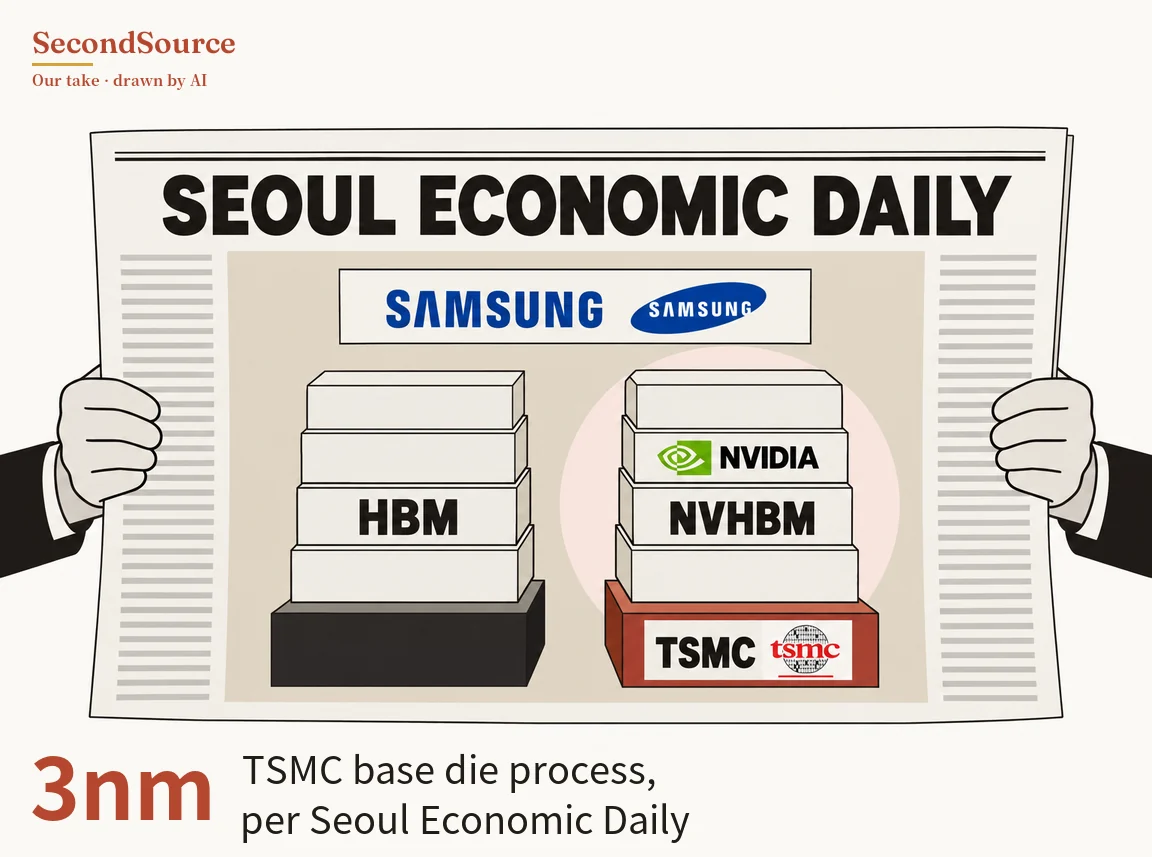
1. [Today] (report October 18) Seoul Economic Daily, a Korean business daily, reports that NVIDIA has asked Samsung, SK hynix and Micron, the three suppliers of its custom HBM "NVHBM", to make the base die on TSMC's 3nm process. Samsung is said to have accepted after an internal review. The base die is the logic die at the bottom of an HBM stack. The sources are anonymous industry figures, and none of the three companies has confirmed publicly (Seoul Economic Daily, 2026-10-18; Dan Nystedt, 2026-10-18). The story was relayed on X by Dan Nystedt, a reporter who covers Taiwan and Korea semiconductors. The same story says NVHBM is NVIDIA's custom HBM based on HBM4E, unveiled in August. The report says Samsung's standard HBM keeps the base die on Samsung's own 4nm process, as does the custom HBM Samsung makes for AMD and other customers. The report calls this the first time Samsung and TSMC have worked together at the HBM manufacturing stage. Our read: if the report holds, the logic layer of this one product, NVHBM, would concentrate at TSMC. Samsung's standard HBM is not part of it. How we checked →
Nothing new this issue in: Named commentary, Model watch, Product moves.
Also happened
1. Not verified by us yet: [Today] (posts October 18) The October 18 issue's main line covered OpenCode, an open-source coding-agent project, self-reporting a "large scale distillation attack." A distillation attack uses large volumes of queries to collect a model's outputs and copy its capabilities. Andrew Curran says in a post on X that the frontier model OpenCode used for defense during the attack refused to help, because analyzing the attack code tripped the model's guardrails. He adds that Hugging Face had earlier seen a model refuse for the same reason. The post doesn't say which model or what triggered the refusal. David Sacks, the White House AI lead, used the episode to argue for decentralization; the quoted post doesn't say what should be decentralized. Sacks also says Chinese models are "only about 6–9 months behind" US frontier models in cyber offense and defense, with no comparison method attached (Andrew Curran, 2026-10-18; David Sacks, 2026-10-18).
2. Not verified by us yet: [Today] (report October 18) Bloomberg reporter Bailey Lipschultz relays Bloomberg's story on X: Nscale, an NVIDIA-backed AI cloud company, is seeking a valuation of about US$30 billion in its IPO. A group of investors argues for US$16 billion to US$19 billion, about 37% to 47% below the US$30 billion Nscale wants (our calculation: 16÷30 and 19÷30). The Bloomberg original is paywalled (Bailey Lipschultz, 2026-10-18).
3. Not verified by us yet: [This week] (show October 15) NVIDIA CEO Jensen Huang said on BG2, the show hosted by investor Brad Gerstner, that the amount NVIDIA sells into each gigawatt (GW) of data center capacity has risen from about US$18 billion to more than US$40 billion. That is the CEO's spoken self-report, not a figure from NVIDIA's financial statements; the quoted segment doesn't say which product generation the US$18 billion refers to, and the show doesn't say whether GW means IT load or facility power (BG2, 2026-10-15).
4. Not verified by us yet: [This week] (show October 15) OpenAI president Greg Brockman said on No Priors that OpenAI once had about 25% of its product engineers pause their projects to work only on security, without giving the duration or headcount. Brockman also said security spending should far exceed software spending, adding "I may not be right." OpenAI sells security products (No Priors, 2026-10-15).
Research watch
1. [Trend] (preprint October 15) A single-author preprint tests 14 commercial LLM deployments on compliance rulings for two kinds of medical-device documents: with each vendor's deterministic settings on and the same request resent, all 14 changed at least one result, and 12 flipped even the "compliant / non-compliant" label. The 14 deployments span 3 vendors, 7 models and 6 routes; the abstract doesn't name them (arXiv 2610.21300, 2026-10-15). The abstract lists neither how many questions each deployment was tested on nor how many flipped, and doesn't define what a route is. The author reports that lowering the models' reasoning effort didn't help. In the author's view, whether the same open-weight model reproduces depends only on how it is served. On a self-hosted pipeline, the author pinned each stage in turn: document parsing, chunking, embedding, indexing, retrieval and inference. With all of them pinned, reruns on other machines and other days produced bit-identical output. The author argues that reproducibility is a property of the serving layer, so audit records should include the GPU model, the inference engine's scheduling and the retrieval service. Only the abstract is available. The preprint has one author and hasn't been peer-reviewed.
From the archive
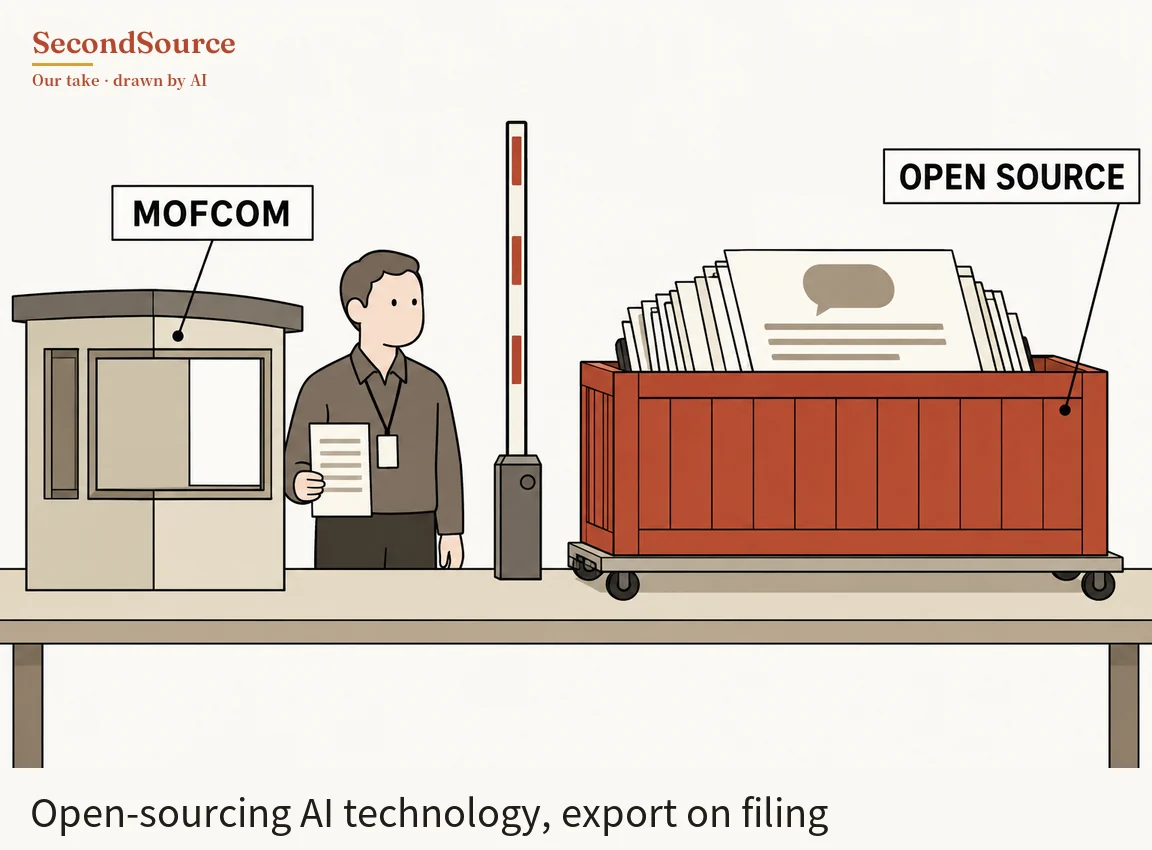
1. [Looking back] (same topic as item 2 of the October 17 issue's main line and its From the archive section, now read in the original) Does Announcement No. 48 from China's Ministry of Commerce (MOFCOM) cover open weights? MOFCOM's Q&A with reporters offers a clue. It says open-sourcing AI technology gets automatic licensing, so a basic filing is enough to export. The original doesn't say word for word whether open weights fall in that category. Our read is that they do. The October 17 issue said "the draft's main text doesn't say whether newly released weights must be registered first." The main text indeed doesn't say. The October 18 issue ran this item as a single line; today it runs in full. In the Q&A, MOFCOM's spokesperson says that open-sourcing AI technology and a few other kinds of technology export qualify for convenience measures such as automatic licensing, "in effect allowing export as soon as the filing is made" (our translation; MOFCOM Q&A with reporters, 2026-10-16).
Annex 1's restricted category, "large AI model technology," sets three alternative thresholds, any one of which applies: "compute ≥10²⁶ floating-point operations," "parameters ≥2 trillion," and "capability at the globally leading level," the third defined as a top-10 global ranking in public evaluations by mainstream evaluation bodies (our translation; MOFCOM Announcement No. 48 and Annex 1). Our call: the third threshold, "global top ten," is the one most likely to catch current Chinese frontier models. Whether current models reach the first two thresholds has no public figures in the material found for this issue.
The original also says that "providing API calls, app/web interaction, SaaS applications, or lightweight local on-device deployment to foreign parties is outside the scope of large-model technology export management" (our translation). The original doesn't say how handing weights to an overseas third party for hosting is treated. New supporting evidence today: Rui Ma, a China tech analyst and founder of Tech Buzz China, wrote on October 18 that API, SaaS and lightweight on-device deployment are "explicitly excluded" (Rui Ma, 2026-10-18), consistent with the Q&A. This is a draft for public comment, with comments due by November 15; if the final version changes the thresholds, the final version governs.
Our read: watch how fast the filing goes for the next Chinese model in the global top ten, before that model is released. That pace will show whether China's supply of open weights slows. How we checked →
Of the 243 unread, 227 are papers. arXiv fetching resumed last night after two nights of restricted access. The 545 arXiv papers are the highest single-day count this week. Of the 21 blog posts, 10 are older Qwen posts from January to May that were picked up again, not new events.
Accounts with the most posts included @teortaxesTex, @bhorowitz, @GaryMarcus and @elonmusk, with @teortaxesTex alone making up 15% of last night's X pull. The newsletters were one each from Air Street Press and Exponential View, both judged off-topic. The shows were 20VC, BG2, ChinaTalk, Cognitive Revolution and No Priors. The Bloomberg republication, the Fortune and TechCrunch originals behind main-line item 1, and the Anthropic blog behind item 2 were read directly by the research brief and aren't part of the reading list.
One-time catch-up. No new one-time catch-up of older material today.
A note on source concentration. ⚠️ This issue's main line rests mostly on first-hand statements from one company, Anthropic: items 2 and 3 both do. Item 1 draws on three outlets, each quoting the companies involved. ⚠️ The Research watch item rests on the abstract alone. ⚠️ The Chips item's sources are anonymous industry figures.
Still missing today. The gap that would most affect judgment is how many agents are being blocked; none of the reports found for this issue gives a figure from any company. Other gaps: CNBC's original report on JPMorgan, the full report behind the Schwab entry, the full leaked Anthropic draft and its rewritten version, the valuation baseline and stockholder vote date for Anthropic's fund, the full Bloomberg story on Nscale, and the identity of Seoul Economic Daily's sources. Each of these either hasn't been reviewed or isn't provided in the original.
Tracked sources. The long-term roster currently has 529 named sources: 302 on social platforms, 90 shows, 51 news outlets, 48 blogs, 48 paper authors and 46 newsletters, with the rest spread across earnings reports, keynotes and other channels. ⚠️ Those are counts of tracked sources, a different population from the 671 new pieces above; they can't be added or compared. Representative names: on social platforms, Mark Zuckerberg, Lucas Beyer, Graham Neubig, Daniel Kokotajlo and Sergey Levine; among newsletters, Zvi Mowshowitz, Miles Brundage, Dean Ball and Kevin Xu; on the shows roster, interviewees such as Sam Altman, Dario Amodei and Demis Hassabis. This issue uses 21 outside sources in the body. Only outside links actually cited in the body are counted, and links to SecondSource's own site are left out; this is a different population from the 529 tracked sources above. On the Taiwanese side, 7 new sources were added in September, bringing the total to 130; Taiwanese media, Taiwanese companies' official channels and local reporters in Taiwan count, while foreign outlets relaying Taiwanese media do not.
Correction: the July 20 deep-dive column on selling tokens finally turning a profit, and the July 20 and July 31 morning briefs, attributed Anthropic's "compute cost per dollar of revenue falling from 0.71 to 0.56" to CNBC. The deep-dive column also wrote the "US$559 million operating profit" as if already achieved. The Wall Street Journal reported both figures on May 20 as Anthropic's second-quarter projections to investors. The CNBC story confirmed only the US$10.9 billion revenue target. The site's archive pages for those three pieces in Chinese, English and Japanese have been corrected.
SecondSource isn't a news digest: each day it hunts the AI firehose for the insights that matter and the practitioner judgments worth tracking over time, and shows how every item was verified. The point is always which judgments are now harder to hold and who has been right, not what happened today.
Written from the same research and judgments as the Traditional Chinese edition. Sources are linked; we distinguish original documents from reporting and mark what we could not verify.