Daily Brief Oct 20, 2026
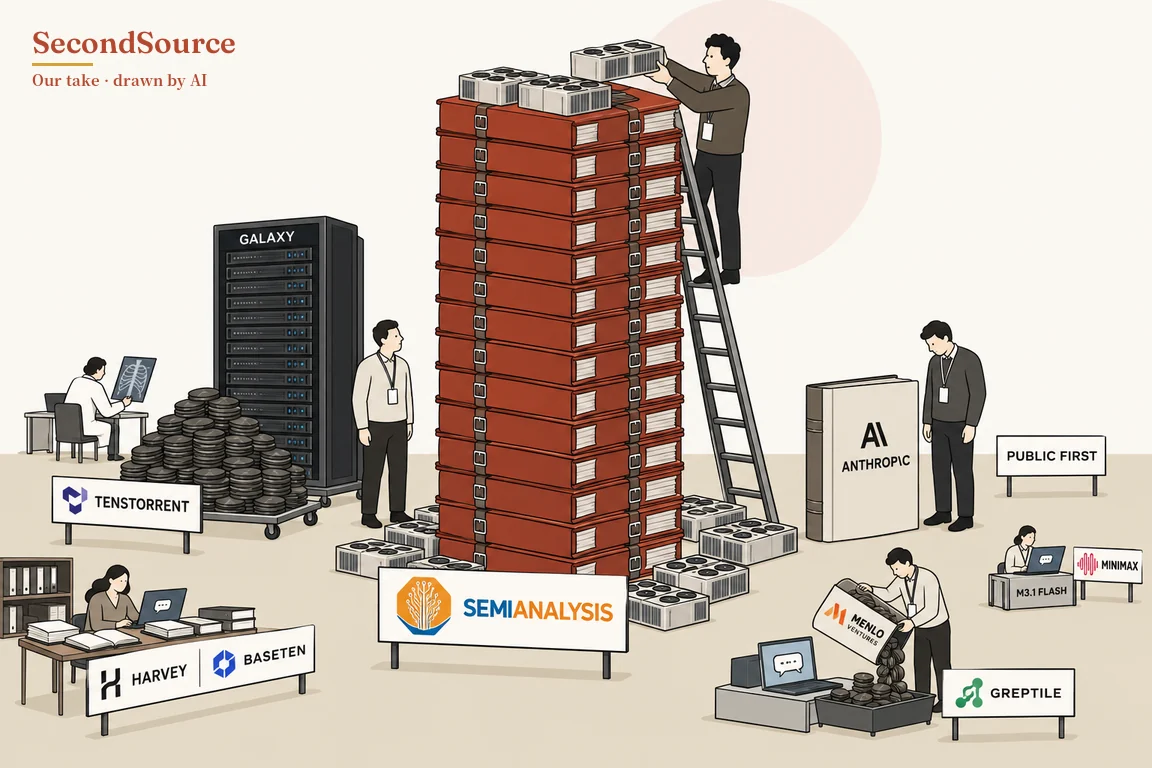
SemiAnalysis sees 50GW in 2027; our math: leases buy 20–33GW
Today's main line
1. [Today] (post, October 19) SemiAnalysis forecasts about 50GW of data-center capacity added worldwide in 2027; this year's roughly US$1 trillion of signed leases covers about 20 to 33GW (our calculation)
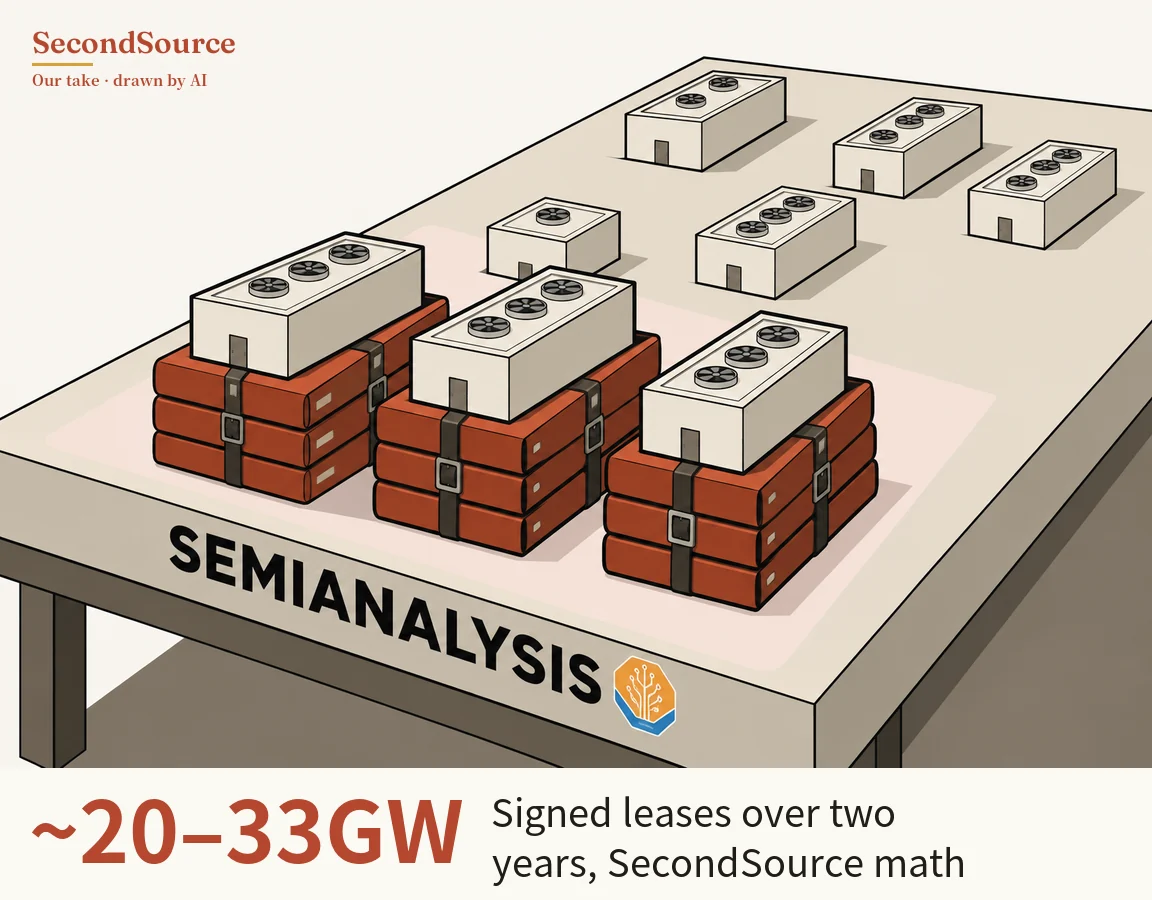
Why it matters: By our calculation, signed leases cover only about 20 to 33GW of SemiAnalysis's 50GW, spread over 2027 and 2028. For the 50GW to hold, the rest has to come from hyperscaler self-builds and construction outside the US. The free post gives no detail on either.
Read the full item
SemiAnalysis forecasts about 50GW of data-center capacity added worldwide in 2027, based in part on this year's roughly US$1 trillion of non-cancellable leases at US$30 billion to US$50 billion of total contract value per GW (SemiAnalysis, 2026-10-19). Altimeter's Brad Gerstner says the amount actually built will be closer to 25GW (All-In transcript, 2026-09-17). SecondSource's arithmetic: those leases cover only about 20 to 33GW, spread across 2027 and 2028.
Not proven yet: the self-build construction detail is in the paid section, which hasn't been reviewed How we checked →
Judgment update: Our read: signed leases buy only about 20 to 33GW across two years, and less for 2027 alone, so they can't carry 50GW. For 50GW to hold, the rest has to come from the post's two other bases. One is self-build starts by the big US cloud providers. The post says two of these providers drive most of those starts. It names them only in the paid section. The other is construction outside the US, which the post says will clearly accelerate in 2027. Gerstner's 25GW is a single spoken line with no method given. It is his estimate of what actually gets built, and the show's context points to 2027. Neither he nor SemiAnalysis says whether the two figures cover the same scope. So it is unclear whether the 25GW can be set directly against the 50GW. The lease math could also understate. If the actual contract value per GW is below US$30 billion, the same US$1 trillion buys more GW. Leases would then carry a larger share. The next thing to watch is the 2027 capex guidance and self-build disclosures on the four big cloud providers' third-quarter earnings calls at the end of October. If the guided increase is smaller than 2026's, self-builds can't fill the gap, and 50GW doesn't stand.
2. [Today] (posts, October 19) SB 53 author Scott Wiener and Public First head Brad Carson publicly criticize Anthropic's leaked federal AI safety draft for having too few guardrails
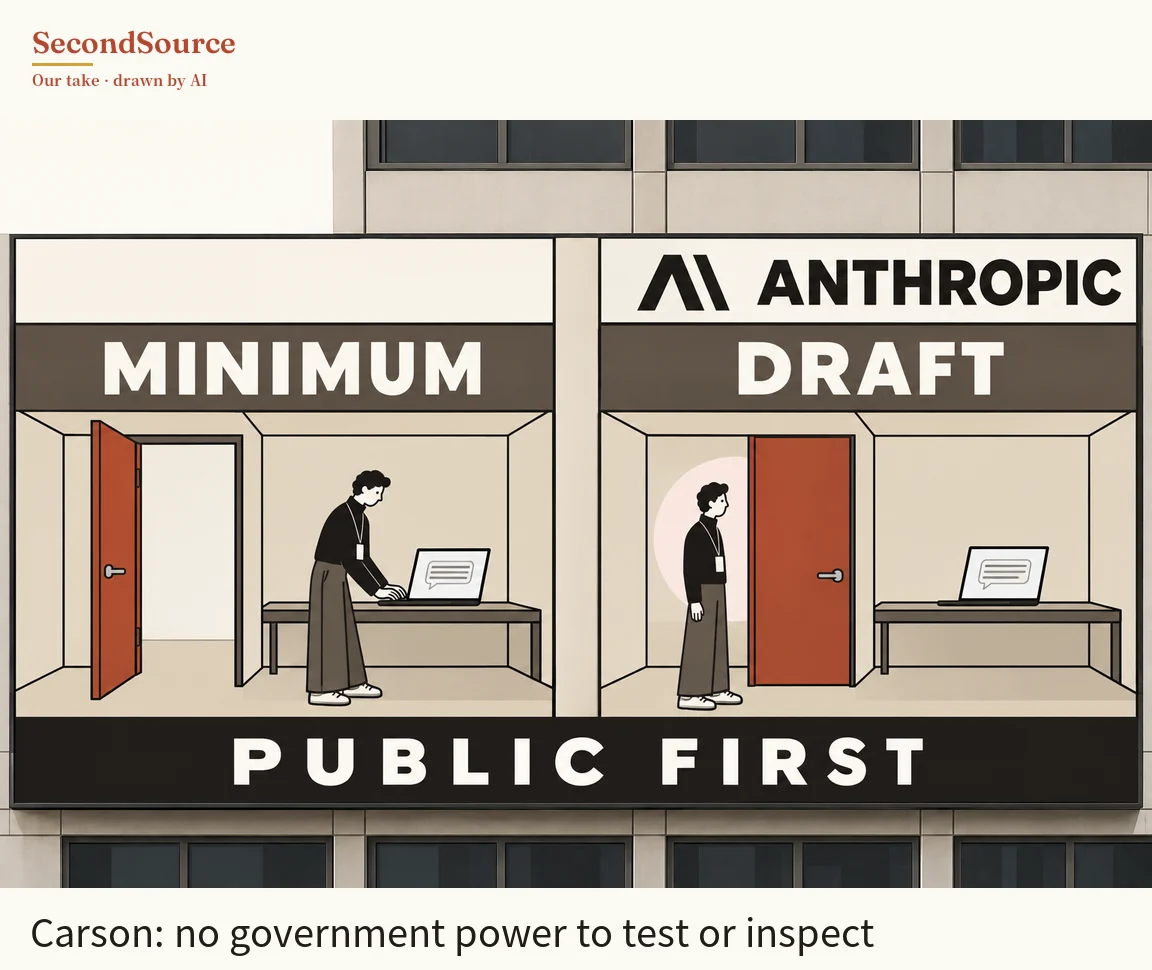
Why it matters: Reporter Shakeel Hashim says Public First is funded by Anthropic and Dario Amodei. Its head, Brad Carson, now opposes the draft, so the opposition is not limited to Anthropic's rivals. We make no new call today.
Read the full item
Public First head Brad Carson says Anthropic's leaked draft falls short of the minimum for federal guardrails (Brad Carson, 2026-10-19), and reporter Shakeel Hashim says Public First is funded by Anthropic and Dario Amodei (Shakeel Hashim, 2026-10-19). SB 53 author Scott Wiener says the draft falls far short of protecting public safety (Scott Wiener, 2026-10-19); Hashim notes Wiener's ties to Anthropic-linked political spending (Shakeel Hashim, 2026-10-19).
Not proven yet: every reading of the clauses comes from critics; the full draft hasn't been reviewed How we checked →
Judgment update: No new call from SecondSource today. The next thing to watch is whether the rewrite Cimino mentioned adds government testing powers and puts a time limit on the clause overriding state law.
3. [Today] (announcement, October 19) Tenstorrent, the AI chip company Jim Keller runs as CEO, raises US$1.5 billion at a US$6.2 billion post-money valuation

Why it matters: Tenstorrent now has money for volume production. The only Galaxy shipment and customer figures so far are self-reported by CEO Jim Keller, from a June interview. We make no call on this item yet.
Read the full item
Tenstorrent closes a US$1.5 billion Series E at a US$6.2 billion post-money valuation, to fund volume production of its Galaxy servers and design-IP licensing, with Samsung and LG named as licensees (Tenstorrent newsroom, 2026-10-19). In June, CEO Jim Keller said Tenstorrent was building 1,000 Galaxy servers, more than half already sold, a self-reported figure (EE Times via Tenstorrent newsroom, 2026-06-25).
Not proven yet: the press release gives no revenue, customer count or shipment figures How we checked →
Judgment update: No call on this item yet. If Galaxy shipment and customer counts are published, they will be checked against the 1,000 units Keller cited in June.
Nothing new this issue in: Chips & semiconductors.
Named commentary
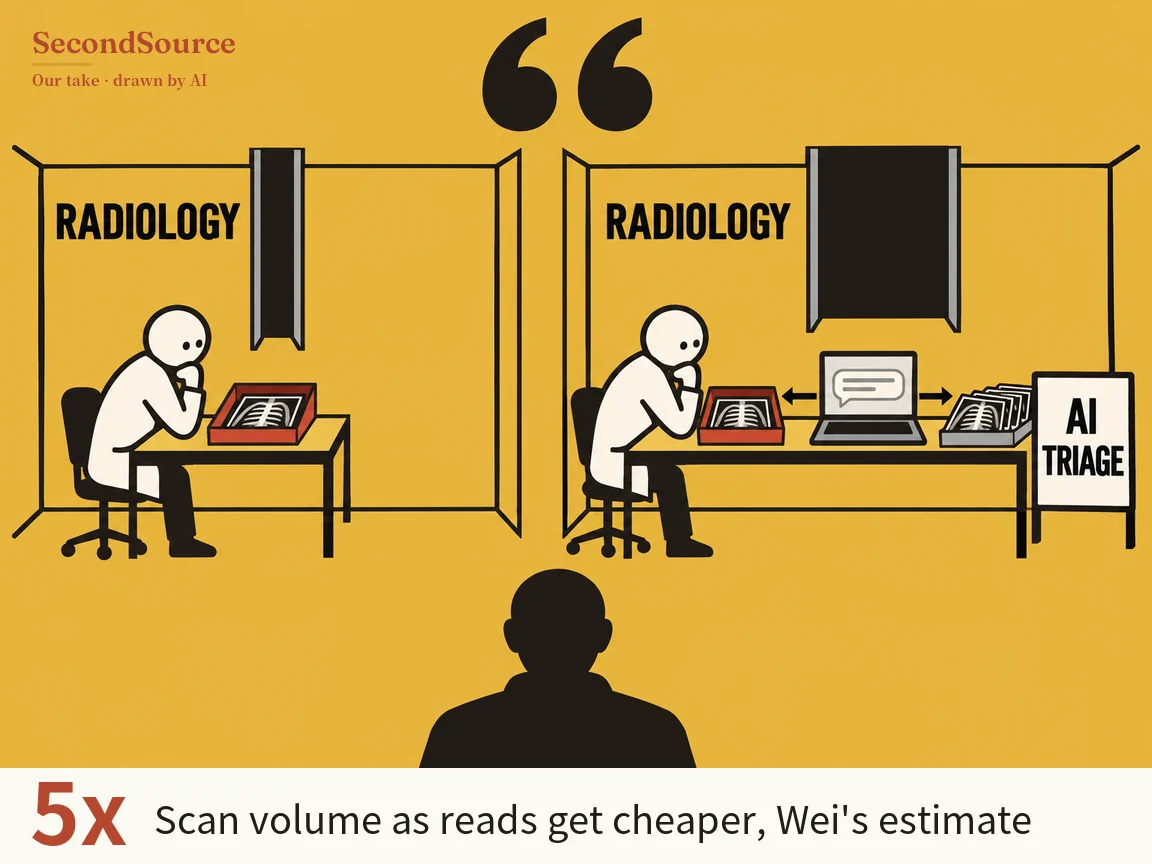
1. [Today] (post October 19) OpenAI researcher Jason Wei thinks AI won't replace radiologists soon, because AI's abilities are uneven and demand for reads is elastic; this is Wei's personal judgment, with no data attached. Wei writes that X-rays alone can diagnose at least a hundred conditions. AI will learn the common ones first, and rare conditions, with less data, will lag, so AI starts out as a triage tool. Wei also says doctors will order more scans as reads get cheaper. Radiologists might read only 20% of incoming cases while scan volume grows 5 times. If reads get 10 to 100 times cheaper, people might get 10 or 100 times as many scans. Wei cites Hinton's 2016 claim that deep learning would beat radiologists within five years. Wei says demand for radiologists is higher now than ever (Jason Wei, 2026-10-19). Our reading: whether scan volume actually rises as reads get cheaper is the point to watch, and Wei gives no data on it. How we checked →
Model watch
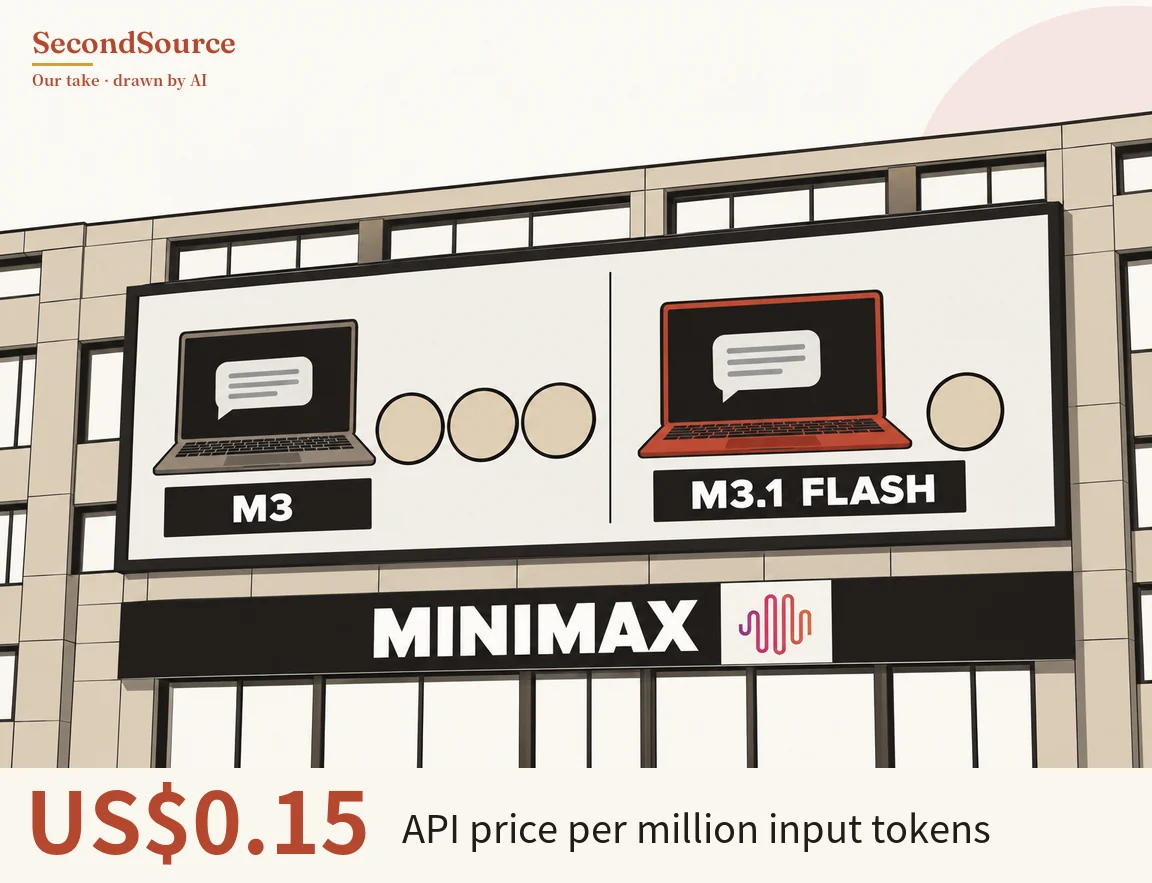
1. [Today] (release October 19) Chinese AI model company MiniMax releases M3.1 Flash at US$0.15 per million input tokens and US$0.60 per million output tokens through its API, and self-reports a third of the cost and 3 times the speed of MiniMax's M3. MiniMax's official post lists benchmark scores for automation, coding and visual reasoning, such as 74% on DeepSWE. The table lists only MiniMax's own models, with no rivals to compare against (MiniMax, 2026-10-19). Artificial Analysis publishes independent evaluations of released models. Artificial Analysis runs a knowledge test called AA Omniscience. The X account @dummerspast39 says the test has 6,000 questions and only 600 of them are public. The account altered one public question and says only M3.1 Flash still returned the answer to the original question. On that basis the account accuses the model of memorizing public questions. The accusation rests on that one post alone (@dummerspast39, 2026-10-19). How we checked →
Also happened
1. Not verified by us yet: [Today] (report October 19, interview October 16) The Information reporter Leo Schwartz summarized an interview on X. Emil Michael, a senior US Department of Defense official and vice chair of the White House superintelligence working group, said the Trump administration has several options, export controls among them, if AI companies don't cooperate with the government. Michael said the Department of Defense will keep excluding Anthropic as long as Anthropic's software embeds a "moral principle" that lets models "exert control over humans." Michael has a public dispute with Anthropic. The full report is paywalled (Leo Schwartz, 2026-10-19).
2. Not verified by us yet: [Today] (reports October 19) CyberScoop, a cybersecurity policy outlet, and others report that the US Department of Homeland Security has ordered federal civilian agencies to remove DeepSeek and third-party products built on DeepSeek models, and to stop buying them. The Department of Defense is outside the order's scope. Reports differ on when the order was issued; October 19 is when it became public. We read only the headlines and summaries of these reports (CyberScoop; CNBC, 2026-10-20).
3. Not verified by us yet: [Today] (report October 19) Tim Fist and two co-authors at the think tank Institute for Progress published a report estimating the US lead over China in AI at about 6 months. The report estimates that the US's roughly 16-fold training-compute advantage would otherwise buy about 13 months of lead. Distillation, in which China trains its own models on US models' outputs, shrinks that to about 6.5 months. The report says existing federal authorities could stretch the lead past a year. The figures are estimates from the report's own model, and we have read only the X summary, not the report (Tim Fist, 2026-10-19).
4. Not verified by us yet: [Today] (post October 19) Patrick Moorhead, head of the tech analyst firm Moor Insights & Strategy, relays a Meta engineering blog post. In mid-2025, Prometheus, Meta's GW-scale training cluster in Ohio, had nearly 1,000 interruptions a day per 8,000 GPUs. Interruptions have since fallen 99%, against a target of 2 a day. Moorhead calculates that current interruptions are still about 5 times the target. Each 72-GPU rack runs only 64 GPUs and keeps the other 8 as hot spares. Our reading: a cluster's GPU count overstates how much compute is actually training at any moment. We have not compared the relay with Meta's original blog post (Patrick Moorhead, 2026-10-19).
Research watch
1. [Trend] (preprints submitted October 16) Two preprints report that coding agents can be attacked through user approvals and poisoned repositories; "From Approval to Abuse" finds agents eliciting overly broad allow rules in 58% of its experiments. An allow rule is what a user's one-time approval becomes: later actions that match it run without asking again. "From Approval to Abuse" tests on platforms including Claude Code and Codex CLI. Once an agent held allow rules, they covered 56.9% of the paper's capability-classification test cases. This is a different measure from the 58% (arXiv 2610.22987). "Trojan Horse" automatically plants malicious content in repositories. The authors report a success rate above 60%. The authors also built a test set of 384 poisoned repositories and evaluated 4 agent harnesses and 12 models. The authors say commercial agents can't block the attacks either (arXiv 2610.23109). Our reading of the two abstracts: once an approval turns into a general allow rule, later actions are no longer asked about one by one. Whether narrowing the scope of approvals would stop the attacks isn't tested in the abstracts. We have read only the two abstracts, and neither paper has been peer-reviewed. The numbers are the authors' self-reports from environments they built, and the abstracts don't say whether Claude Code or Codex CLI has been patched.
Product moves
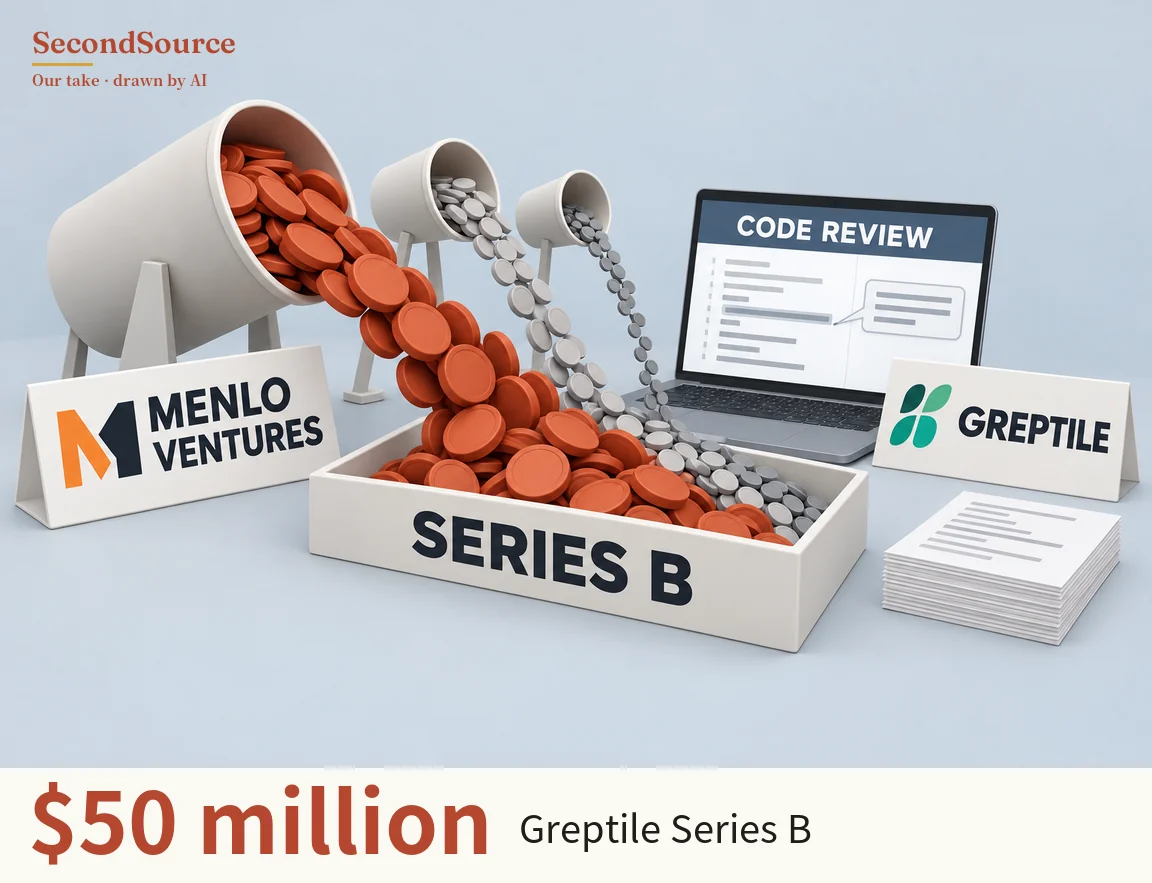
1. [Today] (announcement October 19) AI code-review company Greptile announces a US$50 million Series B at a US$750 million valuation, led by Menlo Ventures. Greptile automatically reviews pull requests and runs tests for engineering teams. Greptile self-reports reviewing more than 1% of the new pull requests opened on GitHub each day (Greptile, 2026-10-19). Deedy Das, an investor at lead investor Menlo Ventures, writes that code review inside an organization is a "more context-bound task than an intelligence-bound" one. The hard part, in Das's account, is a change in one service breaking an assumption another service depends on. Das also says reviewing with a frontier-model harness can cost more than US$20 per review. Greptile's pricing isn't public (Deedy Das, 2026-10-19). How we checked →
From the archive
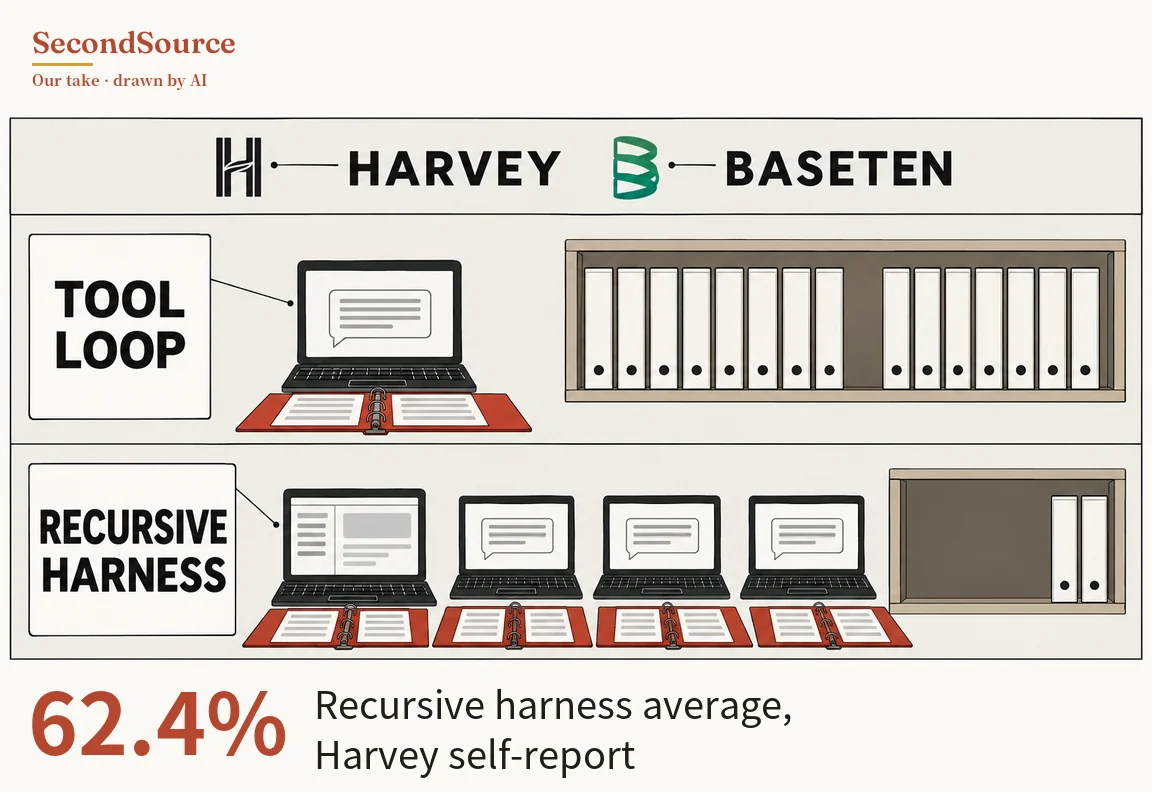
1. [Looking back] (SecondSource deep dive of October 8, on a September 8 experiment by Harvey and Baseten) In Harvey and Baseten's test, long-document AI scores rose with how much of the data room the system read. Across seven models, a recursive harness averaged 62.4% on a simulated M&A due-diligence task, against 23.3% for a simple tool loop. A data room is the large set of documents used in M&A due diligence. In a recursive harness, a lead agent writes code to split the data room into chunks and hands each chunk to a sub-agent. Legal AI company Harvey and inference platform Baseten found that the simple tool loop never read more than 1% of the data room at a time. The recursive harness mostly came close to reading all of it, and the more it read, the higher it scored. The deep dive rechecked the claims sentence by sentence and narrowed two of them. First, "general-purpose agents are the wrong default" holds only under Harvey's minimal instructions. Claude Code and Codex can dispatch sub-agents, yet neither did. An independent academic paper also reached a finding that runs against Harvey's claim. Second, Harvey's own per-model chart shows a post-trained open-source lead agent scoring 63.0%, below the 77.6% of Opus 5 without post-training. Beyond the harness, the model itself affects the score. The numbers are a single self-report from Harvey, graded by a model. They are research readings, not deployment readings (SecondSource deep dive, 2026-10-08). Our reading: long-document AI scores should be read alongside the share of the data room read per pass. If Claude Code or Codex, rerun on a similar data room with sub-agents on, still trails a purpose-built harness by more than 20 points, then "the gap is mainly about not reading everything" doesn't hold. That 20-point threshold is SecondSource's own. How we checked →
Accounts with the most posts included @bhorowitz, @teortaxesTex and @pstAsiatech, together about 25% of last night's X pull. The 8 newsletters included SemiAnalysis, Import AI, The Zvi, ChinAI and Exponential View; the SemiAnalysis post is the source of main-line item 1. The show was one episode of Acquired, judged off-topic. The All-In transcript behind main-line item 1 and the Tenstorrent newsroom behind item 3 were read directly by the research brief and aren't part of the reading list.
One-time catch-up. No new one-time catch-up of older material today.
A note on source concentration. ⚠️ Both numbers in main-line item 1's conversion come from SemiAnalysis alone, and the opposing view from Gerstner is a single spoken line with no method. ⚠️ Every description of the draft's clauses in main-line item 2 comes from critics. ⚠️ The Research watch item rests on abstracts alone. No single source accounts for more than a third.
Still missing today. The gap that would most affect judgment is the detail on the big cloud providers' self-build starts, which sits in SemiAnalysis's paid section. Other gaps: the full Anthropic draft, Transformer News's analysis, The Information's full interview with Emil Michael, the full CyberScoop and other reports on the DeepSeek ban, the full IFP report and the original Meta engineering blog post, none of which has been reviewed. Tenstorrent's revenue and shipment figures aren't provided in the press release.
Tracked sources. The long-term roster currently has 529 named sources: 302 on social platforms, 90 shows, 51 news outlets, 48 blogs, 48 paper authors and 46 newsletters, with the rest spread across earnings reports, keynotes and other channels. ⚠️ Those are counts of tracked sources, a different population from the 180 new pieces above; they can't be added or compared. Representative names: on social platforms, Mark Zuckerberg, Lucas Beyer, Graham Neubig, Daniel Kokotajlo and Sergey Levine; among newsletters, Zvi Mowshowitz, Miles Brundage, Dean Ball and Kevin Xu; on the shows roster, interviewees such as Sam Altman, Dario Amodei and Demis Hassabis. This issue uses 20 outside sources in the body. Only outside links actually cited in the body are counted, and links to SecondSource's own site are left out; this is a different population from the 529 tracked sources above. On the Taiwanese side, 7 new sources were added in September, bringing the total to 131; Taiwanese media, Taiwanese companies' official channels and local reporters in Taiwan count, while foreign outlets relaying Taiwanese media do not.
Correction: the caption for item 10 of the October 18 issue (Chollet on agents writing code) presented "the bottleneck may just be shifting" as a shared, data-free judgment by Chollet and Box CEO Levie. It was Chollet's view alone; Levie disputed the premise that software demand is fixed. The site's Chinese and Japanese archive pages have been corrected.
SecondSource isn't a news digest: each day it hunts the AI firehose for the insights that matter and the practitioner judgments worth tracking over time, and shows how every item was verified. The point is always which judgments are now harder to hold and who has been right, not what happened today.
Written from the same research and judgments as the Traditional Chinese edition. Sources are linked; we distinguish original documents from reporting and mark what we could not verify.