SecondSourceJudgment rebuilt from primary sources

NVIDIA reviews guarantees; figures predate Huang's exit

Source: NVIDIA CFO commentary, 2026-11-17

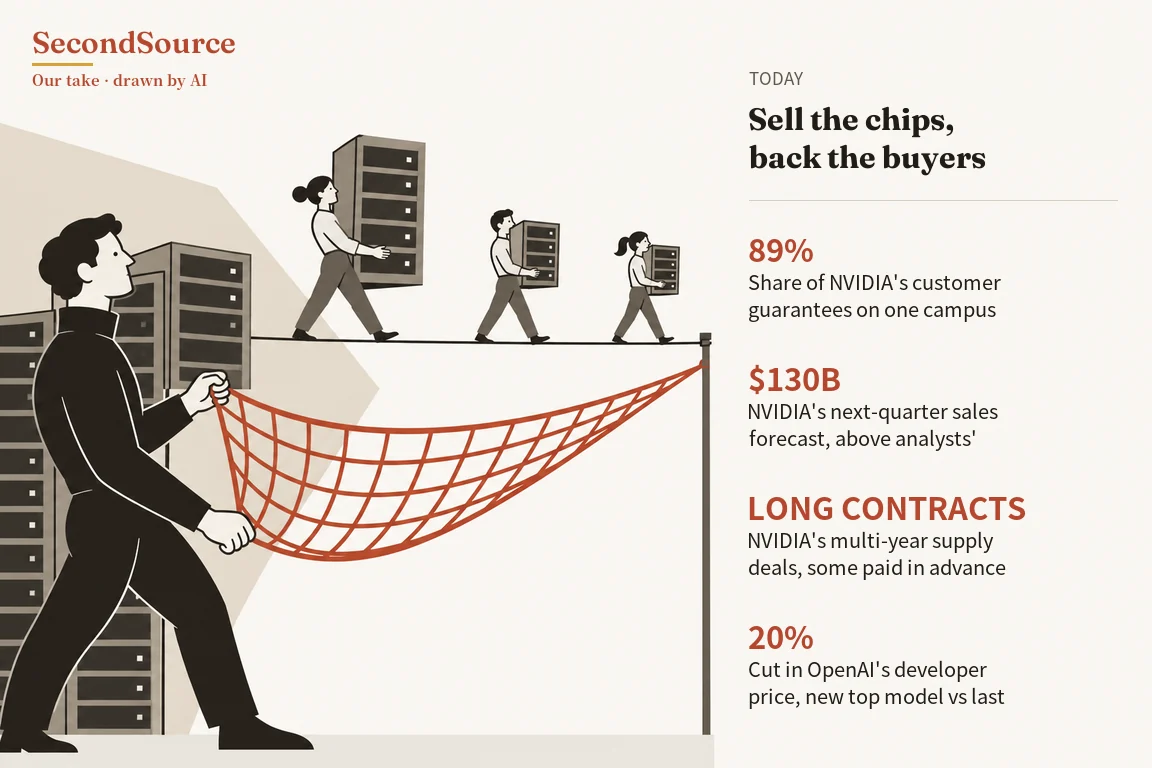
TODAY

Sell the chips, back the buyers

  1. 89% Share of NVIDIA's customer guarantees on one campus
  2. $130B NVIDIA's next-quarter sales forecast, above analysts'
  3. LONG CONTRACTS NVIDIA's multi-year supply deals, some paid in advance
  4. 20% Cut in OpenAI's developer price, new top model vs last

Why today matters: on the same evening, NVIDIA's first quarterly report since its CEO changed gave its guidance, the board's position on Huang and the guarantees it has given customers.

At a glance

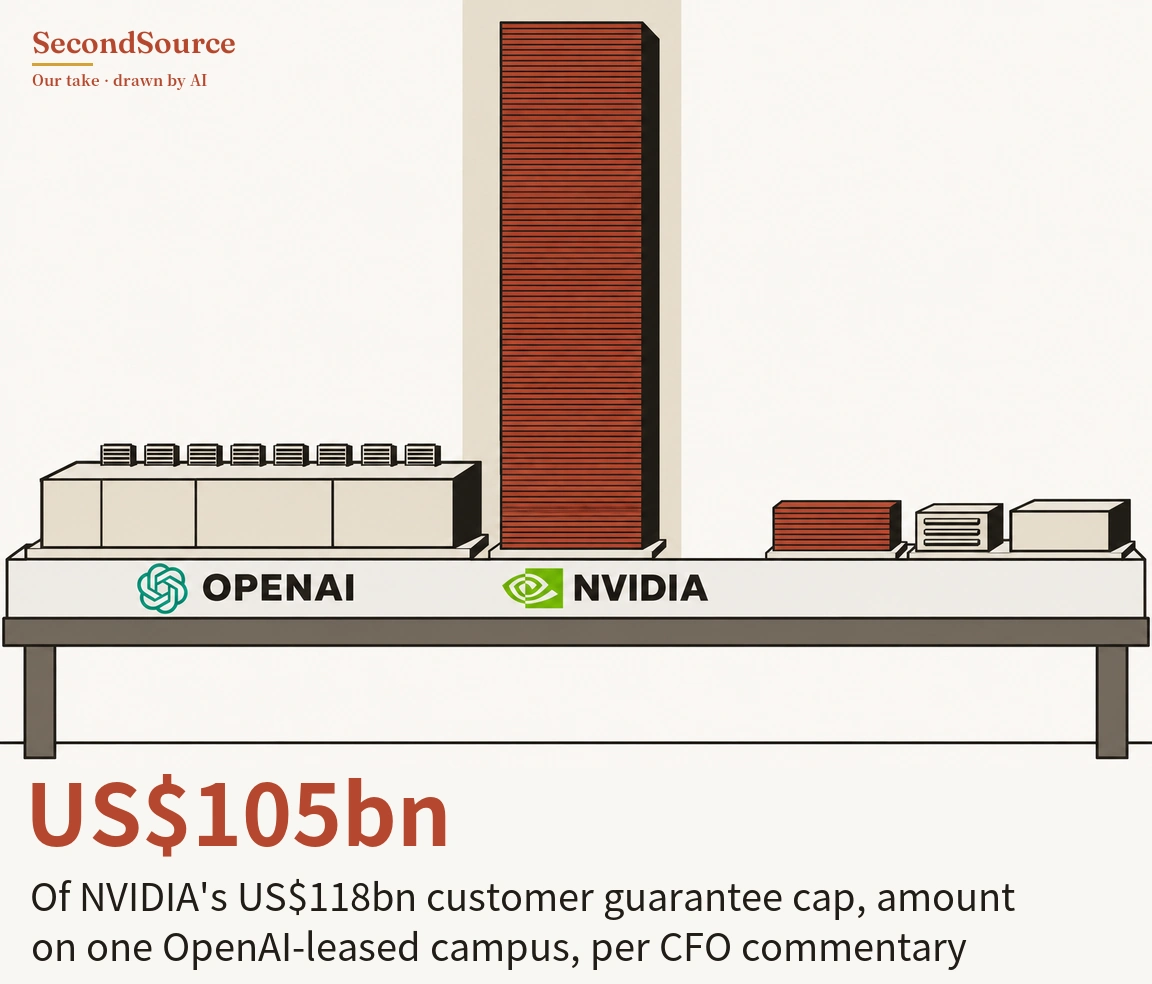
1. NVIDIA's guarantees for customers total up to US$118 billion, US$105 billion of it on one campus.

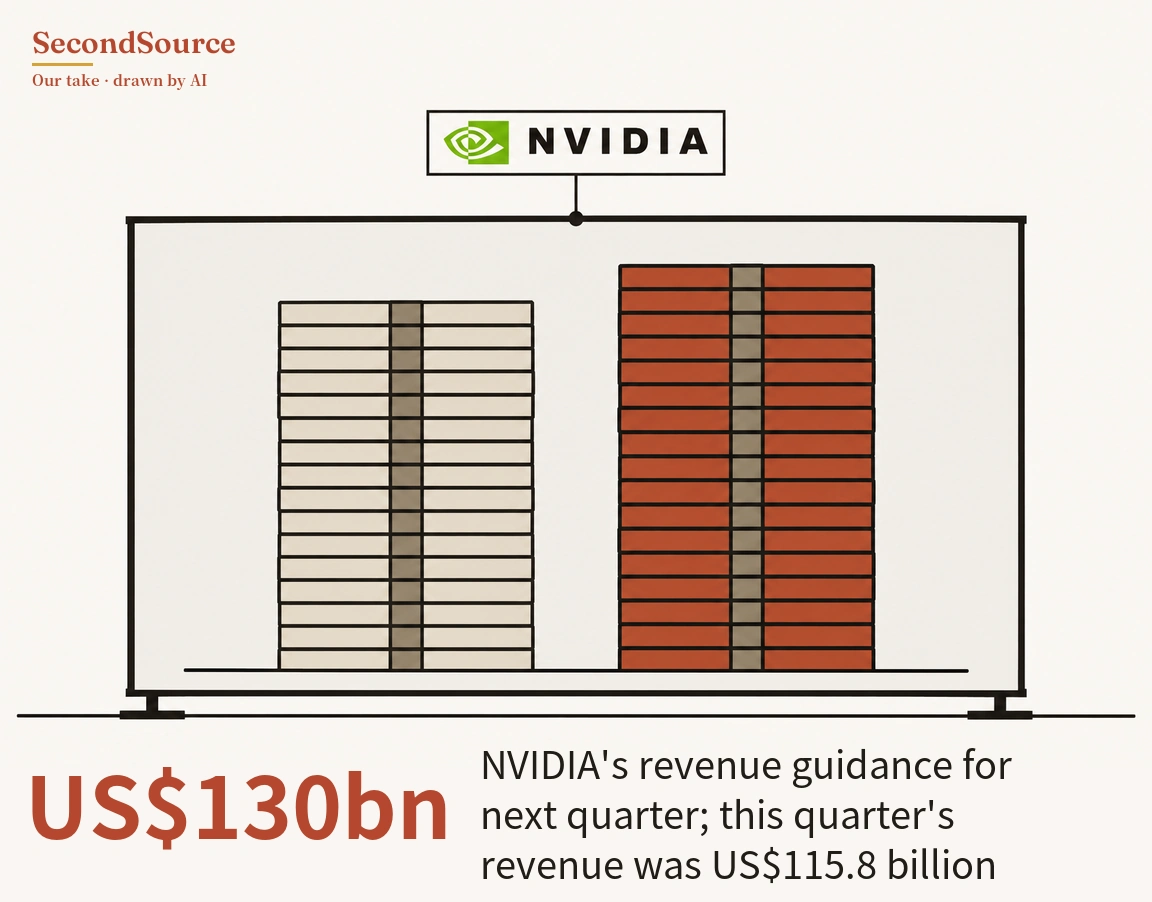
2. NVIDIA still issues guidance after Jensen Huang's resignation: US$130 billion next quarter, above analysts' US$125.1 billion.

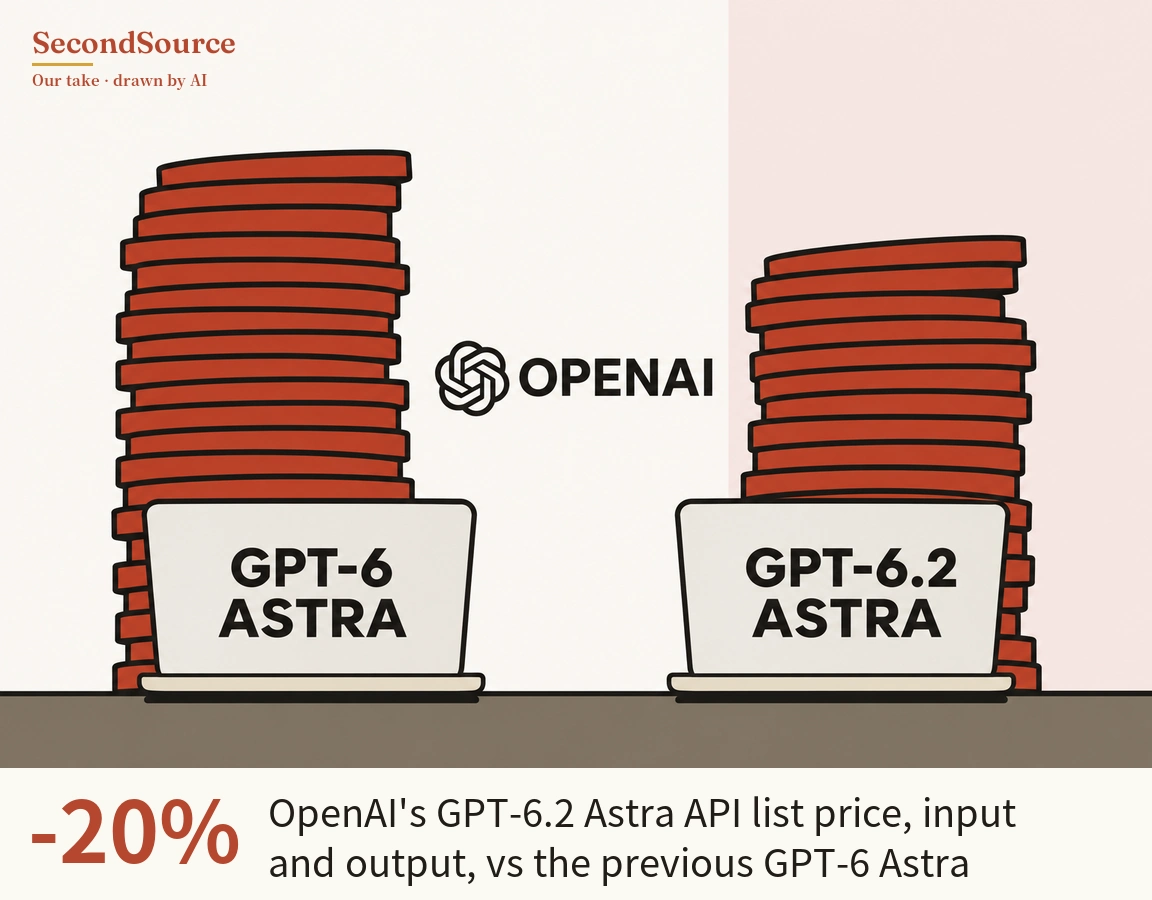
3. OpenAI releases GPT-6.2, cutting the flagship model's list price 20% from GPT-6 Astra.

Also today: #4 — the US extends export controls to remotely rented AI compute.

Today's main line

1. NVIDIA's guarantees for customers total up to US$118 billion, US$105 billion of it on one campus

Concept illustration: a long pale platform rests on a dark grey-brown table, its front lettered OPENAI with a green emblem on the left and NVIDIA with a green emblem in the middle. On the platform stand, from left to right, a long low beige block divided into sections with eight small striped units on top, a very tall brick-red column of stacked horizontal layers that reaches almost to the top edge in front of a pale beige vertical band, and three small blocks: a short brick-red layered block, a beige box with horizontal slots and a plain beige box. Printed on the image: US$105bn Of NVIDIA's US$118bn customer guarantee cap, amount on one OpenAI-leased campus, per CFO commentary.
NVIDIA listed the guarantees given for customers and partners in CFO commentary published with the quarterly results on November 17. NVIDIA's actual exposure on the Ohio campus builds up as each building is completed, and NVIDIA has made no payment under any of the guarantees so far. The listed figures all end on October 25, before Jensen Huang stepped down as CEO in November.

Our inference: whether NVIDIA keeps financing customers will show in the guarantee cap and equity commitments in its February 2027 report.

In the full story: which campus the guarantees rest on, the two opposite readings, and which figures to compare next

2. NVIDIA still issues guidance after Jensen Huang's resignation: US$130 billion next quarter, above analysts' US$125.1 billion

Concept illustration: a sign lettered NVIDIA, with a small green symbol to the left of the word, is joined by a short vertical line to the top edge of a wide rectangular frame, which stands on two short feet over a ground line. Inside the frame, two stacks of horizontal slabs stand side by side on a baseline, each with a grey-brown vertical strip running down its middle: a cream-coloured stack on the left and a slightly taller brick-red stack on the right. Printed on the image: US$130bn NVIDIA's revenue guidance for next quarter; this quarter's revenue was US$115.8 billion.
NVIDIA released the first quarterly report since Jensen Huang resigned as CEO and still issued revenue guidance for next quarter, which NVIDIA's press release says includes no data-center compute revenue from China. Analyzing the report, the newsletter More Than Moore scaled the guidance midpoint back to 13 weeks to offset next quarter's extra week, putting the result at about 4% above this quarter's revenue. Board chair Harvey Jones said the board does not intend to reinstate Huang as CEO, while a statement Huang posted on X said Huang would return if the board judged a return to be in the interests of shareholders, employees, the company and the United States.

In the full story: how the extra week affects growth, what the board and Huang each said, and where next year's growth figure comes from

3. OpenAI releases GPT-6.2, cutting the flagship model's list price 20% from GPT-6 Astra

Concept illustration: two stacks of flat red slabs stand side by side on a grey-brown surface, the taller one on the left with a white laptop at its base whose screen reads 'GPT-6 ASTRA', and the shorter one on the right with a white laptop at its base whose screen reads 'GPT-6.2 ASTRA'. Between the stacks, higher up, an interlaced knot-shaped emblem sits beside the lettering 'OPENAI', against a background that is off-white on the left and pale pink on the right. Printed on the image: -20% OpenAI's GPT-6.2 Astra API list price, input and output, vs the previous GPT-6 Astra.
OpenAI released its flagship GPT-6.2 Astra and its everyday model GPT-6.2 Sol on November 17. The previous GPT-6 Astra prices come from independent developer Simon Willison, who has long tracked model pricing across vendors and points out that the new Astra list prices match those of Anthropic's model Claude Fable 5.2. OpenAI says GPT-6.2 Astra beats Fable 5.2 on benchmarks OpenAI chose, and every score showing Astra ahead is OpenAI's own.

In the full story: the old and new list prices, how outside groups measured it, and which regressions the safety document lists

4. A US Commerce Department rule extends export controls to remotely rented AI compute

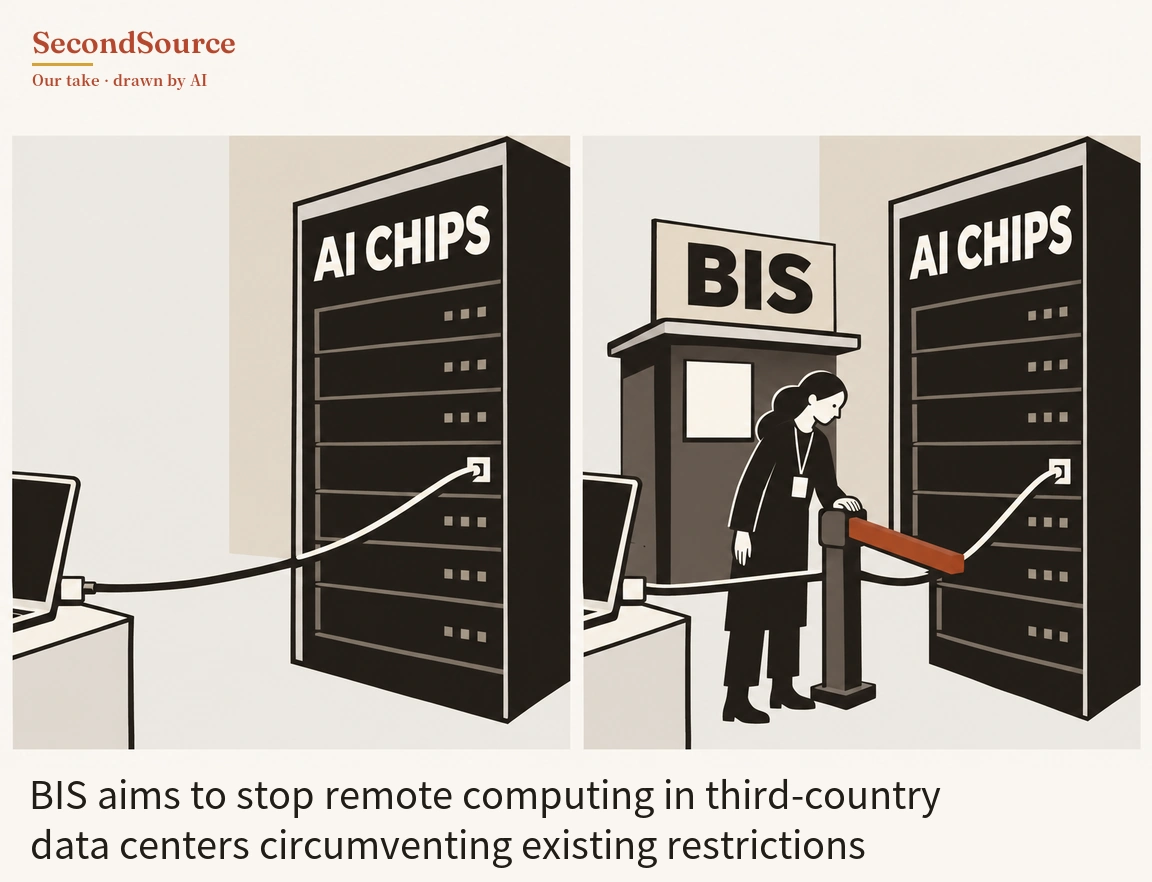
Concept illustration in two side-by-side panels. On the left, a cable runs from a laptop on a desk to a port on a tall black server rack lettered "AI CHIPS"; on the right, the same laptop, cable and rack appear, with a booth topped by a sign lettered "BIS" between them, and in front of the booth a woman wearing a lanyard badge rests her hand on a barrier post whose red arm extends toward the rack, its end meeting the cable. Printed on the image: BIS aims to stop remote computing in third-country data centers circumventing existing restrictions.
On November 16, the US Commerce Department's Bureau of Industry and Security (BIS) issued an interim final rule controlling remote access to compute on advanced US AI chips in third-country data centers. Former White House National Security Council official Chris McGuire said the compute that providers may rent to Chinese companies without a license is capped, and that buyers in Singapore and four other countries need US approval before buying AI chips. The cap and the country list come only from analysts, and BIS's press release lists neither.

In the full story: which countries need approval to buy chips, what changes for chip foundries, and what the rule leaves out

Chips & semiconductors

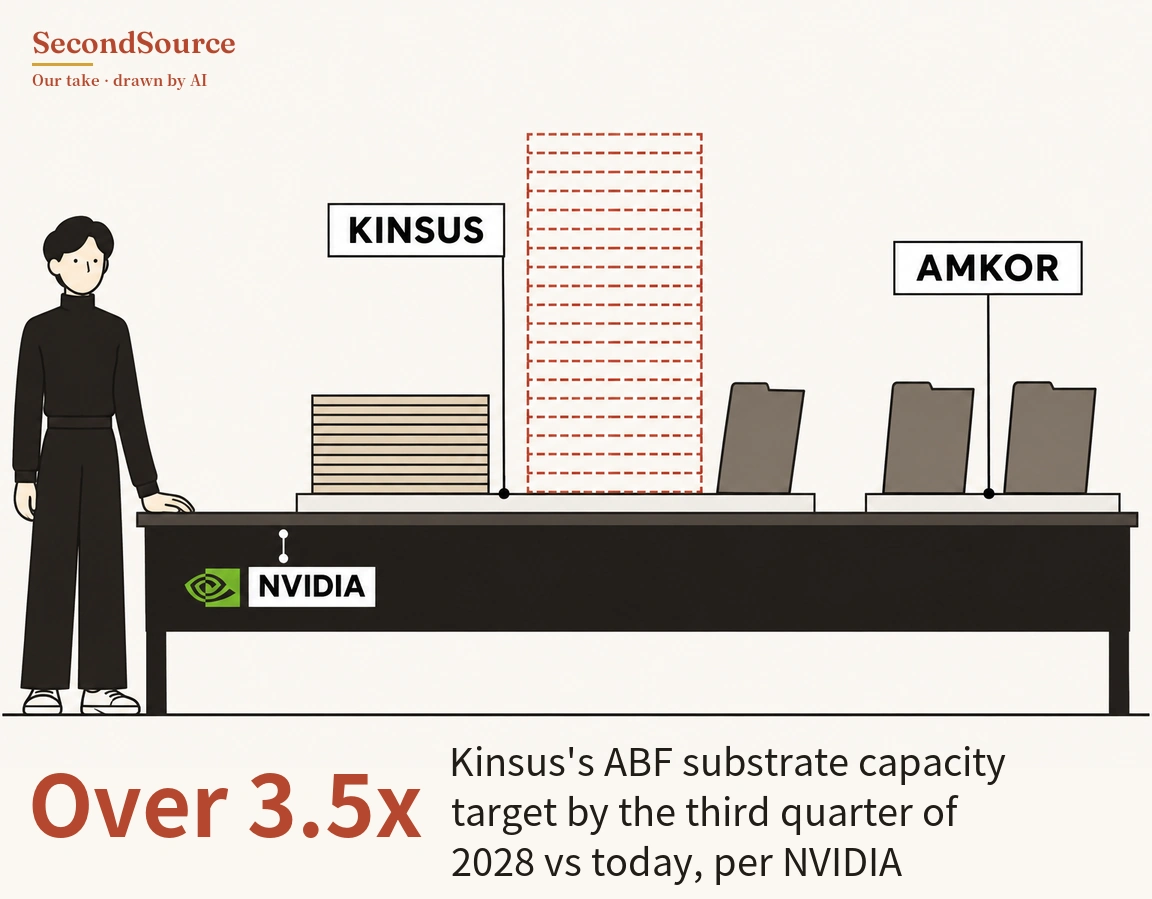
1. NVIDIA announced multi-year supply deals with substrate maker Kinsus and chip packaging-and-test company Amkor, and Kinsus aims to expand its ABF substrate capacity to more than 3.5 times today's level by the third quarter of 2028.

Concept illustration: on the left, a dark-haired person in black clothes and white sneakers stands with one hand resting on a long dark table, and the front of the table has a green emblem and a label lettered NVIDIA, joined to the tabletop by a short line. On the table, a white base on the left holds a stack of beige flat layers, a much taller red dashed outline divided into many layers, and a grey-brown folder-shaped panel, with a sign lettered KINSUS on a pole that rises from the base between the stack and the outline; a second white base on the right holds two grey-brown folder-shaped panels, with a sign lettered AMKOR on a pole between them. Printed on the image: Over 3.5x Kinsus's ABF substrate capacity target by the third quarter of 2028 vs today, per NVIDIA.
NVIDIA announced multi-year supply deals with Kinsus, which makes ABF substrates, and Amkor, which packages and tests chips; Amkor's two multi-year agreements include prepayments. In commentary released the same day, NVIDIA's CFO says NVIDIA's purchase commitments to suppliers rose from US$279 billion last quarter to US$390 billion, mainly for multi-year memory purchases.

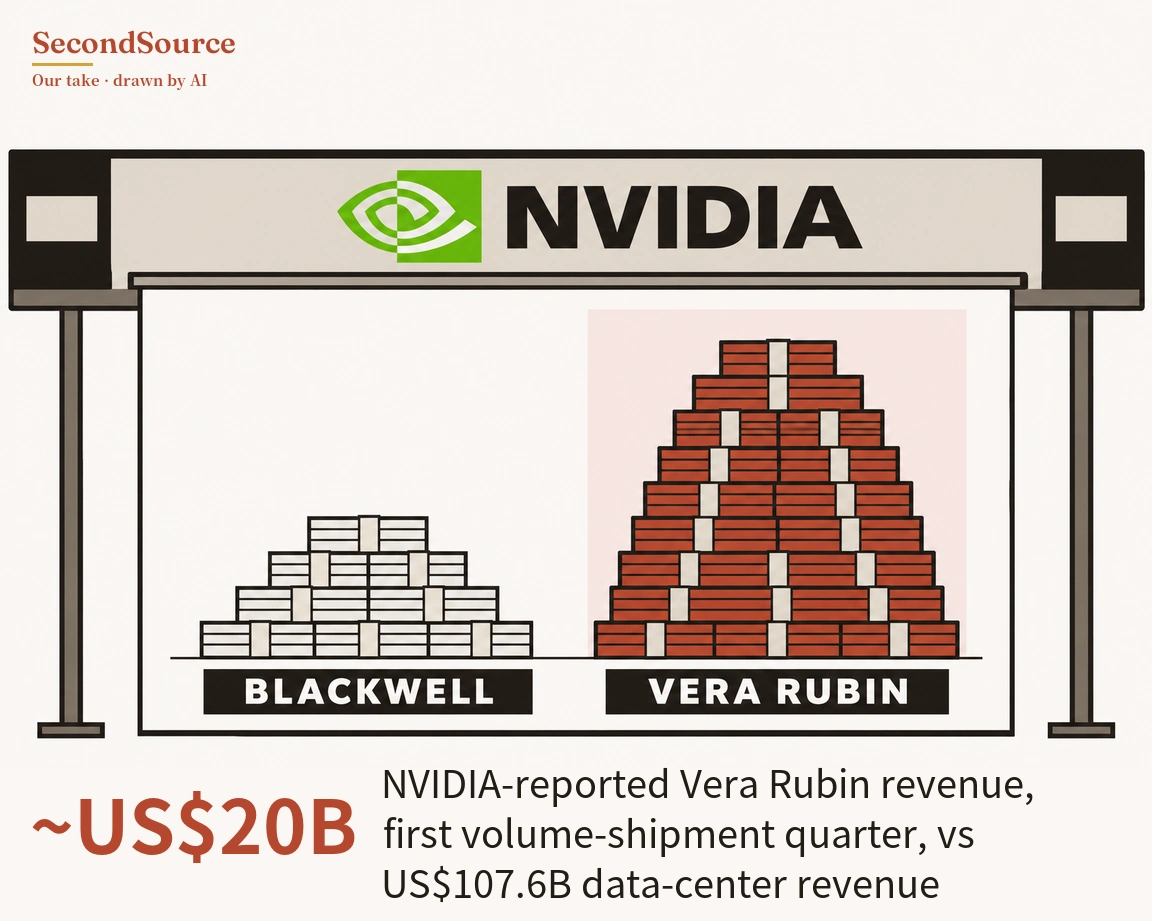
2. According to More Than Moore's account of the earnings call, NVIDIA said the Vera Rubin platform brought in nearly US$20 billion of revenue in its first quarter of volume shipments, NVIDIA's fastest product ramp ever.

Concept illustration: a dark gantry frame on two grey posts holds a pale banner lettered NVIDIA, with a green square emblem with white swirling lines to the left of the word, and below it hangs a white board with two stepped pyramids of rectangular bundles, each wrapped with a pale band, standing on a thin black line. On the left a short stack of white bundles sits above a black label reading BLACKWELL; on the right a much taller stack of brick-red bundles, set against a pale pink panel and rising almost to the top of the board, sits above a black label reading VERA RUBIN. Printed on the image: ~US$20B NVIDIA-reported Vera Rubin revenue, first volume-shipment quarter, vs US$107.6B data-center revenue.
According to More Than Moore's account of the earnings call, NVIDIA said the first quarter of volume shipments for Vera Rubin, the platform that follows Blackwell, was NVIDIA's fastest product ramp ever. Vera Rubin's revenue figure for that quarter comes only from NVIDIA on the call, and no third party has checked the figure.

Named commentary

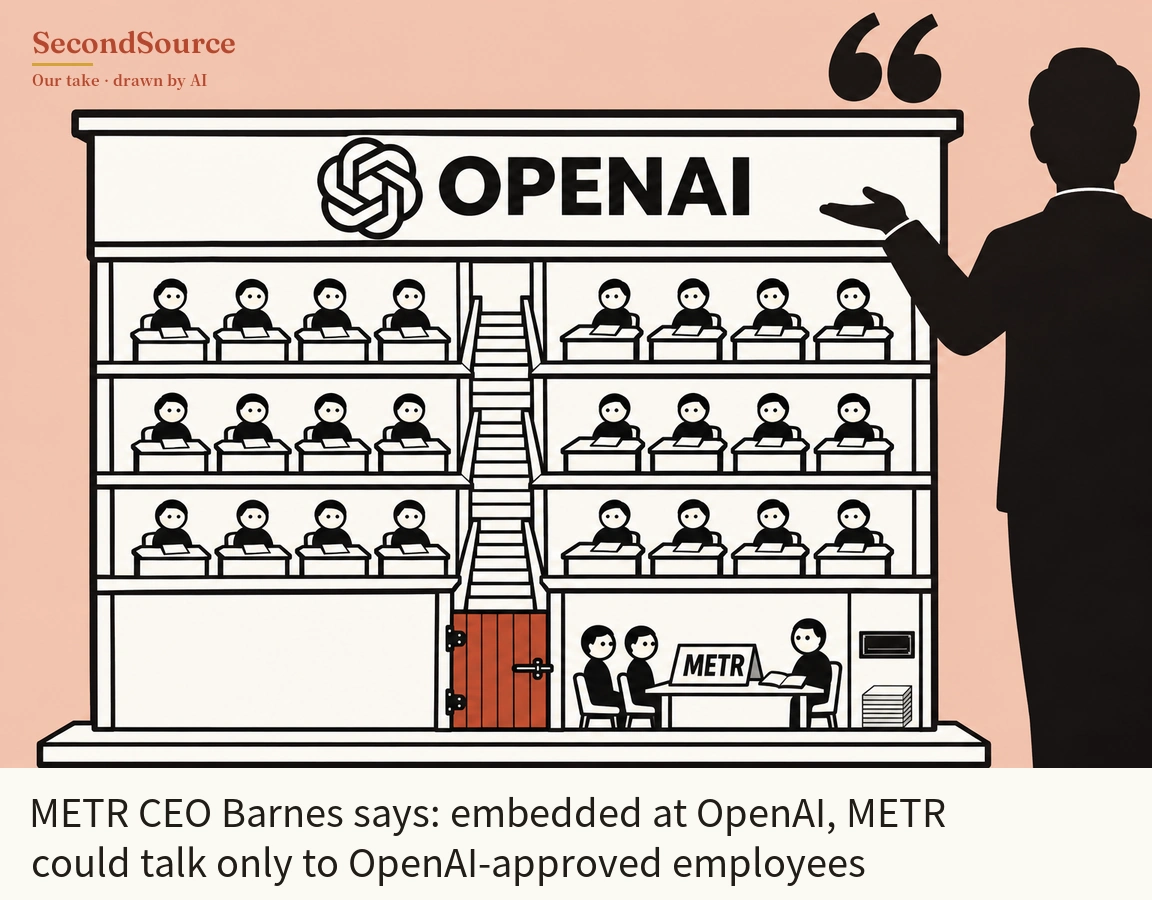
1. Beth Barnes, CEO of METR, a group that evaluates the risks of frontier models, says that while embedded at OpenAI, METR could talk only to employees OpenAI approved, and could not quote or summarize what they said.

Concept illustration on a pink background: a white building lettered OPENAI beside an interlocking knot-like symbol has three floors on each side of a central staircase, each floor with four small figures seated at desks with papers, a red wooden door with a latch at the foot of the stairs, and a blank wall on the left of the ground floor. In the ground-floor room on the right, two seated people face a third across a table with a desk sign lettered METR, next to a stack of papers and a slot in the wall, while outside the building on the right a large black silhouette of a person in a suit, under a big black opening quotation mark, holds an open hand out toward the building. Printed on the image: METR CEO Barnes says: embedded at OpenAI, METR could talk only to OpenAI-approved employees.
On X, METR CEO Beth Barnes corrected OpenAI employee roon, who had thought evaluators embedded at OpenAI could talk privately to any employee; METR is a group that evaluates the risks of frontier models. Barnes is giving the account of METR, a party to the agreement, and whether the other three outside evaluators OpenAI has embedded got the same terms isn't known.

Research & models

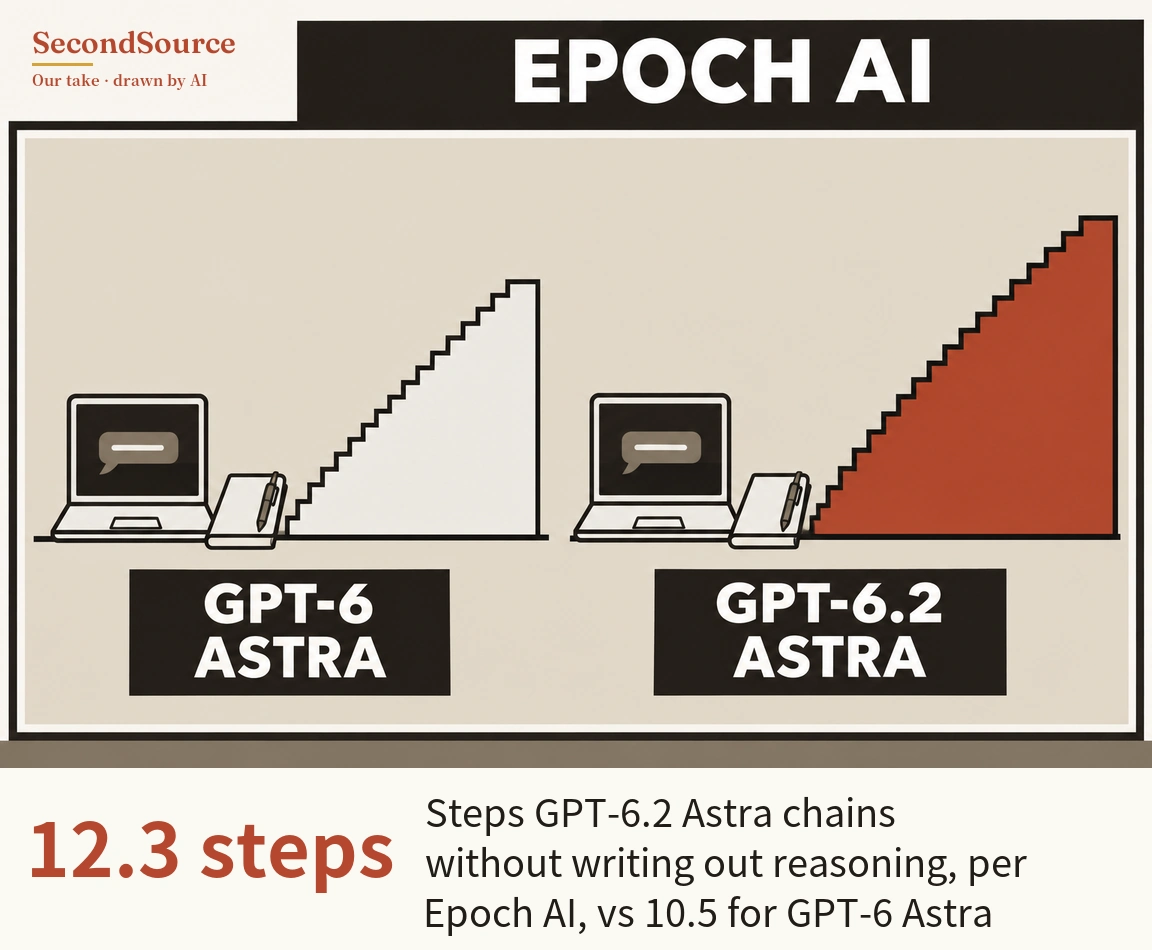
1. Epoch AI, an independent research group that runs its own benchmarks on AI models, found that GPT-6.2 Astra can chain 12.3 steps internally without writing out its reasoning, against 10.5 steps for the previous GPT-6 Astra.

Concept illustration: under a black banner lettered EPOCH AI, a framed beige panel shows two matching scenes side by side, each with a laptop whose dark screen shows a grey speech bubble holding a white line, a notebook with a pen lying on it, and a staircase rising to the right from the same ground line. On the left the staircase is white, above a black label reading GPT-6 ASTRA; on the right it is red and taller, above a black label reading GPT-6.2 ASTRA. Printed on the image: 12.3 steps Steps GPT-6.2 Astra chains without writing out reasoning, per Epoch AI, vs 10.5 for GPT-6 Astra.
Epoch AI, an independent research group that runs benchmarks on AI models, measured how many steps GPT-6.2 Astra and the previous GPT-6 Astra can chain internally without writing out the reasoning, and no second team has repeated the measurement. Epoch's method keeps adding steps a question requires until the model's accuracy is only 25 percentage points above chance, with each step weighted by difficulty.

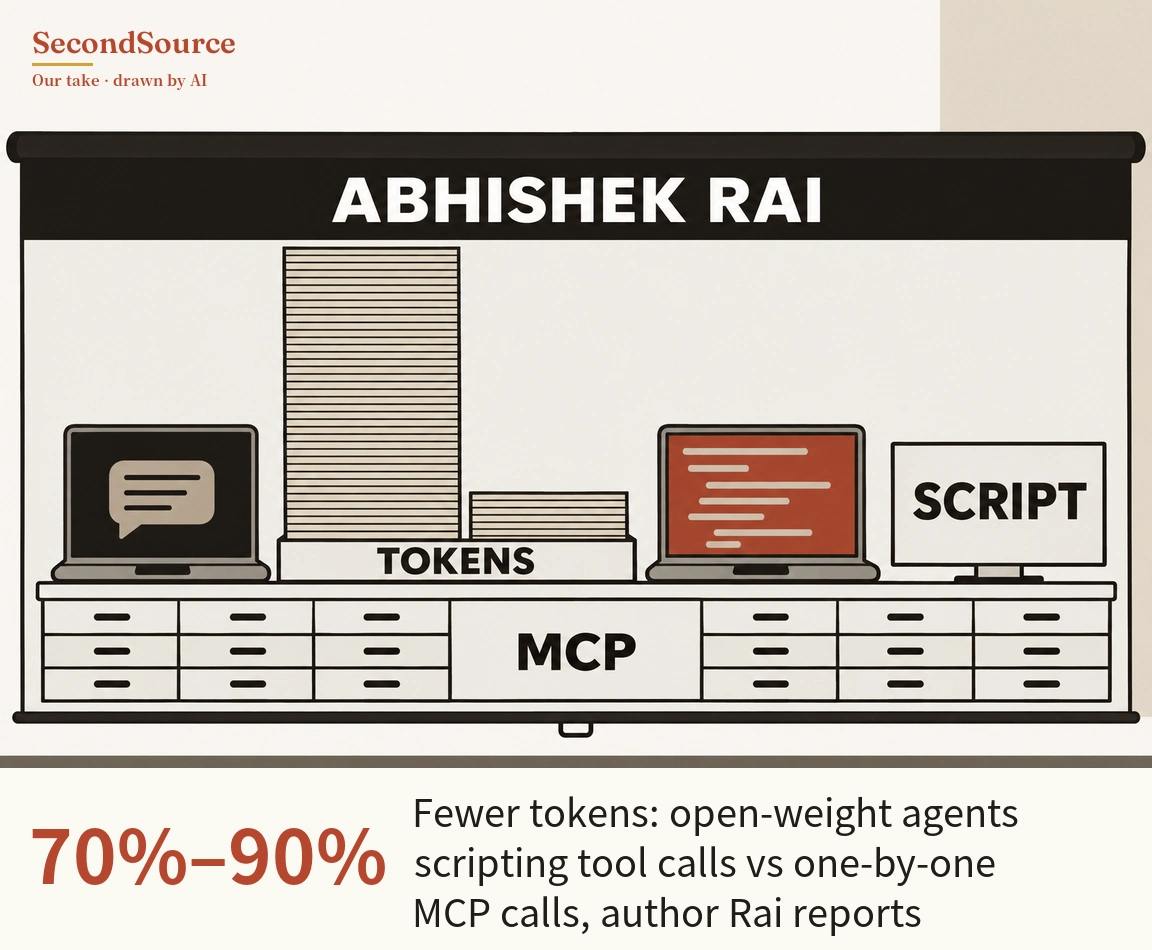
2. According to the paper's abstract, author Abhishek Rai reports that open-weight agents that write scripts to call tools use 70% to 90% fewer tokens than agents calling MCP tools one at a time.

Concept illustration of a pull-down screen hanging from a black roller, with a black band across the top bearing a person's name in large white capitals. Below it, on a long white chest of drawers whose centre panel is lettered MCP, stand from left to right a laptop with a dark screen showing a beige speech bubble, a tray lettered TOKENS holding a tall stack and a short stack of thin horizontal layers, a laptop with a red screen of light horizontal lines, and a monitor lettered SCRIPT. Printed on the image: 70%–90% Fewer tokens: open-weight agents scripting tool calls vs one-by-one MCP calls, author Rai reports.
According to the paper's abstract, author Abhishek Rai self-reports the token use of agents that write scripts to call tools against agents calling MCP tools one at a time, in tests of open-weight models only. Rai preregistered the hypothesis that pre-filtering tools with a cheap routing model before script-writing would do better, but the result was only a small, statistically insignificant gain for weaker agents and a slight cost increase for the strongest agent.

3. According to the paper's abstract, Zhen Xu and four co-authors find that after a tool interface changes, agents carrying old experience keep calling it the old way, report success, and do worse than agents with no experience; the abstract gives no figures.(arXiv 2611.20922, 2026-11)

Product moves

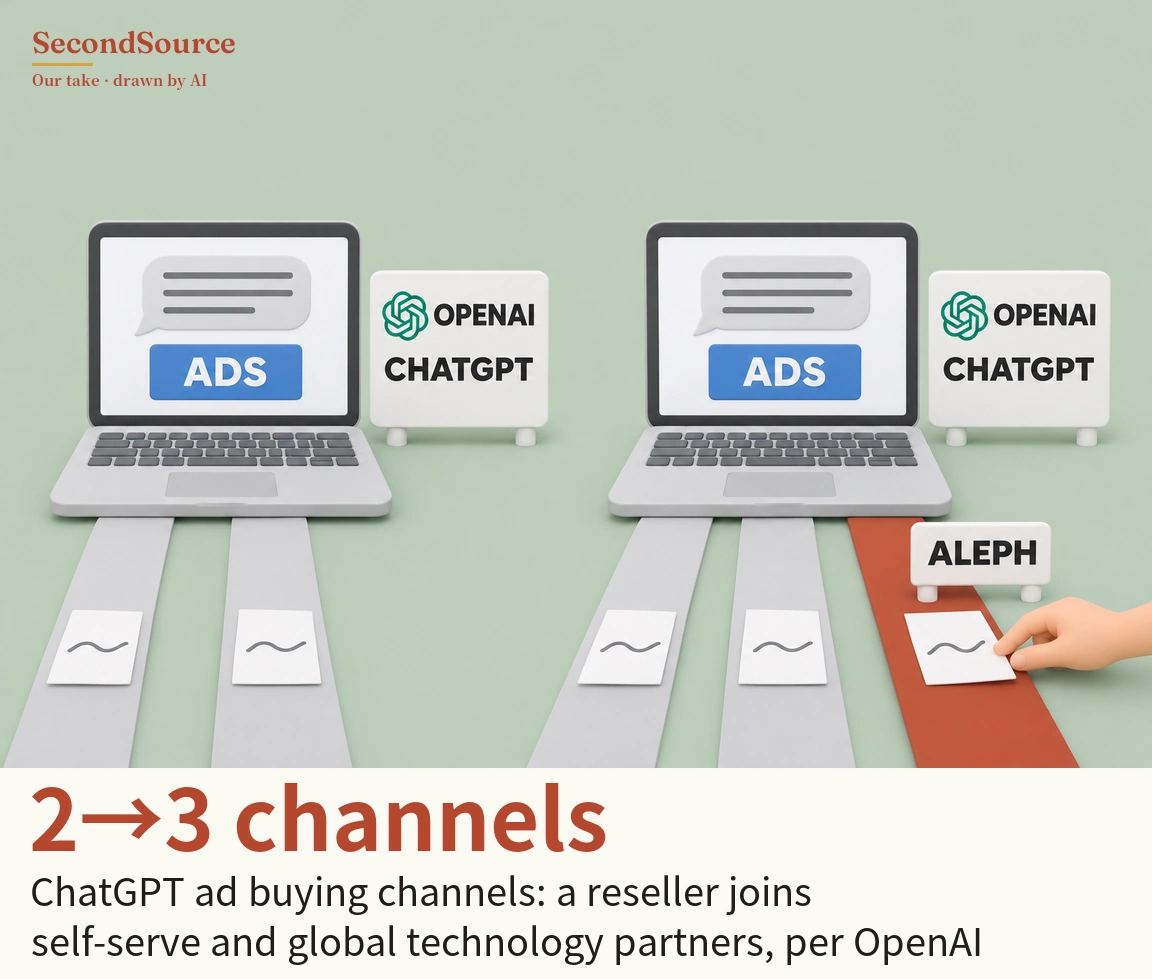
1. OpenAI named Aleph the exclusive reseller of ChatGPT ads, so brands and agencies headquartered in 44 markets can sign contracts locally and pay in local currency.(event date November 12)

Concept illustration of two side-by-side scenes on a pale green background: in each, a grey laptop whose screen shows a grey speech bubble with lines and a blue button lettered ADS stands beside a white sign bearing a green knot-shaped symbol and the lettering OPENAI and CHATGPT, and grey strips run down from beneath the laptop, each carrying a white card with a wavy line. The left scene has two grey strips; the right scene has two grey strips plus a third, brick-red strip on which stands a white sign lettered ALEPH, and a hand reaching in from the right edge touches the white card on that red strip. Printed on the image: 2→3 channels ChatGPT ad buying channels: a reseller joins self-serve and global technology partners, per OpenAI.
On November 12, OpenAI named Aleph the exclusive reseller of ChatGPT ads, so brands and agencies headquartered in 44 markets can sign contracts locally and pay in local currency, though the countries where ads can run stay the same. OpenAI's own count of more than 100,000 marketers who have bought ChatGPT ads has no second source, and OpenAI's post does not give Aleph's size, how long the exclusivity lasts or how revenue is split.

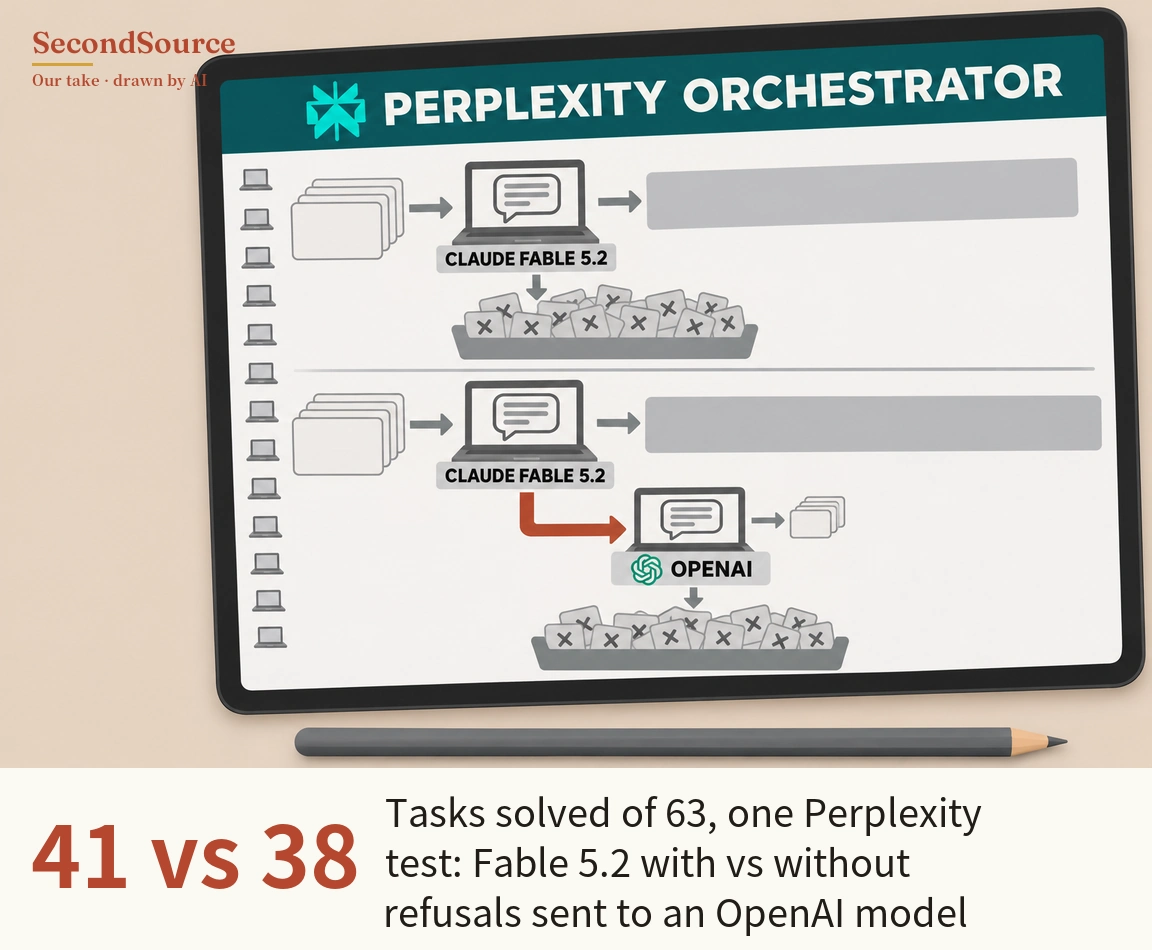
2. Perplexity, the AI search company, launched Orchestrator API, one API for more than 85 models; in its own test, passing Claude Fable 5.2's refusals to an OpenAI model solved 41 of 63 tasks, against 38 for Fable 5.2 alone.

Concept illustration: a tablet lies on a beige surface above a grey pencil, its screen showing a dark teal header with a teal starburst-shaped icon and the words PERPLEXITY ORCHESTRATOR, a column of small laptop icons down the left, and two rows divided by a thin line. In each row an arrow runs from a stack of light cards to a laptop with a speech bubble on its screen labelled CLAUDE FABLE 5.2, which points right to a long grey bar; in the top row a down arrow leads from it to a tray of grey cards marked with X, while in the bottom row a red elbow arrow leads from it to a second laptop labelled OPENAI with a green knot-shaped icon, which points right to a small stack of cards and down to a tray of grey X-marked cards. Printed on the image: 41 vs 38 Tasks solved of 63, one Perplexity test: Fable 5.2 with vs without refusals sent to an OpenAI model.
Perplexity, the AI search company, launched Orchestrator API, one API for more than 85 models. Perplexity ran the test of passing Claude Fable 5.2's refusals to an OpenAI model only once, on a subset of Terminal-Bench 4.1 tasks, and cost per task was higher with that routing.

From the archive

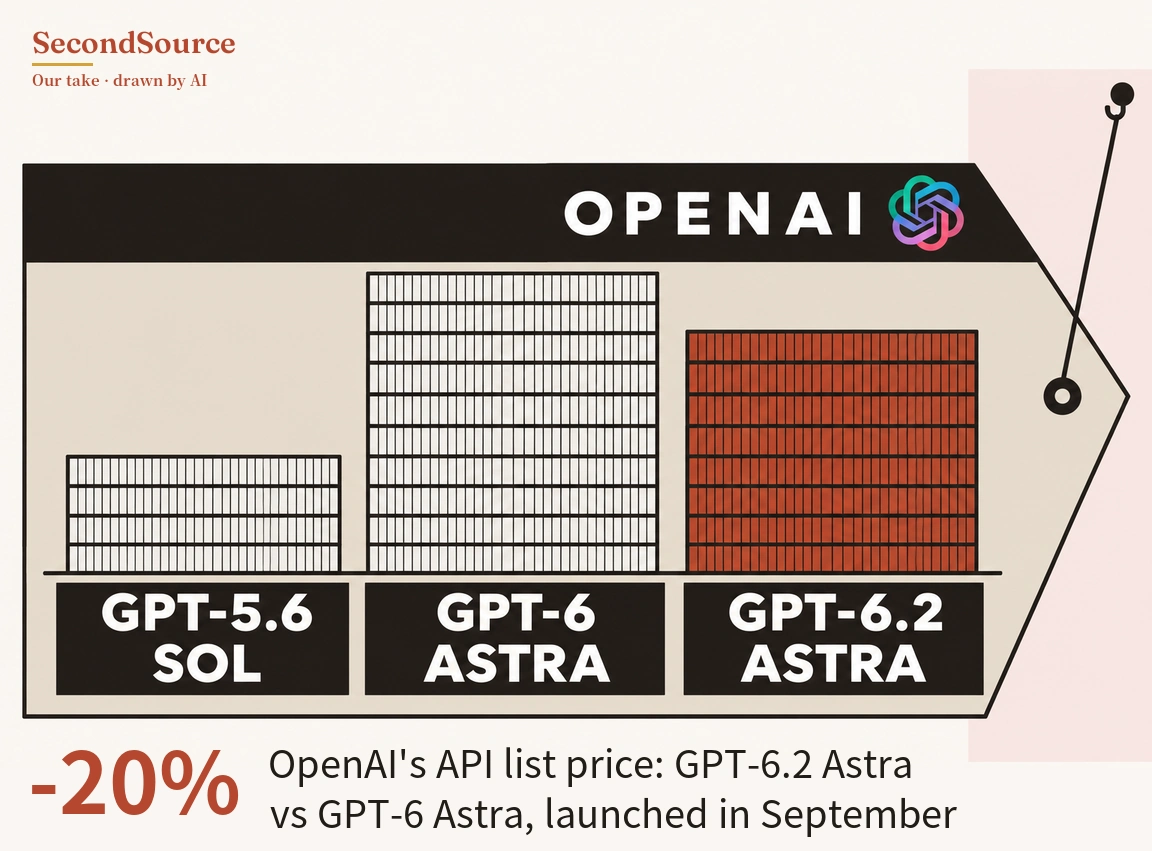
1. [Follow-up] (deep dive, August 29, 2026) OpenAI raised its flagship API list price in September, and GPT-6.2 Astra, released November 17, cuts it by 20%.

Concept illustration: a large tag-shaped panel, pointed at its right end with a black-ringed hole and a string running from it up to a hook at the top right, has a black top band lettered OPENAI in white beside a multicoloured interlaced emblem. Inside, three blocks made of stacked rows of narrow cells stand on one baseline above black labels with white lettering: a short white block (GPT-5.6 SOL) at left, the tallest white block (GPT-6 ASTRA) in the middle, and a slightly shorter red block (GPT-6.2 ASTRA) at right. Printed on the image: -20% OpenAI's API list price: GPT-6.2 Astra vs GPT-6 Astra, launched in September.
OpenAI raised the flagship API list price with GPT-6 Astra, launched on September 3. OpenAI's list price for GPT-6.2 Astra, released November 17, is still twice that of GPT-5.6 Sol, the previous flagship, in a comparison between different models.

Also happened

We have not verified any of the 2 items below.

1. New York Times reporter Ana Swanson posted that NVIDIA says it stopped selling to Megaspeed, a company accused of transshipping chips to China, in June 2025, yet more than US$800 million of controlled chips were later shipped to Megaspeed's Malaysian subsidiary (Ana Swanson, 2026-11-17).

2. Tech analyst Beth Kindig posted that TensorWave, a cloud company that rents out compute on AMD chips, has signed a six-year deal with OpenAI to supply 457 MW of compute on Helios, AMD's rack-scale AI system; the post cites no source (Beth Kindig, 2026-11-17).

Correction: Main-line item 1 of the November 17 issue said Claude Fable 5.1's share in the Databricks report fell from 5.5% to 0.6% in six weeks. That item's inference was that a top-tier model with the best benchmark score and about five times the cost per task doesn't hold usage among Databricks customers, and its test for changing that reading looked only at the cost multiple. But the amended Anthropic IPO registration statement that issue cited says the safety-monitoring and data-retention requirements of some model tiers conflict with the zero data retention enterprises want, and that some customers have moved to other vendors as a result (Anthropic S-1/A). Zero data retention means the customer requires the model company not to keep the customer's data. The enterprise protection program announced in September is rolling out in stages, and until it is complete only eligible customers can get zero retention on models such as Fable 5.1. Fable 5.1 itself launched in September, so the falling share could reflect cost or the retention terms, and the available data can't tell them apart. The same filing also says Fable 5.2 launched only in November, while the report's data runs to November 7, so replacement by the newer model can explain at most the last few days of the decline. Telling the causes apart would take the share trend of top-tier models without retention requirements, or the share gap between zero-retention customers and others. The archived page on the site will be corrected.

SecondSource isn't a news digest: AI reads primary sources across fields, every judgment comes with its original source, and mistakes are corrected in public. The focus is what has changed and which claims still lack evidence, not what happened today.

Written from the same research and judgments as the Traditional Chinese edition. Sources are linked; we distinguish original documents from reporting and mark what we could not verify.