Today · event date October 12
Two outside tests split on Muse Wonder; versions may differ
On Muse Wonder's launch day, two outside tests of Meta's new model gave readings that point different ways
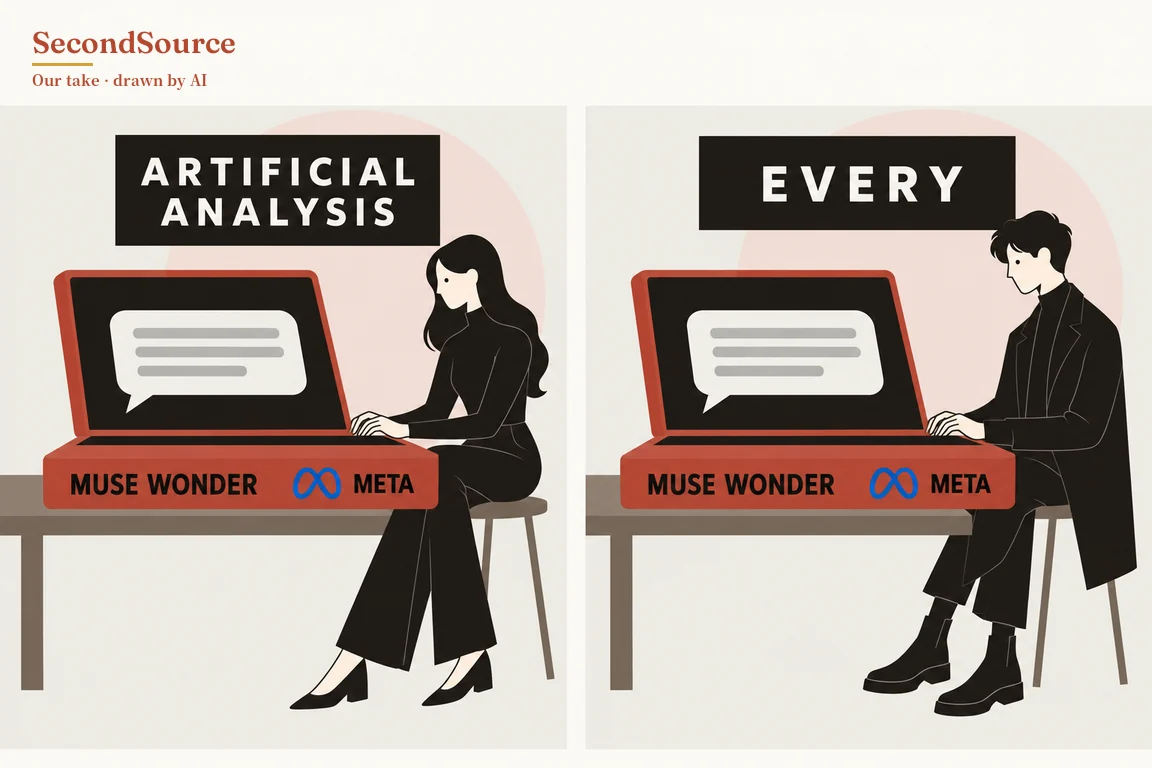
Why this matters to you: Before switching models, run each on a set of your own real engineering tasks; a top-three overall ranking doesn't mean it's strong on yours.
Meta announced the Muse Wonder family on October 12, in a fast version, Wonder, and a full version, Wonder Full. CEO Mark Zuckerberg called it "our new family of frontier models with state of the art performance for personal and professional agentic work" (Mark Zuckerberg, 2026-10-12).
The same day, the independent evaluator Artificial Analysis published the first outside measurements. Wonder Full ranked top three on 6 of the 10 evaluations in its overall intelligence index, and the evaluator itself noted that the leads are small (Artificial Analysis, 2026-10-12). The post we read doesn't list every model it was compared with. One evaluation pits answers on professional work tasks against each other in pairs. There Wonder Full scored 1857 and Anthropic's Claude Opus 5.5 scored 1866. That score is a ranking converted from head-to-head wins and losses. The evaluator notes that the two models' error ranges overlap.
Dan Shipper, CEO of the tech publication Every, ran his own "senior engineer benchmark." The task is rewriting a codebase that an AI had cobbled together. Muse Wonder scored 52% and OpenAI's GPT-Sol 6.1 scored 71% (Dan Shipper, 2026-10-12).
Our reading: the overall index measures performance across many tasks, while Shipper measures one kind of large rewrite. Artificial Analysis tested the full version. Shipper doesn't say which version he tested. Until he does, his 52% shouldn't be weighed against the index ranking.
Not proven yet: we haven't seen Every's task set or how it scores them How we checked →
our analysis is produced with help from Anthropic's models, and Claude Opus 5.5 is one of the models compared in this item.
Source and checks
This item ran in the brief of Oct 13, 2026, alongside 13 other items. How we checked it, the quote checks and what was still missing that day are on that issue's How we checked page.
Cite this item
SecondSource (2026). "Two outside tests split on Muse Wonder; versions may differ." https://secondsource.io/en/news/2026-10-13-2/. Accessed access date.