Today · event date October 15
Anthropic lets only low-risk code skip human review
Anthropic's Claude Code team publishes its review rules: only low-risk changes skip a human reviewer, and an agent's approval never counts as a person's
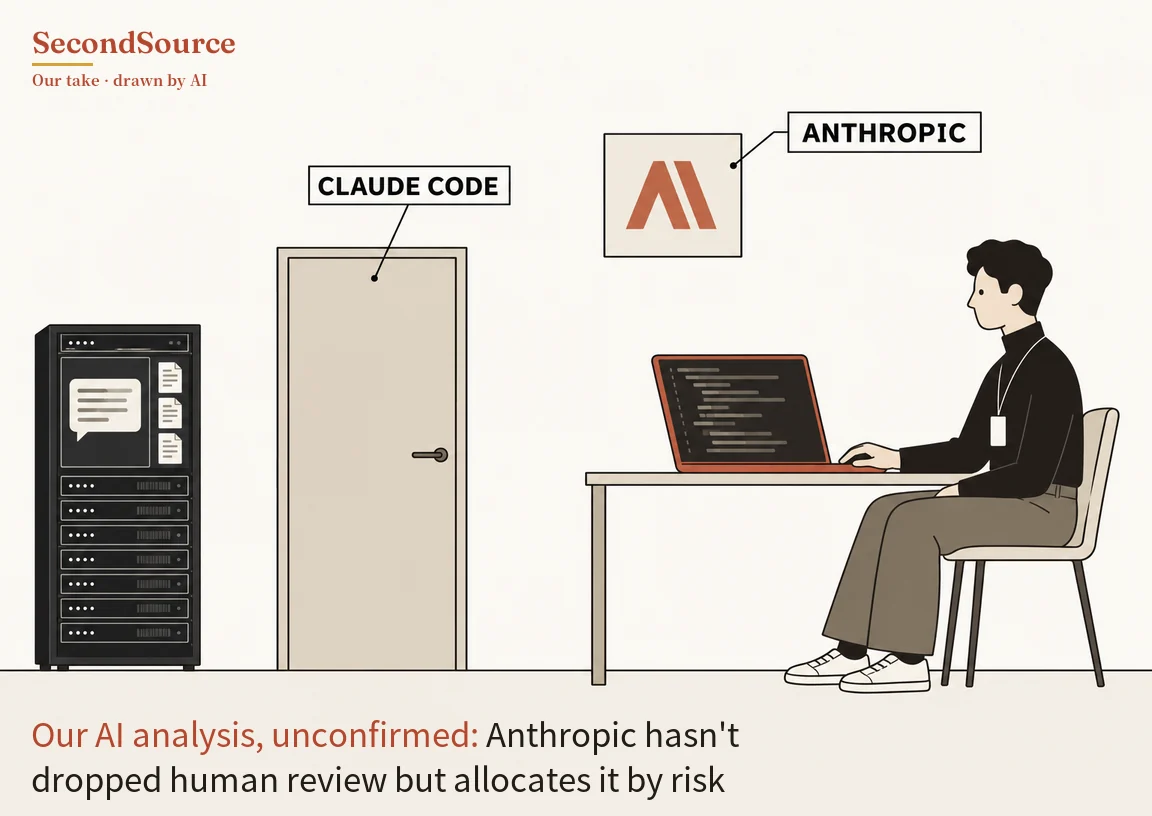
Why it matters: Our read: Anthropic now allocates human review by risk, and a person still approves every change that isn't low risk.
The Claude Code team described its review process on October 15 on Anthropic's developer blog (Claude Code team, 2026-10-15). Changes landing daily in Anthropic's main codebase rose from about 2,500 in May to more than 30,000 in September. That figure covers the whole main codebase, and the October 14 issue reported it. What is new today is how review changed. Documentation, copy and new code behind feature flags count as low risk. Those changes skip human review once they pass machine review and security checks. Everything else still needs a person's approval. The post also says AI approval can't stand in for a person: "An agent's approval never counts as a person's, either".
The results figures that follow cover only the Claude Code product's own codebase, a different population from the main codebase above. The post says: "merged pull requests to Claude Code's codebase more than doubled while the share that had to be reverted fell by more than 40 percent". The period is June to September.
The next day Thorsten Ball, an engineer at Amp, argued for pushing changes straight to the main branch, with several models each reviewing them a few times (Thorsten Ball, 2026-10-16). Amp is an AI coding product where engineers hand off code-writing and test runs to AI agents. That evening Ball added: "I never said 'don't review'." He framed that around a small team of high-trust engineers (Thorsten Ball, 2026-10-16).
Not proven yet: the more-than-40% fall in the share of changes that had to be reverted is self-reported, and its cause isn't isolated How we checked →
Judgment update: One of our working reads, not yet settled, says "mandatory human review is loosening." Anthropic's document supports only half of that; the post says "We didn't remove review." We propose rewording it as: "Engineering organizations have to decide the risk rule that allocates human review." No editor other than the author has reviewed that rewording yet. Confidence stays where it is.
Source and checks
This item ran in the brief of Oct 17, 2026, alongside 15 other items. How we checked it, the quote checks and what was still missing that day are on that issue's How we checked page.
Cite this item
SecondSource (2026). "Anthropic lets only low-risk code skip human review." https://secondsource.io/en/news/2026-10-17-1/. Accessed access date.