Today
Broadcom's 2nd rack-lease backstop covers up to 72.5% rent
Broadcom's second AI rack-lease backstop covers up to 72.5% of unpaid rent, capped at about US$43 billion, down from 85% in the first
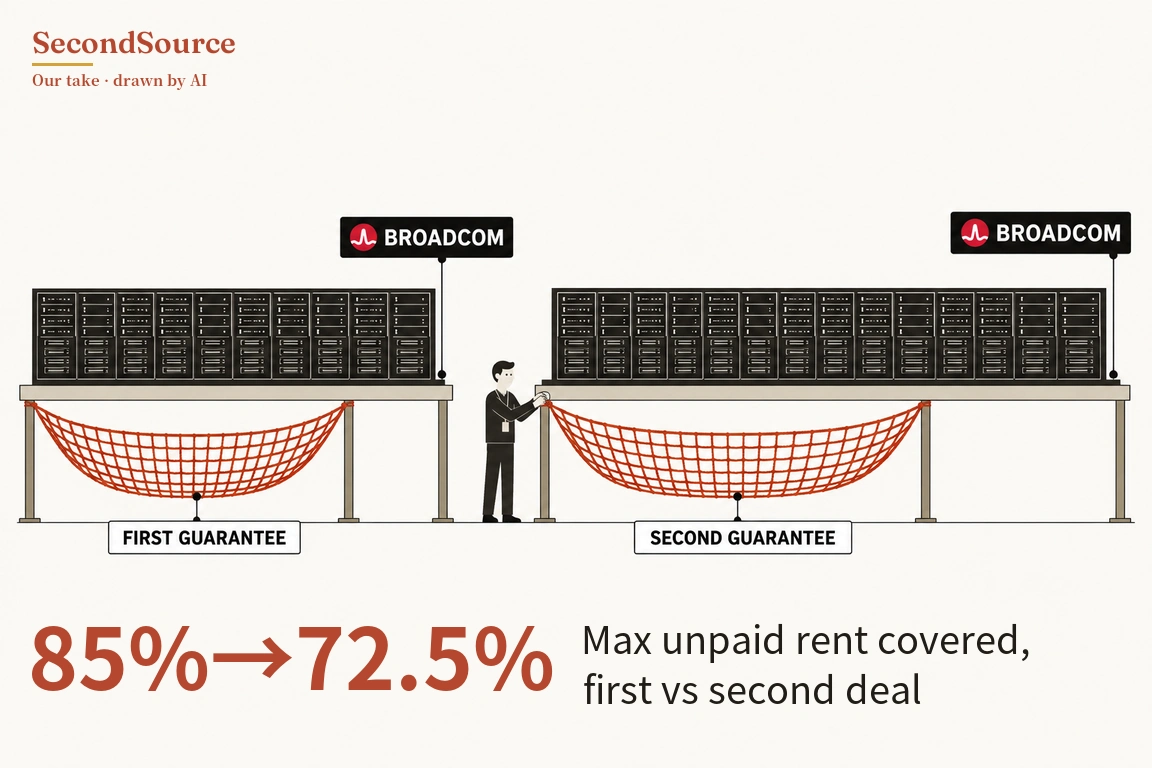
Why it matters: Our inference: if the AI lab renting the racks stops paying, the lenders who financed the racks carry whatever Broadcom's 72.5% does not cover, and their rates and terms on the next rack deal will reflect that gap.
Broadcom filed an 8-K with the US Securities and Exchange Commission on October 27 disclosing a second AI rack-lease backstop.
In these deals, a company formed for the transaction borrows from financial institutions to buy the racks, then leases them to the customer. If the customer stops paying and selling the racks doesn't recover enough, Broadcom pays the difference. The 8-K sets Broadcom's liability at the difference between "72.5% of the outstanding amounts owed on the lease" and "the value of the AI racks received upon the sale of the assets at that time." Once all the racks are deployed, Broadcom's maximum potential liability is approximately US$43 billion, undiscounted; it rises as racks are delivered and falls as the customer pays rent (Broadcom 8-K, 2026-10-27). Broadcom would pay the full US$43 billion only if the customer stopped paying entirely and the racks sold for nothing.
The first backstop covered up to 85% of unpaid rent, a higher ratio than the second. SecondSource's September 11 issue broke down the first: up to 85% of unpaid rent, capped at about US$29 billion, against initial financing of US$35 billion (Broadcom 10-Q, 2026-09-10). According to the financial site 24/7 Wall St.'s summary of an October 26 press release, the second deal's total financing is US$63 billion (24/7 Wall St., 2026-10-26). Dividing each backstop ceiling by its financing gives about 83% for the first deal and about 68% for the second (our calculation). The US$63 billion is not in the 8-K, and whether the two figures describe the same racks can't yet be told.
According to the same summary, Bank of America, Citi and Morgan Stanley provide the senior debt, and the private-equity firm Blackstone alone provides the junior debt; the customer is Anthropic, with deliveries starting in 2027. Senior lenders are repaid first. Under that order, the 27.5% of unpaid rent Broadcom doesn't cover hits the junior lender first. In the first deal, the uncovered share was 15%. Both 27.5% and 15% are 100% minus the payout ratio (our calculation). Whether the senior banks lose money depends on how much each tier lent. The 8-K gives neither the tier amounts nor whether any money the customer put in absorbs losses first.
The 8-K does not give enough to tell whether the second deal protects less money. It omits the lease term, the racks' assumed residual value and the amount each lender tier put in. If the second deal's racks are newer or its lease is shorter, a lower ratio could protect the same amount. Broadcom's September quarterly report also says the customer may issue Broadcom convertible promissory notes of up to US$42 billion, in effect borrowing from Broadcom to pay rent. The October 8-K doesn't say whether that facility applies to the second deal.
Not proven yet: the customer, the US$63 billion and who lends what come only from 24/7 Wall St.'s summary How we checked →
Next to watch: whether Broadcom's December annual report gives the second deal's rack volume, lease term and tier amounts, and whether the US$42 billion note facility applies to it. Two findings in the annual report would overturn our inference. One is another funder absorbing losses before the lenders. The other is Broadcom's backstop plus the notes already covering all the borrowing.
Source and checks
This item ran in the brief of Oct 31, 2026, alongside 7 other items. How we checked it, the quote checks and what was still missing that day are on that issue's How we checked page.
Cite this item
SecondSource (2026). "Broadcom's 2nd rack-lease backstop covers up to 72.5% rent." https://secondsource.io/en/news/2026-10-31-1/. Accessed access date.