Today
FT reports OpenAI cut its raise target to US$20B
OpenAI's target reportedly falls from US$30 billion to US$20 billion, and the US$1.25 trillion valuation was in print eight days before that report
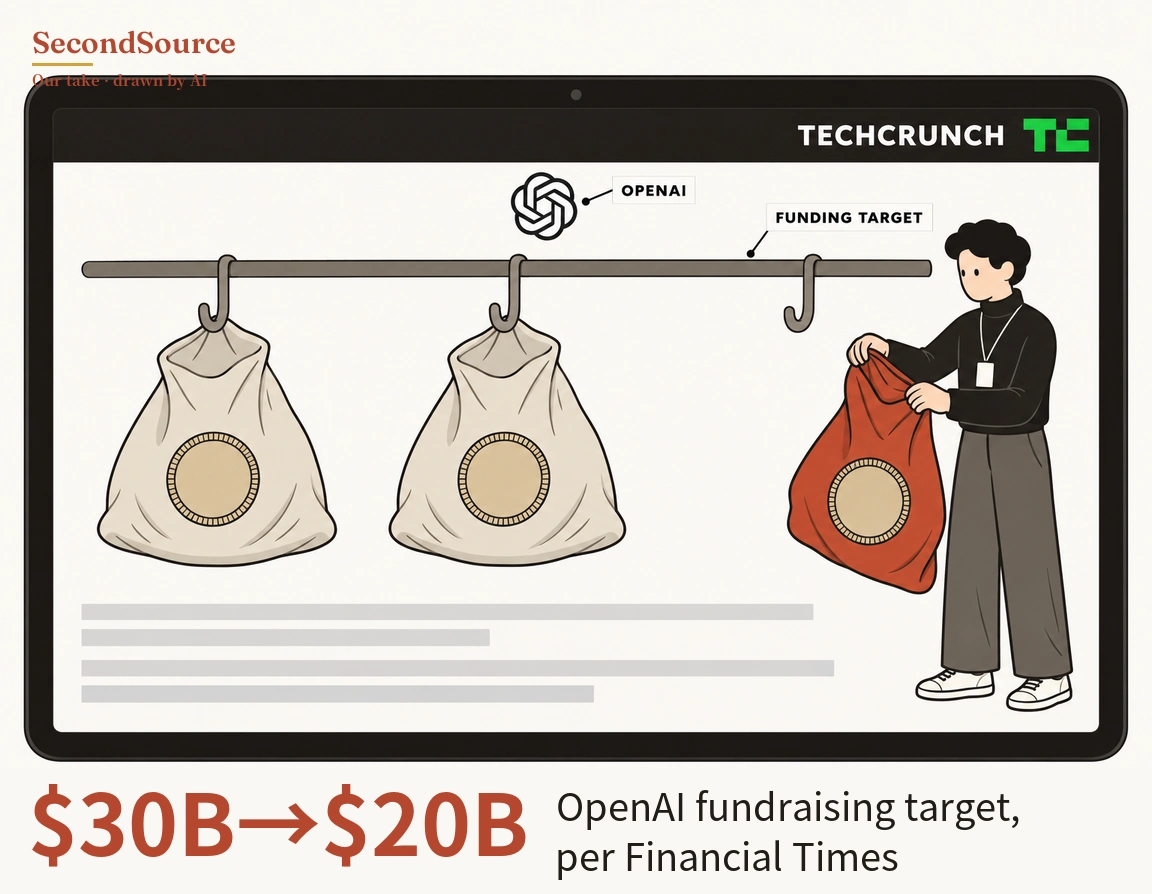
Why it matters: Our inference: this week's change is in OpenAI's fundraising target. OpenAI's US$1.25 trillion valuation is so far only an asking price, not a transaction price. Late-stage funds deciding whether to use it as the benchmark for the next round have to wait for the first close's price.
TechCrunch's October 31 roundup of press reports says OpenAI has cut this round's fundraising target from US$30 billion to US$20 billion.
OpenAI's US$1.25 trillion valuation was already in print eight days before the cut was reported. The Kobeissi Letter, a markets commentary account on X, credits the Financial Times and writes that OpenAI cut both its fundraising target and its valuation during this week's tech-stock selloff (Kobeissi Letter, 2026-10-31). That wording reads as if the selloff forced the valuation down, and the timeline doesn't fit. Beth Kindig, an X writer on chips and tech stocks, relayed Bloomberg's report that talks in late September were still early, with US$30 billion or more sought at a US$1.4 trillion valuation (Kindig, 2026-09-30). CNBC wrote on October 22 of up to US$30 billion at US$1.25 trillion before new money (CNBC, 2026-10-22). What was new in the week of October 30 is the target's explicit cut to US$20 billion.
Investors have committed only about US$11 billion. That is 55% of the new US$20 billion target and about 37% of the original US$30 billion (our calculation). The US$20 billion comes only from the Financial Times, and the US$11 billion only from The Wall Street Journal (TechCrunch, 2026-10-31). The same roundup says the first close is expected to come in below US$20 billion and describes big investors' response as tepid.
According to TechCrunch's account of the Financial Times report, opening the round to wealthy individuals later could bring the total up to US$20 billion. Jessica Lessin, founder of The Information, listed two points on X. First, big investors are increasingly worried that AI revenue won't catch up with capital spending. Second, the round is about "the valuation mark more than the amount", and OpenAI doesn't need that much capital right now. Both are Lessin's personal reading, with no figures attached (Lessin, 2026-10-31). Investors being unwilling to pay and OpenAI not needing that much can both be true. Lessin gives no figures for OpenAI's cash or funding needs, so the two can't yet be separated.
Not proven yet: the first close's price and terms haven't been made public How we checked →
Next to watch: the amount and price of OpenAI's first close in the coming weeks. Another comparison is Anthropic's IPO pricing. Rui Ma wrote on X that Anthropic is expected to list next month, which would be the public market's price for this kind of company (Rui Ma, 2026-10-31). If the close prices below US$1.25 trillion, or comes with terms such as preference rights, US$1.25 trillion can't be read as a transaction price.
Answer check: On August 16, SecondSource asked whether Anthropic's first operating profit, in the second quarter, would hold and whether the third quarter would swing back to a loss. Anthropic's S-1 listing filing puts second-quarter operating income at about US$974 million and doesn't disclose the third-quarter result, so this can't be judged. Whether Anthropic's gross margin lasts, or exists only during a compute shortage, waits on third-quarter figures. Card →
Answer check: On August 16, SecondSource's reading was that any single TSMC advanced-node price rise would stay under 20%; by October 31 none of the press releases from TrendForce, the agreed source, gave a quote change for N3, N2 or A16, so this can't be judged. The upper bound on foundry price rises therefore remains untested by that source. Card →
Answer check: On August 29, SecondSource's reading was that by October 31 no lab would both raise a flagship API list price and tighten consumer allowances. The call missed. OpenAI's new flagship GPT-6 Astra lists US$10 input and US$50 output per million tokens against its predecessor's US$4 and US$20, and OpenAI lowered Pro allowances for new subscribers on September 29, then withdrew that on October 29. OpenAI also cut several prices in the same period. The call missed because the agreed condition was triggered, and that alone doesn't show labs have begun keeping compute for their own use and selling less of it. Card →
Source and checks
This item ran in the brief of Nov 1, 2026, alongside 7 other items. How we checked it, the quote checks and what was still missing that day are on that issue's How we checked page.
Cite this item
SecondSource (2026). "FT reports OpenAI cut its raise target to US$20B." https://secondsource.io/en/news/2026-11-01-1/. Accessed access date.