Looking back · SecondSource call, July 14
On whether synthetic data has a ceiling, SecondSource split fields in two by whether answers can be checked automatically.
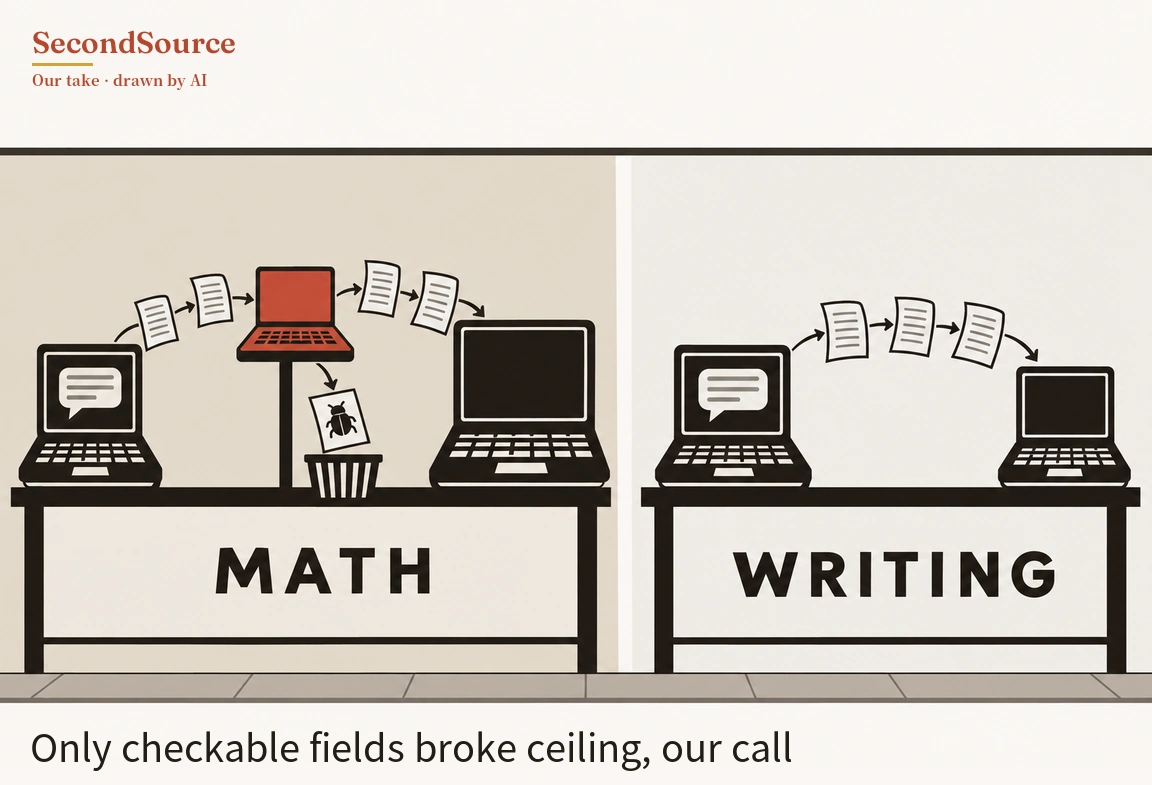
Our inference: synthetic data has already passed its old limit in math and code, where answers can be checked automatically, but not yet in writing and other fields without a standard answer. Synthetic data means training the next generation of AI on data generated by AI. The old problem is that a new model trained only on an old model's output can't outgrow the old model; SecondSource calls this "the student can't surpass the teacher". The July 14 reading was that in math and code, where answers can be checked automatically, models improve on right-or-wrong signals and have already broken through that ceiling. The evidence was OpenAI's process-supervision paper and DeepSeek's paper on reinforcement learning for reasoning. In writing and general capability, where there is no standard answer, the ceiling remains (card). Two developments would rewrite this reading. If separate teams each independently reproduce a "student surpasses teacher" result in a field without standard answers, the reading for writing and other fields without a standard answer changes. If reinforcement learning rewarded on verifiable answers turns out to have verifiers that routinely mark wrong answers as right, letting models game them, the math-and-code breakthrough shrinks and needs to be reassessed. The verdict date SecondSource set is July 14, 2027. How we checked →
Source and checks
This item ran in the brief of Nov 3, 2026, alongside 4 other items. How we checked it, the quote checks and what was still missing that day are on that issue's How we checked page.
Cite this item
SecondSource (2026). "On whether synthetic data has a ceiling, SecondSource split fields in two by whether answers can be checked automatically.." https://secondsource.io/en/news/2026-11-03-4/. Accessed access date.