Ben Thompson says politics is the last constraint on AI compute, and scarcity will last far longer than expected
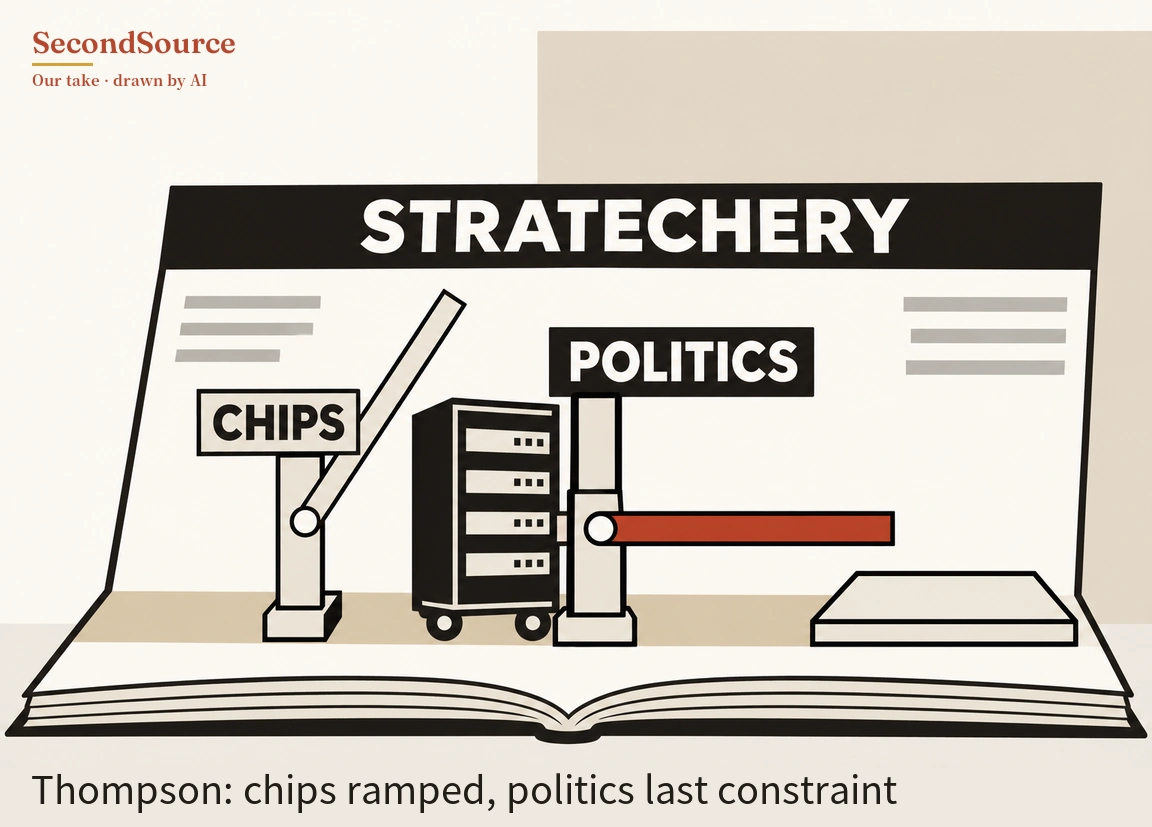
Independent analyst Ben Thompson published a post-election piece, "AI on the Ballot," in Stratechery on November 4 (Stratechery, 2026-11-04). Thompson argues that permits, not chips, will now decide how fast new data centers get built, so compute could stay scarce longer than the industry expects.
Thompson lines the constraints up in order. Chip compute ran short first and has already been ramped up. Memory and power are expected to be fixed next. Politics comes last and is hardest, because it blocks the fixes for the rest. The scarcity Thompson describes is having chips but being unable to build data centers. In Thompson's list of winners and losers, hyperscalers with permitted sites or sites that can be converted come out ahead. Neoclouds, the newer cloud companies that rent out GPUs, face a hurdle beyond financing because they need new permits. Frontier labs gain in a different way. The public is in effect asking for a slower pace, which slows the race for research compute, and Thompson thinks that is good for the labs' finances. Thompson notes these are inferences made the day after the election and doesn't say the effect is permanent. The same piece argues this isn't a partisan issue that will flip with the next election two years from now.
Kevin Xu, who runs Interconnected Capital, a fund that is long AI, said on October 15 that most of the more than 400 local moratoriums Xu tracks expire within a year and will lift on their own in mid-to-late 2027 (Kevin Xu, 2026-10-15). His count covers only local administrative pauses, not ballot measures or a governor's pledge.
Our inference: Xu's expiry curve shows when one kind of constraint lifts, and Xu's numbers can't show whether the ballot-measure and governor layers will loosen with it.
Not proven yet: every point in Thompson's piece is a day-after inference with no numbers How we checked →
Next to watch: whether most moratoriums due to expire by the end of June 2027 get extended, and whether any neocloud calls permits a supply constraint on next quarter's earnings calls. If most pauses expire on schedule with no state law following, Xu's thaw holds up; if most are extended or turned into law, the evidence favors Thompson's reading.
Source and checks
This item ran in the brief of Nov 5, 2026, alongside 13 other items. How we checked it, the quote checks and what was still missing that day are on that issue's How we checked page.
Cite this item
SecondSource (2026). "Ben Thompson says politics is the last constraint on AI compute, and scarcity will last far longer than expected." https://secondsource.io/en/news/2026-11-05-5/. Accessed access date.