SecondSourceJudgment rebuilt from primary sources

Texas elects data-center pause backer; legal power unclear
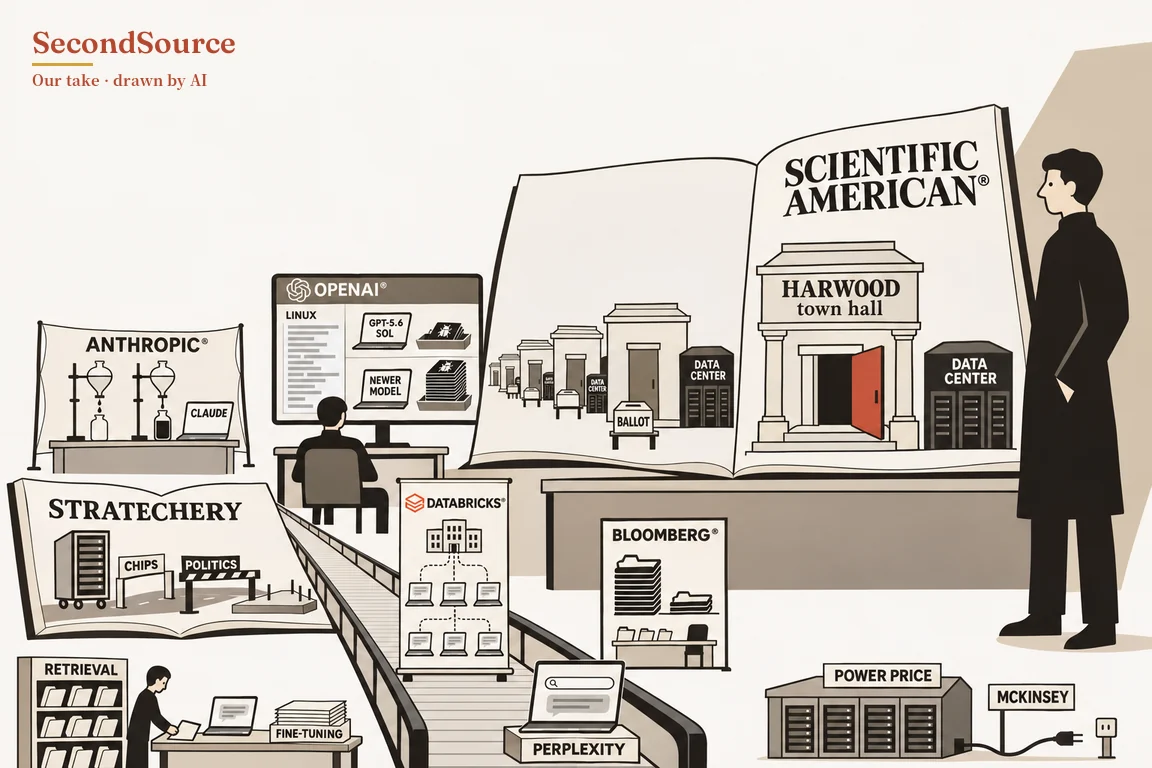
Today's front-page cartoon: one single picture that brings together today's stories.

Why today matters: The day after Texas voters chose a governor and 41 local data-center measures went to the ballot, Ben Thompson ranked politics as the last constraint on AI compute, after power.

At a glance

1. Texas elected Gina Hinojosa, who campaigned on pausing new data centers, as governor. Scientific American counts 41 data-center ballot measures in ten states, and only one decided so far went the industry's way. Counting is still under way.

2. Ben Thompson wrote the day after the election that the last constraint on AI compute is politics; Thompson attached no data.

3. OpenAI self-reports that its newer cybersecurity model found 948 Linux kernel flaws that hand a local user root, against 166 for the July model; no third party has repeated the run.

Today's main line

1. Scientific American's tally of 41 data-center ballot measures in ten states finds one result in the industry's favor, as Texas picks a governor who backed a pause
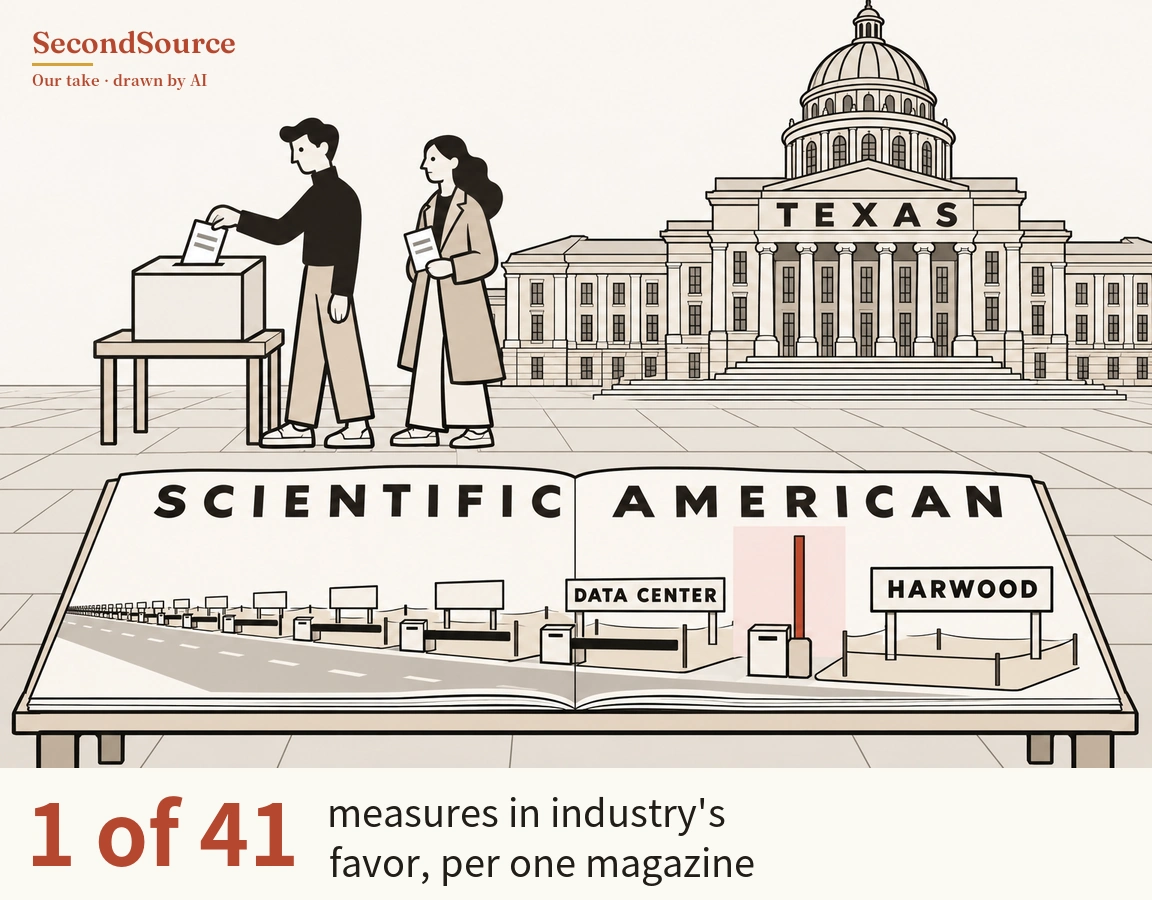
Concept illustration: at upper left a man in a dark sweater slips a sheet of paper into the top of a white box on a small table while a woman in a long beige coat stands behind him holding a sheet of paper, and at upper right a large domed, columned building is lettered TEXAS. In the foreground an open book on a table carries the large heading SCIENTIFIC AMERICAN across both pages, and below it a road runs in from the far left beside a row of low-fenced plots that grow larger toward the right, each with a small white box and a black horizontal bar, most under blank signboards and the one near the middle under a sign lettered DATA CENTER, followed by a pale pink strip holding a tall red upright bar beside a white box and a small beige box, and at the right a fenced plot under a sign lettered HARWOOD. Printed on the image: 1 of 41 measures in industry's favor, per one magazine.
Texas voters on November 3 elected Democrat Gina Hinojosa, who backs pausing new data centers, as governor; the official count isn't complete, and outlets describe Hinojosa's pledge at different strengths. The tally of local data-center ballot measures in ten states comes only from Scientific American, the popular-science magazine, and runs to November 4, when most results were in; other trackers count 38 or 47 measures. In Harwood, North Dakota, the result Scientific American counts in the industry's favor was a vote against extra review for industrial projects, not a vote for data centers.

Our inference: for developers with Texas projects, state permission may now matter as much as grid power. Abbott's pause already covers state environmental permits, and the incoming governor campaigned on a pause.

The Texas Tribune, a nonprofit newsroom covering Texas state politics, lists data-center discontent as one factor in Hinojosa's win, not the main one.

Abbott's own pause has already widened from grid connections to state environmental permits.

Read the full item →

2. Ben Thompson says politics is the last constraint on AI compute, and scarcity will last far longer than expected
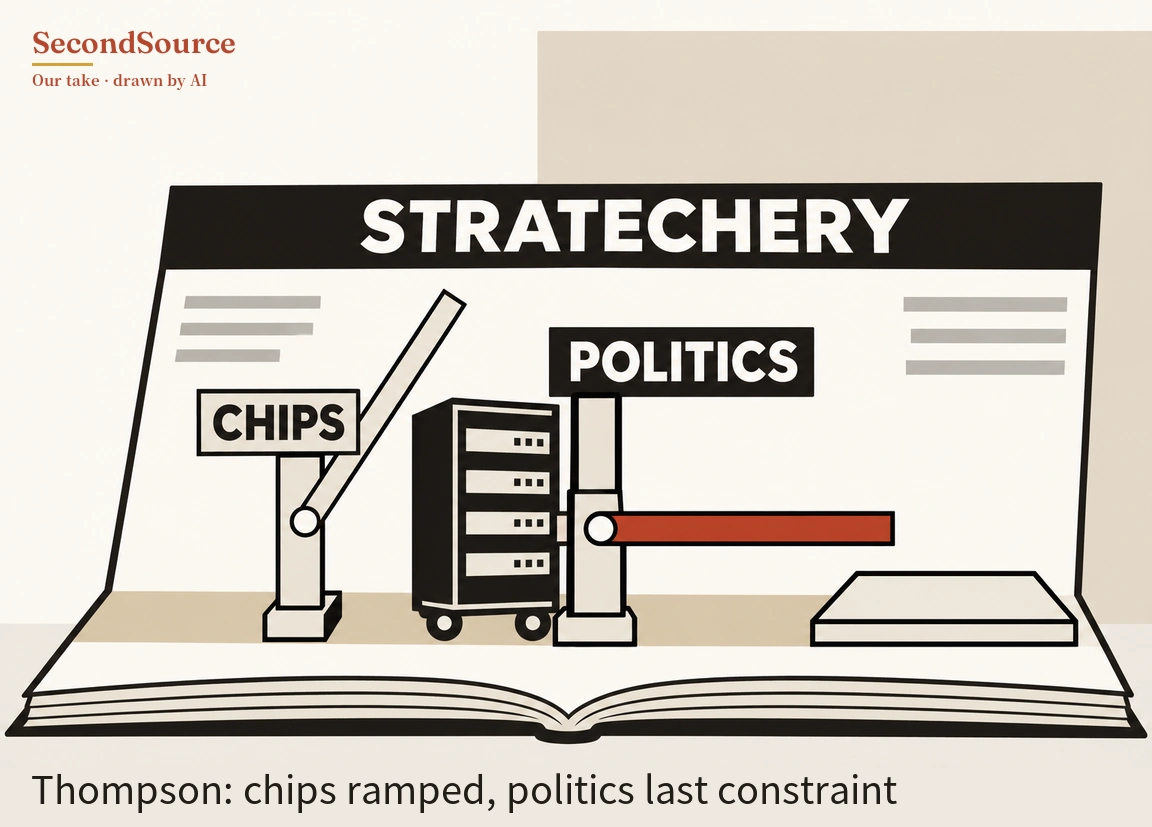
Concept illustration: a large panel stands up out of an open book, topped by a black band lettered STRATECHERY, with a few short gray bars at its upper left and upper right. Along the panel's floor, from left to right, are a post with a sign lettered CHIPS whose barrier arm is raised diagonally up to the right, a black server rack on wheels, a post under a black sign lettered POLITICS whose red barrier arm is lowered level and points right, and a flat pale slab lying on the floor at the far right. Printed on the image: Thompson: chips ramped, politics last constraint.
Independent analyst Ben Thompson argues in a post-election Stratechery piece published November 4 that politics is the last constraint on AI compute and that compute could stay scarce far longer than the industry expects. Each point is a personal inference Thompson made the day after the election, with no numbers attached. Thompson does not say the effect is permanent.

Read the full item →

3. OpenAI says its newer cybersecurity model found 948 Linux kernel flaws that grant root, against 166 for the model it used in July
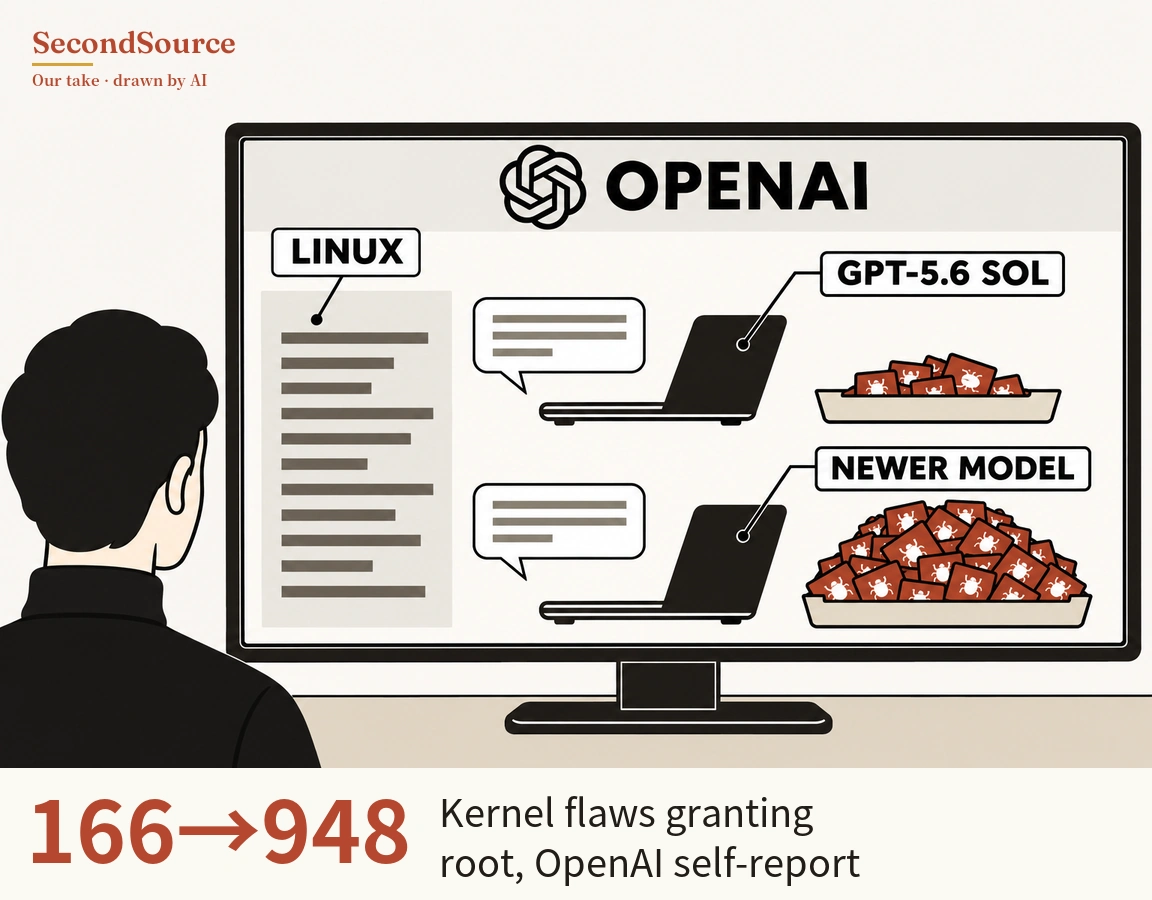
Concept illustration: a black-haired person in black clothing, seen from behind at the lower left, faces a large monitor on a stand on a beige desk; the screen is headed by an interlaced knot-shaped symbol and the lettering OPENAI, and on its left a label LINUX is joined by a line to a grey panel of grey horizontal lines. To the right are two rows, each with a speech bubble holding grey lines beside a black laptop: the upper laptop is joined by a line to a label GPT-5.6 SOL and sits beside a shallow tray with a small pile of red tiles marked with white bug icons, while the lower laptop is joined by a line to a label NEWER MODEL and sits beside a tray heaped with many more of the same tiles. Printed on the image: 166→948 Kernel flaws granting root, OpenAI self-report.
OpenAI reports that OpenAI's security team scanned the Linux kernel with the same automated pipeline, using GPT-5.6 Sol in late July and "a newer cybersecurity model" in mid-October. Every figure is self-reported by OpenAI, and no third party has re-run the scan. OpenAI gives upstream-fix figures only for ten days after the scan ended and does not say which reports kernel maintainers will eventually accept.

That last step is our calculation.

Read the full item →

Chips & semiconductors

No chips & semiconductors item this issue. The only chip item is NVIDIA's CUDA 13.5 in Also happened #4, and nothing qualified for the main line.

Named commentary

1. Exponential View author Azeem Azhar pushes back on McKinsey: what data centers really compete on is how fast they get power, not the power price.(October 31)
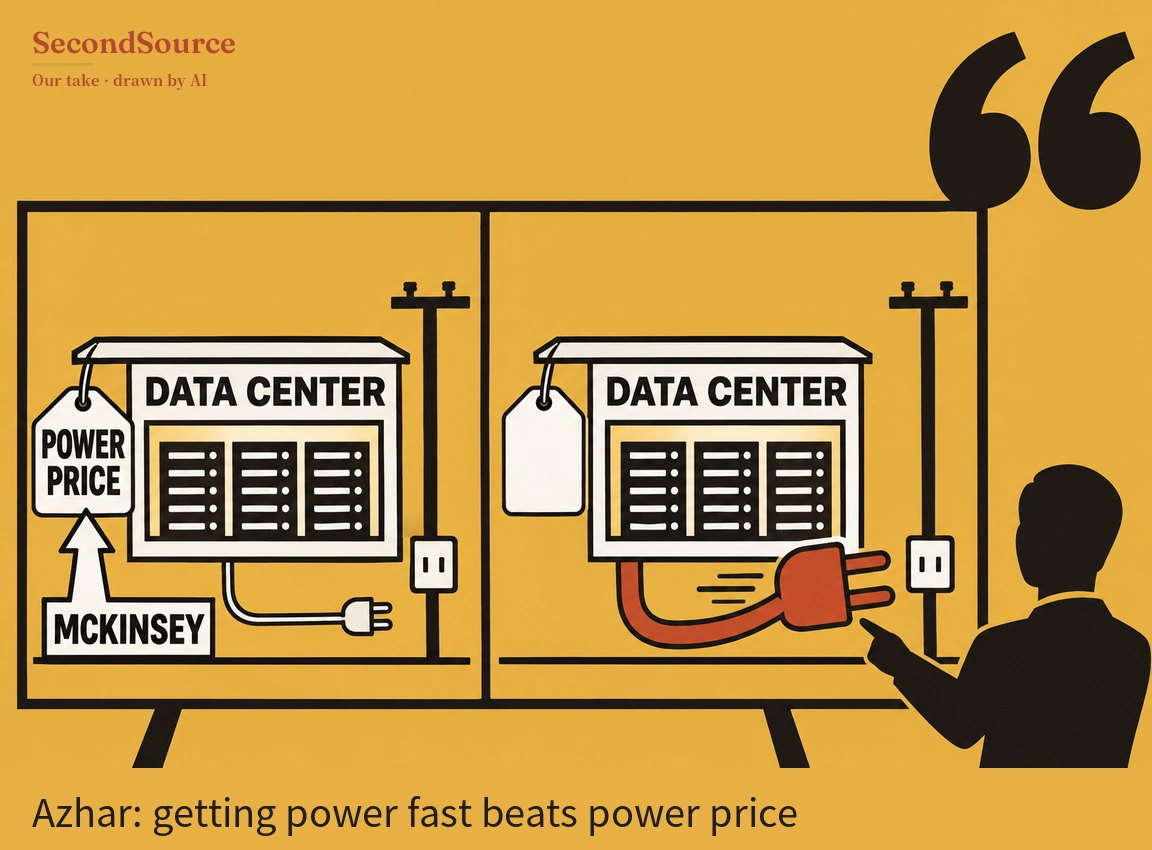
Concept illustration on a mustard background: a large board on a stand is split into two panels, each showing a white building lettered DATA CENTER with server racks inside, a utility pole with a wall outlet to its right, and a tag hanging from the roof's left corner; on the left the tag reads POWER PRICE, with an upward arrow pointing to it from a sign lettered MCKINSEY, and a thin white cord's plug lies on the ground near the pole, while on the right the tag is blank and a thick red cord's plug points rightward toward the outlet with motion lines trailing behind it. A dark silhouette of a person in a suit at the lower right points at the red plug, and a large black opening quotation mark sits in the top-right corner. Printed on the image: Azhar: getting power fast beats power price.
On October 31 on X, Azeem Azhar, the analyst who writes the tech newsletter Exponential View, answered McKinsey Global Institute's claim that electricity cost decides data-center economics, arguing that data centers really compete on how fast a site gets power. Azhar's reasoning is that power is a small share of total data-center cost, with financing and depreciation the big items; this is Azhar's personal argument, and neither side attached cost-structure figures.

Read the full item →

Research & models

1. Bloomberg self-reports that AI-assisted migration across thousands of internal codebases opened 2,333 merge requests, the code changes sent to a team for review, of which 729 succeeded.(paper, November 3) The abstract does not define success and names each team's review and deployment as the bottleneck. (arXiv 2611.05457, 2026-11-03)

2. Anthropic's biology team says that with Claude involved at every step, the team solved the first structure of a prokaryotic vault particle in four months and cut one purification step from three days to 90 minutes.
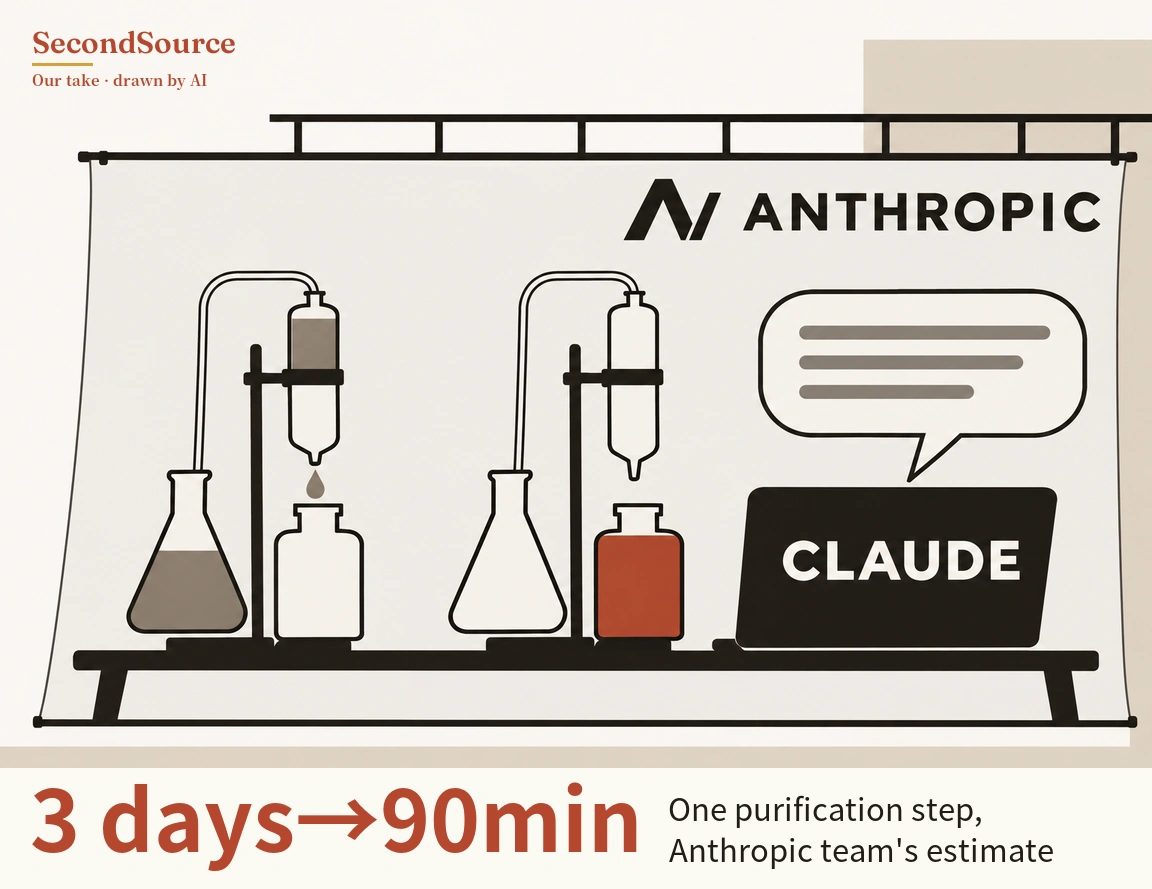
Concept illustration: a large sheet hangs from a black rail, lettered ANTHROPIC beside a black angular mark at top right, and on a long black bench across it stand two matching lab setups, each a conical flask joined by a tube to a funnel clamped on a stand above a bottle; on the left the flask and funnel hold grey liquid and a drop falls from the funnel tip toward a clear bottle, while on the right the flask and funnel are clear and the bottle holds red liquid. At the right end of the bench is a black laptop-like panel lettered CLAUDE, with a speech bubble containing three grey lines above it. Printed on the image: 3 days→90min One purification step, Anthropic team's estimate.
Anthropic's biology team says the team used Claude at every step and solved the first structure of a prokaryotic vault particle in four months; vault particles are large hollow protein shells present in almost every human cell. The account comes only from Anthropic and concerns Anthropic's own model, the time savings are the team's estimates, and the preprint has not been peer reviewed.

Read the full item →

Product moves

1. Databricks says Unity Gateway customers used an average of 7.1 models in July, up from 4.2 in January.
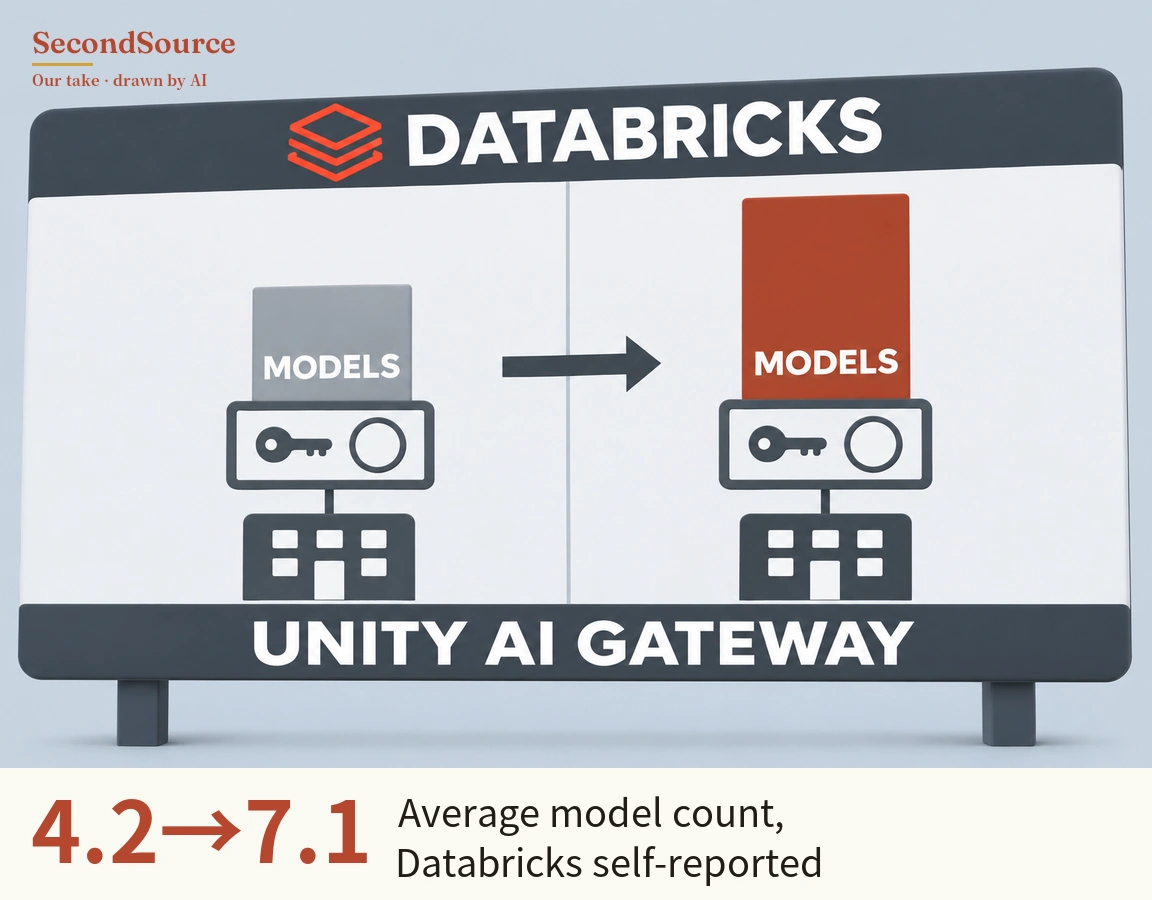
Concept illustration of a signboard on two posts, its dark top band lettered “DATABRICKS” beside a red stacked-layers icon and its dark bottom band lettered “UNITY AI GATEWAY”. The panel between is split into two halves, each showing a building joined by a line up to a frame holding a key and a circle, topped by a block lettered “MODELS” (small and grey on the left, much taller and red on the right), with a black arrow in the left half pointing right. Printed on the image: 4.2→7.1 Average model count, Databricks self-reported.
Databricks self-reported the average number of models Unity AI Gateway customers used in January and July while promoting the gateway, a Databricks API that lets an enterprise connect open-weight, frontier and outside models at once and manage permissions and budgets in one place. Databricks says about 40% of the models customers connected in July are open-weight and gives no January share to compare with.

Read the full item →

2. Perplexity's Decisions API can now search the web before answering, and on Perplexity's own test true/false accuracy rose from 56.4% without search to 97.3% with it.
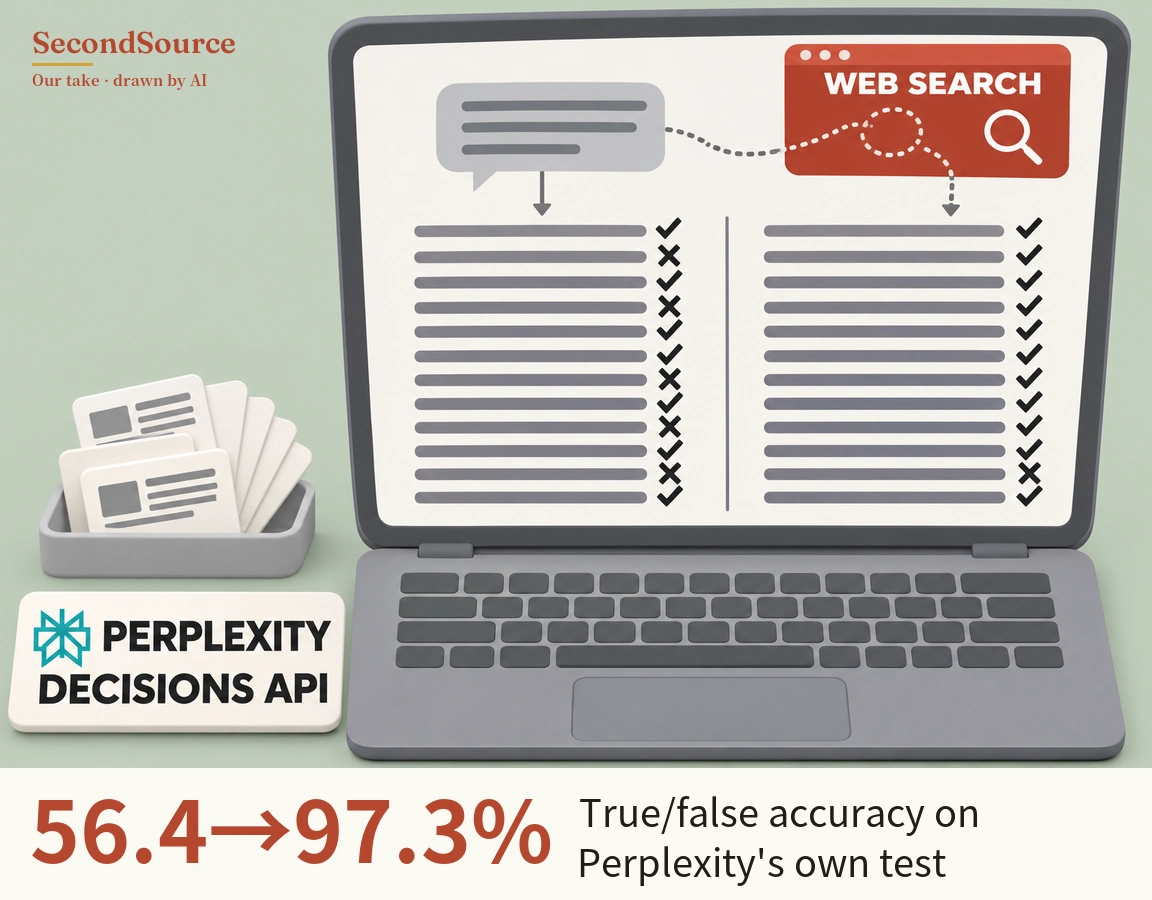
Concept illustration: a grey laptop on a pale green background; on its screen a grey speech bubble at top left has an arrow pointing down to a left column of text lines marked with a mix of check marks and crosses, while a dotted line runs from the bubble into a red window lettered "WEB SEARCH" with a magnifying-glass icon at top right, loops there, and ends in an arrow pointing down to a right column, separated from the left by a vertical line, whose lines are marked almost entirely with check marks and one cross near the bottom. To the left of the laptop sits a grey tray of cream cards showing picture boxes and text lines, and at bottom left a white plaque with a teal geometric icon is lettered "PERPLEXITY DECISIONS API". Printed on the image: 56.4→97.3% True/false accuracy on Perplexity's own test.
Perplexity has added web search before answering to the Decisions API, a service that lets a program ask yes/no, multiple-choice or scoring questions and get probabilities back. The true/false test used 328 questions Perplexity selected, mixing October news and obscure facts, and Perplexity reports median latency with search at 2.6 times the median latency without search.

Read the full item →

From the archive

1. [Looking back] (SecondSource call, July 14) Enterprises can teach a general model their business through retrieval or fine-tuning; SecondSource's reading is that the two split the work rather than one replacing the other.
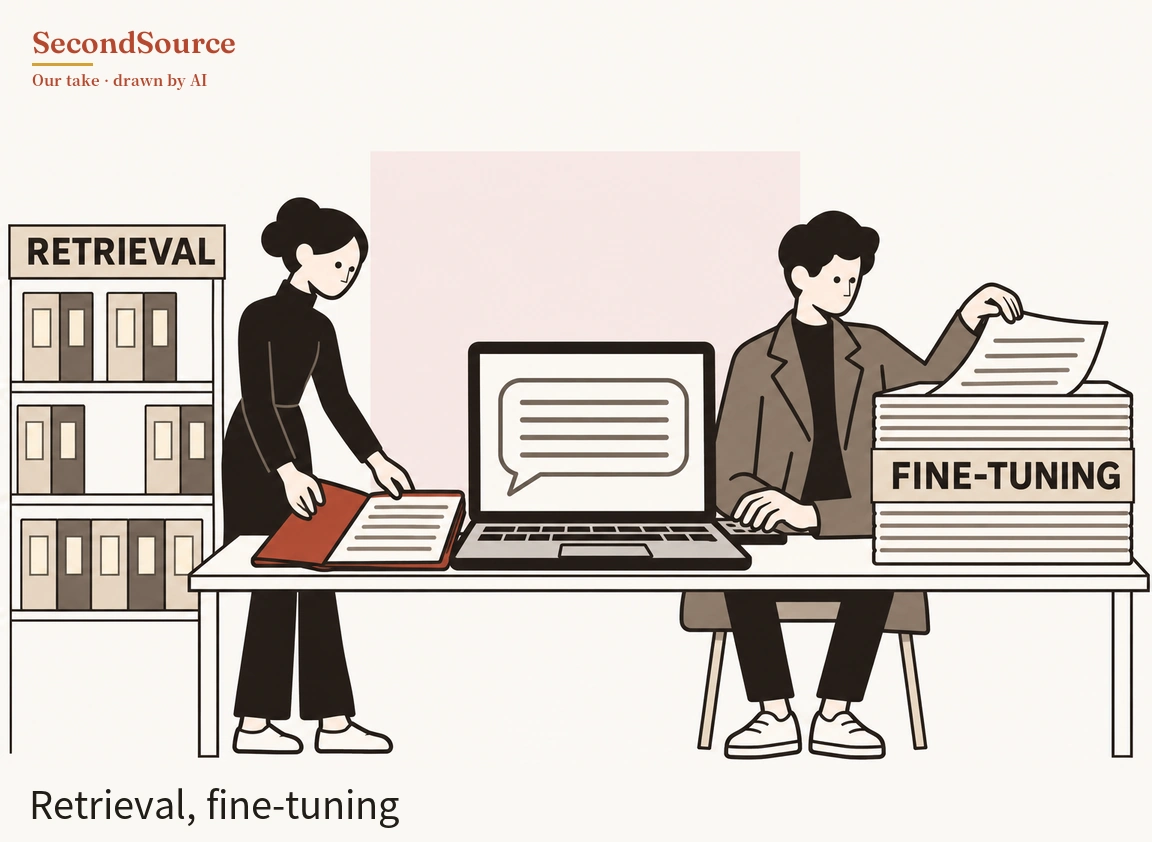
Concept illustration: a long white table spans the scene with an open laptop at its centre, its screen showing a speech bubble filled with lines, set in front of a pale pink rectangle. On the left, a person in black stands beside a white shelf of binders topped by a sign lettered RETRIEVAL and leans over the table to open a red-covered file with a lined page; on the right, a person in a brown jacket sits at the table with one hand on the keys at the laptop's right edge and the other holding a lined sheet of paper above a tall stack of paper at the table's right end, labelled FINE-TUNING. Printed on the image: Retrieval, fine-tuning.
One route for an enterprise teaching a general model the business is to retrieve relevant documents at question time and hand them to the model. The other route is to train the model further on the data.

SecondSource split the call into two checkable conditions, both read from named annual enterprise AI surveys such as a16z's. One: enterprises that use retrieval or prompting as their main way of injecting knowledge are more than 60%. Two: "injecting knowledge" is under 30% of fine-tuning uses. A share that low would mean most fine-tuning shapes behavior and style rather than teaching facts. Both thresholds and the deadline are ones SecondSource set on July 14.

This reading changes if the approach from Stanford's Cartridges work, which pre-trains a whole document set and loads it at inference time, is independently reproduced in enterprise settings at a lower total cost than retrieval. The deadline is July 14, 2027 (card, card). How we checked →

Read the full item →

Also happened

1. Not verified by us yet: According to the newsletter Newcomer, an anonymous investor in both OpenAI and Anthropic expects Anthropic to go public before Thanksgiving (November 26); the claim comes only from that investor (Newcomer, 2026-11-04).

2. Not verified by us yet: OpenAI says it will acquire Pierre, which makes Git code-review tools, and fold it into Codex; terms weren't disclosed and the deal awaits regulatory approval (OpenAI, 2026-11-04).

3. Not verified by us yet: Salesforce self-reports more than 185,000 Agentforce Coworker users and 21-fold usage growth over three months, without saying how users are counted (Salesforce, 2026-11-04).

4. Not verified by us yet: NVIDIA says CUDA 13.5 brings Vera Rubin to general availability; the announcement lists no specs (NVIDIA, 2026-11-04).

5. Not verified by us yet: According to an X post by NBC reporter Steve Kopack, NBC exit polls show voters worried about AI and overwhelmingly opposed to data centers; the percentages appear only in the image attached to the post (NBC News, 2026-11-03).

Academic papers, 929: 328 read, 280 screened out, 321 not yet read; the paper feed was rate-limited last night, and these 929 are one round of a three-day rotating scan. Linked articles, 160: 81 read, 56 screened out, 22 not yet read, 1 being refetched. Social-platform posts, 140: 21 read, 17 screened out, 3 logged only, 99 not yet read. Blogs, 70: 10 read, 7 screened out, 8 logged only, 45 not yet read. Second paper feed, 55: none read yet. Company filings, 13: 6 read, 1 screened out, 2 logged only, 4 not yet read. Newsletters, 5: 2 read, 2 screened out, 1 not yet read. Show transcripts, 3: 2 read, 1 screened out.

The Texas Tribune, Yahoo Finance and Scientific American reports and the campaign press release in main-line item 1 were retrieved separately that day and aren't among the 1,375. Last night's collection pulled 558 original social-platform posts from 374 accounts. These 558 are a separate count from the 140 above and can't be compared with them directly.

One-time catch-up. The database also holds several one-time catch-up batches dated between July 1 and October 30 this year, counted separately from the past 24 hours above. None of it was used in this issue.

Still missing today. The gap that most affects judgment is whether Hinojosa has legal authority to order a pause on private projects; none of the reports says. Abbott's September 21 letter and the Texas Commission on Environmental Quality's notice aren't in this issue's material. Neither Yahoo Finance nor Bosa gives a source for Texas holding a quarter or more of US capacity. Scientific American doesn't break down which of the 41 measures are bans and which only add review. The half of Newcomer's piece about OpenAI isn't in this issue's material. For the Bloomberg migration paper, only the abstract is in this issue's material, and the abstract doesn't give each of the two cases' success rates. This issue has no macro section.

Tracked sources. The long-term roster currently has 529 named sources: 302 on social platforms, 90 shows, 51 news outlets, 48 blogs, 48 paper authors and 46 newsletters, with the rest spread across earnings reports, keynotes and other channels. The same source may be tracked on several channels, so the channel figures add up to more than 529. These are counts of tracked sources and can't be added to the piece counts above; the 374 accounts actually pulled last night, the shows behind the 3 transcripts and the 4 publishers behind the 5 newsletters are different lists from the roster's 302 social-platform sources, 90 show interviewees and 46 newsletter sources, and can't be compared directly. Representative names include Daniel Kokotajlo, Sergey Levine, Arvind Narayanan and Chris Lattner on social platforms; Terence Tao and Lilian Weng among blogs; and Sam Altman, Dario Amodei and Demis Hassabis among show interviewees. This issue uses 20 outside sources in the body. Only outside links actually cited in the body are counted; these 20 are a separate count from the 529 tracked sources. Sources from Taiwan total 158, with 43 added in October; Taiwanese media, Taiwanese companies' official channels and local reporters in Taiwan count, while foreign outlets relaying Taiwanese media do not.

SecondSource isn't a news digest: AI reads primary sources across fields, every judgment comes with its original source, and mistakes are corrected in public. The focus is what has changed and which claims still lack evidence, not what happened today.

Written from the same research and judgments as the Traditional Chinese edition. Sources are linked; we distinguish original documents from reporting and mark what we could not verify.