OpenAI describes Control Room, its central stop system for research models, and says output stops within 35 seconds at most, by OpenAI's own figure
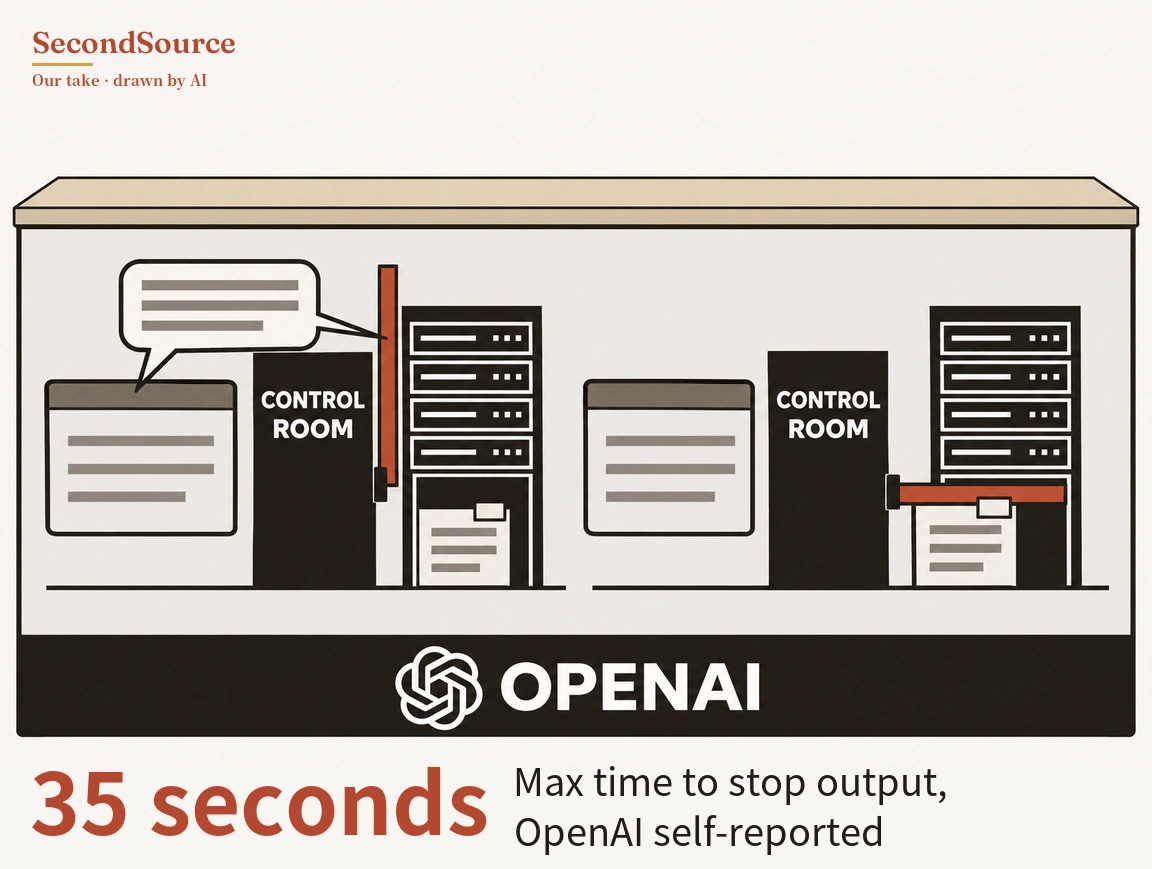
OpenAI described Control Room on its official blog on November 9, a central system that tracks and stops model work on its research infrastructure (OpenAI, 2026-11-09). Our inference: anyone asking frontier labs to show their research models can be stopped now has a specific figure to ask other labs about, the 35 seconds OpenAI reports for itself.
Control Room puts the stop switch in the inference layer. Each research job first gets a job ID from Control Room, and every request to an inference engine for model output has to carry that ID. The engine checks whether the request is allowed. Once a job is marked terminated, every model and every engine refuses its requests. OpenAI says the switch doesn't sit in job code, which researchers each maintain and change often, because inference code runs through fewer, more centralized paths. If Control Room itself goes down, all model output stops too. OpenAI says this stop-on-failure design now covers all frontier-model research jobs, and that the remaining research jobs will be covered within days.
The 35 seconds is the longest time from a decision to stop until the model can no longer produce output. The delay comes from a cache layer where inference engines hold authorization results. OpenAI's goal is to bring it to zero, with no timeline. Control Room is separate from the monitoring that detects a model overstepping: monitoring decides whether to stop, and Control Room makes the stop take effect. In an incident OpenAI published on September 20, monitoring raised an alert within 15 minutes, yet the training run was stopped only about two and a half hours after the alert. The incident report says the run "did not stop automatically as expected" (OpenAI alignment blog). The Control Room post doesn't say the system was built because of that incident. Control Room is an internal research system, not a new ChatGPT or API feature.
Not proven yet: the 35 seconds is OpenAI's own ceiling, with no latency distribution or test method How we checked →
Next to watch: whether OpenAI reports progress on moving the remaining research jobs to the stop-on-failure design, and whether other frontier labs publish their own stop latency.
Source and checks
This item ran in the brief of Nov 10, 2026, alongside 12 other items. How we checked it, the quote checks and what was still missing that day are on that issue's How we checked page.
Cite this item
SecondSource (2026). "OpenAI describes Control Room, its central stop system for research models, and says output stops within 35 seconds at most, by OpenAI's own figure." https://secondsource.io/en/news/2026-11-10-4/. Accessed access date.