SecondSourceJudgment rebuilt from primary sources

Anthropic: Fable 5.2 matches Opus 5.5 at half the cost

Source: Anthropic
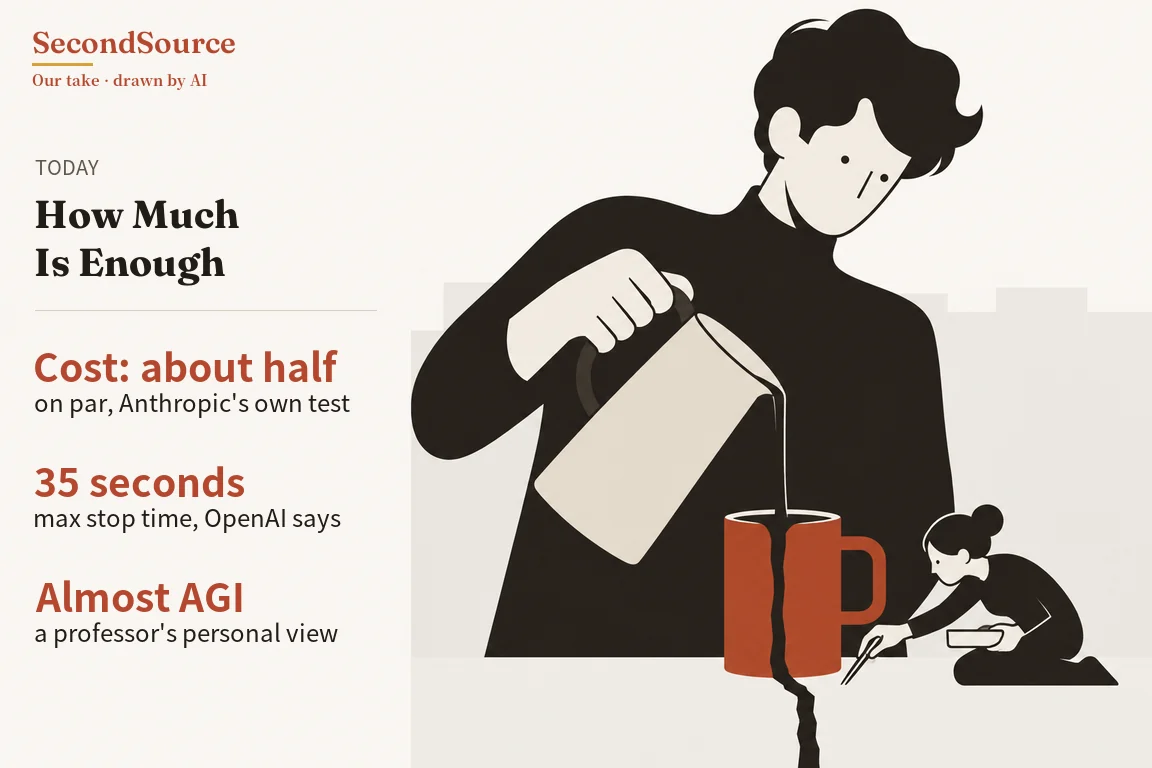
Today's front-page cover: How Much Is Enough; Cost: about half on par, Anthropic's own test; 35 seconds max stop time, OpenAI says; Almost AGI a professor's personal view

At a glance

1. On FrontierCode 2.0, a coding benchmark that checks whether open-source maintainers would merge a model's changes, Anthropic's new Fable 5.2 roughly matches Opus 5.5's best score at about half Opus 5.5's cost per task, in tests Anthropic ran.

2. Anthropic filed an amended IPO registration, and an exhibit says Google will buy US$10 billion of Anthropic stock at the offering price, settling after the listing; the fee table caps the whole offering at about US$74 billion.

3. According to the New York Times, the Commerce Department's investigation into Megaspeed, an NVIDIA cloud customer suspected of transshipping AI chips, has gone to the Justice Department and is now a criminal investigation.

Also today: #4 — OpenAI describes Control Room, the system that stops its research models, and says model output stops within 35 seconds at most, a figure OpenAI reports about its own system.

Today's main line

1. Anthropic releases Fable 5.2 and Mythos 5.2, and in its own FrontierCode 2.0 run Fable 5.2 matches Opus 5.5's best score at about half the cost per task
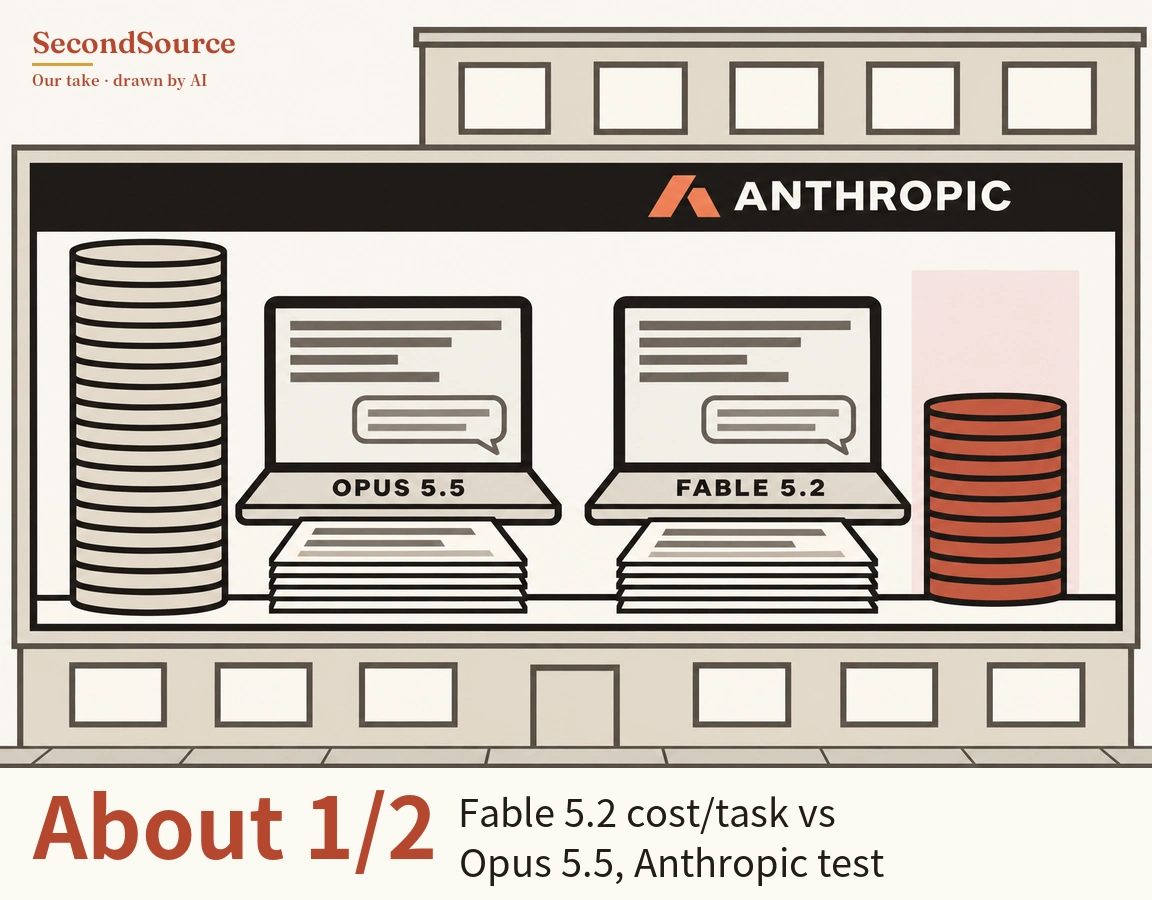
Concept illustration of a building with a wide shop window under a black sign lettered ANTHROPIC, with an orange angular shape to the left of the word; there is a row of windows on the floor above and a row of windows and a door on the floor below. Inside the window, on one shelf from left to right, are a tall stack of cream coins and two laptops labelled OPUS 5.5 and FABLE 5.2, each sitting on a stack of papers with grey text lines and a speech bubble on its screen, and on the far right a shorter stack of red coins in front of a pale pink strip. Printed on the image: About 1/2 Fable 5.2 cost/task vs Opus 5.5, Anthropic test.
Anthropic released Claude Fable 5.2 on November 9 and reports that Fable 5.2 roughly matches Opus 5.5's best score on FrontierCode 2.0, a benchmark that measures whether open-source maintainers would merge the code changes a model writes. Anthropic measured 45.3% for Fable 5.2 at the High reasoning-effort setting, against a best of 45.5% for Opus 5.5 across effort settings. The scores and the cost comparison come from Anthropic alone, with no outside rerun attached.

2. Anthropic files a second amended IPO registration, and an exhibit commits Google to buy US$10 billion of Anthropic stock at the offering price

Concept illustration: on the left, a building with a sign lettered "ANTHROPIC" has double glass doors lettered "IPO", with a brown ribbon tied in a bow across the door handles; in the middle, a person in a long black coat stands with one hand in a pocket and the other resting on a large heap of red banknote bundles with white bands on the right, head turned back toward the building. A white sign showing a multicoloured G and the lettering "GOOGLE" leans against the front of the heap. Printed on the image: US$10B Google to buy Anthropic stock at offering price.
Anthropic filed its second amended IPO registration with the US Securities and Exchange Commission (SEC) on November 10, including a stock subscription agreement that Anthropic and Google signed the same day. Google's share count is the subscription amount divided by the IPO price, and the purchase settles immediately after listing. The SEC can still ask Anthropic for revisions during review, and no shares can be sold before the registration is declared effective.

Our inference: Google already sells TPU compute to Anthropic and has committed to buy US$10 billion of its stock at the IPO, so after listing Anthropic's compute supplier would also be one of its shareholders. Anyone assessing Anthropic has to weigh those two relationships together.

3. According to the New York Times, the Commerce Department's Megaspeed probe went to the Justice Department after NVIDIA's general counsel contacted investigators
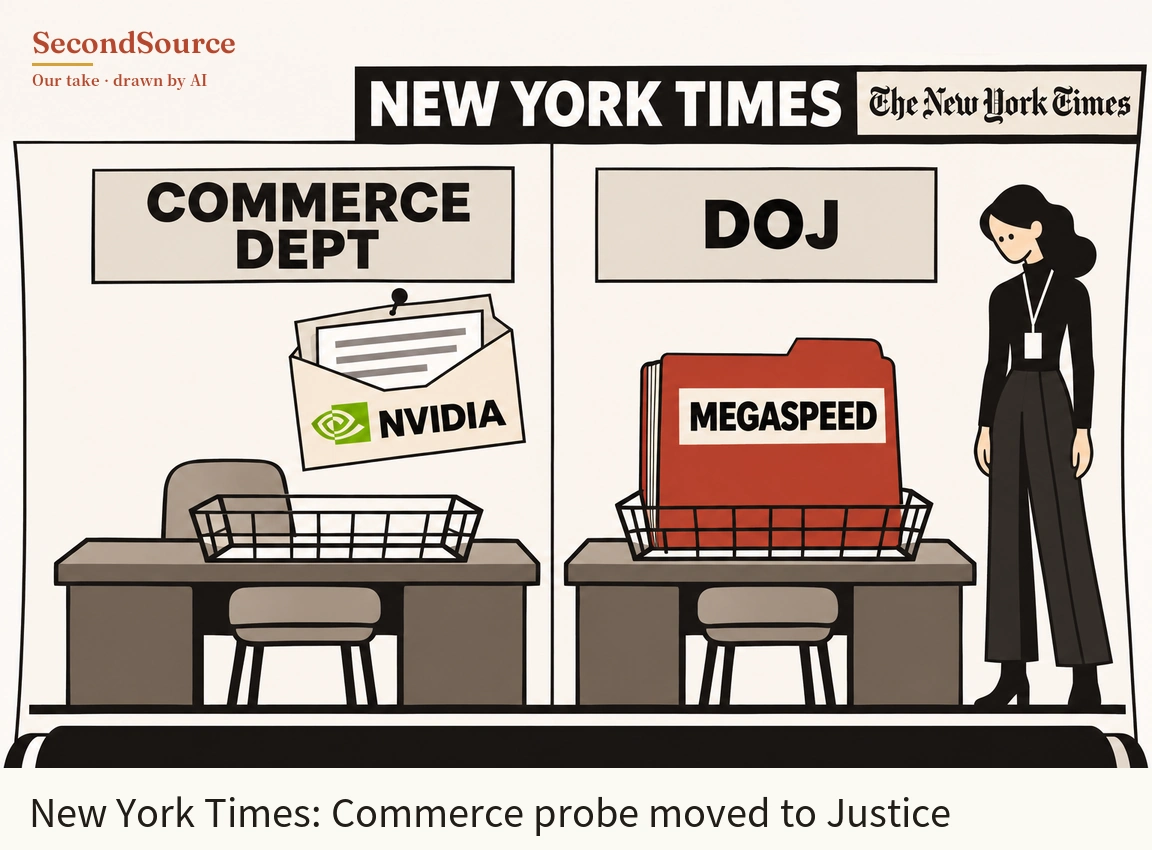
Concept illustration: along the top, a black banner lettered NEW YORK TIMES sits beside a white panel lettered The New York Times in old-style type, and below it the scene is split into two halves by a vertical line. On the left, under a sign lettered COMMERCE DEPT, an open envelope with a green emblem and the letters NVIDIA, a lined sheet sticking out of it, is pinned above an empty wire tray on a desk with a chair; on the right, under a sign lettered DOJ, a red folder lettered MEGASPEED sits in a wire tray on a second desk with a chair, a dark-haired woman in black with a white card on a lanyard stands beside it looking down toward the folder, and a black bar runs along the bottom. Printed on the image: New York Times: Commerce probe moved to Justice.
NVIDIA general counsel Tim Teter wrote to Commerce Department investigators asking about the investigation into chip transshipment by Megaspeed, a Singapore cloud company and NVIDIA cloud customer in Southeast Asia, the New York Times reports, citing anonymous people familiar with the matter. Teter said the contact had been approved by Jeffrey Kessler, the Commerce Department's export-control chief; Commerce Department officials say Kessler did not interfere in decisions about the investigation. The Justice Department declined to comment, and nothing is public about charges, closure or timing.

Our inference: whether NVIDIA chips reached China through Megaspeed will have to wait for the Justice Department's criminal investigation. NVIDIA's board is examining reports that foreign intelligence targeted Jensen Huang, the November 18 closed-door briefing is about counterintelligence, and the public descriptions of both say nothing about where the chips went.

Outside observers want to know whether NVIDIA chips reached China through a Singapore middleman, and whether anyone is actually investigating.

Bloomberg adds a second account of the same contact.

4. OpenAI describes Control Room, its central stop system for research models, and says output stops within 35 seconds at most, by OpenAI's own figure
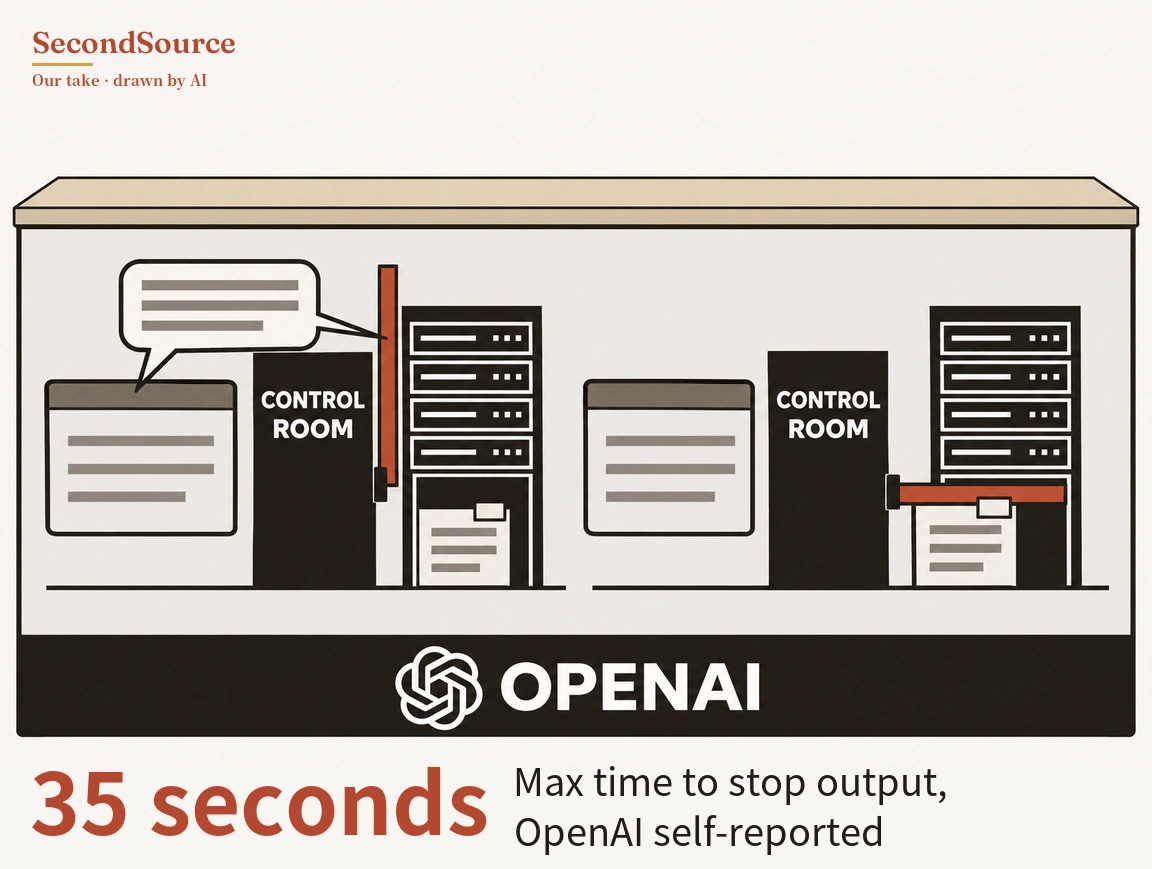
Concept illustration: a wide light-gray panel with a tan ledge on top and a black band along the bottom, lettered OPENAI in white beside an interlaced knot-shaped emblem, holds two near-identical scenes side by side, each on a black ground line with, from left to right, a window with a dark title bar and gray text lines, a tall black block lettered CONTROL ROOM, and a black server rack of four stacked units with a white tabbed card with gray lines in its bottom compartment. In the left scene a speech bubble of gray lines sits above the window, with one tail pointing down to the window and another pointing right to a red bar standing upright on a small black hinge between the block and the rack; in the right scene there is no speech bubble, and the red bar lies horizontally, running from a black hinge between the block and the rack across the front of the rack at the top edge of the card. Printed on the image: 35 seconds Max time to stop output, OpenAI self-reported.
On November 9, OpenAI described Control Room, a central internal system that tracks and stops model work on OpenAI's research infrastructure, not a new ChatGPT or API feature. Every research job must carry a job ID from Control Room when asking an inference engine for output, and once a job is marked terminated, every model and every engine refuses the job's requests. The stop-time ceiling is self-reported by OpenAI, with no latency distribution or test method given.

Our inference: anyone asking frontier labs to show their research models can be stopped now has a specific figure to ask other labs about, the 35 seconds OpenAI reports for itself.

Chips & semiconductors
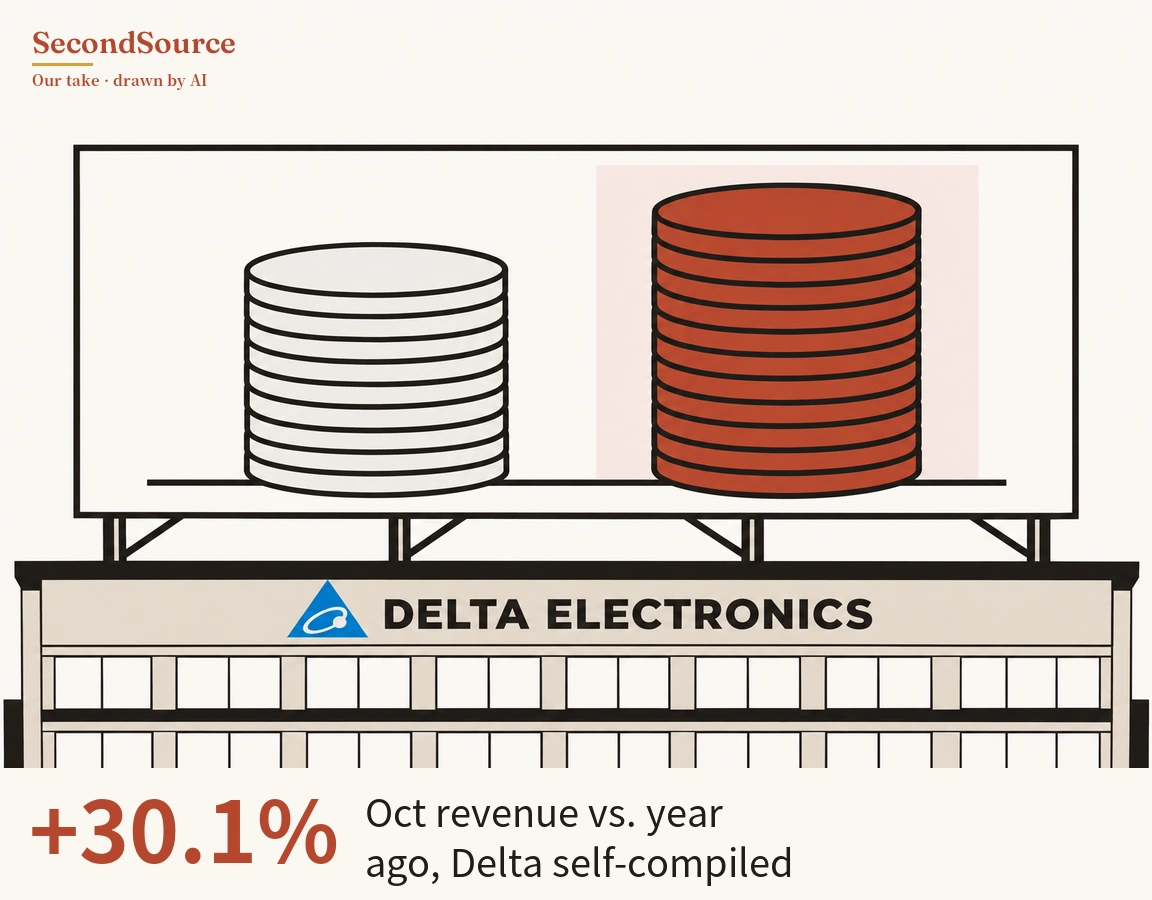
1. Delta Electronics, a maker of power and cooling components, reported October consolidated revenue of NT$74.666B, up 30.1% from a year earlier, and the announcement gives no product breakdown.

Concept illustration: a large billboard on a building's roof shows two stacks of flat discs standing on one horizontal line, a shorter white stack on the left and a taller brick-red stack on the right, set against a pale pink panel. Below the billboard's support struts, the building's front carries a sign with a blue triangle mark and the lettering DELTA ELECTRONICS, above rows of windows. Printed on the image: +30.1% Oct revenue vs. year ago, Delta self-compiled.
Delta Electronics, a maker of power and cooling components, reported October consolidated revenue without a product breakdown. Delta's monthly revenue is self-compiled and isn't reviewed by auditors, and the announcement doesn't state the effect of exchange rates.

Named commentary

1. Wharton professor Ethan Mollick, after trying Fable 5.2, says the model is "almost" artificial general intelligence, and that what it lacks is judging whether its work is good enough.

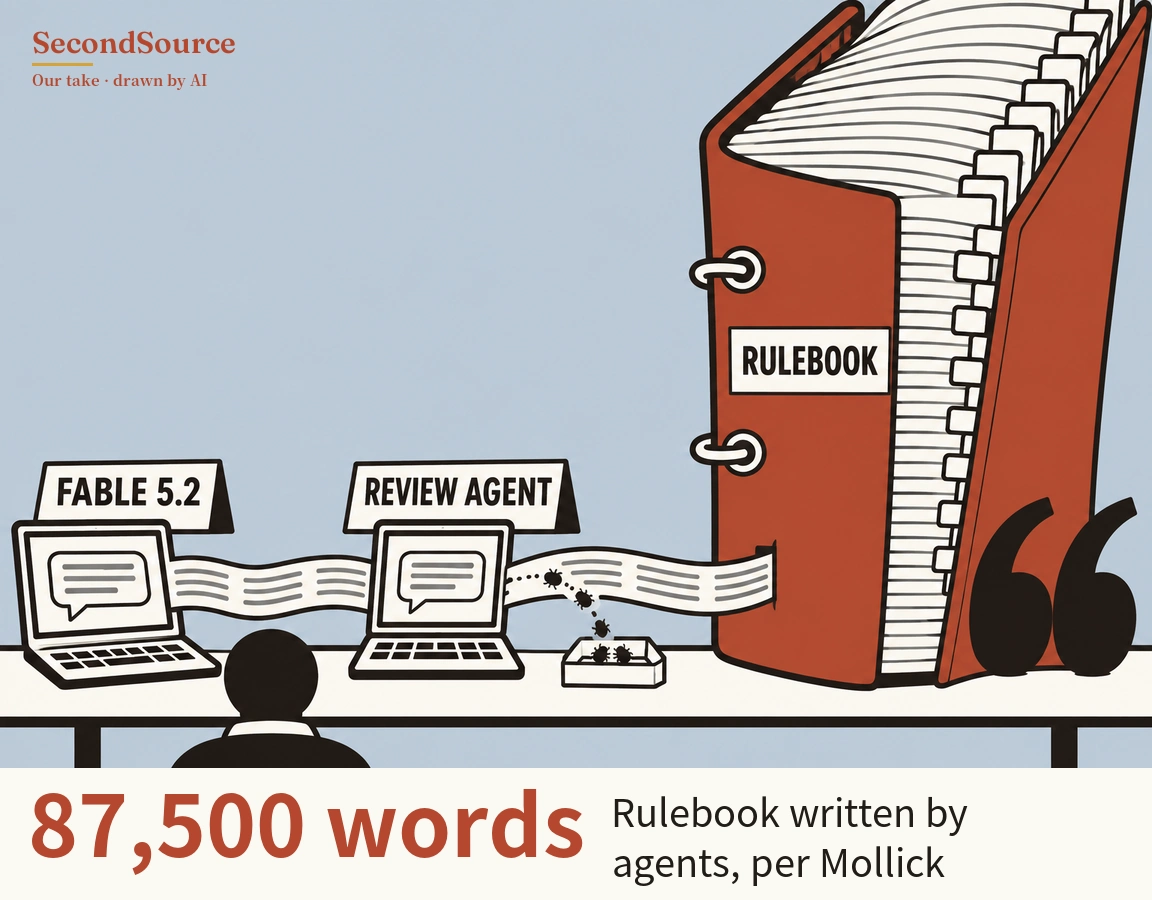
Concept illustration: on a long white desk against a light-blue background sit two laptops, each screen showing a speech bubble, with tent cards above them reading "FABLE 5.2" (left) and "REVIEW AGENT" (middle), and the dark silhouette of a person's head and shoulders, seen from behind, in the foreground at the desk. A wavy paper strip with gray lines links the left laptop's screen to the middle laptop, and a second strip runs right from the middle laptop into a slot in the side of a giant upright red ring binder lettered "RULEBOOK", which is stuffed with pages and white tabs and rises past the top edge; from the second strip, small black insects drop along a dotted line into a small open white box on the desk, and a large black pair of opening quotation marks (“) stands beside the binder at the bottom right. Printed on the image: 87,500 words Rulebook written by agents, per Mollick.
After trying the AI model Fable 5.2 with early access, Wharton professor Ethan Mollick says Fable 5.2 is "almost" artificial general intelligence and that what the model lacks is judging whether the work is good enough. Mollick's definition counts only intellectual work done on a computer, and both the almost-AGI verdict and the rulebook from a small 3D-world project come from one uncontrolled experiment by Mollick.

2. Venture capitalist Tomasz Tunguz estimates the US will have to buy AI model output from data centers abroad as early as 2028, with the timing set by how many planned data centers can't get connected to power.

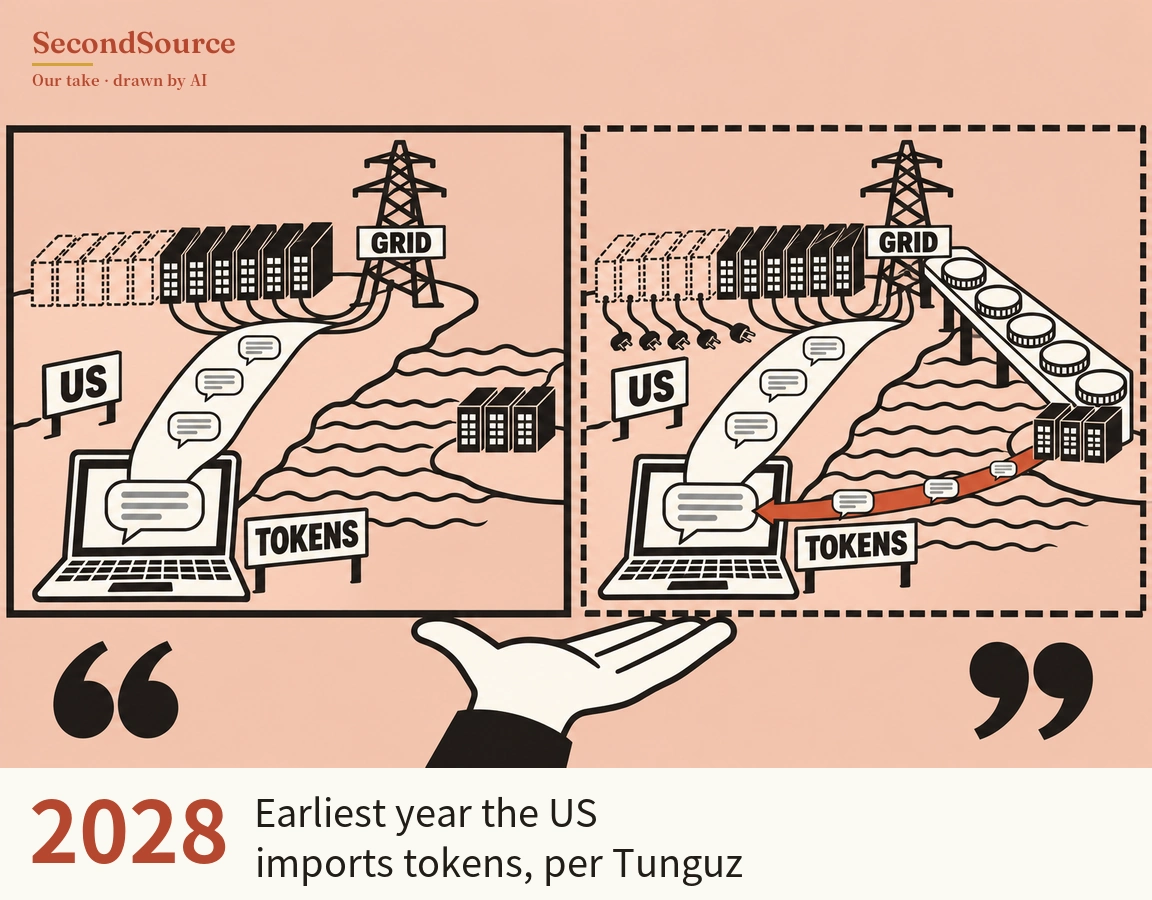
Concept illustration of two side-by-side panels, the left in a solid frame and the right in a dashed one, above an open upturned hand at bottom centre, with a large black opening quotation mark at bottom left and a closing one at bottom right; in both panels a row of dark rack-like blocks with small square windows sits beside dashed-outline blocks and is wired to a pylon lettered GRID, a pale curved ribbon dotted with speech bubbles links the blocks with a laptop at lower left, signs read US and TOKENS, and three more dark blocks stand beyond a field of wavy lines on the right. In the right panel only, loose power plugs dangle beneath the dashed outlines, a raised conveyor on pillars carrying a row of coins links the area beside the GRID pylon with the three far blocks, and a red arrow carrying small speech bubbles points from those three blocks to the laptop. Printed on the image: 2028 Earliest year the US imports tokens, per Tunguz.
Venture capitalist Tomasz Tunguz estimates that how soon the US has to buy some AI model output from data centers abroad depends mainly on how many planned data centers can't get connected to power. The estimate is one analyst's and assumes tokens produced per watt grow about 2.9 times a year, a rate Tunguz combined from three new chips' gains over the prior generation without saying how.

Research & models

1. An Anthropic research post says Fable 5.2 produced three manufacturable circuit-board prototypes from one prompt, and scored 69% on partner Diode's internal layout grading, against 25% for Fable 5.

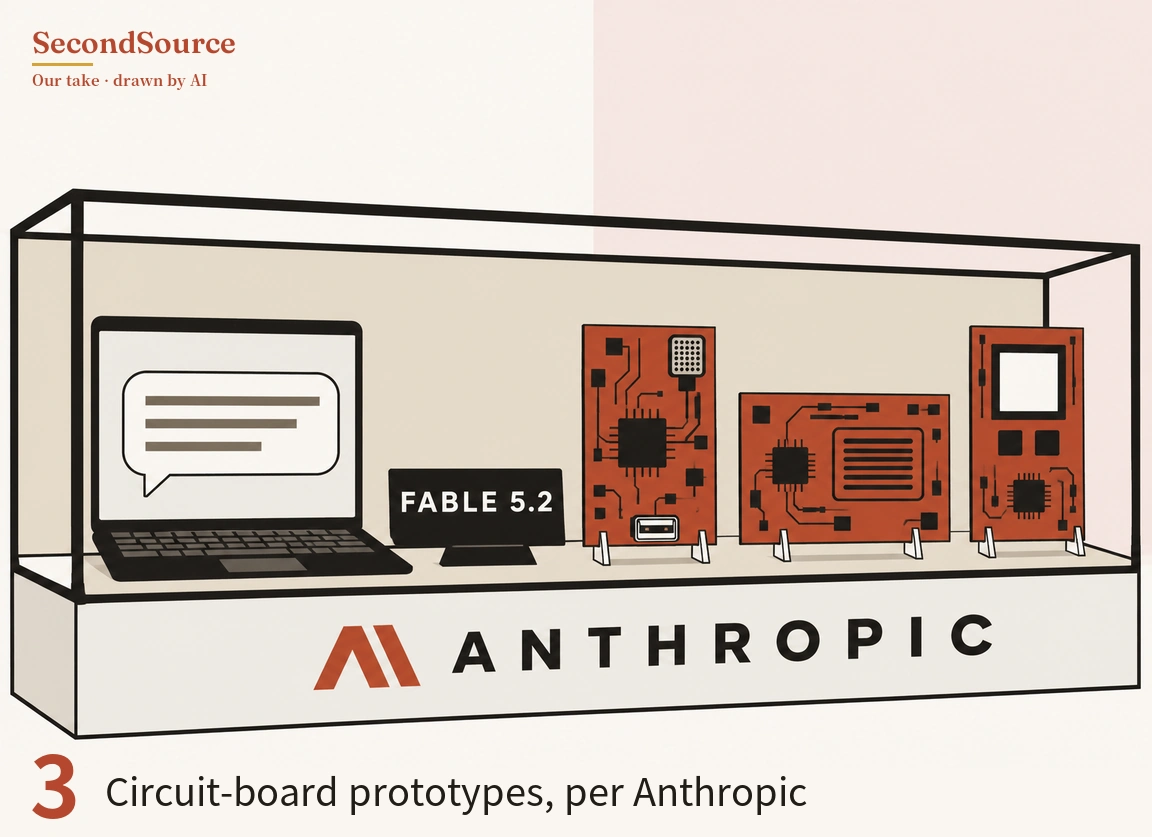
Concept illustration: a transparent display case outlined in black sits on a white base lettered ANTHROPIC, with a red inverted-V mark to the left of the lettering; inside, from left to right, stand an open laptop whose screen shows a speech bubble with three grey lines, a small black placard lettered FABLE 5.2, and three orange-red circuit boards upright on small white stands. The boards are drawn with dark chips and traces: the tall left one has a square of dots and a rectangular connector at its bottom edge, the wide middle one has a striped rectangle, and the tall right one has a white square near its top. Printed on the image: 3 Circuit-board prototypes, per Anthropic.
An Anthropic research post says Anthropic's model Fable 5.2 produced manufacturable circuit-board prototypes from one prompt, and that Diode Computers, a company that designs and manufactures circuit boards for clients, built the boards straight from Fable 5.2's design files without revisions. Anthropic says the boards are all prototypes with no electrical validation, antenna tuning, thermal testing or certification, and Anthropic has a commercial relationship with Diode.

2. [Looking back] (papers from 2023 to 2025) Three research groups found that reward models and AI judges favor longer answers.

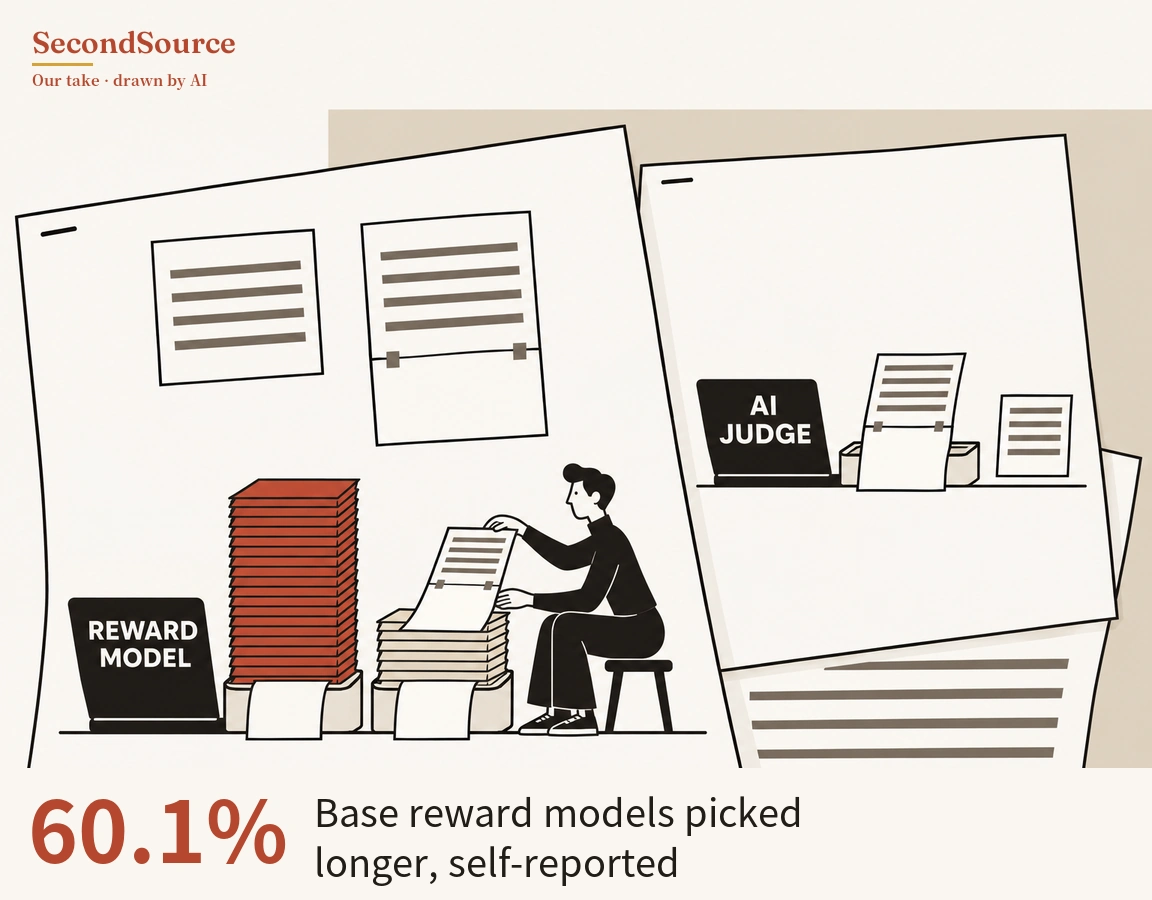
Concept illustration of tilted, overlapping paper sheets on a beige backdrop: on the large left sheet, two framed pages hang at the top, the left with gray lines and the right with gray lines plus a plain lower section attached by two tabs, and below them a black screen lettered "REWARD MODEL" stands beside a tall stack of red sheets and a shorter stack of beige sheets, each on a tray with a paper slip showing at the front, while a person in black seated on a stool holds a sheet with gray lines on top and a plain attached lower section over the beige stack. On the sheet to the right, a black screen lettered "AI JUDGE" sits on a shelf next to a tray holding an upright long sheet made of a lined top and a plain lower part joined by two tabs, and a smaller lined sheet, while another sheet with gray lines shows at the bottom right. Printed on the image: 60.1% Base reward models picked longer, self-reported.
Three research groups found in papers from 2023 to 2025 that reward models and AI judges favor longer answers unless answer length is controlled, in the authors' self-reported experiments, which tested only the judge models of the time. A 2025 paper's authors ran a control that only lengthened answers without adding content and compared how often base reward models and humans picked the longer version.

Product moves

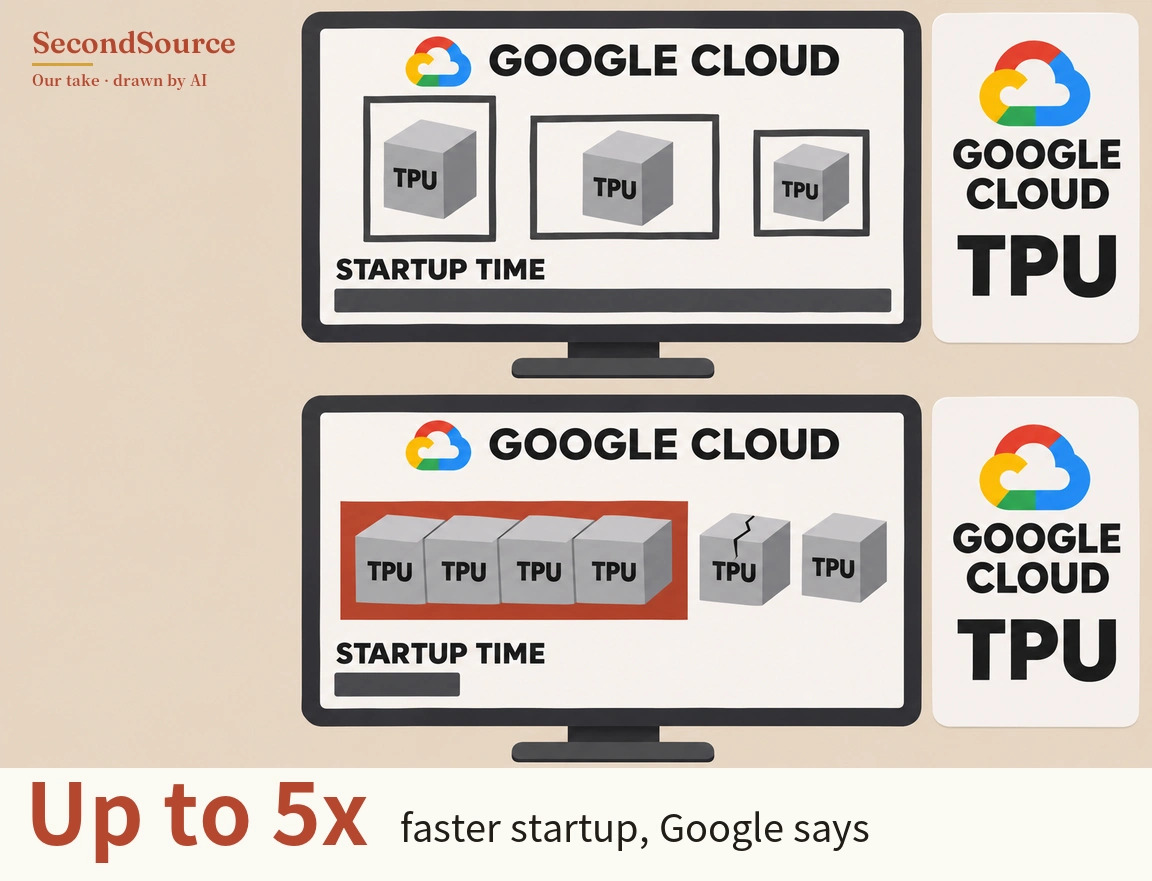
1. Google Cloud lets Kubernetes join TPU capacity into larger slices or split it into smaller ones at scheduling time, and Google says startup is up to five times faster.

Concept illustration of two monitors on stands, one above the other, each screen headed by a multicolored cloud icon and the lettering GOOGLE CLOUD, with a white card to the right of each monitor showing the same icon, GOOGLE CLOUD and a large TPU. On the upper screen three gray cubes marked TPU each sit inside their own black-outlined frame of a different size above a long dark bar labeled STARTUP TIME, while on the lower screen four TPU cubes stand side by side on a red rectangle at the left and two separate TPU cubes stand to its right, the first with a crack at its top edge, above a much shorter dark bar labeled STARTUP TIME. Printed on the image: Up to 5x faster startup, Google says.
Google Cloud lets Kubernetes join TPU capacity into larger slices or split TPU capacity into smaller ones at scheduling time, but only on reserved capacity, not on-demand or discounted Spot capacity. Google self-reports the startup and recovery multiples, compares both with building a fixed node pool for each TPU slice, and gives no test settings.

2. OpenAI listed ChatGPT Enterprise on AWS Marketplace, so companies can count eligible spending toward their AWS spending commitments, the usage they committed to AWS in advance; the conditions aren't public.(OpenAI, 2026-11-09)

From the archive
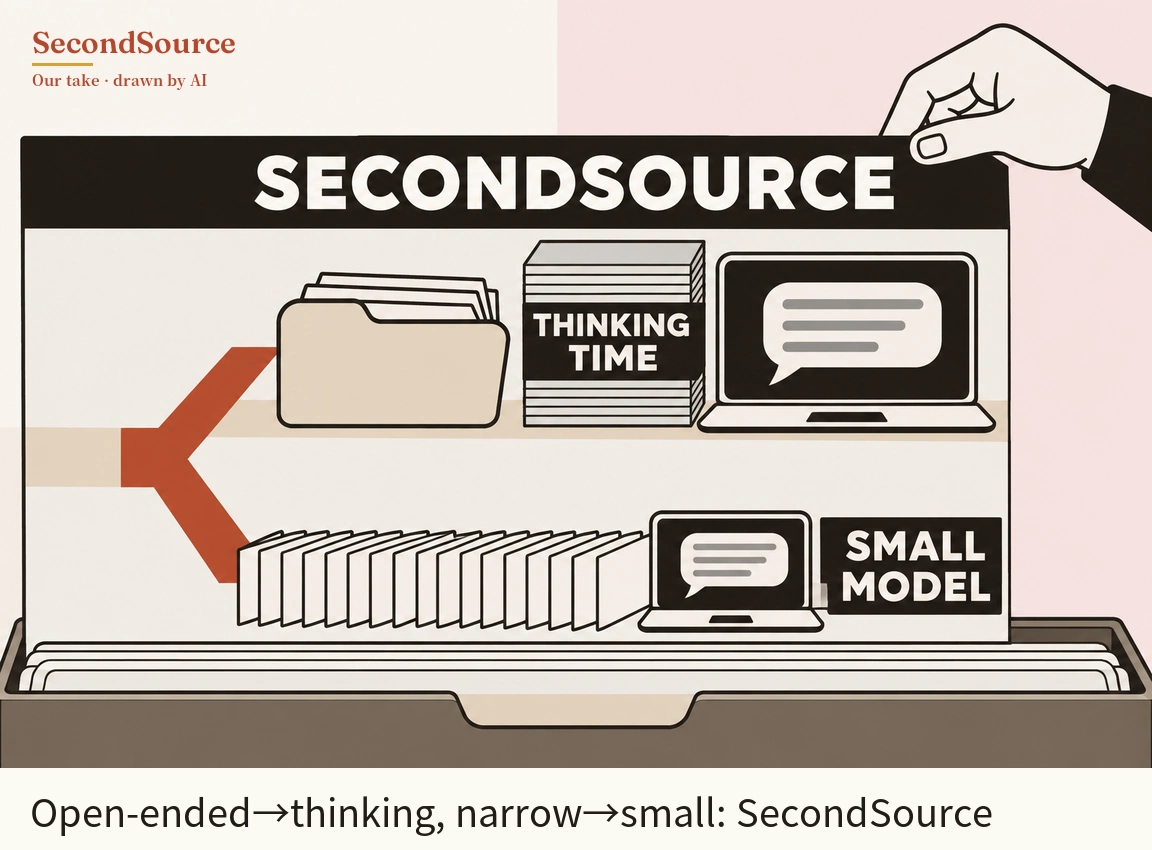
1. [Looking back] (SecondSource reading of July 14) Spending on model inference will split two ways: open-ended problems pay for thinking time, while narrow, high-frequency work moves to distilled small models.

Concept illustration: a hand at top right lifts a large card out of a brown file drawer at the bottom, and the card's black header bar is lettered SECONDSOURCE in white. On the card, a beige band from the left edge meets a red fork that splits in two: the upper branch leads to a beige folder holding papers, a thick paper stack labelled THINKING TIME and a laptop showing a speech bubble, and the lower branch leads to a long row of thin upright cards, a smaller laptop showing a speech bubble and a label reading SMALL MODEL. Printed on the image: Open-ended→thinking, narrow→small: SecondSource.
SecondSource's reading of July 14 holds that spending on model inference will split two ways, and on July 31 SecondSource turned the half on narrow, high-frequency work into a countable condition. That half of the reading weakens if named enterprises have fewer than 10 deployments in named use cases by July 14, 2027.

Also happened

1. Not verified by us yet: According to The Information, inference provider Fireworks told customers that Fireworks had been hacked and data had leaked (Stephanie Palazzolo, 2026-11-09). Fireworks issued a security notice on October 6 saying API keys and tokens stored in some accounts may have been taken; whether this is a separate incident hasn't been confirmed.

SecondSource isn't a news digest: AI reads primary sources across fields, every judgment comes with its original source, and mistakes are corrected in public. The focus is what has changed and which claims still lack evidence, not what happened today.

Written from the same research and judgments as the Traditional Chinese edition. Sources are linked; we distinguish original documents from reporting and mark what we could not verify.