Alibaba releases Qwen4-Max without opening the flagship model's weights
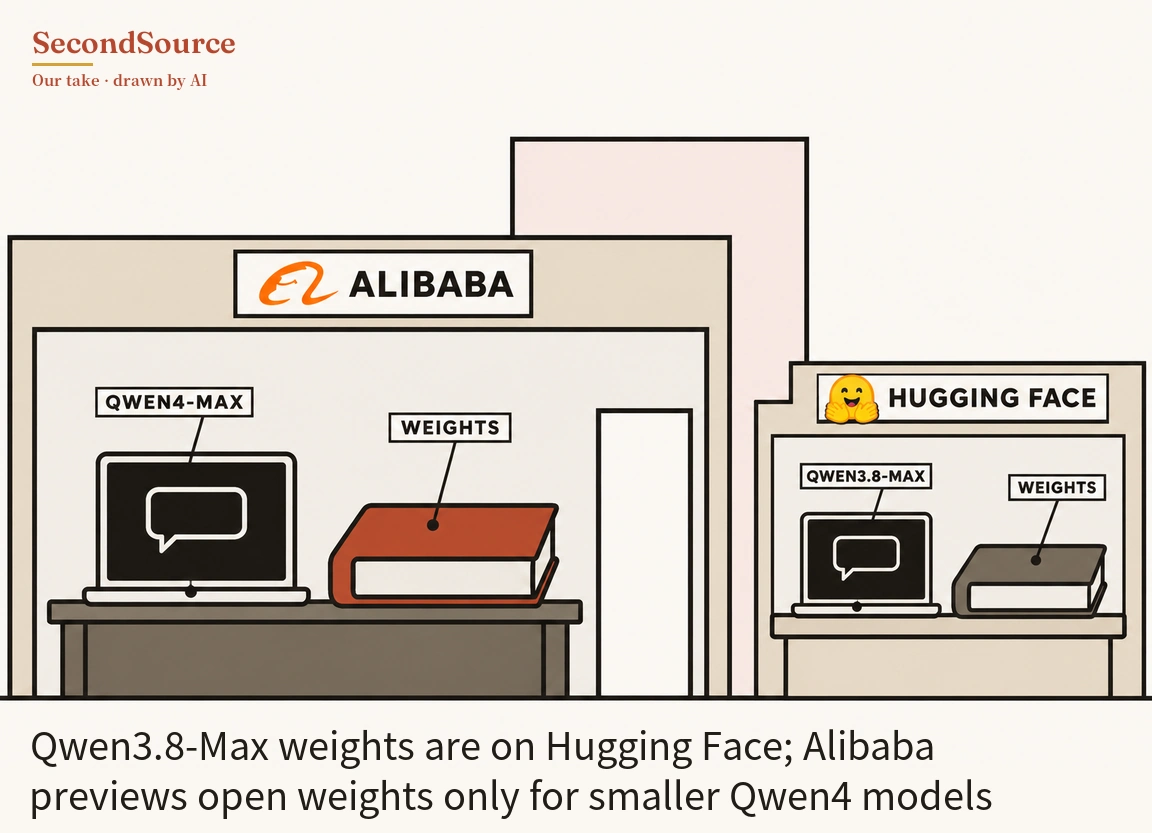
Alibaba released the full version of its flagship model Qwen4-Max on the official Qwen blog on November 16 (Qwen blog, 2026-11-16). Teams that want to self-host the flagship or fine-tune its weights can, for now, use Qwen4-Max only on Alibaba's platform.
Alibaba opened a preview version on November 11. The Qwen4-Max API is now live on QwenCloud at US$1.50 per million input tokens and US$4.50 per million output tokens, and Alibaba says both prices are below those of the previous flagship, Qwen3.8-Max (Qwen on X, 2026-11-16). The official Qwen X account's launch post for Qwen3.8-Max listed it at US$2 per million input tokens and US$6 per million output tokens. QwenCloud is Alibaba's platform for serving Qwen models. Besides the API, Qwen4-Max is also available through the platform's Token Plan subscription.
Alibaba's comparison with the previous generation uses Work360, a work-task benchmark Alibaba built for this release. Qwen4-Max scores 52.69, against 47.74 for Qwen3.8-Max. Average cost per task falls from US$4.43 to US$1.67, which Alibaba calls a 62% cut. That is spending per task on the benchmark, not a price-list reduction. Alibaba doesn't split how much of the cut comes from lower prices and how much from using fewer tokens.
Alibaba says the main network of Qwen4-Max has 2.4 trillion parameters, of which 71 billion, about 3%, are active for each token (our calculation). That makes it a sparse mixture-of-experts model.
What Alibaba open-sourced this time is a plugin called Qwen-Live-Delivery-Plugin. The plugin lets a long task hand over a usable first draft and then update it in rounds, so users can step in midway. When Alibaba launched the previous flagship, Qwen3.8-Max, it promised open weights the following week, and the weights later went up on Hugging Face. This release only previews open weights for smaller Qwen4 models and says nothing about the flagship.
Not proven yet: the cost and Work360 scores are Alibaba's own, on a benchmark Alibaba built How we checked →
Next to watch: whether Alibaba releases the weights of Qwen4-Max itself in the week after launch, the timing it promised for Qwen3.8-Max, and where third-party leaderboards place Qwen4-Max in their own tests. If the flagship's weights appear on Hugging Face, self-hosting becomes an option.
Source and checks
This item ran in the brief of Nov 16, 2026, alongside 10 other items. How we checked it, the quote checks and what was still missing that day are on that issue's How we checked page.
Cite this item
SecondSource (2026). "Alibaba releases Qwen4-Max without opening the flagship model's weights." https://secondsource.io/en/news/2026-11-16-1/. Accessed access date.