Claude Fable 5.1's share of Databricks customers' proprietary-model tokens fell from 5.5% to 0.6% in six weeks
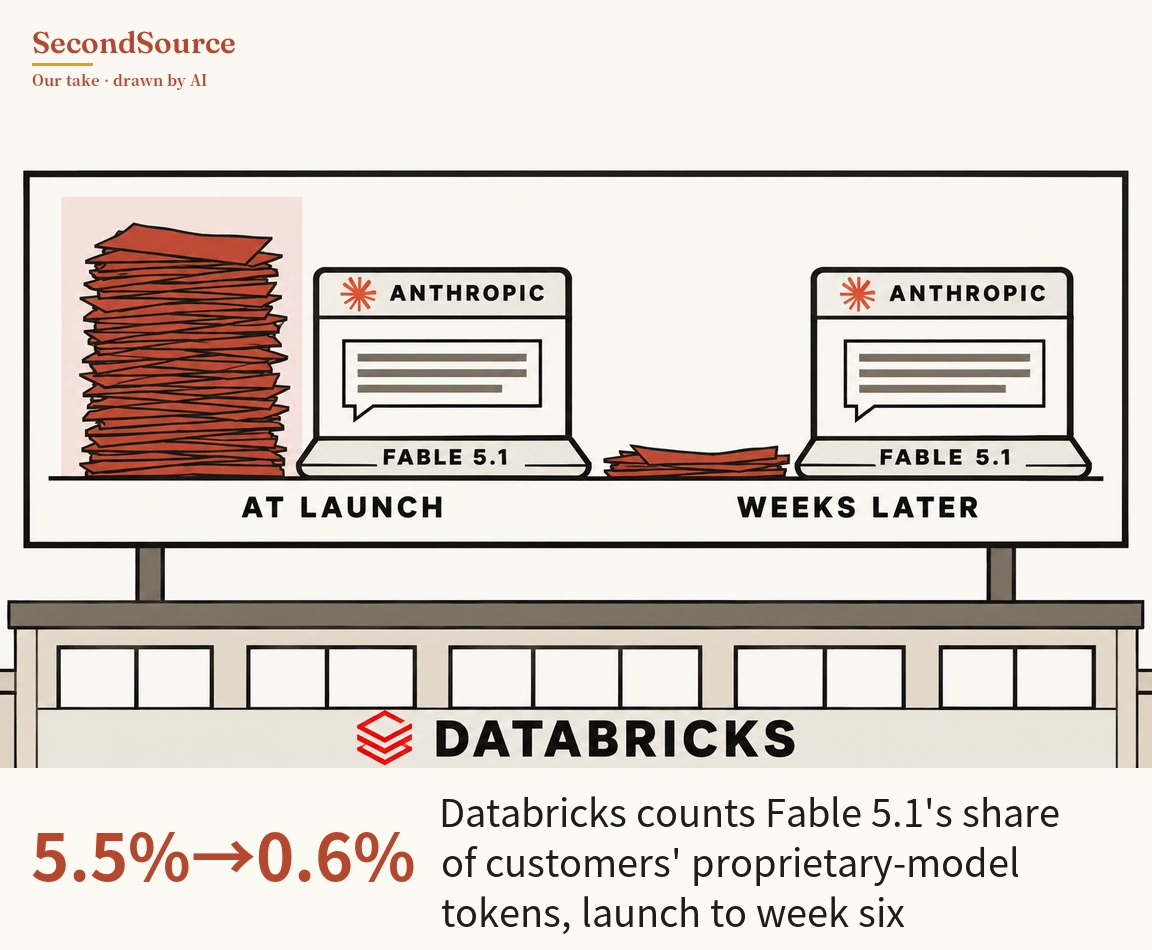
Databricks, the data and AI platform company, published its first enterprise model-usage report on November 16, tracking which models more than 10,000 enterprise customers use (Databricks, 2026-11-16). Our inference: a top-tier model with the best benchmark score but about five times the cost per task doesn't hold usage among Databricks customers.
On Databricks' coding-agent benchmark, Anthropic's top model, Claude Fable 5.1, buys a small gain in success rate at about five times the cost per task. Fable 5.1 succeeds on 96.0% of tasks at US$7.47 per task. A model called Muse Wonder succeeds on 94.9% at US$1.53 per task. The report doesn't say which company makes Muse Wonder.
Six weeks after launch, Fable 5.1's share of proprietary-model tokens had fallen from 5.5% to 0.6%. In the same report, Anthropic's next tier down, Claude Opus 5.5, rose from 7.2% to 37.9% in its first six weeks and lifted Anthropic's overall share from 57.6% to 68.8%. What fell was Anthropic's most expensive model, not Anthropic. Each model's six weeks are counted from its own launch date. The report has no data on customers switching from Fable 5.1 to Opus 5.5.
Cost per task alone doesn't explain Opus 5.5's gain. Opus 5.5 succeeds on 89.1% of the same benchmark's tasks at US$1.62 per task. GPT-6 Luna matches that success rate at US$0.05 per task. Databricks gives no share for Luna.
Anthropic's account stresses a different point: enterprises keep adopting its newest, most capable models. Anthropic's amended IPO registration statement, filed with the US Securities and Exchange Commission on November 17, says enterprises "consistently utilize our latest and most capable models as soon as they are released, gravitating to the most advanced option for their highest-value work" (Anthropic S-1/A, 2026-11-17). Anthropic attaches no measurement to that sentence. The same filing also says "Lower costs per task drive greater usage." Read together, the two sentences suggest that a low share for the top-tier model need not contradict Anthropic's account.
Fable 5.1's falling share could also reflect replacement by its successor, Fable 5.2. AWS's weekly roundup of November 16 says Fable 5.2 is available on Bedrock, Amazon's model-hosting service, with data retained for up to 30 days for safety monitoring; the roundup adds that eligible internal uses can for now have zero retention (AWS weekly roundup, 2026-11-16). The report has no share figure for Fable 5.2 among these customers. The data runs to November 7, so this explanation holds only if Fable 5.2 was available before then. Likewise, Opus 5.5's rise may simply be the new Opus replacing the previous one.
Not proven yet: every figure comes from Databricks' own customers and Databricks' own benchmark How we checked →
The benchmark uses real development tasks from Databricks' own codebase, with each model running inside a harness such as Claude Code or Codex. The benchmark covers only coding work, while the shares cover all uses. Cost per task is estimated at public list prices, without enterprise discounts. Gemini 3.8 Flash is cheap per token but averages 140 turns per task, for US$11.97 per task. The shares are measured against proprietary-model tokens only, not all tokens. The report doesn't give the number of benchmark tasks, which harness each model ran in, or the two models' launch dates.
Databricks has also switched the default for its internal Claude Code use to Opus 5.5, citing better quality and 29% lower cost per use than the previous generation; the report doesn't say which model that previous generation is. The quoted sentences from Anthropic are from the original text of Amendment No. 3 to its registration statement. The same filing says Opus 5.5 cuts customers' cost per task by about 40% against Opus 5. The filing also says the safety-monitoring requirements of some models conflict with the zero data retention some customers want, and that some customers have moved to other vendors as a result. The Fable 5.2 terms are from AWS's weekly roundup.
Next to watch: Fable 5.2's share in the Databricks report six weeks after its launch. SecondSource's test for this reading: if, by March 31, 2027, a top-tier model whose cost per task is at least three times that of the same vendor's next tier still holds more than 15% share six weeks after launch, the reading that top-tier models don't hold usage has to change.
Source and checks
This item ran in the brief of Nov 17, 2026, alongside 13 other items. How we checked it, the quote checks and what was still missing that day are on that issue's How we checked page.
Cite this item
SecondSource (2026). "Claude Fable 5.1's share of Databricks customers' proprietary-model tokens fell from 5.5% to 0.6% in six weeks." https://secondsource.io/en/news/2026-11-17-1/. Accessed access date.