SecondSourceJudgment rebuilt from primary sources

Claude Fable 5.1 share sinks; figures are Databricks' own

Source: Databricks

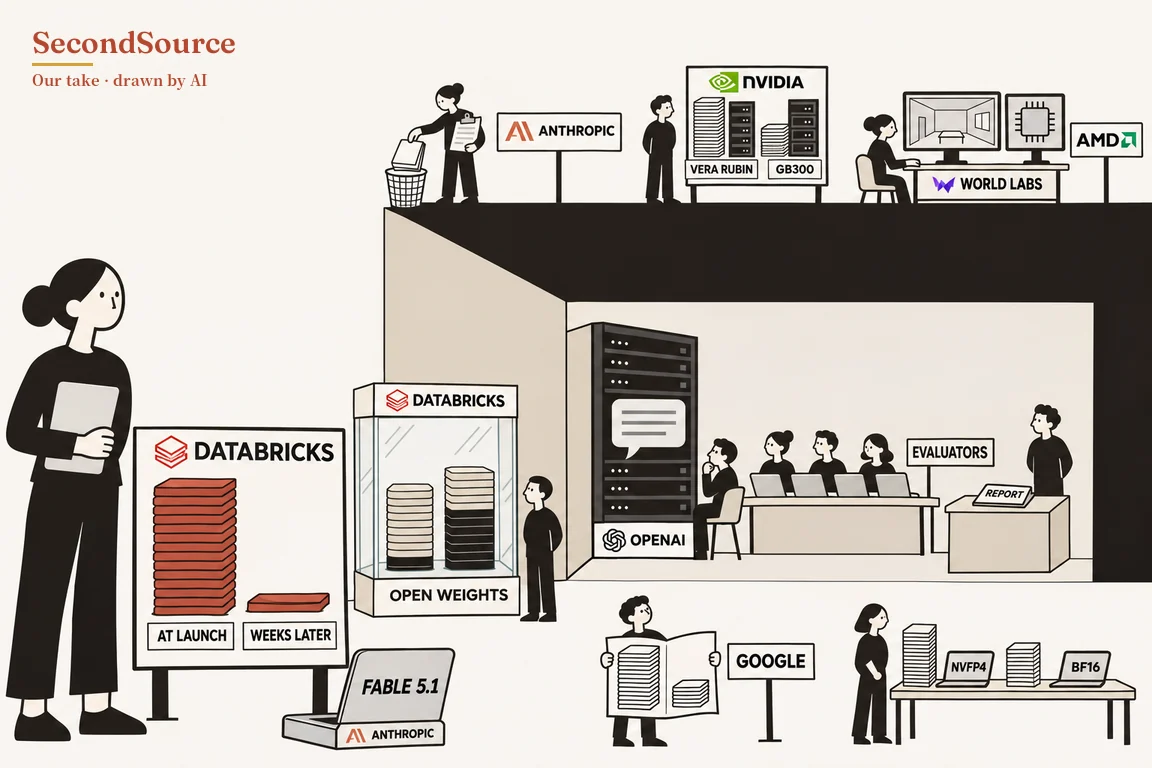
Today's front-page cartoon: one single picture that brings together today's stories.

Why today matters: One Databricks report carries two sets of numbers. One shows the share of Claude's most expensive model falling sharply, and the other shows companies connecting to more model vendors at the same time.

At a glance

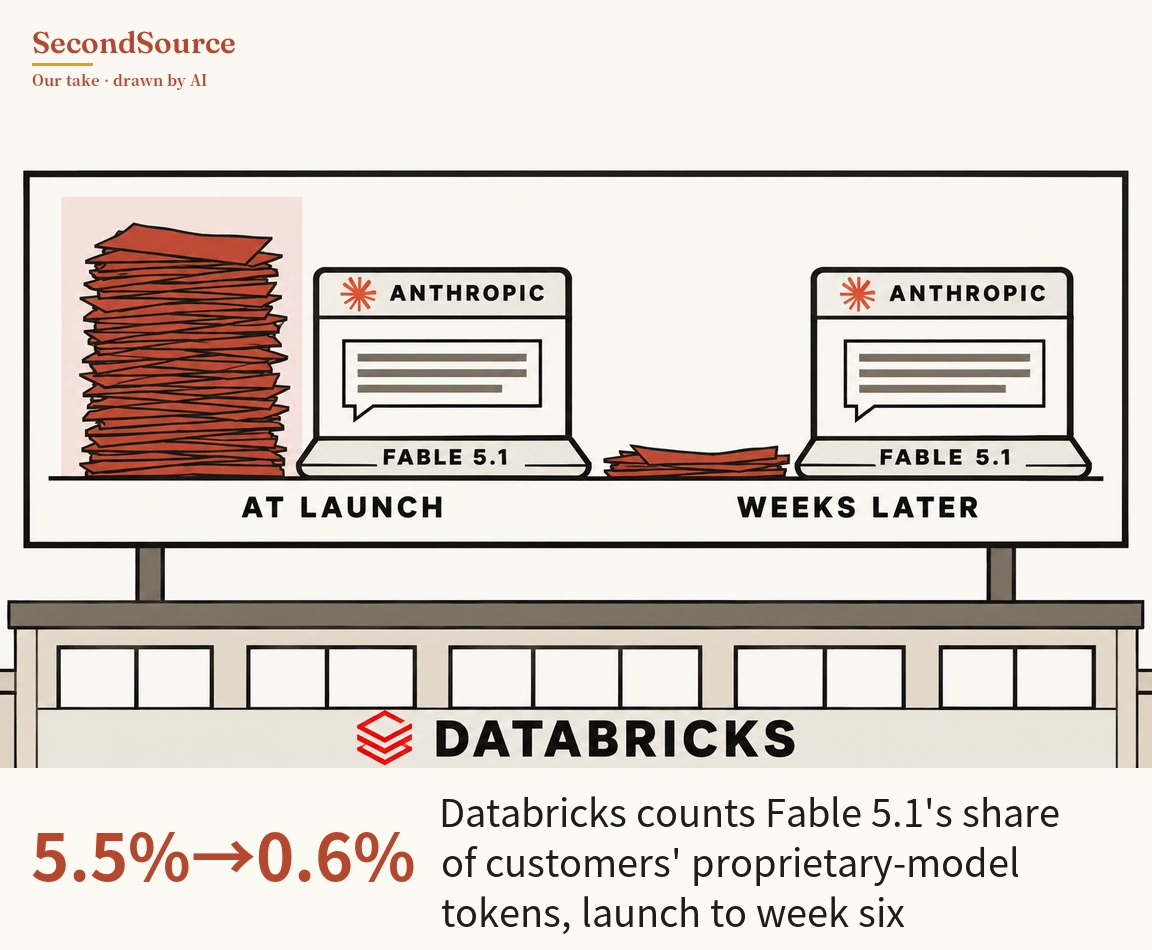
1. Claude Fable 5.1's share of Databricks customers' proprietary-model tokens fell from 5.5% to 0.6% in six weeks.

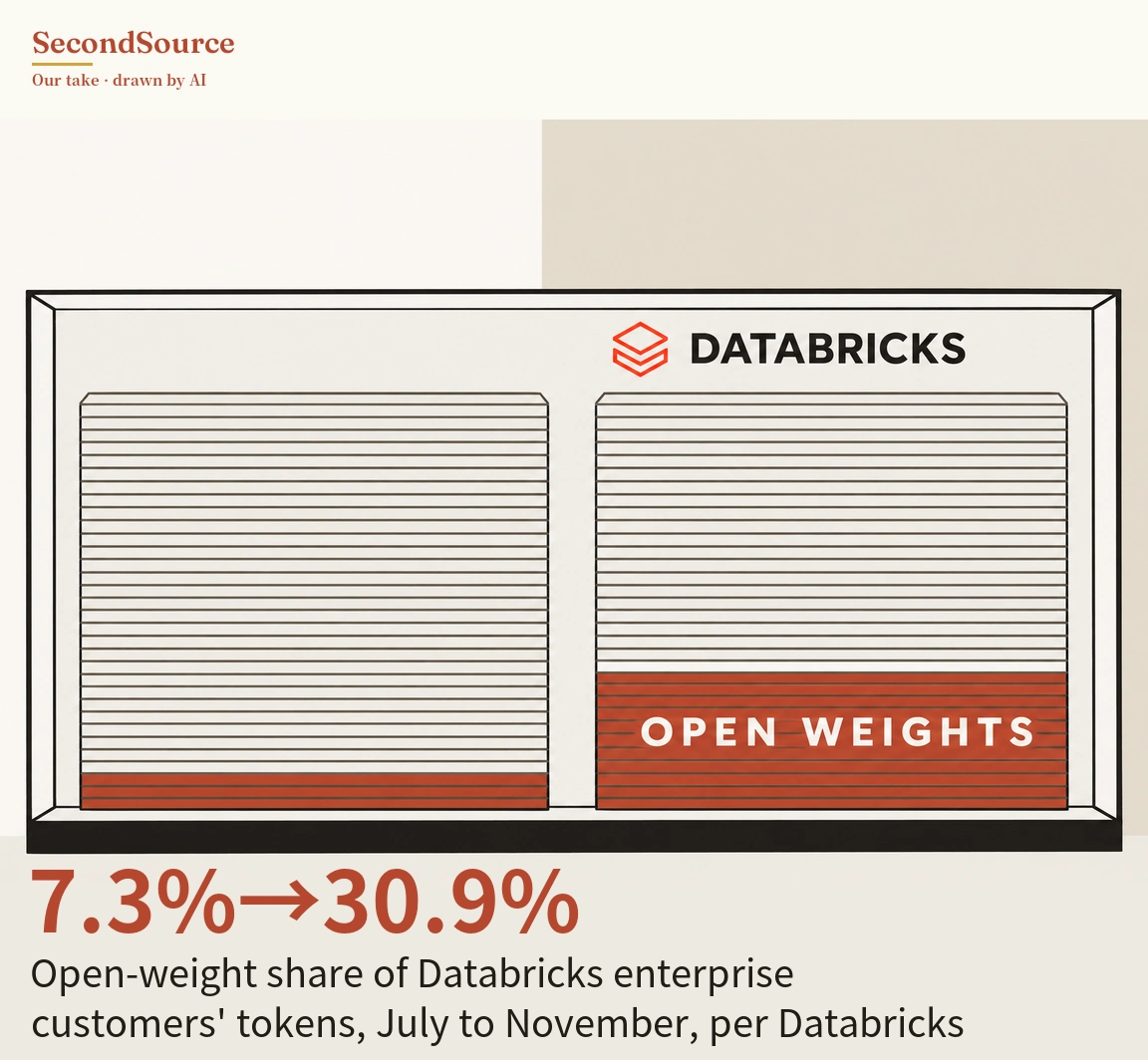
2. Open-weight models' share of Databricks customers' tokens rose from 7.3% to 30.9% in four months.

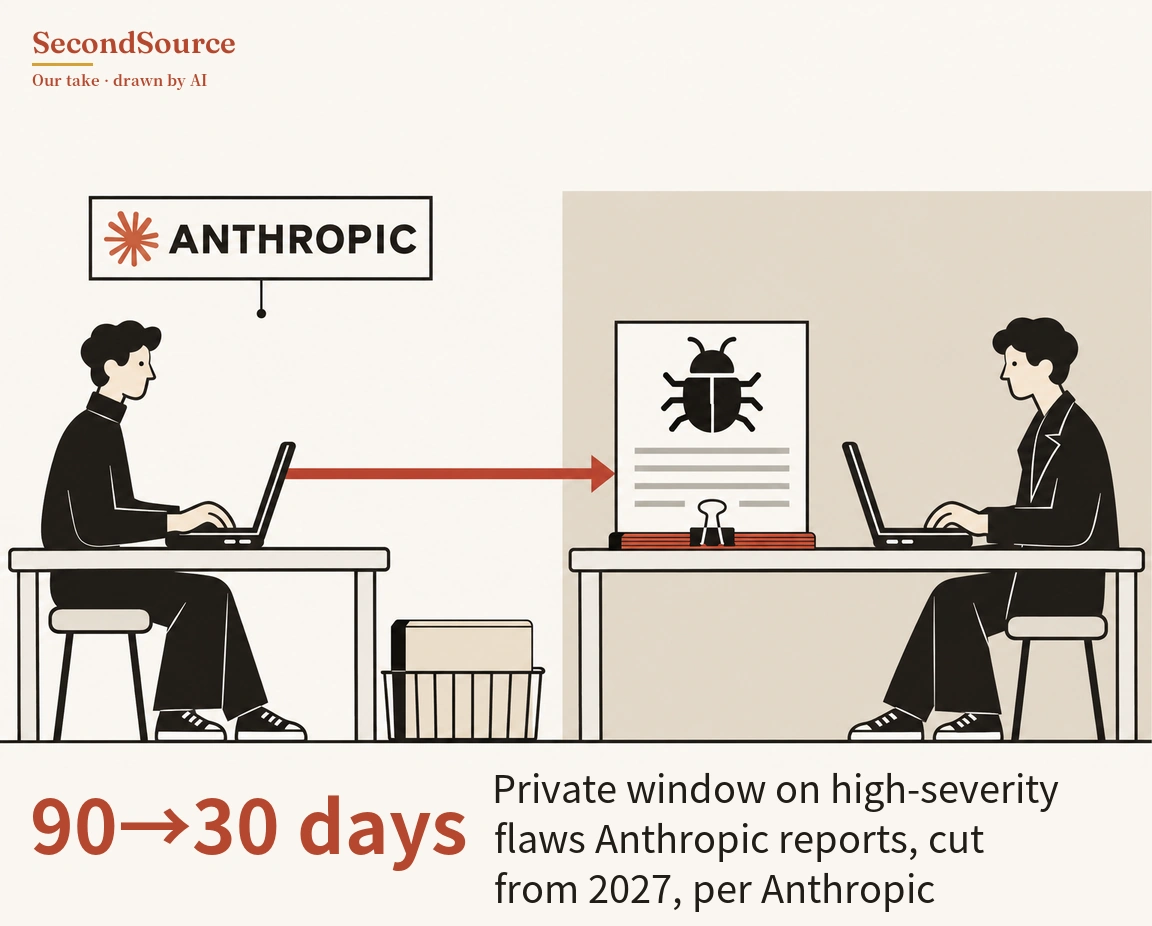
3. Anthropic shortens its disclosure deadline for high-severity vulnerabilities from 90 to 30 days from 2027.

Also today: #4 — OpenAI lets four outside evaluators examine models still in training.

Today's main line

1. Claude Fable 5.1's share of Databricks customers' proprietary-model tokens fell from 5.5% to 0.6% in six weeks

Concept illustration: a billboard stands on two posts on the roof of a building lettered DATABRICKS (with a red stacked-layer icon left of the lettering), and on it sit two matching open laptops, each screen showing a red starburst icon with the lettering ANTHROPIC at the top, a speech bubble of grey lines in the middle, and FABLE 5.1 on the base. On the left half, labelled AT LAUNCH, a tall stack of red sheets on a pale pink panel stands beside the first laptop; on the right half, labelled WEEKS LATER, only a small, low pile of red sheets lies beside the second laptop. Printed on the image: 5.5%→0.6% Databricks counts Fable 5.1's share of customers' proprietary-model tokens, launch to week six.
Databricks, the data and AI platform company, published an inaugural enterprise model-usage report on November 16, tracking which models more than 10,000 enterprise customers use, with data through November 7. All of the report's figures come from Databricks customers that use Unity Gateway, the Databricks model gateway through which these enterprises connect to several model vendors at once. The report has no data on customers switching from Claude Fable 5.1, Anthropic's top-tier model, to Claude Opus 5.5, the next tier down, and gives no share for Fable 5.1's successor, Fable 5.2, among these customers.

Our inference: a top-tier model with the best benchmark score but about five times the cost per task doesn't hold usage among Databricks customers.

In the full story: how far apart the top and next tier are, what Anthropic's filing says, and other explanations for the falling share

2. Open-weight models' share of Databricks customers' tokens rose from 7.3% to 30.9% in four months

Concept illustration: against a cream background with a beige block at the upper right, a wide white frame with a thick black outline stands on a black base, with an orange-red stacked-layers icon and black lettering reading DATABRICKS at its upper right, above two side-by-side panels of horizontal slats like roller shutters. The bottom of the left panel is a thin brick-red strip, while the bottom of the right panel is a much taller brick-red section, about a third of the panel's height, lettered OPEN WEIGHTS in white. Printed on the image: 7.3%→30.9% Open-weight share of Databricks enterprise customers' tokens, July to November, per Databricks.
In a November 16 report, Databricks compared the models enterprise customers used in July and in November, counting only companies that use Databricks' gateway. The report's closing note says the current data covers September 21 to November 7. The report doesn't explain which data the July baseline comes from.

In the full story: the open-weight share on developer platforms, how the two sets of figures differ, and what Hugging Face changed

3. Anthropic shortens its disclosure deadline for high-severity vulnerabilities from 90 to 30 days from 2027

Concept illustration: on the left, a person in black sits on a stool typing on a laptop at a desk, below a sign lettered ANTHROPIC with an orange-red asterisk-shaped mark, which hangs from a thin line above the person; a red arrow runs from that laptop to the right-hand desk, where a sheet with a black bug icon, grey lines and a binder clip at its bottom edge stands on an orange-red stack next to a second person in black, seated on a stool and typing on a laptop in front of a beige backdrop. On the floor between the two desks, a beige box sits in a wire basket. Printed on the image: 90→30 days Private window on high-severity flaws Anthropic reports, cut from 2027, per Anthropic.
On November 16, Anthropic announced new disclosure deadlines that apply only to reports Anthropic sends to vendors and open-source maintainers on or after January 1, 2027. Anthropic says the reason is that others now rediscover the same flaw more often, but the announcement gives no figure for that rate. Deadlines used by other research teams and vendors are unaffected, and issues found by AI scanning without human review are not covered by the new deadlines.

In the full story: how the usual practice works, which flaws get case-by-case timelines, and which flaws fall outside the new deadlines

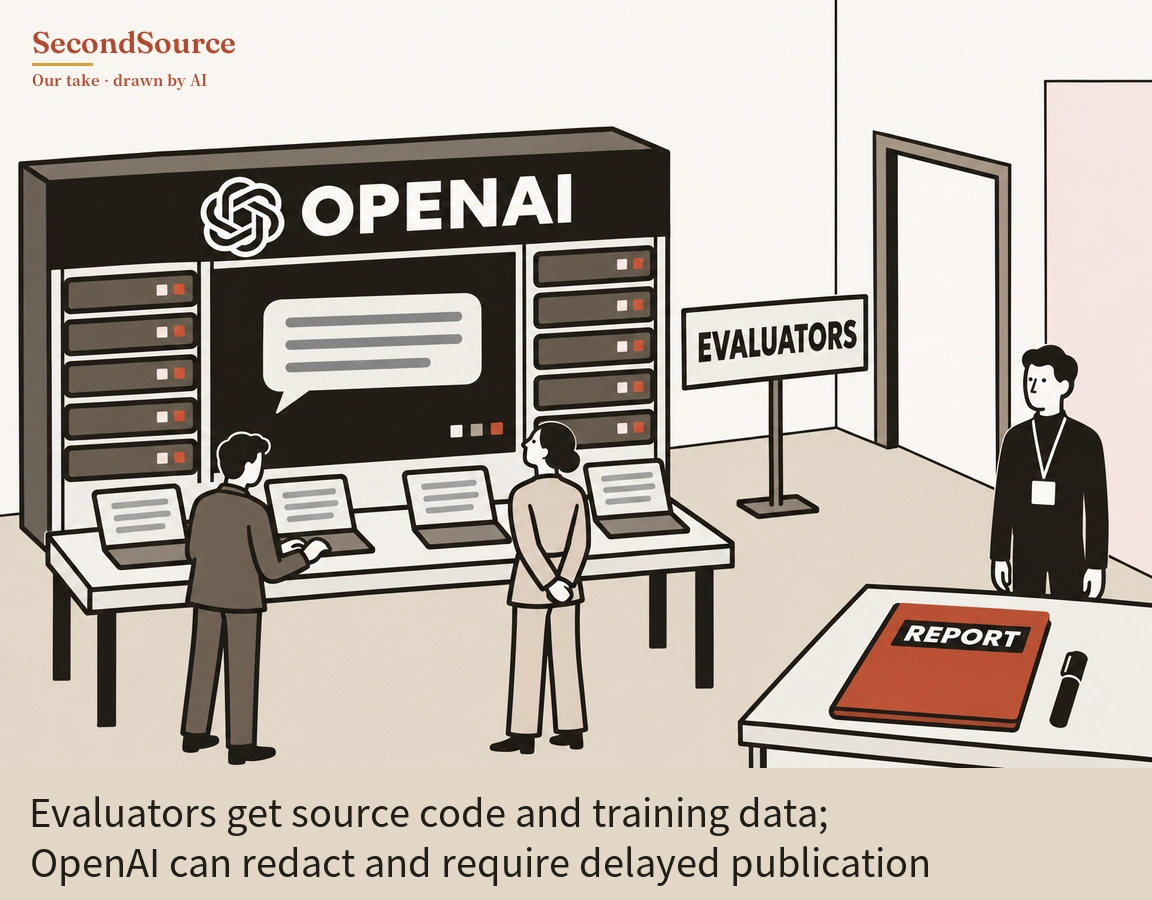
4. OpenAI lets four outside evaluators examine models still in training

Concept illustration: on the left, a large display wall lettered OPENAI beside a white interlaced knot-shaped emblem has rack-style panels with small red and white lights on both sides and a central dark screen showing a speech bubble with grey lines and three small squares; in front of it a long table holds four open laptops whose screens show grey lines, where a man in a suit types on one laptop and a woman stands with her hands behind her back, looking up at the screen. On the right, a sign on a stand lettered EVALUATORS stands in front of a doorway, and a man in dark clothes wearing a badge on a lanyard stands behind a foreground desk that holds a red folder lettered REPORT and a black pen. Printed on the image: Evaluators get source code and training data; OpenAI can redact and require delayed publication.
OpenAI announced on November 16 the first phase of "embedded assessments," in which four outside evaluation groups work inside OpenAI examining internal models still in training. Under the terms OpenAI published, what employees say in interviews may not be quoted publicly, and disputes go to the safety committee of the OpenAI Foundation's board. For METR, a group that evaluates AI autonomy and monitoring, the scope of the monitoring evaluation is still to be negotiated.

In the full story: what each of the four groups examines, which powers OpenAI keeps, and how outside observers reacted

Chips & semiconductors

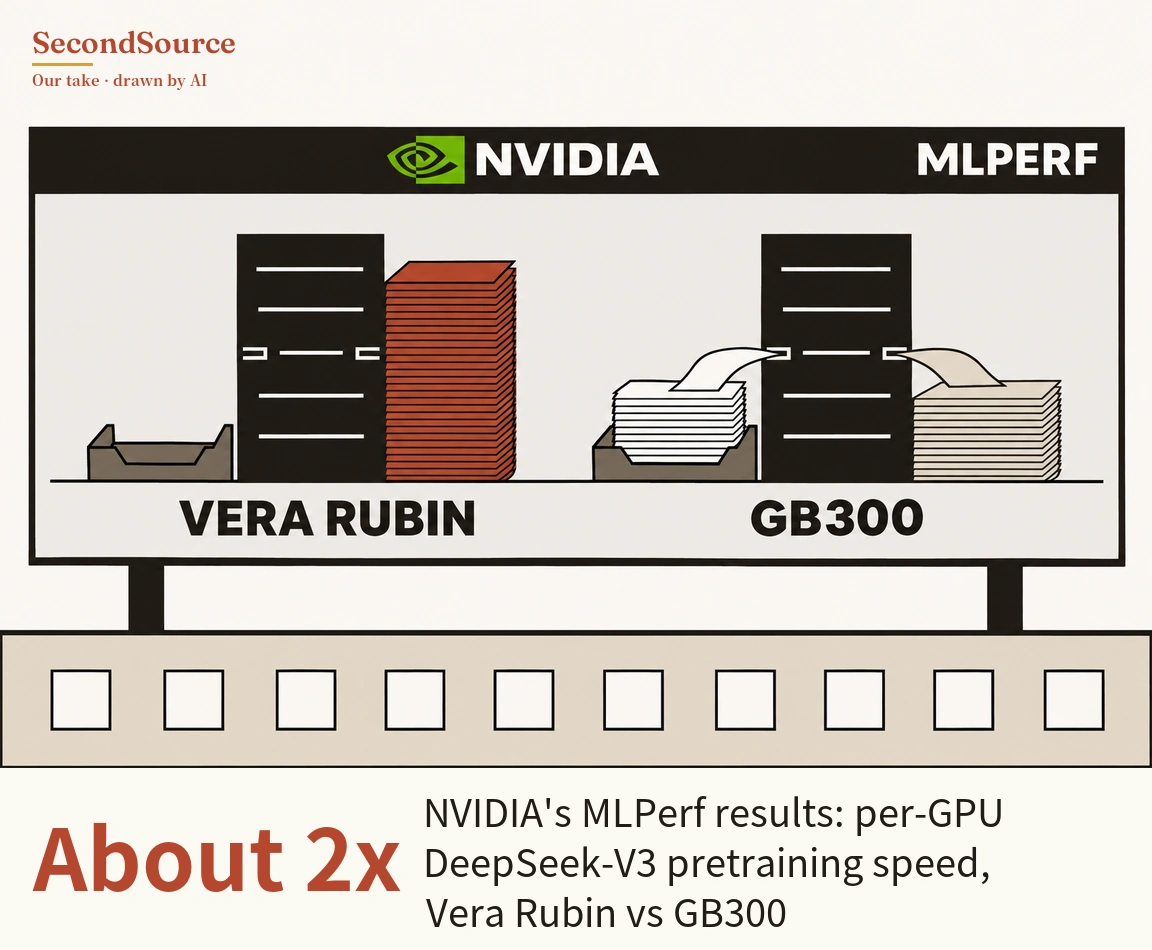
1. NVIDIA published MLPerf results on November 16 showing Vera Rubin NVL72 at about twice the per-GPU pretraining speed of the previous-generation GB300 on the DeepSeek-V3 test.

Concept illustration: a billboard on two black posts above a beige building with a row of square windows, its black top band carrying a green square icon, the word NVIDIA and, at the right, MLPERF. On the board's left, above the letters VERA RUBIN, a tall black cabinet with white horizontal lines stands between an empty tray and a stack of red sheets nearly as tall as the cabinet; on the right, above the letters GB300, a matching cabinet has a sheet curling into it from a tray of white sheets and a sheet curling out of it onto a much shorter stack of beige sheets. Printed on the image: About 2x NVIDIA's MLPerf results: per-GPU DeepSeek-V3 pretraining speed, Vera Rubin vs GB300.
NVIDIA published results on November 16 from MLPerf, the training and inference benchmark maintained by the industry consortium MLCommons, comparing Vera Rubin NVL72 with the previous-generation GB300 on the DeepSeek-V3 pretraining test with 1,024 GPUs on each side. NVIDIA also claims more than 10 times GB300's inference throughput per watt, but in the inference test Vera Rubin served 1,024 concurrent requests against 48 for GB300, and MLCommons hasn't yet verified the inference results.

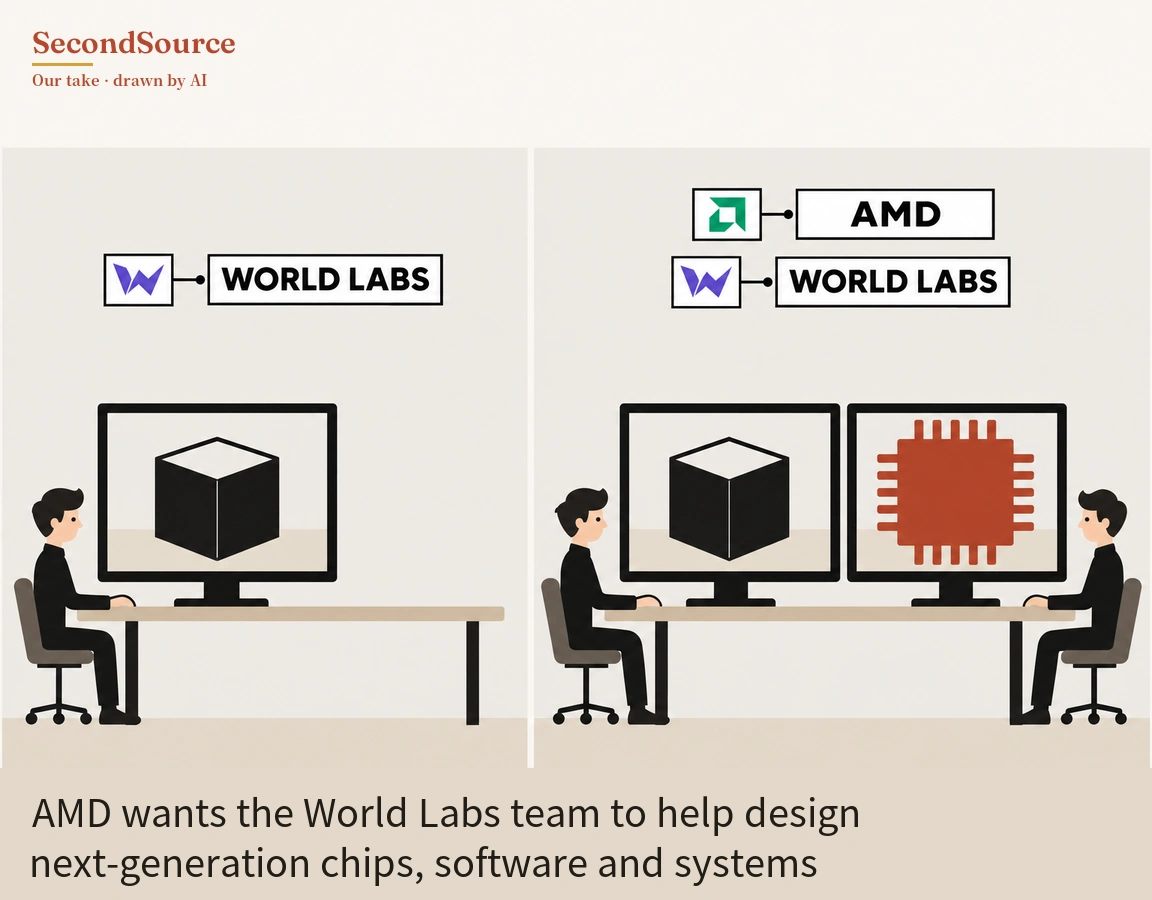
2. AMD announced on November 16 that it has completed its acquisition of World Labs, and co-founder Fei-Fei Li joins AMD as executive vice president and chief scientist.

Concept illustration in two side-by-side panels: on the left, a square icon with a purple zigzag mark is linked by a short line to a box lettered WORLD LABS, and below it a dark-haired person in black sits on an office chair at a desk, facing a monitor that shows a black cube. On the right, a square icon with a green angular mark is linked by a line to a box lettered AMD, above the same purple-icon WORLD LABS box; below them, two people in black sit at opposite ends of one long desk with two monitors side by side, the left person facing the monitor that shows the black cube and the right person facing the monitor that shows a red-orange chip with pins along its edges. Printed on the image: AMD wants the World Labs team to help design next-generation chips, software and systems.
AMD announced on November 16 that AMD has completed the acquisition of World Labs, which builds models for 3D environments and robot simulation, and that World Labs co-founder Fei-Fei Li joins AMD as executive vice president and chief scientist. The AMD press release doesn't give the deal value or details of regulatory approval.

3. NVIDIA announced Rubin HPC, a separate GPU for scientific simulation due in 2028, with precision, power and price not yet disclosed.(NVIDIA, 2026-11-16)

Named commentary

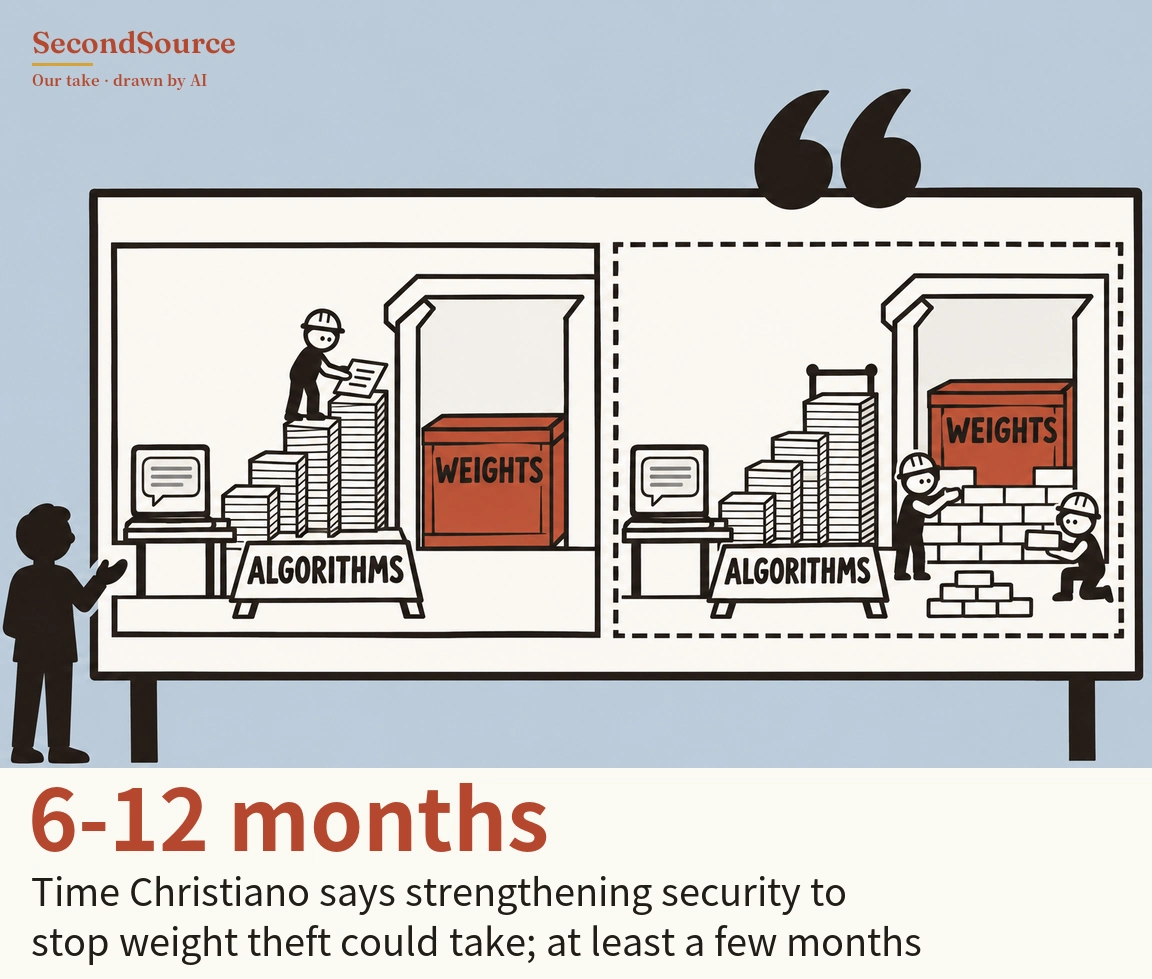
1. Paul Christiano, an OpenAI board member who heads ARC, a group researching how to make AI act on human intent, argues on the Dwarkesh Podcast that frontier labs should pause algorithmic progress until their security can stop the theft of weights and algorithms.

Concept illustration: on a light blue background, a dark silhouetted figure at the left holds an open hand toward a white board on two posts with a large black opening quotation mark on its top edge, and the board holds two side-by-side panels, a solid-bordered left one and a dashed-bordered right one, each with a desk and a monitor showing a speech bubble, four rising stacks of paper on a bench lettered ALGORITHMS, and a red box lettered WEIGHTS inside a large open doorway frame. In the left panel a worker in a hard hat stands on the second-tallest stack holding a sheet of paper toward the tallest one, while in the right panel no one is on the stacks, a small rail sits on top of the tallest stack, and two hard-hatted workers, one standing and one kneeling, lay a brick wall that covers the lower part of the box, beside a small pile of bricks on the floor. Printed on the image: 6-12 months Time Christiano says strengthening security to stop weight theft could take; at least a few months.
Paul Christiano, an OpenAI board member who heads ARC, a group researching how to make AI act on human intent, argues on the Dwarkesh Podcast that frontier labs should pause algorithmic progress until the labs' security can stop the theft of weights and algorithms. This is Christiano's personal position, and the probability Christiano attaches to superintelligence within a year is a subjective estimate with no model behind it.

Research & models

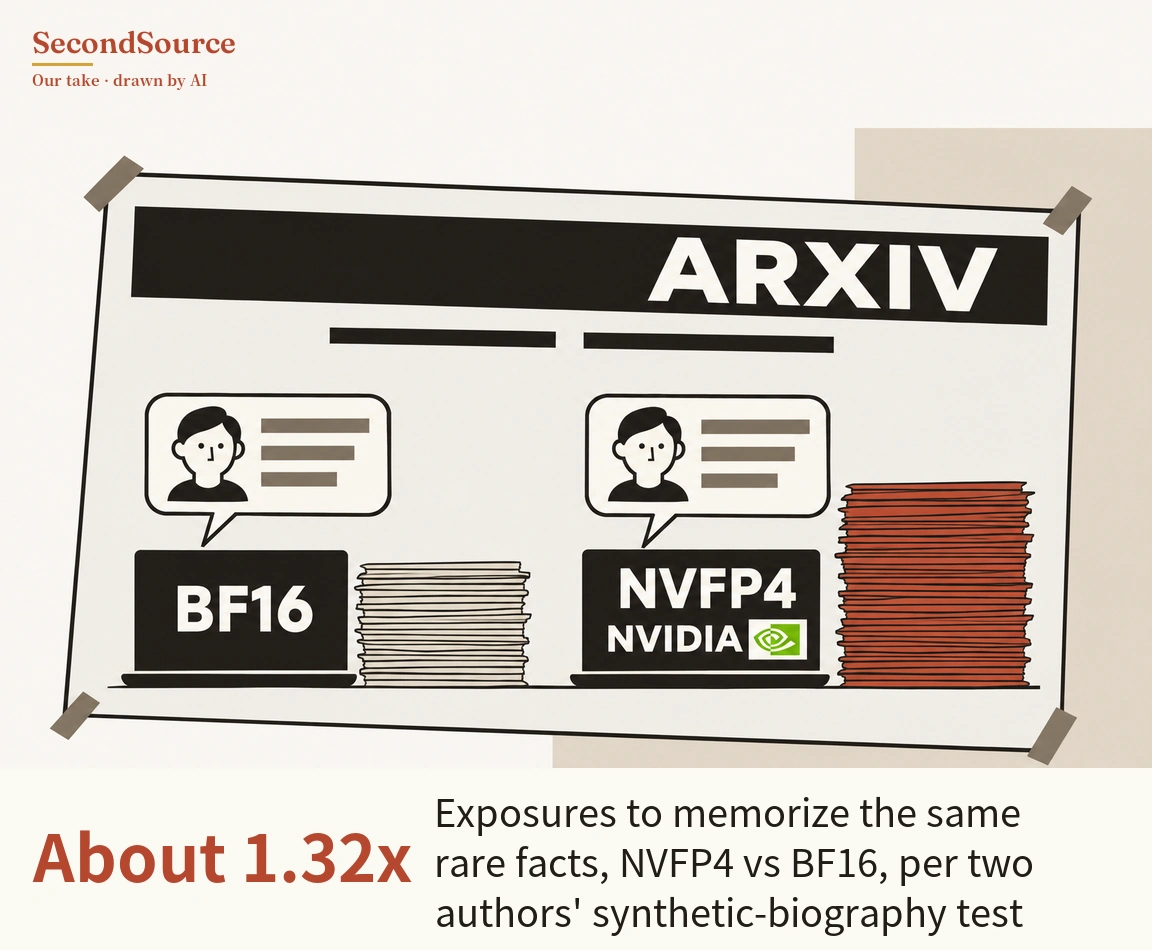
1. According to the paper's abstract, two authors report that pretraining from scratch in NVFP4, NVIDIA's 4-bit format, leaves validation loss only 0.5% above BF16, but the model needs about 1.32 times as many exposures to memorize the same rare facts.

Concept illustration: a sheet of paper taped by its four corners to a light wall, partly in front of a beige panel, with a black bar across its top lettered ARXIV and two short black lines beneath it. On the left half a laptop with a black screen lettered BF16 sits beside a short stack of white papers, and on the right half a laptop whose screen is lettered NVFP4 and NVIDIA with a small green square icon sits beside a taller stack of brick-red papers; above each laptop a rounded speech bubble, its tail pointing down to the laptop, holds a cartoon head-and-shoulders figure of a person with short dark hair and three grey lines. Printed on the image: About 1.32x Exposures to memorize the same rare facts, NVFP4 vs BF16, per two authors' synthetic-biography test.
According to the paper's abstract, two authors report that pretraining from scratch in NVFP4, NVIDIA's 4-bit format, leaves validation loss only 0.5% above BF16. The result comes from a controlled experiment on synthetic biographies, with a model size the abstract does not give.

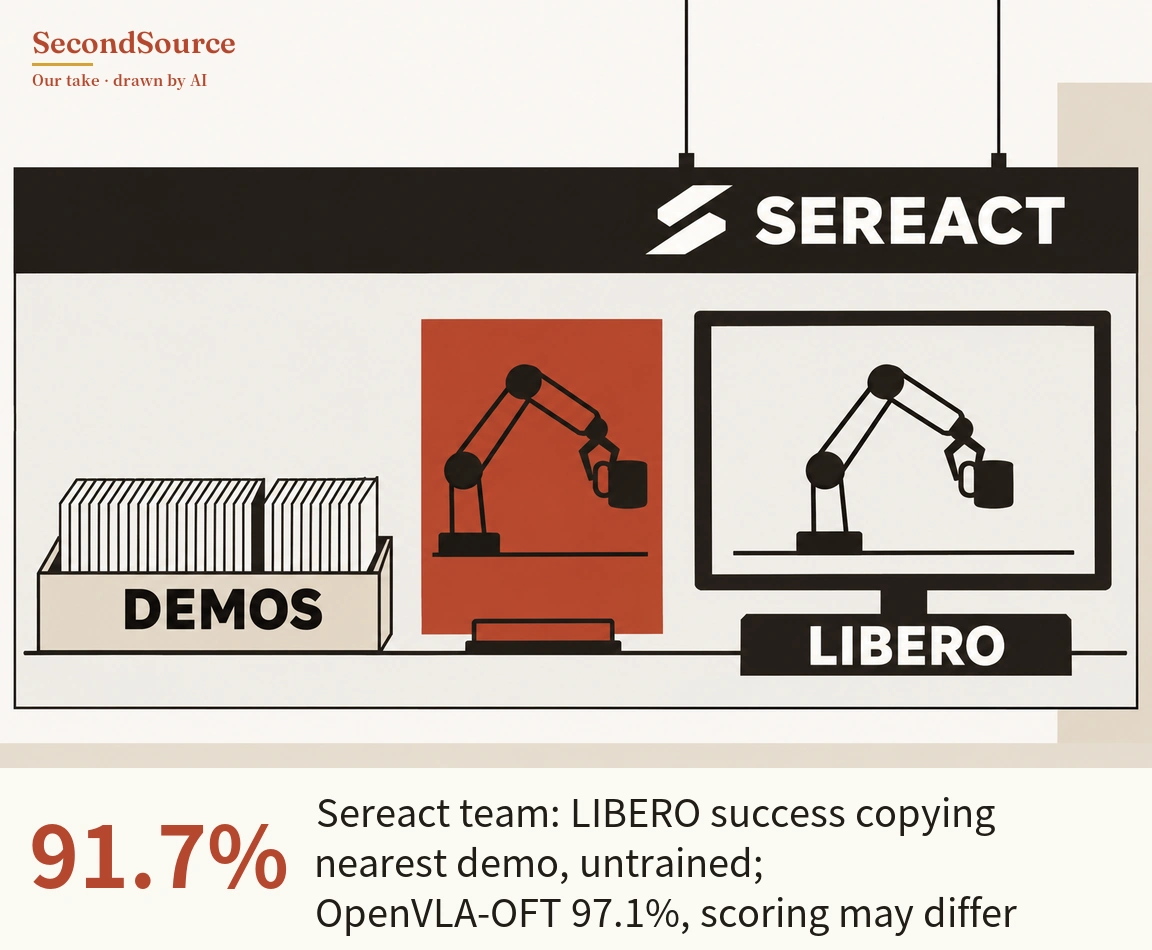
2. According to the paper's abstract, three authors report that a robot that trains no policy and simply copies the actions of the nearest demonstration reaches a 91.7% success rate on the LIBERO simulation benchmark.

Concept illustration: a wide board hangs from two thin cables, and its black top strip is lettered SEREACT in white, with a white angular mark to the left of the word. Along a line at the bottom of the board stand, from left to right, a beige open box lettered DEMOS holding two groups of thin white upright sheets, a red-orange panel on a small low stand showing a black robot arm gripping a mug, and a monitor whose base is lettered LIBERO, its screen showing a nearly identical black robot arm that also grips a mug. Printed on the image: 91.7% Sereact team: LIBERO success copying nearest demo, untrained; OpenVLA-OFT 97.1%, scoring may differ.
Three authors from the Sereact team had a robot train no policy and simply copy the actions of the nearest demonstration on LIBERO, a benchmark that tests robots in simulation, and report the success rate, according to the paper's abstract. The abstract does not say which task suites were tested or how many trials were run, and has no real-robot results.

Product moves

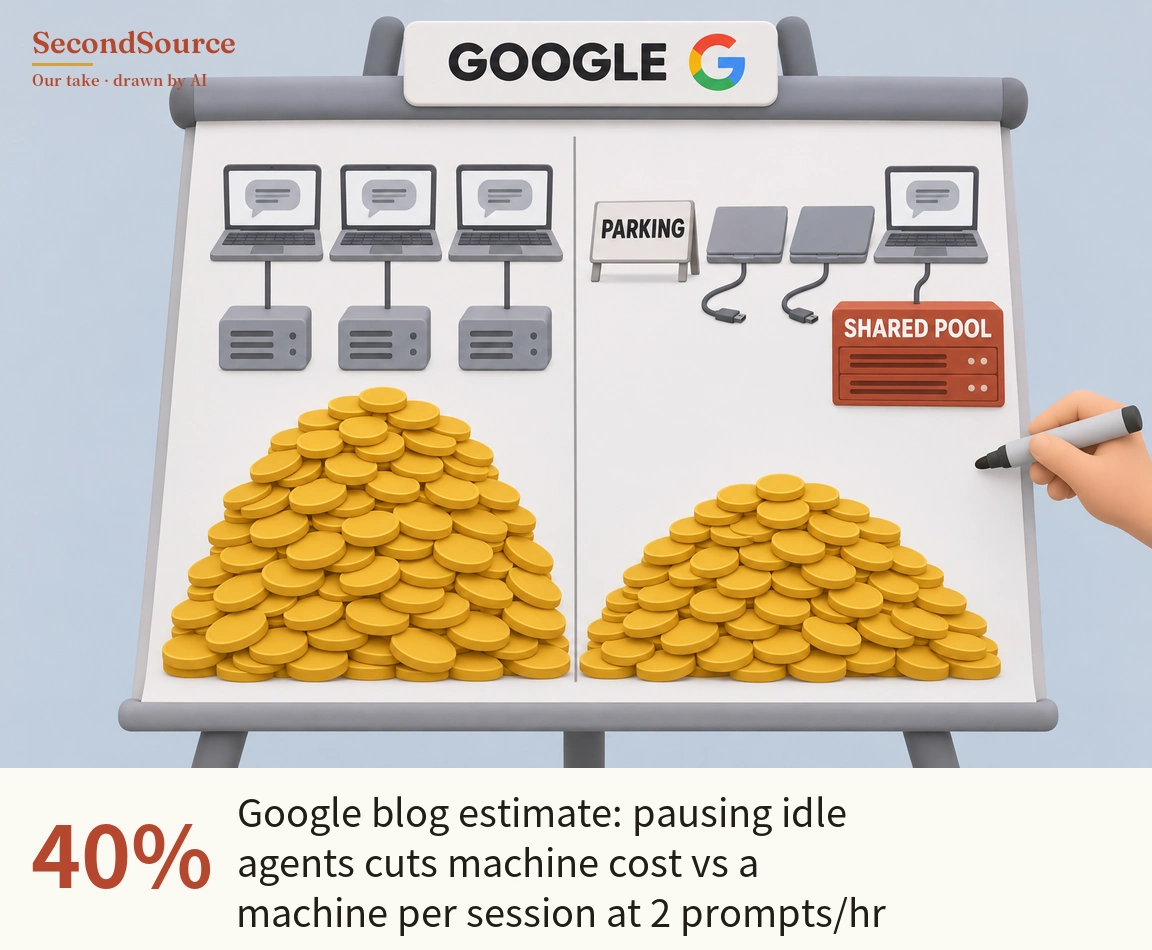
1. A Google developer blog post estimates that pausing a coding agent after two idle minutes and returning its machine to a shared pool, which the author calls "parking," saves 40% on machine costs against one machine per session at 2 prompts an hour, and only 4% at 4 prompts an hour.

Concept illustration of a whiteboard on an easel topped by a sign lettered GOOGLE beside a multicoloured G, the board split by a vertical line; on the left, three open laptops showing speech-bubble icons are each wired to their own grey server-style box above a large pile of gold coins. On the right, next to a small sign lettered PARKING, two closed grey laptops have cables ending in unconnected plugs, one open laptop with a speech-bubble icon is wired to a red box lettered SHARED POOL, and a smaller pile of gold coins lies below, while a hand holding a marker reaches toward the board from the right edge. Printed on the image: 40% Google blog estimate: pausing idle agents cuts machine cost vs a machine per session at 2 prompts/hr.
A Google developer blog post estimates machine costs for what the author calls "parking": pausing a coding agent after two idle minutes and returning the agent's machine to a shared pool. The rate of 2 prompts an hour in the estimate is the author's assumption, and the author says prompt frequency is the least certain input in the whole estimate.

2. Perplexity, the AI search company, launched Frontier Research, whose scope includes pretraining, with more than 10,000 GPUs of compute; the post doesn't give the GPU model or whether Perplexity owns them.(Perplexity, 2026-11-16)

3. OpenAI switched its free plan for academic researchers from Pro to Plus and doubled its enrollment target to 200,000, saying most pilot users stayed within Plus limits.(OpenAI, 2026-11-16)

Also happened

1. Not verified by us yet: An AMD press release says Lux, an AMD-powered supercomputer at the US Oak Ridge National Laboratory, has opened to scientific users and ranks 14th on today's global TOP500 supercomputer list (AMD press release, 2026-11-16).

Sections with nothing new this issue

From the archive

SecondSource isn't a news digest: AI reads primary sources across fields, every judgment comes with its original source, and mistakes are corrected in public. The focus is what has changed and which claims still lack evidence, not what happened today.

Written from the same research and judgments as the Traditional Chinese edition. Sources are linked; we distinguish original documents from reporting and mark what we could not verify.