NVIDIA published MLPerf results on November 16 showing Vera Rubin NVL72 at about twice the per-GPU pretraining speed of the previous-generation GB300 on the DeepSeek-V3 test.
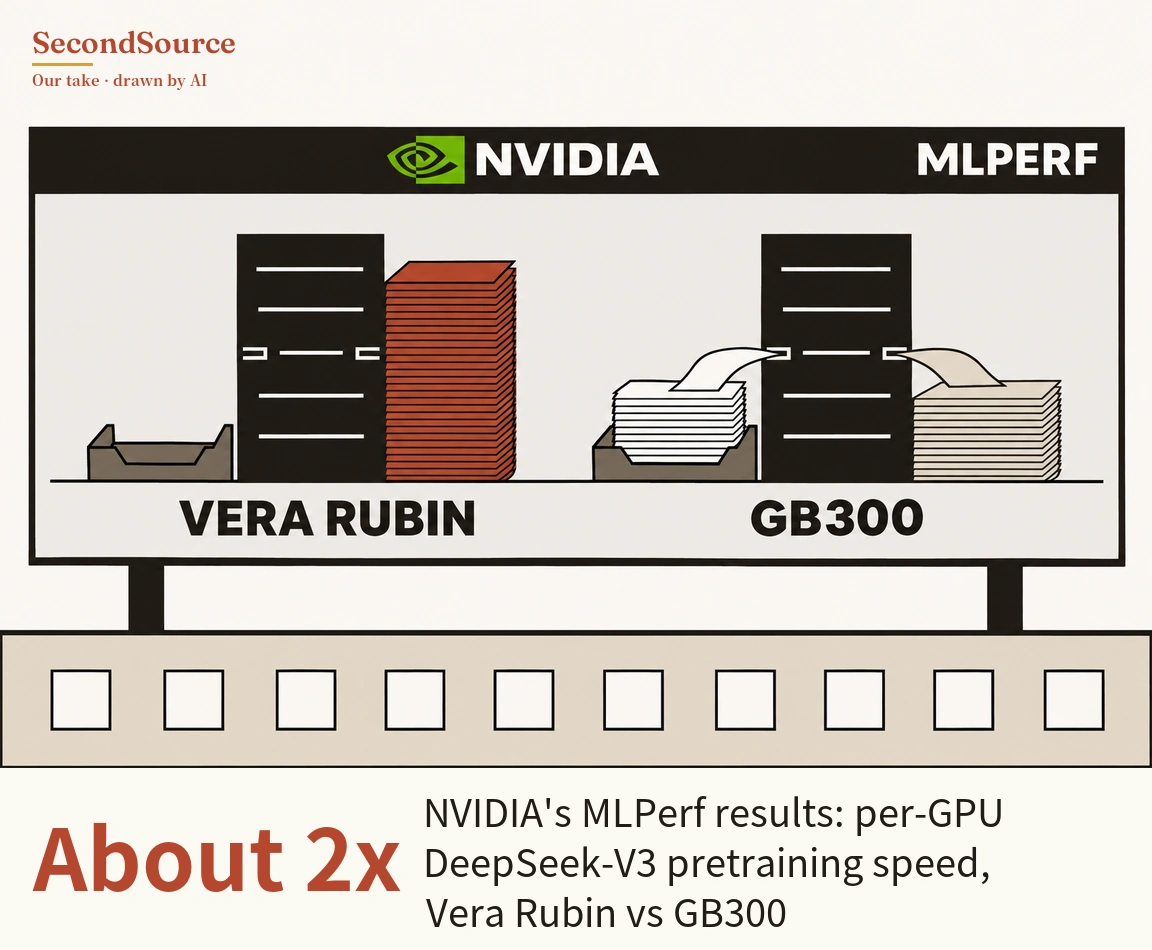
NVIDIA claims more than 10 times the inference throughput per watt, but Vera Rubin served 1,024 concurrent requests against 48 for GB300, and MLCommons hasn't yet verified the inference results. MLPerf is the training and inference benchmark maintained by MLCommons, an industry consortium. In the training test, both systems used 1,024 GPUs: Vera Rubin finished in 4.14 minutes, GB300 in 8.03 (NVIDIA, 2026-11-16). The "2.7 times" that CoreWeave, another GPU cloud, published the same day is a ratio of DeepSeek-V3 training times with 256 GPUs on each side, and it compares against the older GB200, not GB300 (CoreWeave, 2026-11-16). The inference results use a new benchmark, MLPerf Endpoints, running agent work on the open-weight model Kimi K3. Vera Rubin used 32 accelerators to serve 1,024 concurrent requests, and GB300 used 48 to serve 48, and each system kept about 50 tokens per second per user (NVIDIA technical blog, 2026-11-16). The two sides' concurrent request counts differ by a factor of 21 (our calculation). From NVIDIA's published throughput and power, Vera Rubin outputs about 410 tokens per second per kW and GB300 about 37, roughly 11 times (our calculation). Vera Rubin is slower to the first token: its P90 time to first token is 4,673.9 milliseconds, against 2,305.1 for GB300. How we checked →
Source and checks
This item ran in the brief of Nov 17, 2026, alongside 13 other items. How we checked it, the quote checks and what was still missing that day are on that issue's How we checked page.
Cite this item
SecondSource (2026). "NVIDIA published MLPerf results on November 16 showing Vera Rubin NVL72 at about twice the per-GPU pretraining speed of the previous-generation GB300 on the DeepSeek-V3 test.." https://secondsource.io/en/news/2026-11-17-5/. Accessed access date.