Anthropic offers dreaming, which consolidates agent memory offline, as a research-preview API in Managed Agents. In the same research post's own test, Opus 5 with memory raised its average score on CL-Bench database tasks from 0.564 to 0.828; those numbers compare memory with no memory, not dreaming itself.
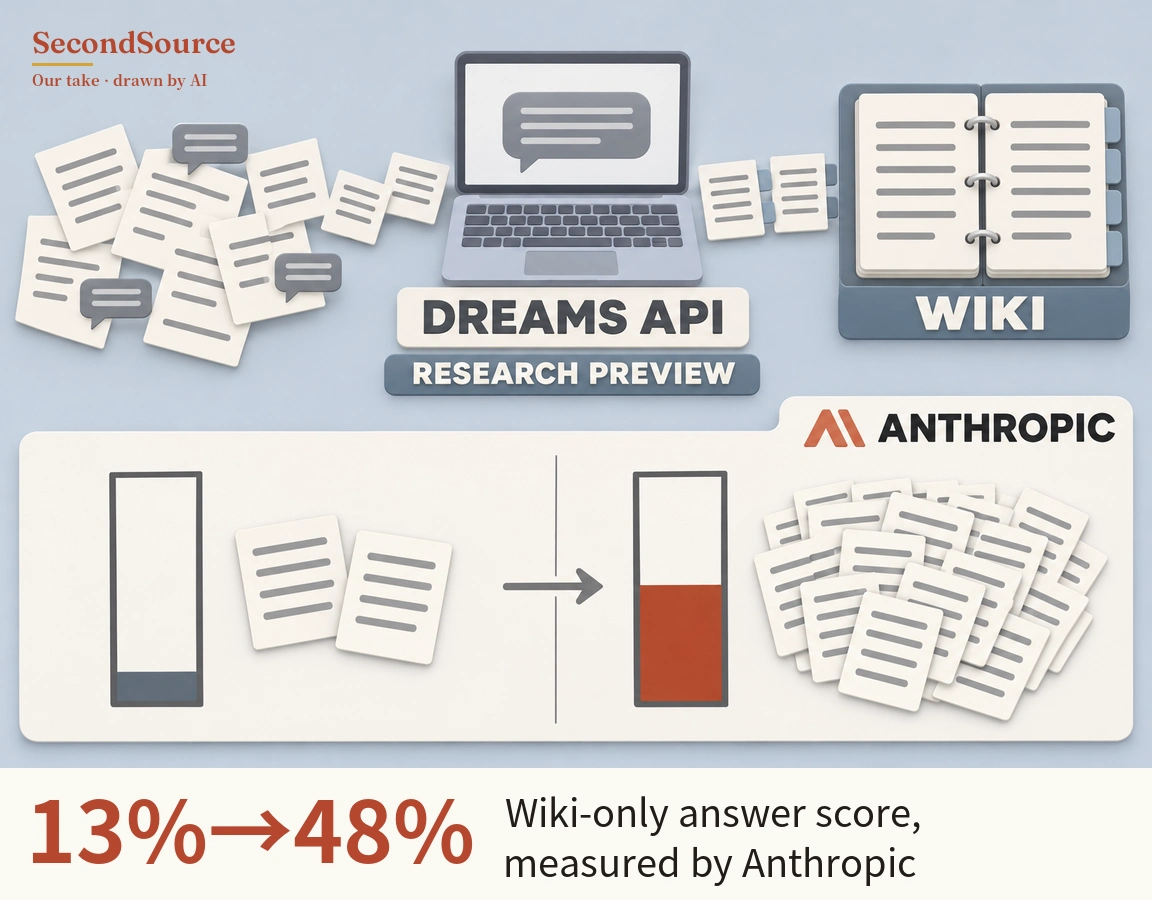
Anthropic is treating agent memory as work an agent also does between jobs, not only during them, and gives no figure for what that extra inference costs. The Dreams API bills at the chosen model's token rates. Anthropic's November 6 research post splits agent memory into two jobs. One is writing notes in real time during work. The other, between jobs, uses the raw conversation logs to verify, merge and correct the notes and build a wiki, which Anthropic calls dreaming (Anthropic, 2026-11-06). CL-Bench 1.0 is a benchmark of how agents use memory on long tasks: Opus 5 scores 0.564 without memory and 0.828 with it. Adding a rule to Opus 5 to "remember only failures" cut the score by 0.234, wiping out most of the gain from memory. Dreaming itself is tested in a separate experiment. Anthropic took about 350,000 documents from Stainless, a software company Anthropic acquired, and wrote 25 questions. Answering from the wiki alone, the score rose from 13% to 48% as dreaming expanded from 2 sessions to 128. The Dreams API is open as a research preview and is not eligible for zero data retention (Dreams documentation). Each benchmark measures something different, so they can't be compared side by side. How we checked →
Source and checks
This item ran in the brief of Nov 7, 2026, alongside 13 other items. How we checked it, the quote checks and what was still missing that day are on that issue's How we checked page.
Cite this item
SecondSource (2026). "Anthropic offers dreaming, which consolidates agent memory offline, as a research-preview API in Managed Agents. In the same research post's own test, Opus 5 with memory raised its average score on CL-Bench database tasks from 0.564 to 0.828; those numbers compare memory with no memory, not dreaming itself.." https://secondsource.io/en/product/2026-11-07-1/. Accessed access date.