Research & models Oct 12, 2026
Today · post October 11
Sakana's MASS trains on its own wins; only posts report it
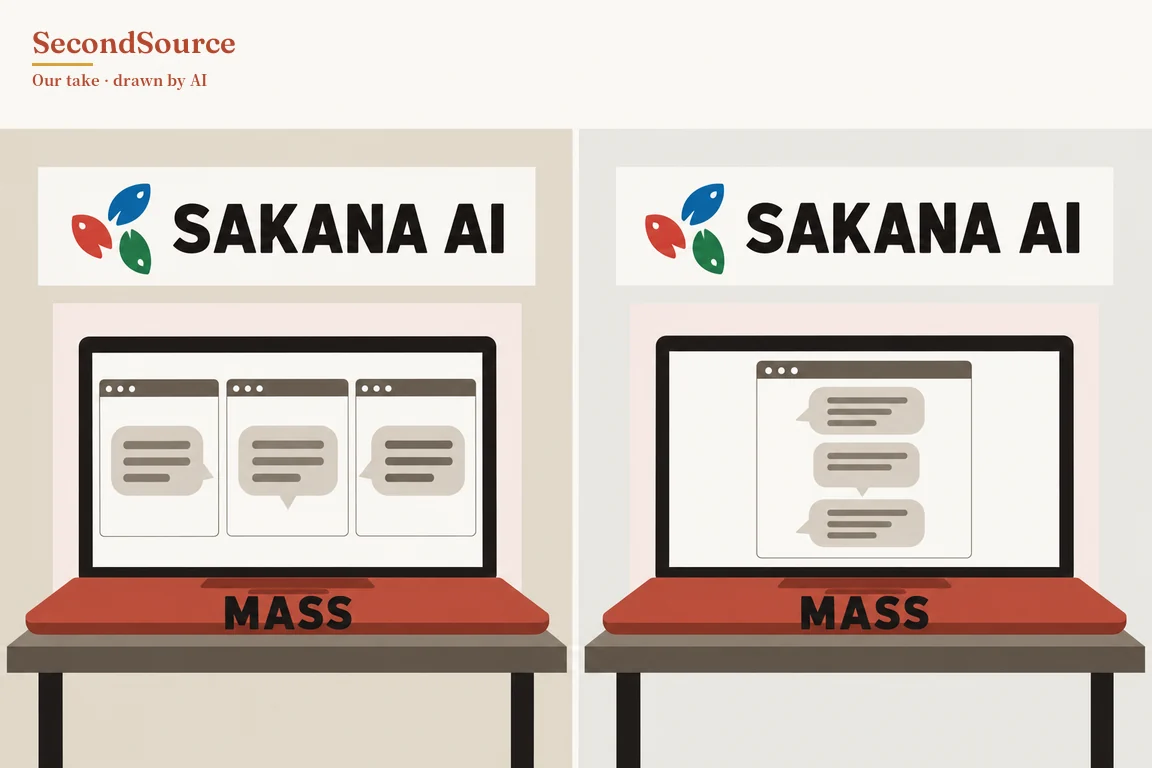
Sakana AI introduced MASS, built with UC Berkeley: one open model with 27 billion parameters acts as a team with divided roles, then fine-tunes itself on its successful collaborations. The company's post says that after two rounds, its evaluation score per output token is 1.2 to 1.6 times that of the original model. As Sakana AI co-founder David Ha explains it, the method alternates two steps: first the model evolves how several roles divide the work, then the successful collaborations are used to train the shared model. The model trains on successes it generated itself; the post doesn't prove whether that counts as continuous self-improvement (David Ha, 2026-10-11; Sakana AI, 2026-10-11). The evaluations are research tasks; the post says four but names only three, MLR-Bench, ScienceAgentBench and DSBench. The ratio is evaluation score divided by output length, not a 1.2- to 1.6-fold gain in capability; a higher ratio could simply mean shorter output, and the post doesn't give the score and length changes separately. According to the posts, the paper itself warns that when a model also grades itself, shared blind spots can let errors be counted as progress and keep reinforcing them. ⚠️ The numbers come only from the company's posts; we haven't read the paper. How we checked →
Source and checks
This item ran in the brief of Oct 12, 2026, alongside 13 other items. How we checked it, the quote checks and what was still missing that day are on that issue's How we checked page.
Cite this item
SecondSource (2026). "Sakana's MASS trains on its own wins; only posts report it." https://secondsource.io/en/research/2026-10-12-1/. Accessed access date.