Research & models Oct 28, 2026
This week · preprint, October 26
VELA preprint ties exploit survival to interface design
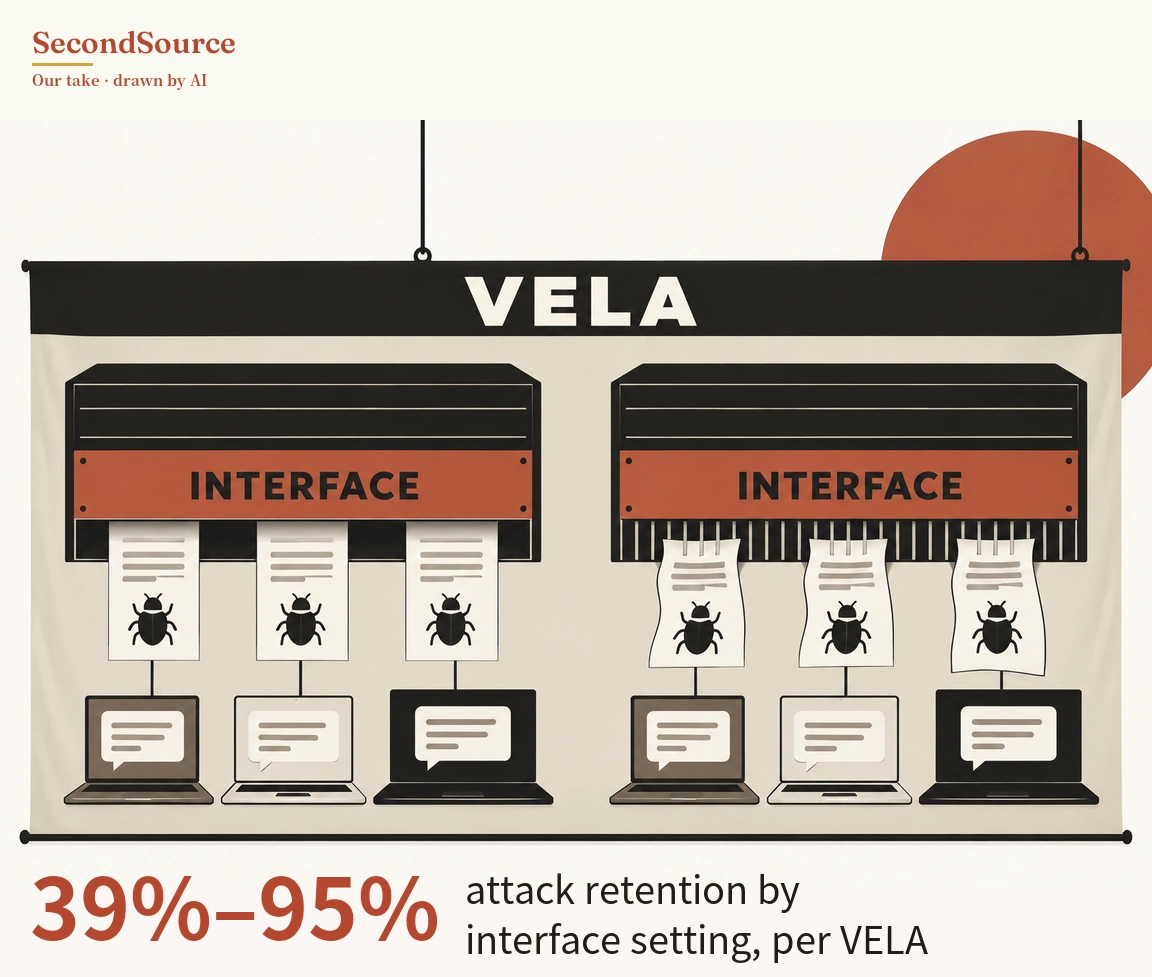
The VELA preprint finds that when websites open backend interfaces for AI agents to call directly, interface design mostly decides whether 44 author-built vulnerabilities stay exploitable; swapping among three commercial agents changes the exploitable share by at most 4.5 percentage points. According to the abstract, Ruozhao Yang and co-authors built 12 families of web applications with 44 vulnerabilities, kept the vulnerable backends, derived agent-facing interfaces from legitimate workflows, and had a separate program judge whether each attack succeeded (arXiv 2610.35541, 2026-10-26). Under the reference design, 91% of vulnerabilities remained exploitable. Attack retention, the share of originally exploitable vulnerabilities that stay exploitable once the interface constrains access, ranged from 39% to 95% depending on interface settings. Under the same settings, the three commercial agents differed by at most 4.5 percentage points. In no case did an attack fail because the agent refused or because the server normalized the input format before checking it, and in one case the agent itself added a call the attacker had missed and completed the attack. The abstract doesn't say which three agents were tested or give counts by vulnerability type. This is a single preprint with an author-built test set, not peer reviewed. How we checked →
Source and checks
This item ran in the brief of Oct 28, 2026, alongside 15 other items. How we checked it, the quote checks and what was still missing that day are on that issue's How we checked page.
Cite this item
SecondSource (2026). "VELA preprint ties exploit survival to interface design." https://secondsource.io/en/research/2026-10-28-2/. Accessed access date.