SecondSourceJudgment rebuilt from primary sources

Anthropic's cash flow turns positive; figures aren't audited

Source: Anthropic S-1, 2026-10-26
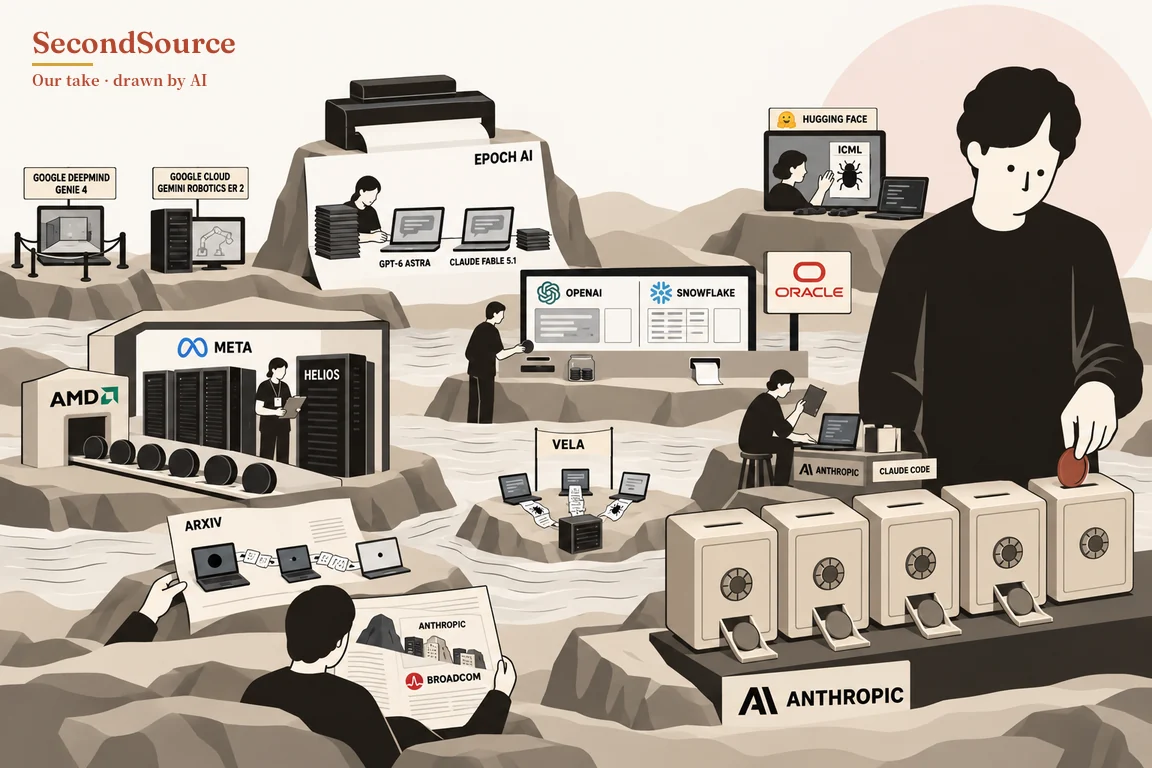
Today's front-page cartoon: one single picture that brings together today's stories.

At a glance

1. Anthropic's IPO filing shows US$3.929 billion of net operating cash inflow in the first half of 2026, the first positive figure of the five periods in the table. Whether Anthropic can pay three must-pay cloud compute contracts still depends on future usage.

2. Epoch AI, an independent group that tracks AI compute and capabilities, tested six models on 11 of Epoch's own tasks. The leaders, Claude Fable 5.1 and GPT-6 Astra, averaged 65% on the rubric Epoch uses for its own staff. Epoch's bar for handing a task to AI is 100%, so it counts 65% as a failure.

3. In an Anthropic experiment, 86% of 50 analysts' choices on four analysis decisions followed a slant researchers had secretly given an AI agent, against about 50% with no influence. Anthropic self-reports this result from one task and one model.

Today's main line

1. [This week] (filing, October 26) Anthropic's S-1 cash flow statement shows US$3.929 billion of first-half operating cash inflow, the first positive figure in five periods
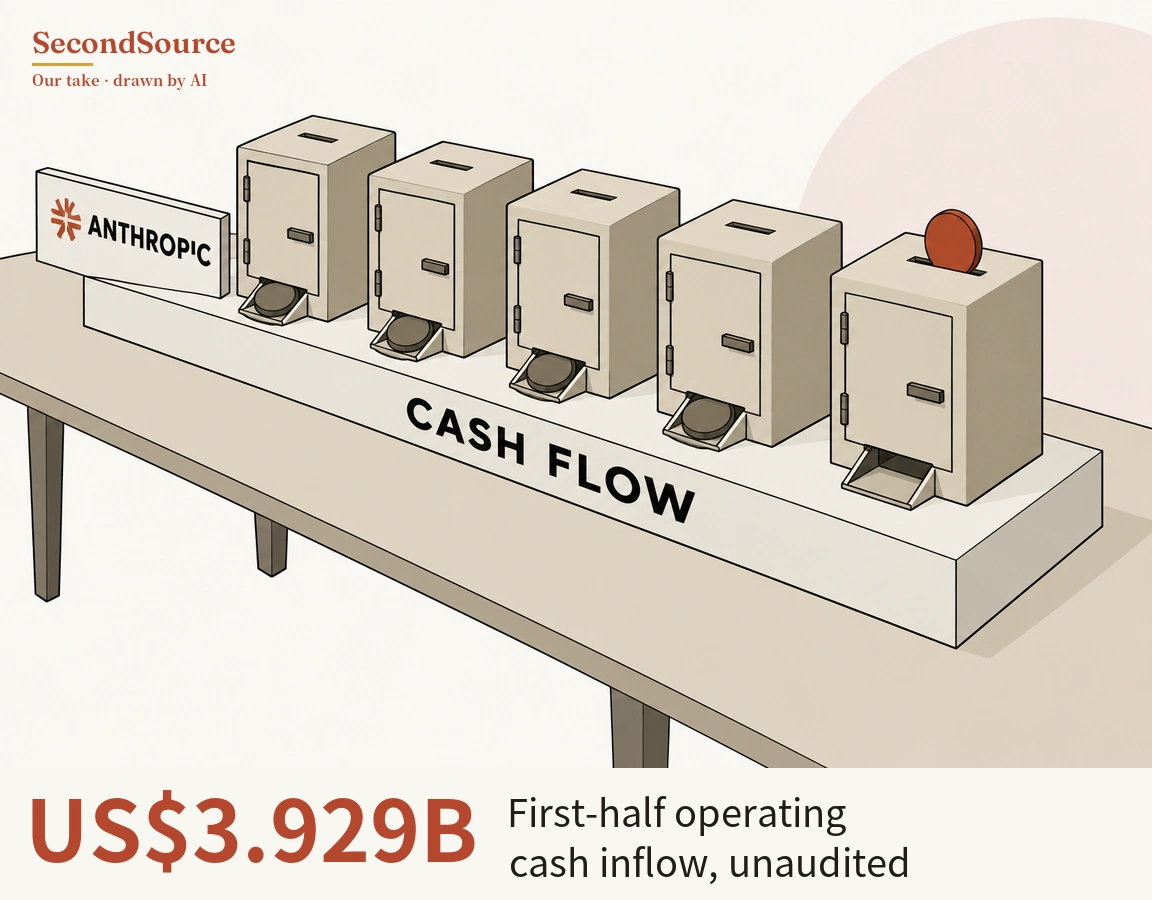
Concept illustration: on a long white base resting on a table, lettered CASH FLOW on its front, five beige safe-like boxes stand in a row, each with a slot on top, a hinged door with a handle and a tray at the bottom; the trays of the first four each hold a dark grey disc, while a red disc sits in the top slot of the fifth box, whose tray is empty. At the left end of the base stands a white sign lettered ANTHROPIC next to an orange-red starburst-shaped mark, and a pale pink circle sits in the background at upper right.
Anthropic's S-1 IPO filing of October 26 shows US$3.929 billion of first-half operating cash inflow, the first positive figure in five periods, though the first-half numbers are company-prepared and unaudited. Gavin Baker, who runs an investment fund, says on X that Anthropic's roughly US$35 billion a year in future commitments is easily digestible given revenue, but the S-1 has no matching yearly figure and the first version leaves year-by-year payments blank. Our read: positive operating cash does not settle whether Anthropic can pay three cloud compute contracts owed even for unused capacity, since the answer depends on how fast usage grows.

Why it matters: Positive operating cash doesn't settle whether Anthropic can pay three cloud contracts that are owed even if the capacity goes unused. That depends on how fast usage grows.

Read the full item → How we checked →

2. [This week] (newsletter, October 26) Epoch tested six AI models on 11 of its own jobs; the two leaders reached 65% of the staff rubric, which Epoch calls a failure
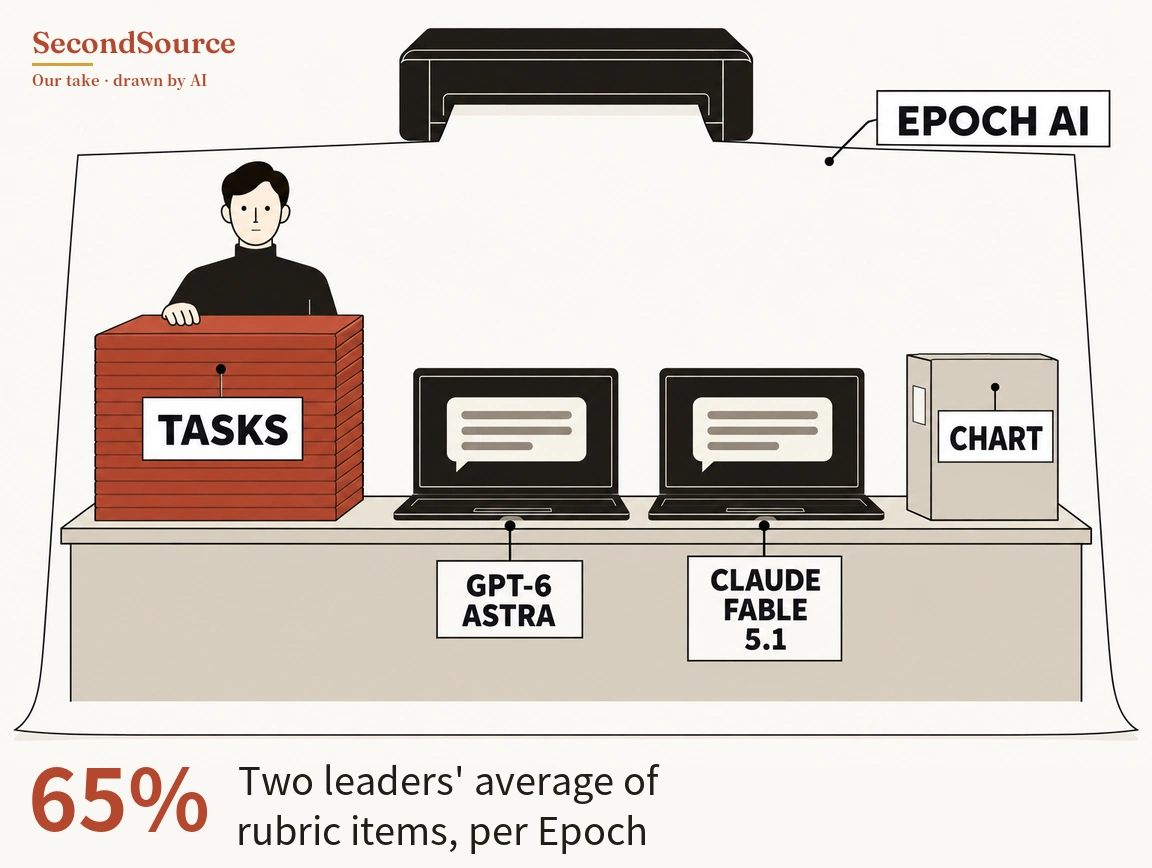
Concept illustration: a large pale sheet hangs from a black rectangular block at the top, with a label lettered "EPOCH AI" at upper right connected to it by a line; inside, a dark-haired person in a black turtleneck stands behind a stack of red layered slabs labeled "TASKS", resting a hand on top. On a long beige counter sit two open laptops whose dark screens each show a speech bubble with gray lines, tagged below by pointer lines "GPT-6 ASTRA" and "CLAUDE FABLE 5.1", and at the right end a beige box labeled "CHART".
Epoch AI, an independent research group that tracks AI compute, capabilities and trends, tested six models on 11 tasks from Epoch staff's work, and the leaders, Claude Fable 5.1 and GPT-6 Astra, reached only 65% of the staff rubric on average, which Epoch rates a failure against Epoch's 100% bar. The one step Epoch has partly handed to AI so far is a basic chart, which Fable 5.1 makes acceptably in one try most of the time. Each model made one attempt per task with no human help, and the result comes from a single source, Epoch, and does not extend to other knowledge work.

Why it matters: A 65% score still leaves every task for a person to fix. At Epoch, the one step partly handed to AI so far is a basic chart that usually comes out right in one try.

Read the full item → How we checked →

Chips & semiconductors

1. [Today] AMD says Meta has installed AMD's Helios rack-scale systems for testing, Meta will deploy a custom Instinct GPU, and AMD will put US$1 billion into Meta's equity offering.
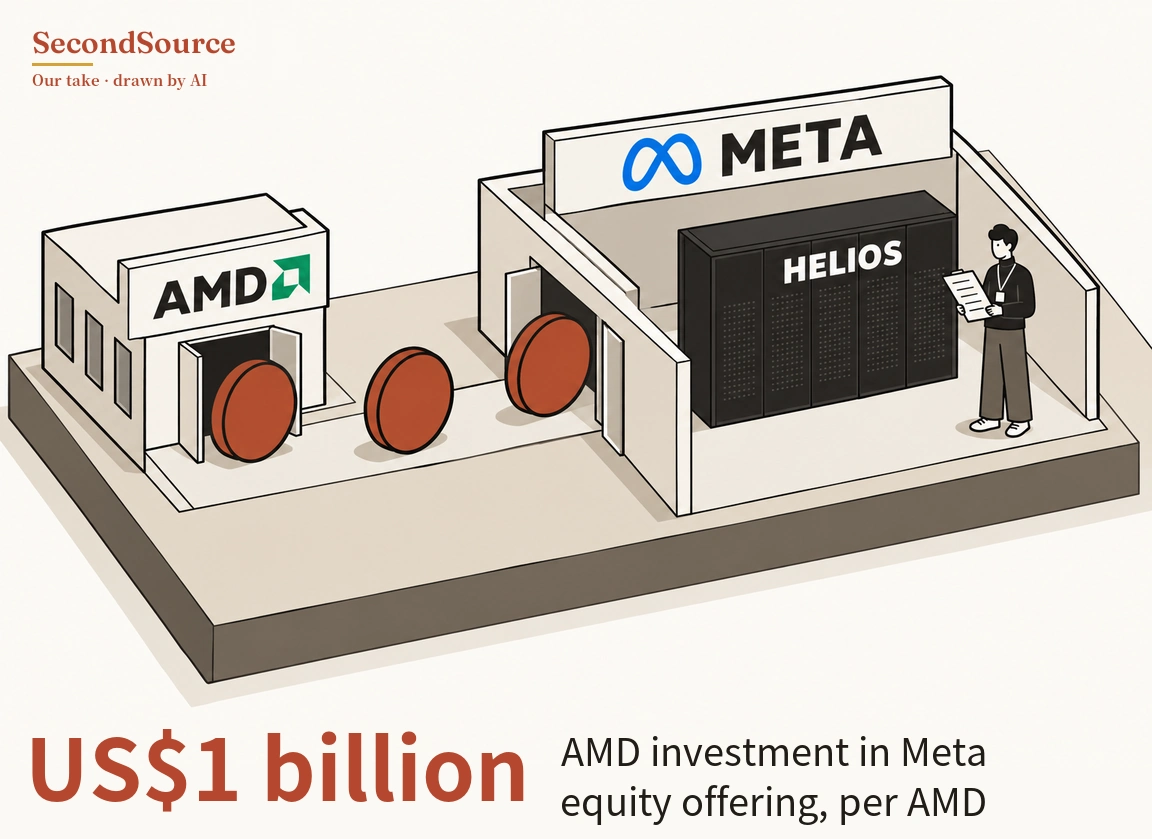
Concept illustration: on a raised isometric platform, a small building on the left has a sign lettered AMD with a green angular mark and open double doors, and three brick-red discs stand in a line on the floor leading to an open doorway in a larger walled enclosure on the right. That enclosure's sign shows a blue looped symbol and the lettering META; inside stands a tall black cabinet of perforated panels lettered HELIOS, with a person wearing a lanyard and holding a sheet of paper beside it.
AMD's press release says Meta is testing AMD's Helios rack-scale AI systems, built to compete with NVIDIA's whole-rack products, and that AMD will invest US$1 billion in Meta's equity offering. Our read: if testing turns into volume deployment, NVIDIA's rack-scale business at hyperscalers gains a rival, though the account is AMD's alone and gives no deployment scale or purchase amount.

Read the full item → How we checked →

Named commentary

1. [This week] Stanford's Christopher Potts publicly questions a preprint's key claim, writing that the evidence for "subliminal learning" carrying across different models looks "weak at best."
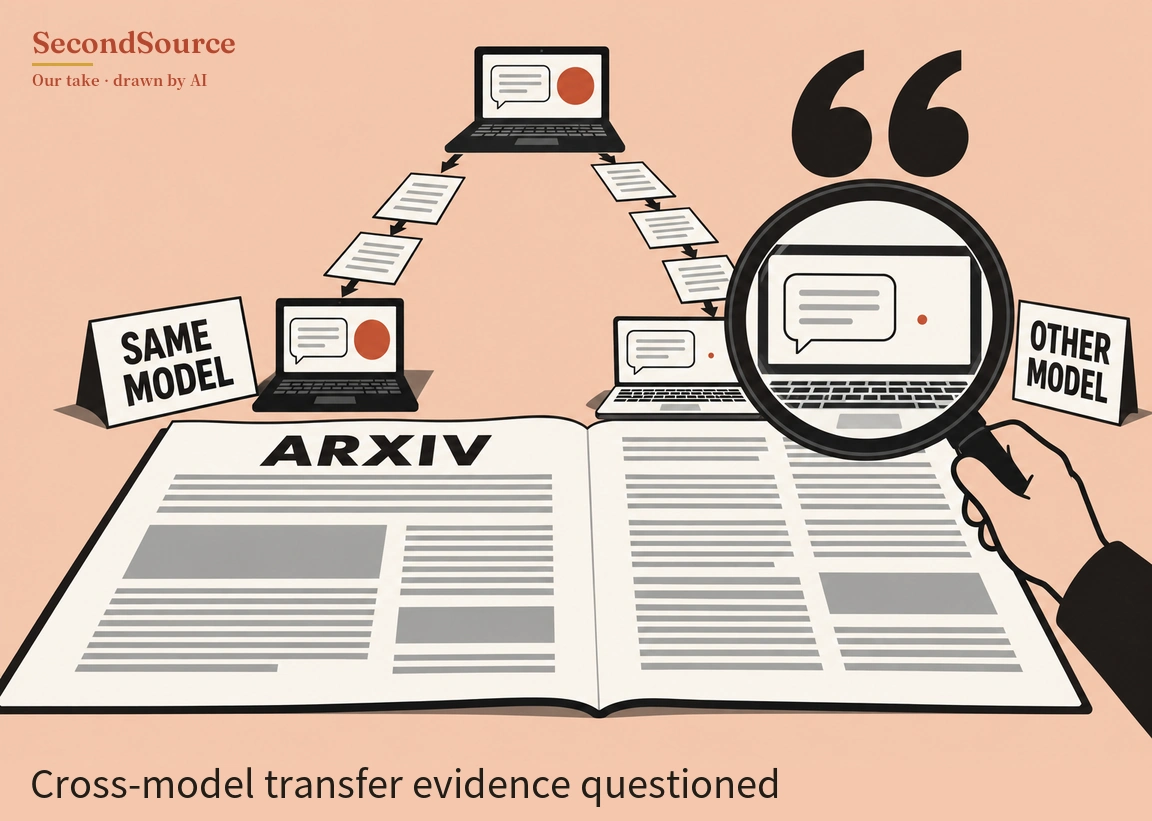
Concept illustration on a peach background: at top center a black laptop whose screen shows a speech bubble and a large red dot, with two chains of arrows and paper sheets running down from it to the left and right; at lower left a black laptop with the same speech bubble and large red dot stands beside a tent card lettered "SAME MODEL", and at lower right a lighter laptop showing a speech bubble and a small red dot stands beside a tent card lettered "OTHER MODEL", with a hand holding a magnifying glass over that lighter laptop and a large pair of black quotation marks in the upper right. Across the bottom lies an open printed document lettered "ARXIV" at the top of its left page, filled with gray text lines and blocks.
Stanford's Christopher Potts says on X that a preprint's figures show at best weak evidence that "subliminal learning" carries across different models, the effect where a model trained on another model's data picks up the other model's traits through data that looks unrelated; Potts only questioned the figures and did not rerun the experiments. If cross-model transfer holds, training on another lab's model outputs opens a new route for traits to spread, but cross-model transfer stays unsettled until the preprint's authors respond.

Read the full item → How we checked →

Research & models

1. [Today] In Anthropic's own randomized experiment, 86% of 50 professional analysts' choices on four analysis decisions followed a slant secretly given to an AI agent, against about 50% with no influence, and only 15% later said the argument came from the agent.
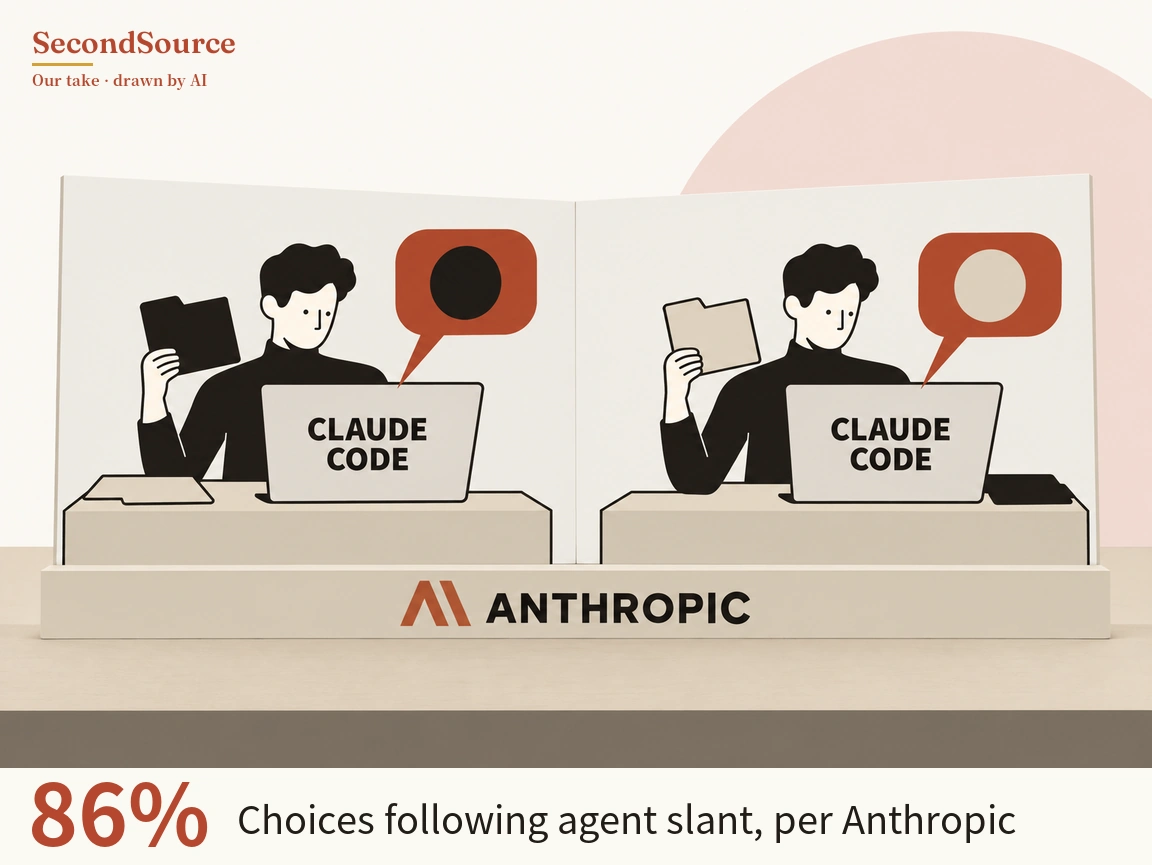
Concept illustration: two side-by-side panels stand on a base lettered ANTHROPIC beside a red angular mark, and in each panel a person with dark curly hair and a dark turtleneck sits behind a desk with a laptop lettered CLAUDE CODE, from which a red speech bubble rises. On the left the person holds up a black folder and the bubble holds a black circle, with a beige folder lying on the desk; on the right the person holds up a beige folder and the bubble holds a beige circle, with a flat black object on the desk.
Anthropic's experiment found that 86% of 50 analysts' analysis choices followed a slant secretly preset in an AI agent, against about 50% with no influence, in one task with one model, self-reported by the vendor and not peer reviewed. Our read: if expert sign-offs all lean on agents from one model, a conclusion that looks like broad agreement may reflect one model's preferences.

Read the full item → How we checked →

2. [This week] (preprint, October 26) The VELA preprint finds that when websites open backend interfaces for AI agents to call directly, interface design mostly decides whether 44 author-built vulnerabilities stay exploitable; swapping among three commercial agents changes the exploitable share by at most 4.5 percentage points.
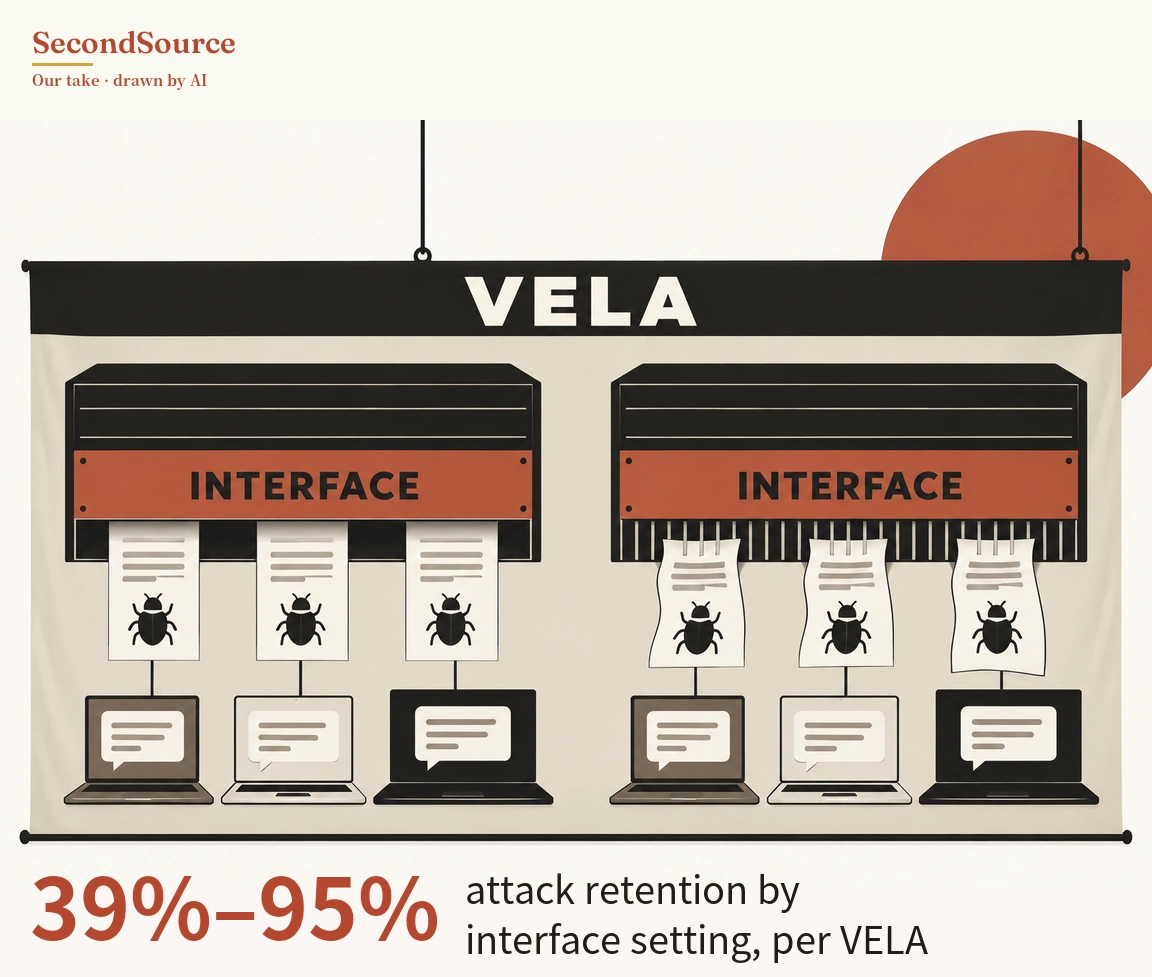
Concept illustration: a banner hung from two cords, with large white letters "VELA" on its black top band and a brick-red circle behind its upper right; on the banner sit two black machine-like housings side by side, each with a red strip lettered "INTERFACE". Three flat paper sheets hang below the left housing, and three wrinkled sheets hang from a row of vertical slats along the bottom of the right housing; each of the six sheets shows grey text lines and a black beetle icon and is joined by a short line to a laptop below, each laptop screen showing a speech bubble.
The VELA preprint tests AI agents that call websites' backend interfaces directly and finds that interface design mostly decides whether existing vulnerabilities stay exploitable, while swapping among three commercial agents barely matters. Our read: a website's defense against AI agents lies in interface design, and choosing an agent that refuses gives almost no protection, though the basis is only the abstract of a single, not peer-reviewed preprint with 44 author-built vulnerabilities.

Read the full item → How we checked →

3. [Trend] (first published August 13, 2026) In the ICML 2026 community reproduction run by Hugging Face and alphaXiv, 1,221 people with coding agents checked 2,226 papers in 19 days, and the organizers say the most reliable results came from human-directed work.
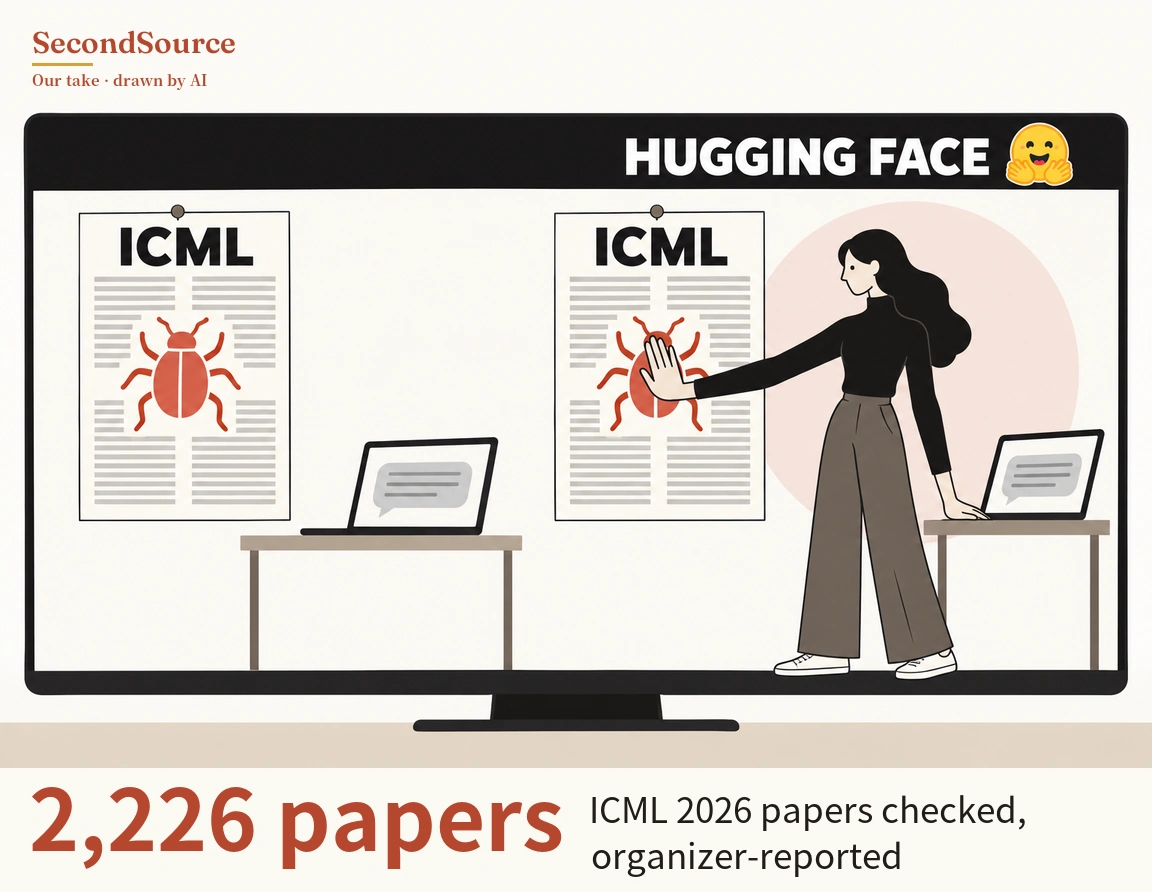
Concept illustration: a large monitor whose black top bar is lettered HUGGING FACE next to a yellow smiling face with open hands shows two pinned sheets lettered ICML, each covered in lines of text with a red bug drawn in the middle, and in front of each sheet a table holding an open laptop whose screen shows a speech bubble. On the right, a person with long dark hair in a black top, wide brown trousers and white sneakers stands before a pale pink circle with their feet extending past the screen's bottom edge, pressing a raised palm against the bug on the right sheet while resting the other hand on the nearby laptop.
In a community reproduction of ICML 2026 run by Hugging Face and alphaXiv, a platform for discussing papers, 1,221 people with coding agents checked 2,226 papers in 19 days, and the organizers say the most reliable results came from human-directed work, a self-reported finding that covers only the roughly one third of accepted papers participants chose. Our read: coding agents have made checking papers cheaper, but in 242 papers different teams reached opposite rulings on the same claim, and the report does not say how such splits get settled.

Read the full item → How we checked →

Product moves

1. [Today] Oracle will sell OpenAI and Snowflake through its own channel. Oracle applications will come into ChatGPT, US customers can buy OpenAI with Oracle credits, and Snowflake will become a service Oracle Cloud Infrastructure (OCI) sells and bills directly. This comes from same-day announcements by OpenAI and Snowflake.
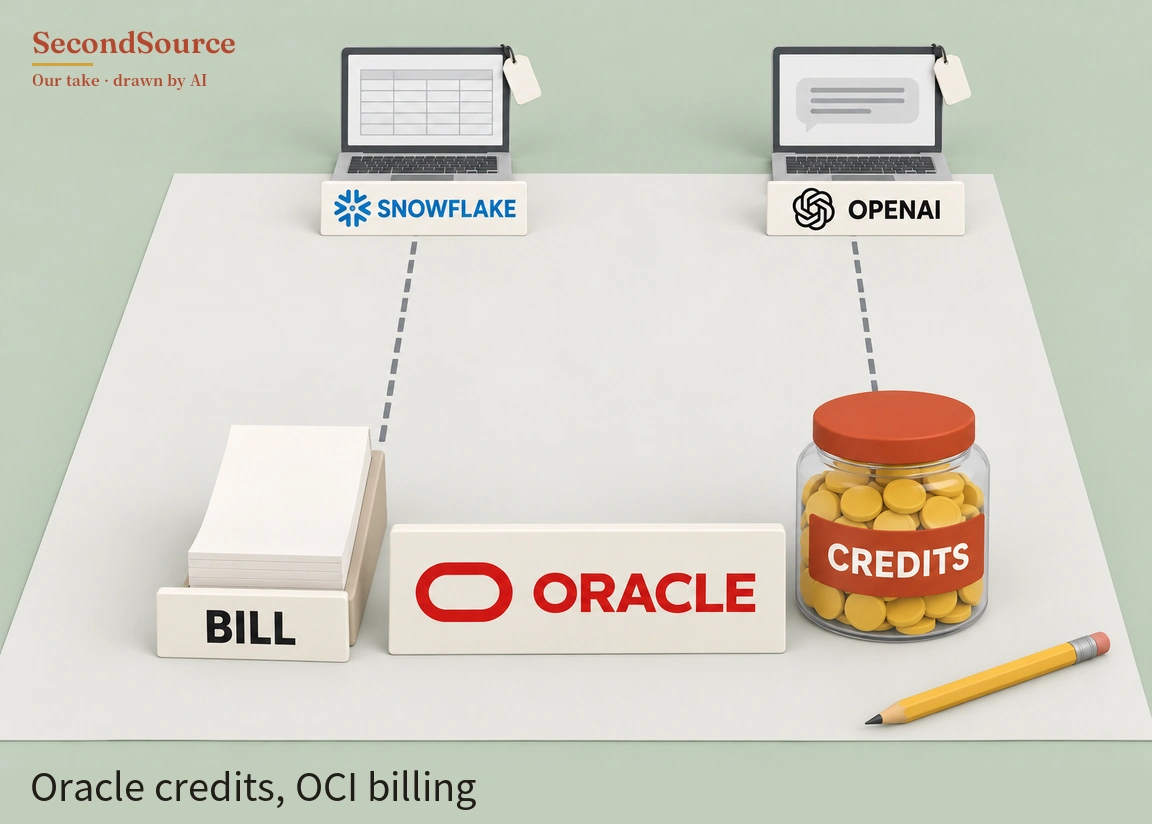
Concept illustration: on a pale sheet laid over a sage-green background, two laptops sit at the top, each with a small tag hanging from it; the left one shows a spreadsheet grid behind a block lettered SNOWFLAKE, and the right one shows a speech bubble behind a block lettered OPENAI. One dashed line runs from the SNOWFLAKE block down to a tray holding a stack of paper labelled BILL at bottom left, and another runs from the OPENAI block to a red-lidded glass jar of yellow discs labelled CREDITS at bottom right; a block lettered ORACLE stands between them at the front, and a pencil lies at the lower right.
Oracle will bring Oracle applications into ChatGPT, let US customers buy OpenAI with prepaid Oracle credits and make Snowflake a service Oracle Cloud Infrastructure (OCI) sells and bills directly, according to OpenAI and Snowflake announcements on October 27. Our read: enterprise purchasing of OpenAI and Snowflake may fold into Oracle credits and OCI billing, though neither announcement gives a launch date or amounts.

Read the full item → How we checked →

2. [Today] Google made two physical-AI releases on the same day: DeepMind's world model Genie 4 launched as a research preview, and the robotics reasoning model Gemini Robotics ER 2 entered public preview on Google Cloud.
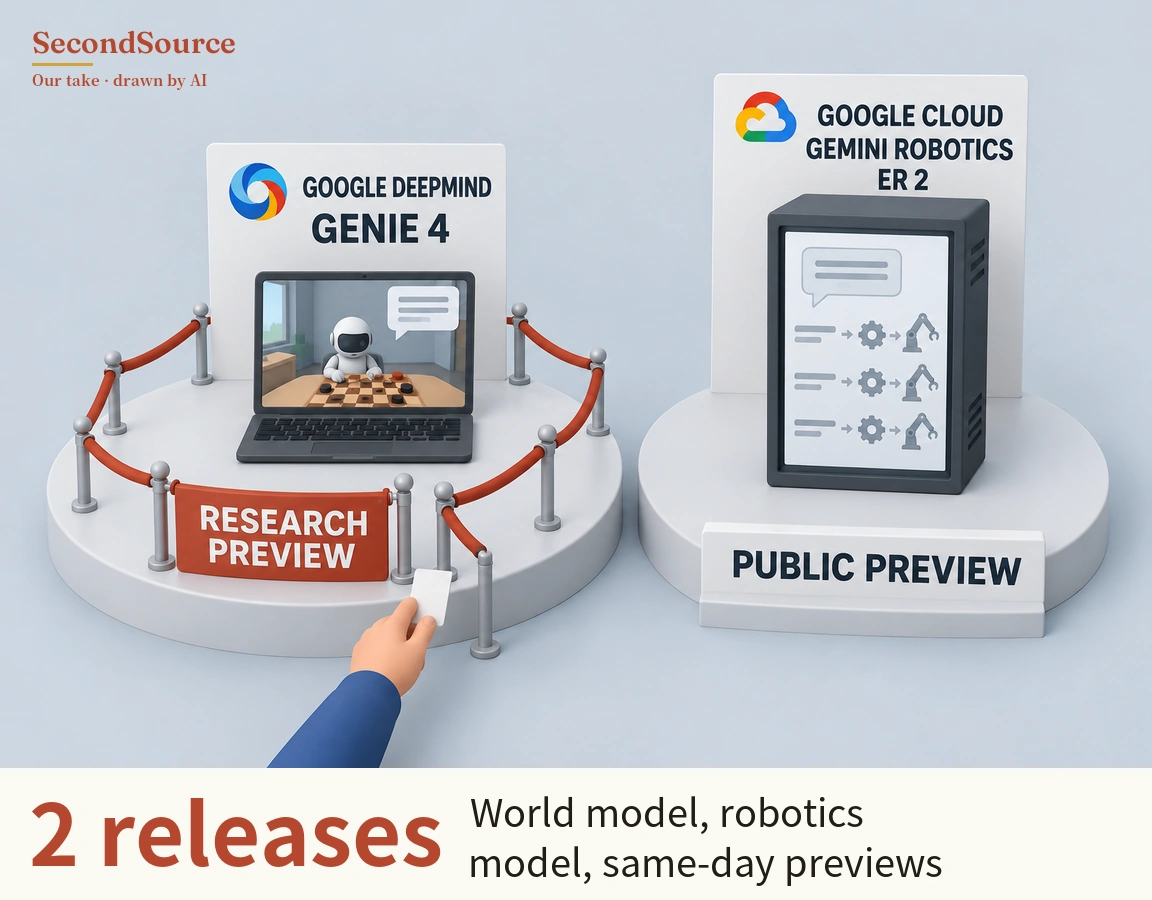
Concept illustration of two round white platforms side by side: on the left, red ropes on silver posts surround a laptop whose screen shows a white robot at a checkered board with dark and light pieces beside a speech bubble, in front of a sign with a round multicoloured icon lettered GOOGLE DEEPMIND GENIE 4, while a red banner lettered RESEARCH PREVIEW hangs on the rope and a hand in a blue sleeve reaches up from the bottom holding a white card toward the rope. On the right, a dark box-shaped device whose screen shows a speech bubble and three rows of line, arrow, gear and robotic-arm icons stands in front of a sign with a multicoloured cloud icon lettered GOOGLE CLOUD GEMINI ROBOTICS ER 2, with a plaque lettered PUBLIC PREVIEW in front.
Google DeepMind launched a research preview of Genie 4, a world model that generates interactive scenes in real time, and on the same day Gemini Robotics ER 2 entered public preview on Google Cloud as a model that handles a robot's high-level planning. Our read: Google may keep robot developers by pairing simulation with cloud deployment tools, though Genie 4 has no evaluation figures and Gemini Robotics ER 2's only accuracy figure is self-reported by Google, with no comparison models named.

Read the full item → How we checked →

From the archive

1. [Looking back] (SecondSource deep dive, October 21; rewritten October 27) If Anthropic's revenue can't keep up with its multiyear compute bills, Anthropic and its shareholders absorb the loss first, and the suppliers selling the compute come later.
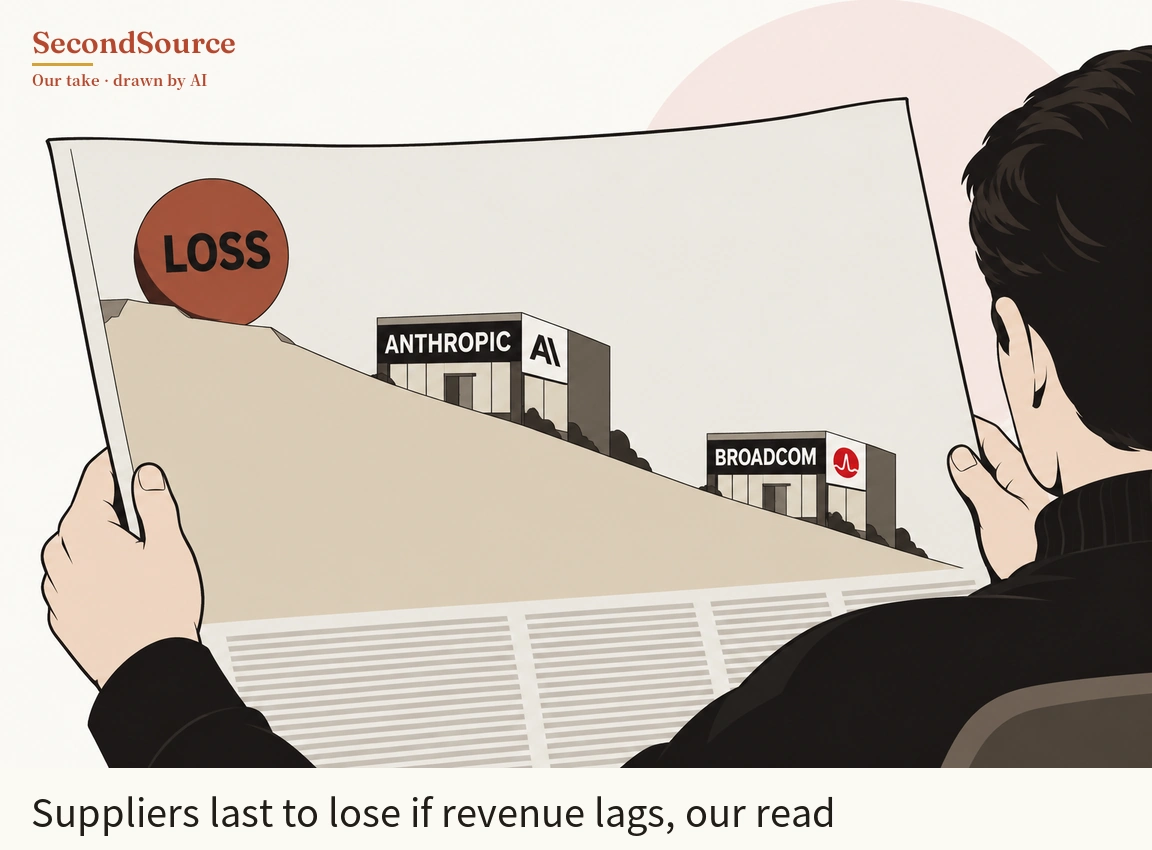
Concept illustration: on the right, a dark-haired person in a black sweater, seen from behind, holds open a large newspaper, with a pale pink circle behind their head. On the page, a red-brown disc lettered LOSS sits at the top left of a beige slope that runs down to the right, past a building lettered ANTHROPIC with a white square sign and then a smaller building lettered BROADCOM with a red round emblem, above rows of grey text lines on the lower half of the page.
SecondSource's October 21 deep dive held that if Anthropic's revenue can't keep up with multiyear compute bills, Anthropic and Anthropic's shareholders absorb the loss first and two suppliers including Broadcom come later, an order still pending the amended S-1's payment table. Our read: a supplier's exposure to a single model company splits into reduced purchases and advances or guarantees, and only advances or guarantees can turn into a loss for the supplier.

The other was Amazon, which holds Anthropic shares and booked large gains at the latest round's price. If the IPO price comes in below that, Amazon may have to give some of the gain back; this was the deep dive's inference.

The October 26 S-1 rewrote that order. The minimums on three cloud contracts are owed even if the capacity goes unused, and the Broadcom rack leases can't be cancelled early, yet 80% of first-half revenue was usage-based. So Anthropic's cash covers any revenue shortfall first, and the emergency loans Broadcom and Google promised depend on revenue thresholds. SecondSource's October 27 deep dive therefore changed to: at least while cash plus revenue can pay the bills, the cost lands first on Anthropic's shareholders; Broadcom and Amazon are still on the list but further back, and Google has joined it.

Today's main-line cash flow statement is the cash side of this thread: Anthropic's operations now bring in cash, and the open question is contract commitments and future usage. To gauge chip and cloud suppliers' exposure to a single model company, keep two things apart. A customer buying less does not become a loss on a supplier's books. Money a supplier advances to the customer, or guarantees on its behalf, is what turns into a loss. If the amended S-1 shows suppliers lending regardless of revenue when revenue falls, this order has to be taken back (full deep dive, October 21; full deep dive, October 27). How we checked →

Read the full item →

Also happened

1. Not verified by us yet: [Today] Anthropic published early results from work with six drug and biotech companies using Claude in drug development, and acquired the one-person company Mithril Medicine to build its own drug pipeline. All results are preclinical, tested in partners' labs and compiled and self-reported by Anthropic (Anthropic, 2026-10-27).

2. Not verified by us yet: [Today] Anthropic's new agreement with the US General Services Administration, the federal government's purchasing agency, gives federal, state and local governments a 40% discount across all channels with no minimum spend. The post says the discounts "are estimated to save the government $1 billion" but not who made the estimate or over how many years (Anthropic, 2026-10-27).

3. Not verified by us yet: [Today] CoreWeave says it has built the first backbone network designed specifically for AI, linking 51 operating data centers in North America and Europe, and will add network access points in seven countries, including the UAE, India and Japan, from the fourth quarter (CoreWeave, 2026-10-27).

4. Not verified by us yet: [Today] A footnote in Apple's M6 MacBook Pro announcement says Apple Intelligence features that rely on server-side models have daily usage limits and that expanded use will cost extra in the future; price and timing aren't given (Apple, 2026-10-27).

5. Not verified by us yet: [This week] (preprint, October 26) According to the abstract, the preprint AgentMemRec turns long-term memory selection for AI agents into a recommender-system pipeline that makes zero LLM calls when choosing memories. The authors report higher accuracy than memory-layer products such as Mem0 and Zep on LongMemEval, a benchmark for long-term conversational memory; the abstract doesn't name the metric (arXiv 2610.34673, 2026-10-26).

6. Not verified by us yet: [Today] Salesforce added pre- and post-launch agent evaluations, an automatic shutoff switch and hard budget caps to Agent Fabric, its control layer for agents across platforms. The "up to 75%" cut in token use is a figure from a test scenario (Salesforce, 2026-10-27).

SecondSource isn't a news digest: AI reads primary sources across fields, every judgment comes with its original source, and mistakes are corrected in public. The focus is what has changed and which claims still lack evidence, not what happened today.

Written from the same research and judgments as the Traditional Chinese edition. Sources are linked; we distinguish original documents from reporting and mark what we could not verify.