An 11-author preprint says 41% to 46% of the reasoning text AI agents write can be deleted with task performance roughly unchanged, and how much can be deleted varies more with the task and the agent harness than with the model.
(paper dated November 4)
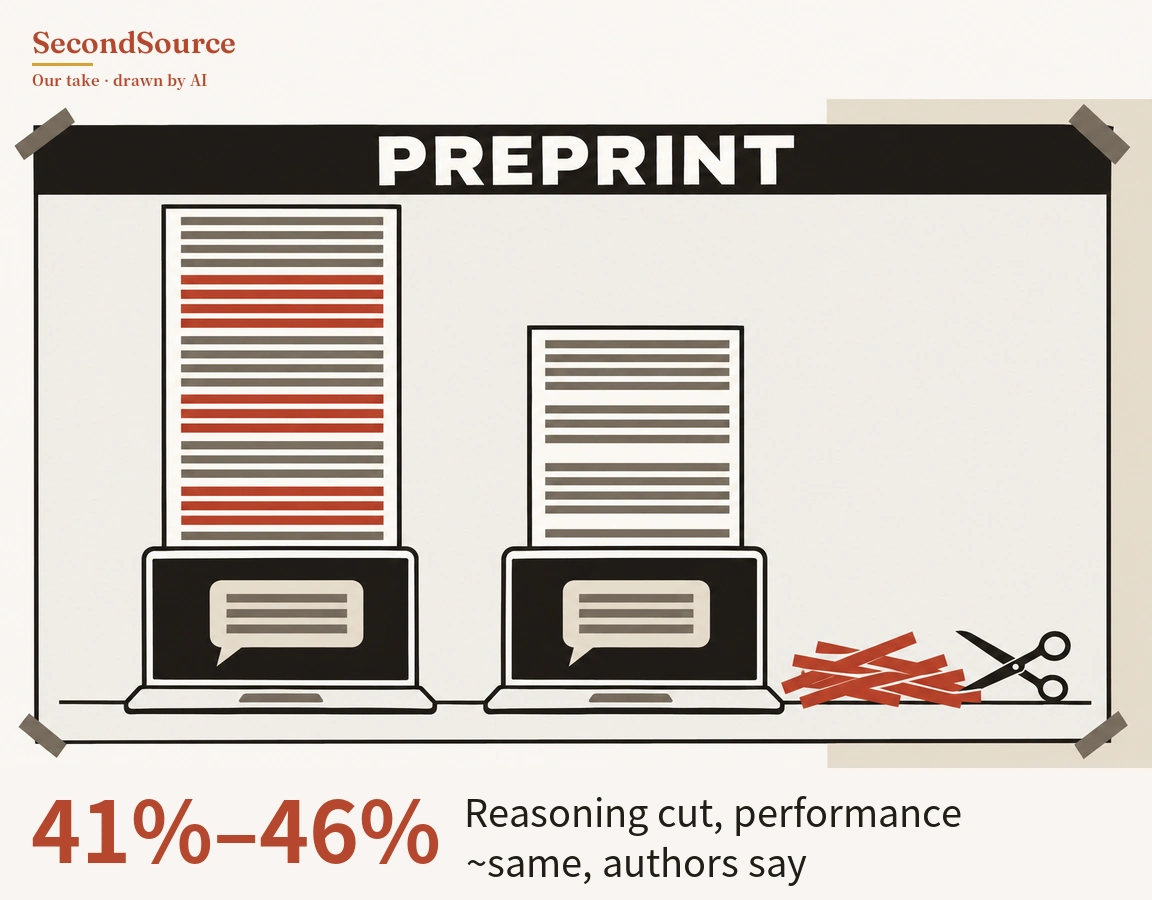
Our inference: teams paying for agents by the token may be able to shorten reasoning by changing the software around the model, which the paper calls the harness, not only by switching models, though the authors only showed that deleting these segments after the fact left performance roughly unchanged. According to the paper's abstract, the authors recorded full agent runs, had another model mark the segments that could be cut, actually cut them and let the agent continue, then checked whether the result and the agent's next actions changed (arXiv 2611.07238, 2026-11-04). The harness manages context, tools, permissions and error recovery. A 2026 paper argues that the real-world performance of such workflows depends on this layer as well as on the underlying model (arXiv 2605.27922). The authors report that for the same model on the same task, changing the harness changed how much could be cut and at which steps. The abstract doesn't say how much difference "roughly unchanged" allows or which benchmarks were used. How we checked →
Source and checks
This item ran in the brief of Nov 8, 2026, alongside 10 other items. How we checked it, the quote checks and what was still missing that day are on that issue's How we checked page.
Cite this item
SecondSource (2026). "An 11-author preprint says 41% to 46% of the reasoning text AI agents write can be deleted with task performance roughly unchanged, and how much can be deleted varies more with the task and the agent harness than with the model.." https://secondsource.io/en/research/2026-11-08-1/. Accessed access date.