SecondSourceJudgment rebuilt from primary sources

TEL: 2027 chip-tool plans top US$210 billion, pre-selloff

Source: TEL earnings Q&A, 2026-11-04
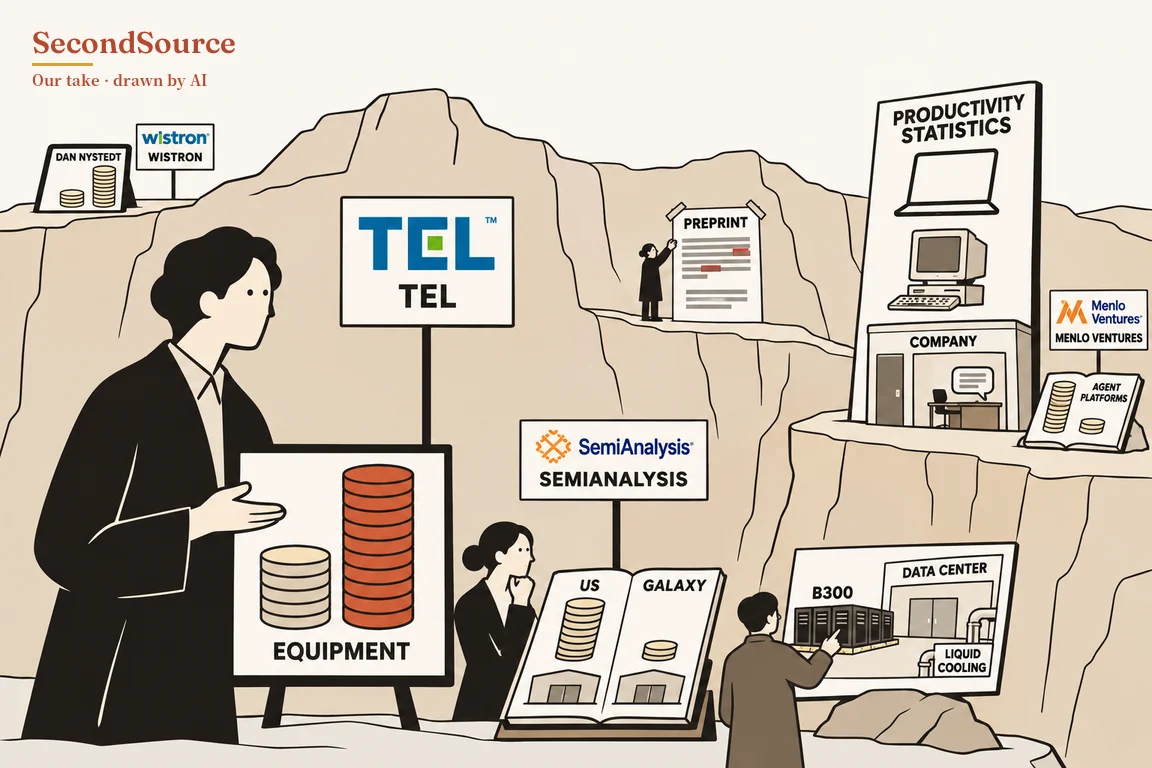
Today's front-page cartoon: one single picture that brings together today's stories.

At a glance

1. Chip-equipment maker TEL said at its October 30 earnings briefing that customers' investment plans add up to a 2027 global wafer-equipment market above US$210 billion, more than 30% above this year's. TEL made the estimate before the November 5 chip-stock drop.

2. The research firm SemiAnalysis says the first 120MW phase of a data-center campus planned for 800MW in Inner Mongolia was delivered within a year at about a fifth of US costs, a cost comparison that only SemiAnalysis has made so far.

This week's column: Claims & Receipts

Every Sunday: one AI claim making the rounds, checked against the original documents.

No new claim was added for checking this week; this issue only returns to three older calls that came due.

OpenAI's flagship list price and subscription allowances, Anthropic's third-quarter operating result, TSMC's advanced-node price rises: can these three older calls be settled?

The short version: of the three, one didn't come true and two can't be judged. In August, SecondSource bet that AI labs would not both raise flagship API list prices and tighten subscription allowances, and OpenAI did both within the deadline. Of the other two, the Anthropic call lacks a second independent source, and the source named for the TSMC call never gave a figure.

How to use it. OpenAI raising its flagship list price and tightening Pro allowances at the same time doesn't show that labs are taking compute back for their own use, and so far it has happened at only one company.

Will Anthropic swing back to an operating loss in the third quarter, after turning an operating profit in the second? Can't judge: Anthropic's IPO registration filing, submitted October 26, puts second-quarter operating income at about US$974 million but doesn't disclose the third-quarter operating result. As of October 31, the SEC filing system showed no amendment either. The third-quarter margins in media reports all come from the same leaked investor presentation, which counts as one source. SecondSource set two independent sources as the bar for this call, and that bar isn't met. The presentation's figures are also not on a GAAP basis, so they can't be read directly as an operating result. Answer check →

Will any single TSMC advanced-node price rise stay under 20%? Can't judge: the source SecondSource named was the press center of the market researcher TrendForce. Between August 16 and October 31, none of the 36 press releases there gave a price change for TSMC's N3, N2 or A16 advanced nodes. The only foundry release covering TSMC's business gives only second-quarter revenue. TrendForce's site also has a news section that relays Korean and Taiwanese media reports on 2nm price increases. That section states that it is independent of TrendForce's research team, and it is not the source SecondSource named. SecondSource agreed not to switch sources to settle the call, so this one can't be judged. Answer check →

Will AI labs both raise flagship API list prices and tighten consumer subscription allowances? Didn't come true: SecondSource's original reading was that labs would not do both, and OpenAI did both. Over that half-year, prices were falling and allowances loosening, which looked more like demand not keeping up than labs pulling compute back from outside inference for their own use. SecondSource also wrote at the time that a list-price rise and an allowance cut both appearing before the fourth quarter would overturn that reading. Both happened before the fourth quarter. OpenAI's new flagship GPT-6 Astra, launched September 3, is priced at US$10 per million input tokens and US$50 per million output tokens, against US$4 and US$20 for the previous flagship, GPT-5.6 Sol. This is a new-generation flagship, not a price rise on the same model, and the comparison covers only per-million-token list prices. SecondSource said at the outset that new pricing at a generation change counts as a list-price adjustment. According to OpenAI's help page, new ChatGPT Pro subscribers got only the reduced allowance from September 29. OpenAI reversed the cut on October 29 and doubled the allowance, but the two moves had already happened together within the deadline. Next to watch: whether ChatGPT Pro allowances change again after the doubling, and the list prices of other labs' next flagships. Answer check →

All of SecondSource's calls and their verdict dates → the full ledger

Today's main line

1. Japanese chip-equipment maker TEL says customers' investment plans add up to a 2027 global wafer-equipment market above US$210 billion, more than 30% above this year's(transcript published November 4)
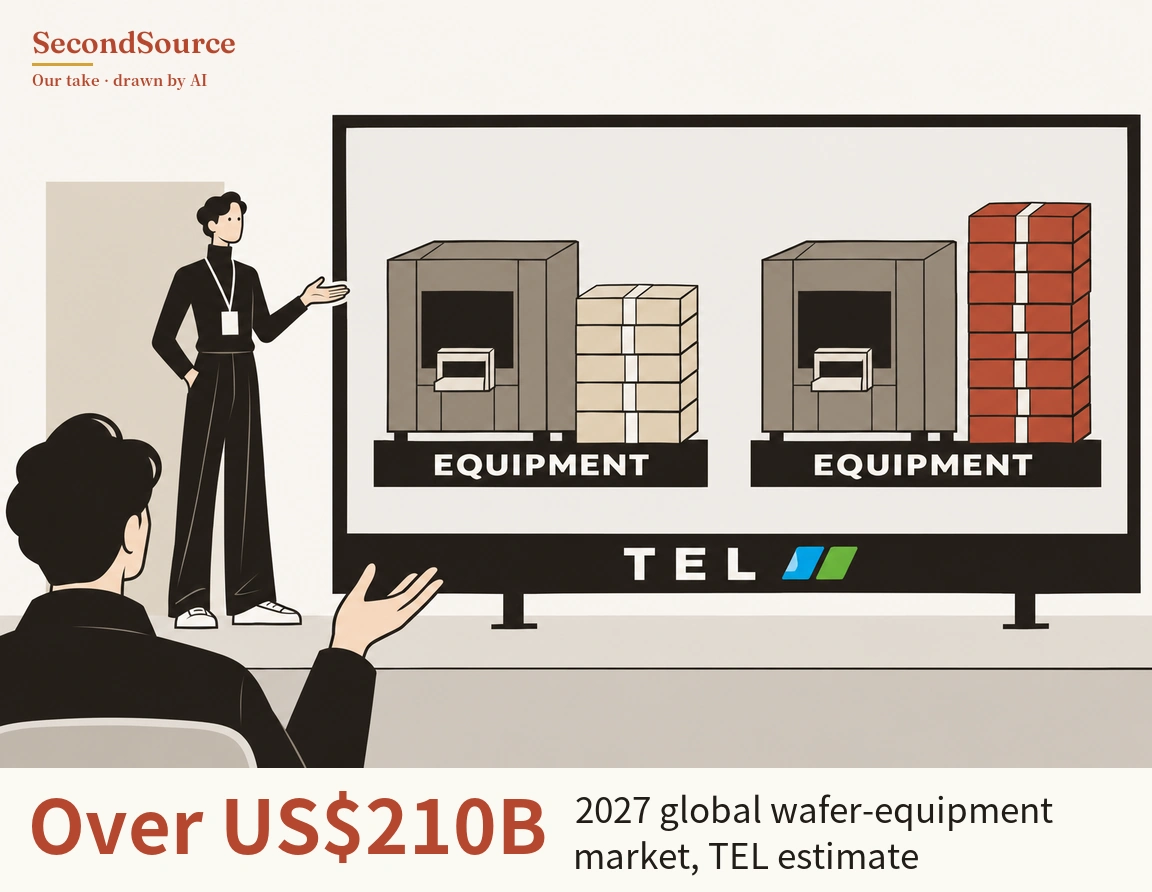
Concept illustration: a person in black wearing a lanyard badge stands at left, gesturing toward a large screen, while another person in the lower-left foreground, seen from behind, raises a hand toward it. The screen shows two matching grey machines side by side, each on a black base lettered EQUIPMENT; the left one has a short stack of beige blocks beside it, the right one a much taller stack of red blocks, each block with a white band around its middle; the black lower frame of the screen is lettered TEL, next to a blue and a green slanted bar. Printed on the image: Over US$210B 2027 global wafer-equipment market, TEL estimate.
TEL, the Japanese maker of wafer coater/developer and etch tools, says chipmaker customers' investment plans add up to a 2027 global wafer-equipment market more than 30% above this year's market. TEL's forecast is a sum of customers' plans, not orders placed. TEL gave the forecast at the October 30 earnings briefing, before the November 5 chip-stock drop.

Chipmakers order tools and build lines before data centers buy the chips, so a data-center delay has to change chipmakers' plans before it reaches equipment makers.

2. SemiAnalysis visits an 800MW-class data-center campus in Inner Mongolia and says its first 120MW phase was delivered within a year at about a fifth of US costs
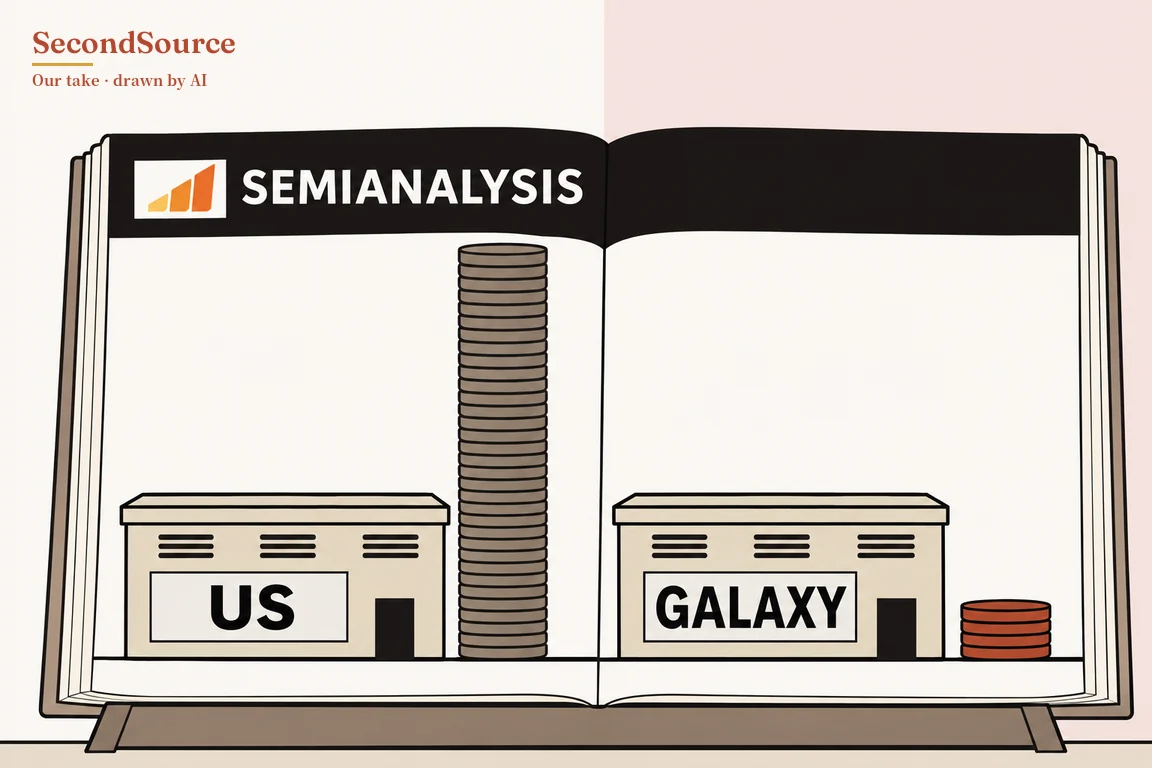
Concept illustration of an open book standing on a wooden stand, with a black band across the top of the spread bearing a small white-backed icon of rising orange bars and the lettering SEMIANALYSIS. On the left page, a low beige building with a sign reading US has a tall stack of grey-brown coins beside it on the right that reaches almost to the band; on the right page, a matching building with a sign reading GALAXY has a short stack of a few red coins beside it on the right.
In September SemiAnalysis, a research firm that tracks data centers site by site, visited the 800MW-class Galaxy campus in Ulanqab, Inner Mongolia, and says Galaxy's first 120MW phase was delivered within a year. The build speed and the cost both come from SemiAnalysis's on-site observations and in-house model, and SemiAnalysis is the only source for both. SemiAnalysis doesn't say which kind of US campus the cost is compared with or whether the cost includes power facilities.

Chips & semiconductors

1. According to Dan Nystedt, relaying Taiwanese media, AI server maker Wistron's October revenue was NT$402.6 billion, up 117.6% year over year, and that of fellow Taiwanese server maker Wiwynn rose 80.9%.(event date November 6)
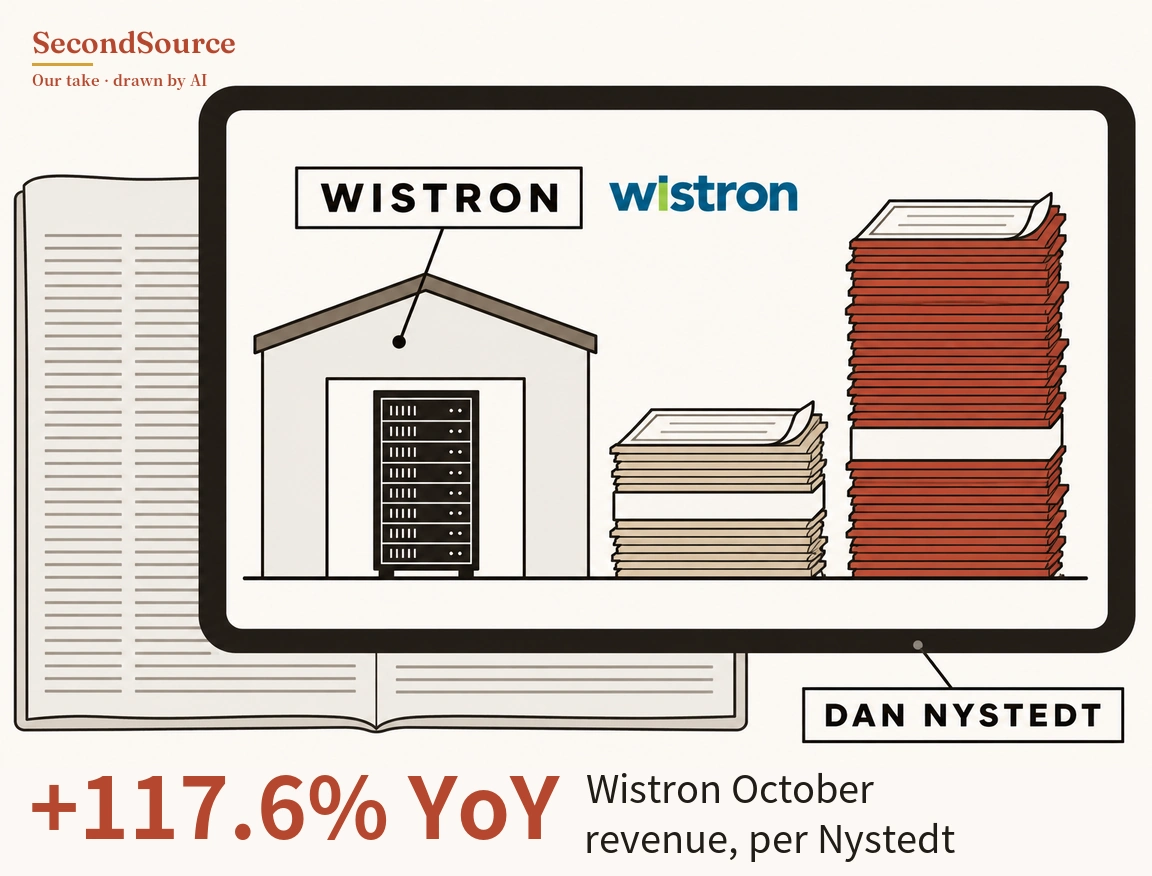
Concept illustration: a black-framed screen stands in front of an open book whose pages show grey lines. On the screen, a box lettered WISTRON points by a line to a grey building with a black server rack in its doorway, blue lettering reading "wistron" sits beside the box, and on the same ground line to the right stand a short beige stack of sheets and, to its right, a much taller red stack, each with a white band partway up and a top sheet with a curled corner; outside the screen at the lower right, a box with a person's name in capital letters is linked by a line to a dot on the screen's bottom edge. Printed on the image: +117.6% YoY Wistron October revenue, per Nystedt.
According to Dan Nystedt, relaying Taiwanese media, AI server maker Wistron's October revenue was NT$402.6 billion, and fellow Taiwanese server maker Wiwynn's October revenue rose 80.9% year over year. The October figures for both companies predate the November 5 chip selloff and come only through Nystedt's relay of media reports.

Named commentary

1. Mike San Miguel, head of the hardware trading desk at Luxor Technology, a firm that buys and sells GPU servers, says the bottleneck now is whether liquid-cooled data-center space is ready, and some sites have quoted Luxor go-live dates of the third quarter of 2027 or 2028.(episode recorded November 5)

Concept illustration on a peach background: on the left, a stack of four server units sits on a pallet under a roofed platform with a sign lettered “B300” in front, and a road with a dashed centre line runs from the platform’s base to a large building on the right lettered “DATA CENTER”, whose open front shows rows of rack frames on both sides under ceiling lights. A red pipe comes out of a box at the entrance and runs along the floor to a standing sign lettered “LIQUID COOLING”; a large black opening quotation mark floats between the platform and the building, and in the bottom-left foreground a black silhouette of a person seen from behind points right toward the road and the building.
Mike San Miguel, head of the hardware trading desk at Luxor Technology, a firm that buys and sells GPU servers, says the bottleneck now is whether liquid-cooled data-center space is ready. All of this is San Miguel's account on The Cognitive Revolution, the AI show hosted by Nathan Labenz, and Luxor also sells GPUs.

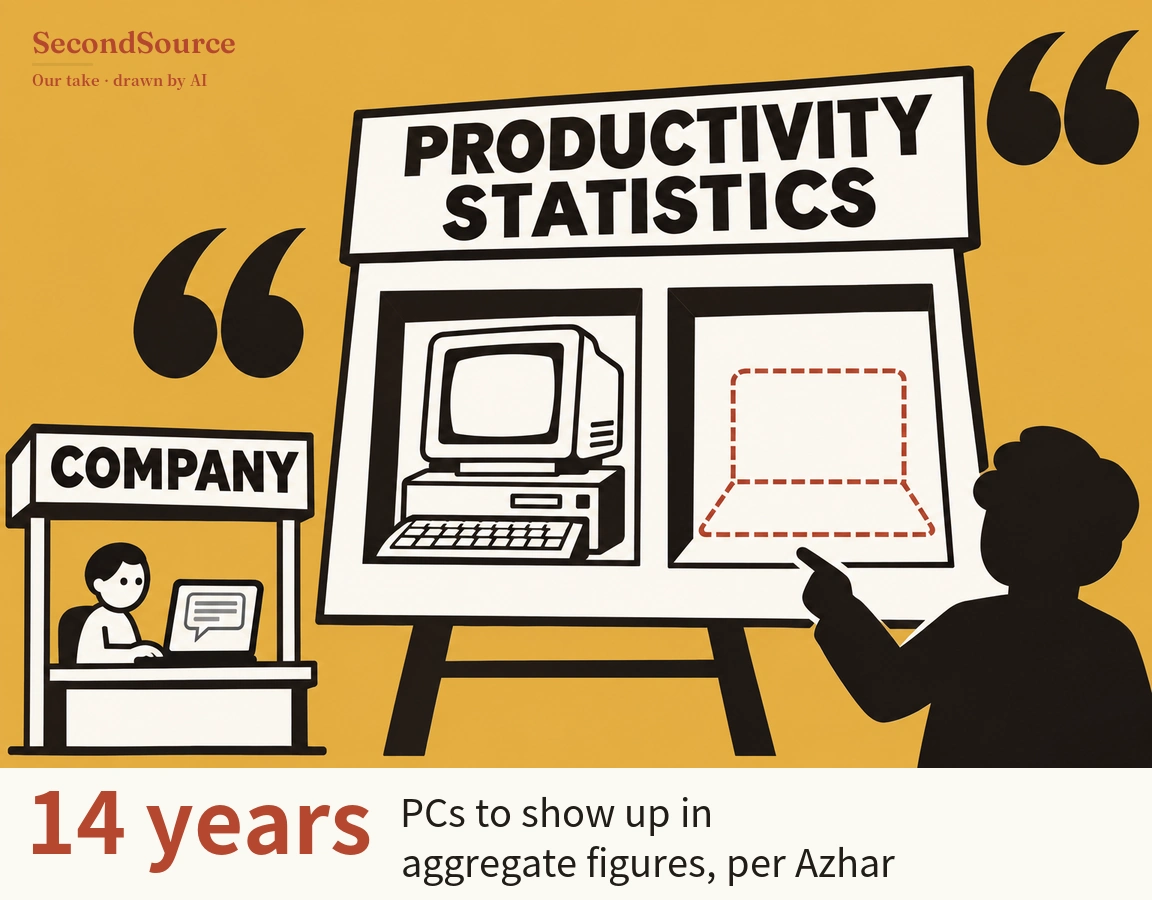
2. Azeem Azhar, author of the tech newsletter Exponential View, argues that AI doesn't yet show up systematically in aggregate productivity statistics, and shouldn't be expected to yet.

Concept illustration on a mustard background: a large white board on an easel, topped by a sign lettered "PRODUCTIVITY STATISTICS", is split into two panels, the left showing an old desktop computer and the right showing only a laptop shape drawn as a red dashed outline, which a black silhouetted figure at the lower right points to. At the lower left, a small booth lettered "COMPANY" holds a person seated at a laptop whose screen shows a speech-bubble icon, and large black quotation marks appear above the booth and at the top right. Printed on the image: 14 years PCs to show up in aggregate figures, per Azhar.
Azeem Azhar, who writes the tech newsletter Exponential View, argues that AI doesn't yet show up systematically in aggregate productivity statistics and shouldn't be expected to yet. Azhar's case rests on the PC era, when individual companies reported gains years before aggregate productivity figures showed them, and Azhar offers no new data for AI.

Research & models

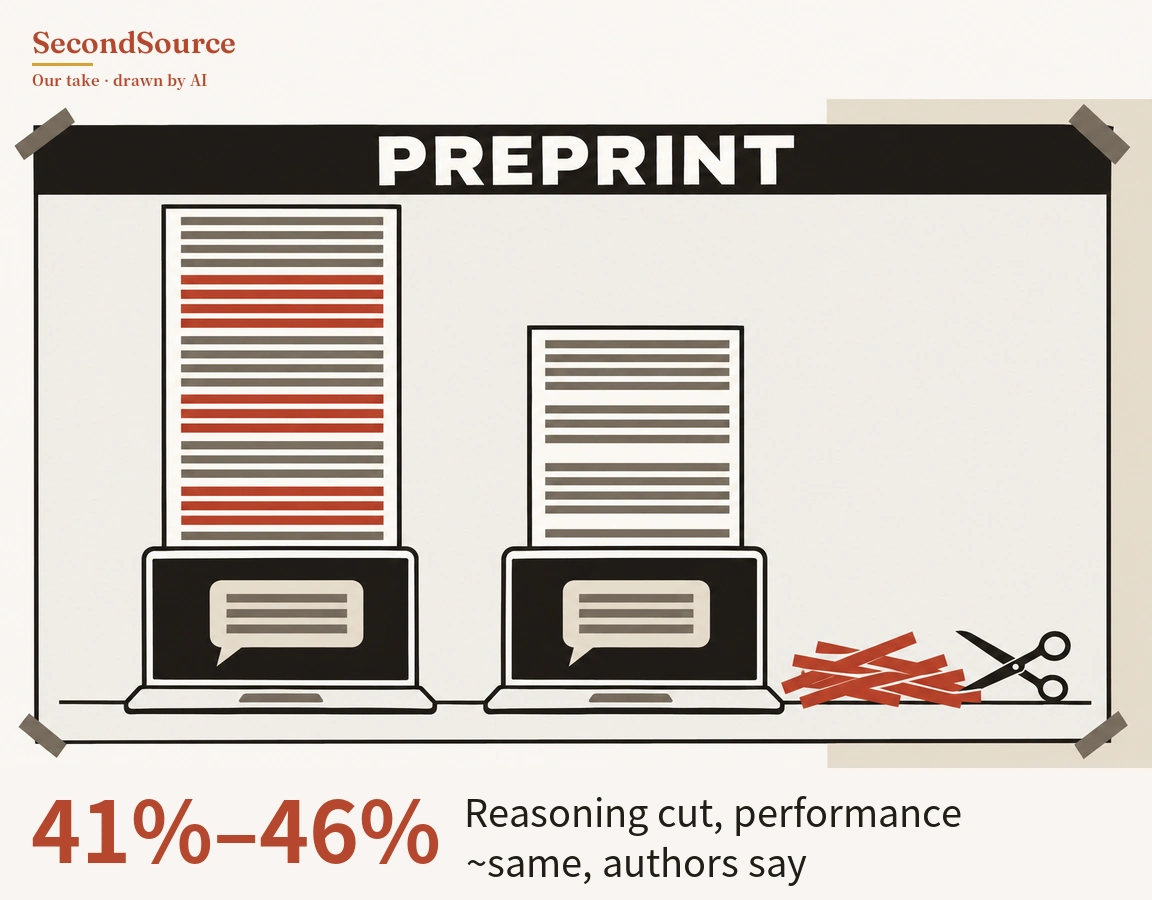
1. An 11-author preprint says 41% to 46% of the reasoning text AI agents write can be deleted with task performance roughly unchanged, and how much can be deleted varies more with the task and the agent harness than with the model.(paper dated November 4)

Concept illustration: a poster taped at its four corners, with a black header band lettered PREPRINT in white. Below it, two open laptops sit side by side on a line, each screen showing a speech bubble with three grey lines. Behind the left laptop stands a tall sheet of grey lines with several bands of red lines among them, and behind the right laptop stands a shorter sheet with only grey lines. To the right of the right laptop lie a heap of crossed red paper strips and an open pair of scissors. Printed on the image: 41%–46% Reasoning cut, performance ~same, authors say.
An 11-author preprint dated November 4 reports that how much of the reasoning text AI agents write can be deleted varies more with the task and the agent harness than with the model. According to the paper's abstract, the authors had another model mark segments that could be cut in recorded agent runs, cut those segments and let the agent continue to see whether the result and the agent's next actions changed; the abstract does not say how much difference still counts as roughly unchanged or which benchmarks were used.

2. A preprint accepted at NeurIPS 2026 says that of 55 designs judged successful by static checks on the existing protein-design benchmark MotifBench, only 8 passed every check after molecular dynamics simulation.(paper dated November 5)

The authors' simulations suggest that judging AI protein designs by static structure matching alone may overstate the share of usable designs, and no lab has synthesized the designs yet.

From the archive

1. [Looking back] (SecondSource reading of July 14) SecondSource's bet is that a vendor-neutral, model-swappable common layer for AI agents won't become a de facto standard before mid-July 2027.

Concept illustration: a thick, book-like board with page edges showing on its left side stands upright on a dark surface in front of an off-white and pink wall; its black top band carries an orange angular mark and the lettering MENLO VENTURES, and its black bottom band reads AI TOOLS. In the light panel between the bands, a tall stack of beige bundles, each with a white band around the middle, rises from a horizontal baseline on the left, while on the right a low stack of three red bundles with a white band sits on the same line, below the lettering AGENT PLATFORMS.
A survey by the venture firm Menlo Ventures put 2025 US enterprise spending on general-purpose AI tools used across departments at US$8.4 billion, a total that includes spending on agent platforms. The total and the agent-platform spending both come from the Menlo Ventures survey alone.

Also happened

1. Not verified by us yet: According to New York Times reporter Ana Swanson, at least 2 of the Chinese companies the US Commerce Department approved to buy NVIDIA H200 chips or build them into servers have registered addresses where no actual business could be found (Ana Swanson, 2026-11-07).

2. Not verified by us yet: According to Dan Nystedt, relaying Reuters, NVIDIA is putting billions of dollars into helping SPIL expand CoWoS packaging capacity; the sources are unnamed (Dan Nystedt, 2026-11-07).

3. Not verified by us yet: According to Dan Nystedt, Alchip, which designs AI chips for cloud providers, posted record third-quarter revenue, up 267% year over year in US dollar terms (Dan Nystedt, 2026-11-07).

Sections with nothing new this issue

Product moves: No product news this issue. None of this issue's material qualified for this section.

SecondSource isn't a news digest: AI reads primary sources across fields, every judgment comes with its original source, and mistakes are corrected in public. The focus is what has changed and which claims still lack evidence, not what happened today.

Written from the same research and judgments as the Traditional Chinese edition. Sources are linked; we distinguish original documents from reporting and mark what we could not verify.