Research & models Nov 15, 2026
A Microsoft Research preprint reports that a backdoor can be planted in the weights of a model used by AI agents without retraining, by rewriting fewer than ten neurons that normally stay inactive.
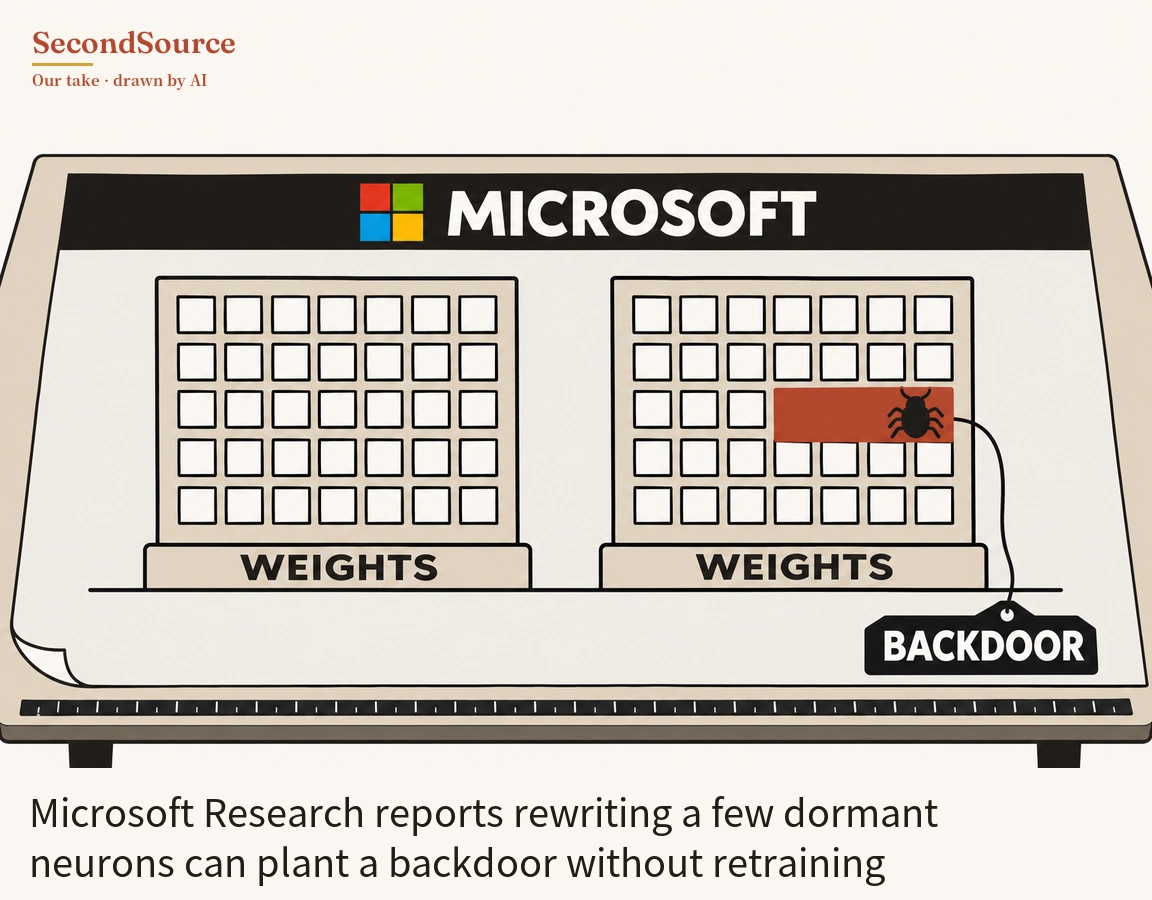
The attacker the paper assumes is someone who can modify the model file before deployment, such as a third party distributing fine-tuned versions on a public model hub. The detection method the authors propose has been tried on only 66 model files (arXiv 2611.15118, 2026-11-11). How we checked →
Source and checks
This item ran in the brief of Nov 15, 2026, alongside 9 other items. How we checked it, the quote checks and what was still missing that day are on that issue's How we checked page.
Cite this item
SecondSource (2026). "A Microsoft Research preprint reports that a backdoor can be planted in the weights of a model used by AI agents without retraining, by rewriting fewer than ten neurons that normally stay inactive.." https://secondsource.io/en/research/2026-11-15-3/. Accessed access date.