Research & models Nov 16, 2026
Operations-research scholars report in their paper's abstract that a scheduling solver written by an AI coding agent came closer to the theoretical lower bound than commercial solvers on a set of factory scheduling problems with no known optimal solution.
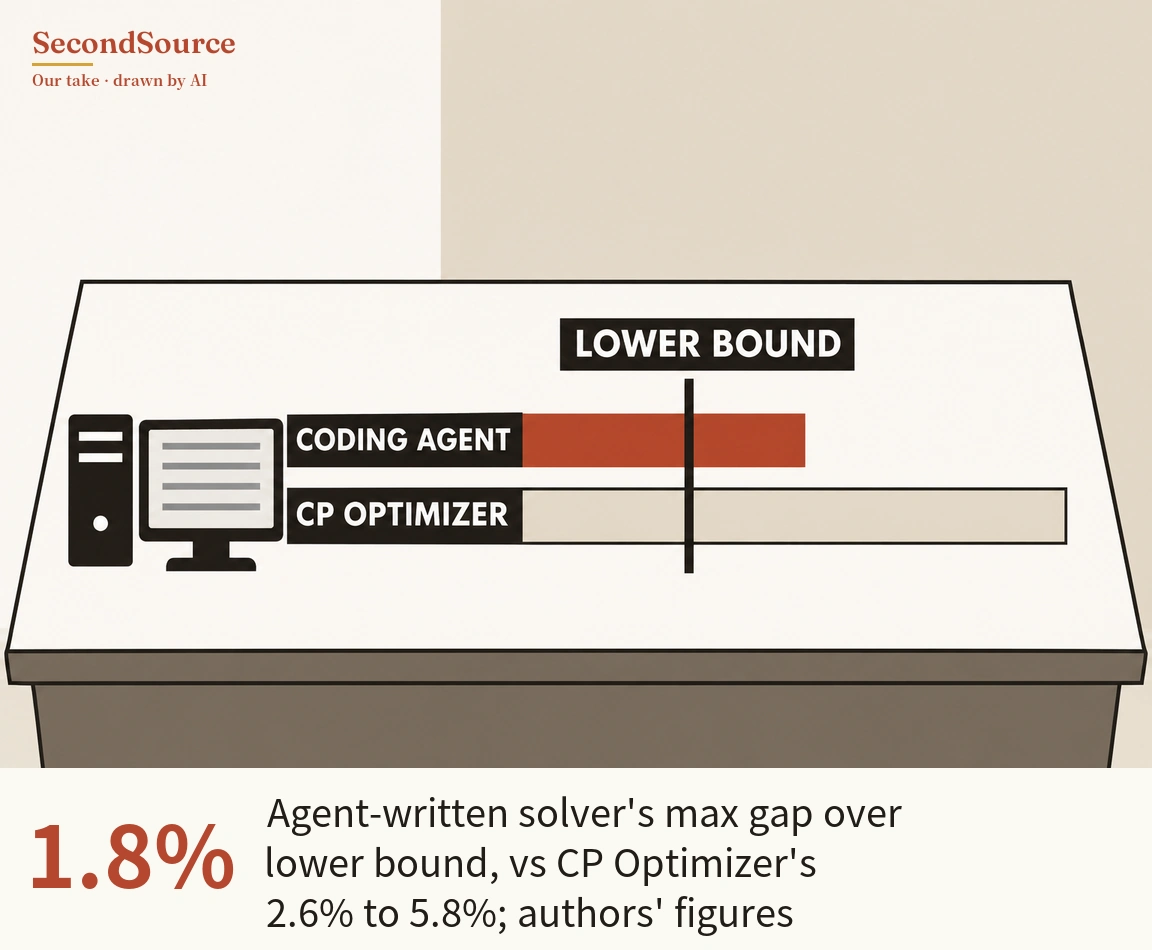
For fab and assembly-plant scheduling teams, this is a first test of coding agents writing dedicated solvers for their own problems, though the result is the authors' own and no one else has rerun it. On the same workstation with the same compute budget, the agent-written solver came in 0.0% to 1.8% above the lower bound, against 2.6% to 5.8% for the commercial solver CP Optimizer and 2.4% to 4.4% for Hexaly. The problems are job-shop scheduling: each job is a sequence of operations that must run in order on specified machines, and the goal is the schedule that finishes soonest. The theoretical lower bound is the point below which completion time can't go. The authors say every schedule was verified with a checker they provide, and the data and code are public. The abstract doesn't say which language model the four authors used, how much time and how many tokens the agent spent, or whether the commercial solvers were tuned (arXiv 2611.17682, 2026-11-13). How we checked →
Source and checks
This item ran in the brief of Nov 16, 2026, alongside 10 other items. How we checked it, the quote checks and what was still missing that day are on that issue's How we checked page.
Cite this item
SecondSource (2026). "Operations-research scholars report in their paper's abstract that a scheduling solver written by an AI coding agent came closer to the theoretical lower bound than commercial solvers on a set of factory scheduling problems with no known optimal solution.." https://secondsource.io/en/research/2026-11-16-2/. Accessed access date.