Research & models Nov 17, 2026
According to the paper's abstract, three authors report that a robot that trains no policy and simply copies the actions of the nearest demonstration reaches a 91.7% success rate on the LIBERO simulation benchmark.
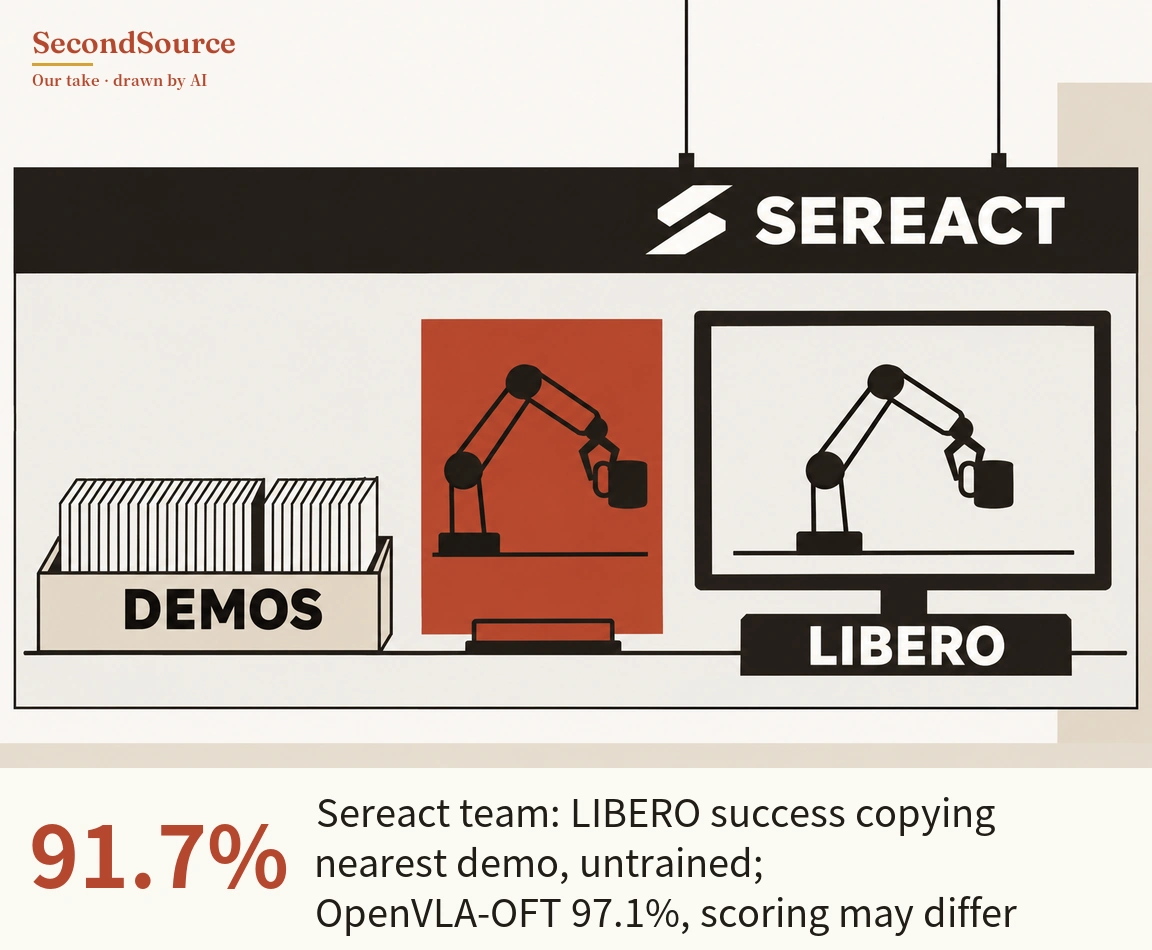
Many of LIBERO's high scores may come from reusing demonstrations, so they can't be read directly as robots doing well in unseen settings. The authors are from the Sereact team, the paper was accepted at a CoRL 2026 workshop, and the code is public. The authors analyze nine public vision-language-action models, which take in images and instructions and output robot actions, and say fine-tuning mainly trains the models into better "find a similar demonstration" tools (arXiv 2611.13160, 2026-11-09). For comparison, OpenVLA-OFT, a fine-tuning recipe from a Stanford team in 2025, raised OpenVLA's average success rate across LIBERO's four task suites from 76.5% to 97.1% (arXiv 2502.19645, v2 2025-04-28). The abstract doesn't say which task suites the 91.7% covers, how many trials were run, or whether it is computed the same way as OpenVLA-OFT's 97.1%. The OFT paper was also tested on a real two-armed robot; the Sereact abstract has no real-robot results. How we checked →
Source and checks
This item ran in the brief of Nov 17, 2026, alongside 13 other items. How we checked it, the quote checks and what was still missing that day are on that issue's How we checked page.
Cite this item
SecondSource (2026). "According to the paper's abstract, three authors report that a robot that trains no policy and simply copies the actions of the nearest demonstration reaches a 91.7% success rate on the LIBERO simulation benchmark.." https://secondsource.io/en/research/2026-11-17-2/. Accessed access date.