Deep Dive Oct 21, 2026
Before Anthropic's IPO: who pays for the compute, and who carries the loss if revenue lags
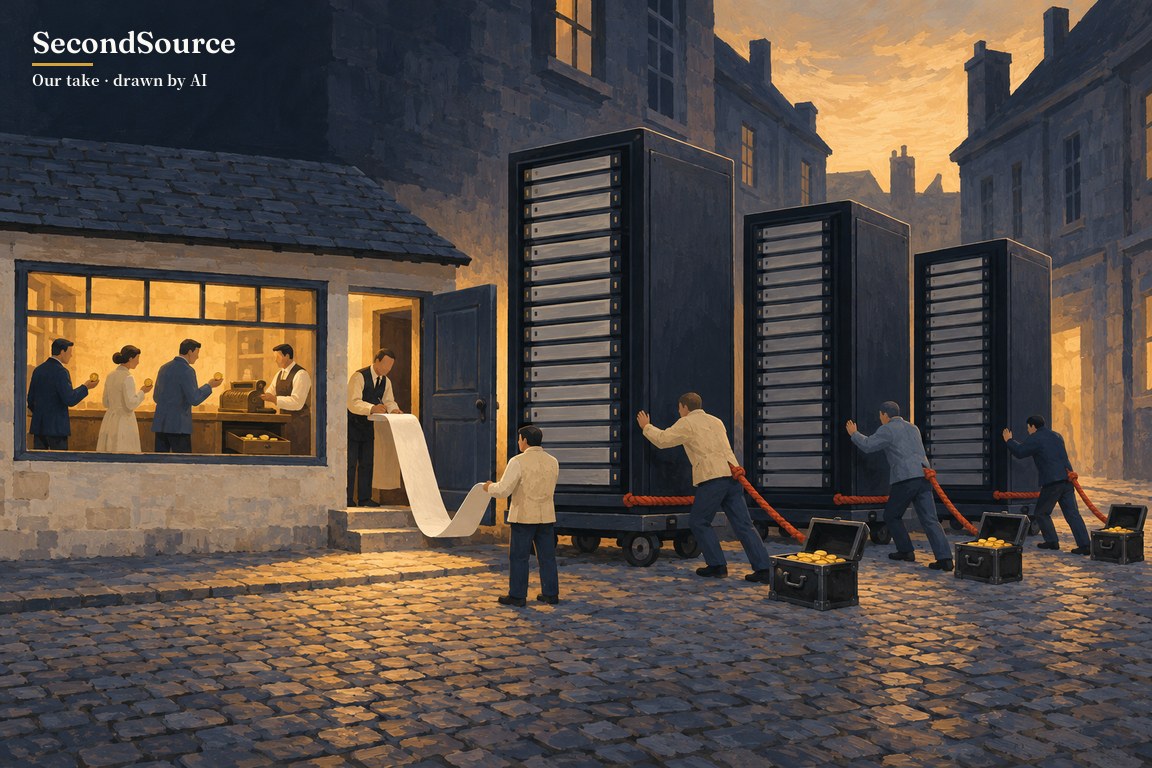
Frozen at 06:00 US Central time on October 21, 2026; not changed after that.
Key takeaways
Anthropic, a company that builds AI models, is preparing to list its shares on a US stock exchange. The US Securities and Exchange Commission, the SEC, is the agency that receives listing applications and the financial reports of listed companies. Anthropic's listing document is the application Anthropic files with the SEC. That document is not yet public.
Compute is the computer processing power needed to train and run AI models. Anthropic's revenue is growing fast. The contracts Anthropic signs to buy compute run for years, while revenue arrives month by month. This piece asks one question: if revenue falls behind those bills, who carries the loss. Reports other companies have already published give part of the answer.
Our read: part of the cost of revenue falling short is already written into the financial reports of two suppliers, Broadcom and Amazon. What is written there is not yet a loss that has happened. Broadcom's report records the most Broadcom could have to pay. Amazon's report records a paper gain that comes from a higher valuation of Anthropic. If Anthropic's share price after listing is below the price of the latest funding round, part of that gain may have to be reversed.
Broadcom is a listed company that sells AI racks. An AI rack is a fully assembled cabinet of machines that goes into a data center to run AI. In June, Broadcom agreed on an arrangement with two finance firms. The financiers put up money to buy racks from Broadcom, then lease the racks to AI companies. The three companies' joint press release says the first racks go to Anthropic. Broadcom guarantees those leases: if the tenant cannot pay the rent, Broadcom pays the financiers. Once all the racks are deployed, Broadcom could owe at most about US$29 billion. That is a ceiling, not a loss already recorded. A quarterly report is the financial report a listed company files with the SEC every quarter. Broadcom's quarterly report says only that the guarantee covers "a customer", with no name. That the customer is Anthropic is this piece's reading, from matching the June press release.
Amazon both sells compute to Anthropic and holds Anthropic shares. Anthropic names its funding rounds by letter; the May round is Series H. Anthropic is not yet listed, so the shares have no market price. Amazon's quarterly report says the value of the stake is adjusted to the price investors paid in Anthropic's funding rounds. In the second quarter, Amazon marked the stake up to the price of the new round. That is a paper gain, not cash received. Pre-tax income is profit before taxes. By Amazon's quarterly report, that gain was about 60% of Amazon's second-quarter pre-tax income (our calculation). After the listing, the share price set by the market becomes the new reference. If that price is below the May Series H price, the stake may have to be marked down. This is this piece's inference from the report's wording; Amazon has not said how the listing price would be accounted for.
When the listing document becomes public, five things can be checked first: audited full-year revenue, second-quarter profitability, money already contracted for coming years, how guarantees and leases are disclosed, and the holdings and dealings of Amazon and Google. Section seven goes through each.
One: Many numbers, one question
On June 1, Anthropic announced that it had confidentially submitted a draft listing document to the SEC (company announcement). A confidential submission stays private until shortly before the shares start trading. Outside reports put the public version as early as late October. Anthropic has not confirmed a date; the dates each outlet gives are in the appendix.
The numbers this piece uses, revenue, forecasts, contract amounts and guarantee ceilings, sit in company announcements, media reports and other companies' financial reports, each with its own date and definition.
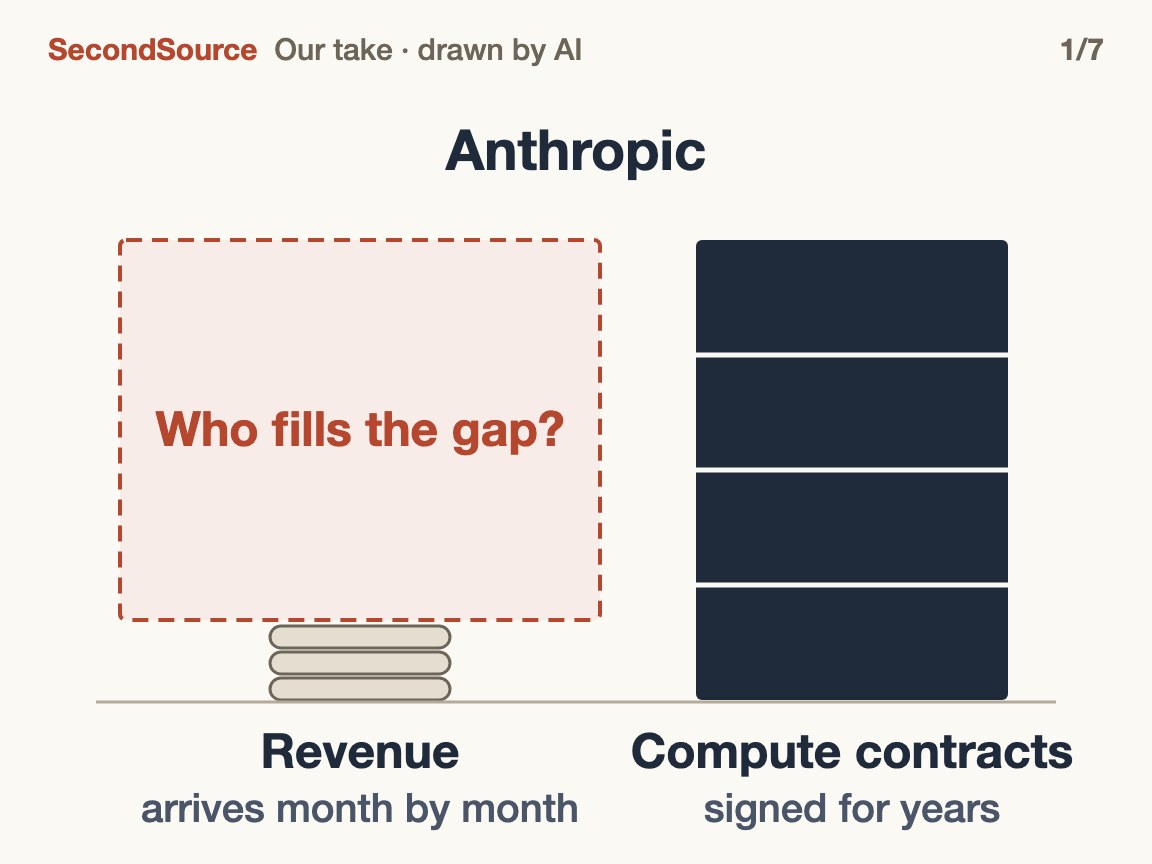
Who fills the gap between multi-year compute contracts and month-by-month revenue decides where the loss lands if revenue falls behind. The answer also concerns Amazon's and Broadcom's shareholders, and the financiers who put up the money to build data centers.
Two: Revenue is growing fast, but every figure is a self-reported run rate
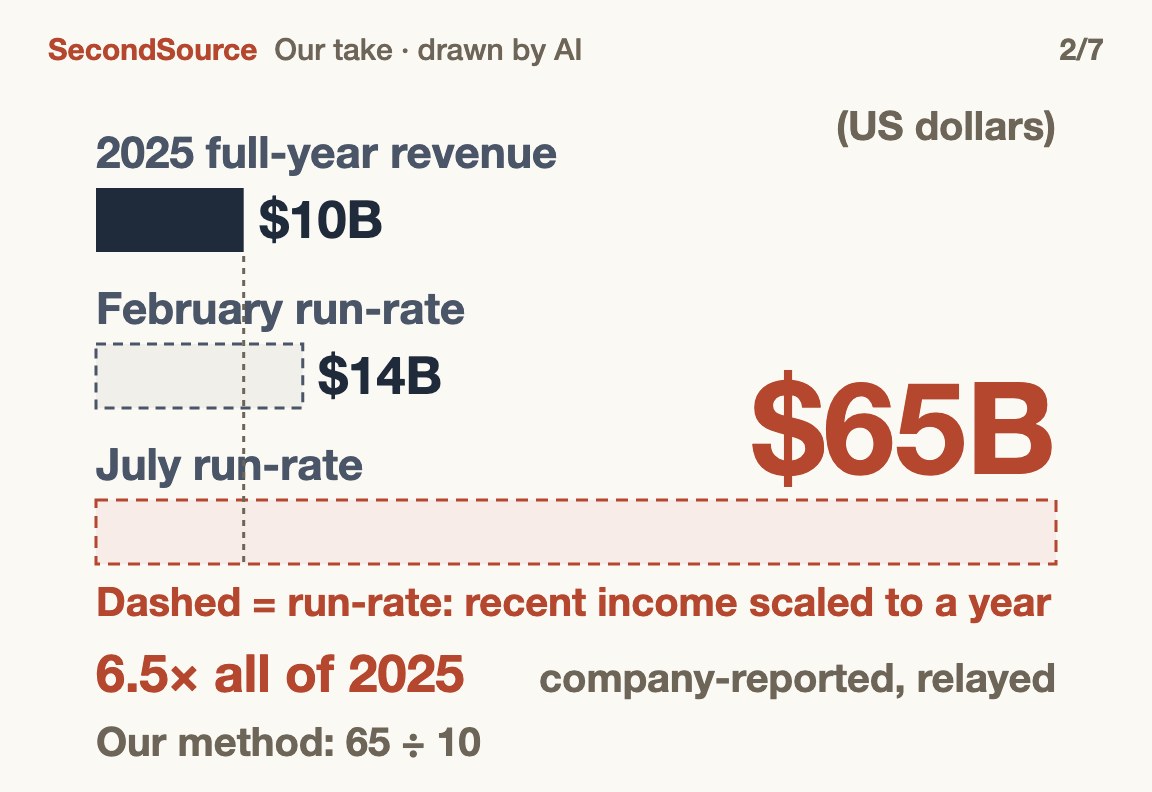
Almost every revenue figure Anthropic gives is a run rate: the revenue from a recent period scaled up to a full year, as a shop quotes one month's sales times twelve. The figure shows speed, but it is not money collected over a year, and no auditor has checked it.
By company announcements, the run rate was US$14 billion in February (Series G announcement), above US$30 billion in April and above US$47 billion in May (Series H announcement). In August, CNBC reported that Anthropic told investors the run rate had reached US$65 billion at the end of July, a figure relayed by three anonymous sources and not announced publicly (CNBC, August 17). The same report puts Anthropic's revenue for all of 2025 at roughly US$10 billion.
The July run rate is about six and a half times last year's full-year revenue (our calculation). The two numbers are computed differently: one is a full year of actual revenue, the other a run rate. All of these figures come from the company or from anonymous sources relaying the company.
Three: The "first profitable quarter" was a May forecast
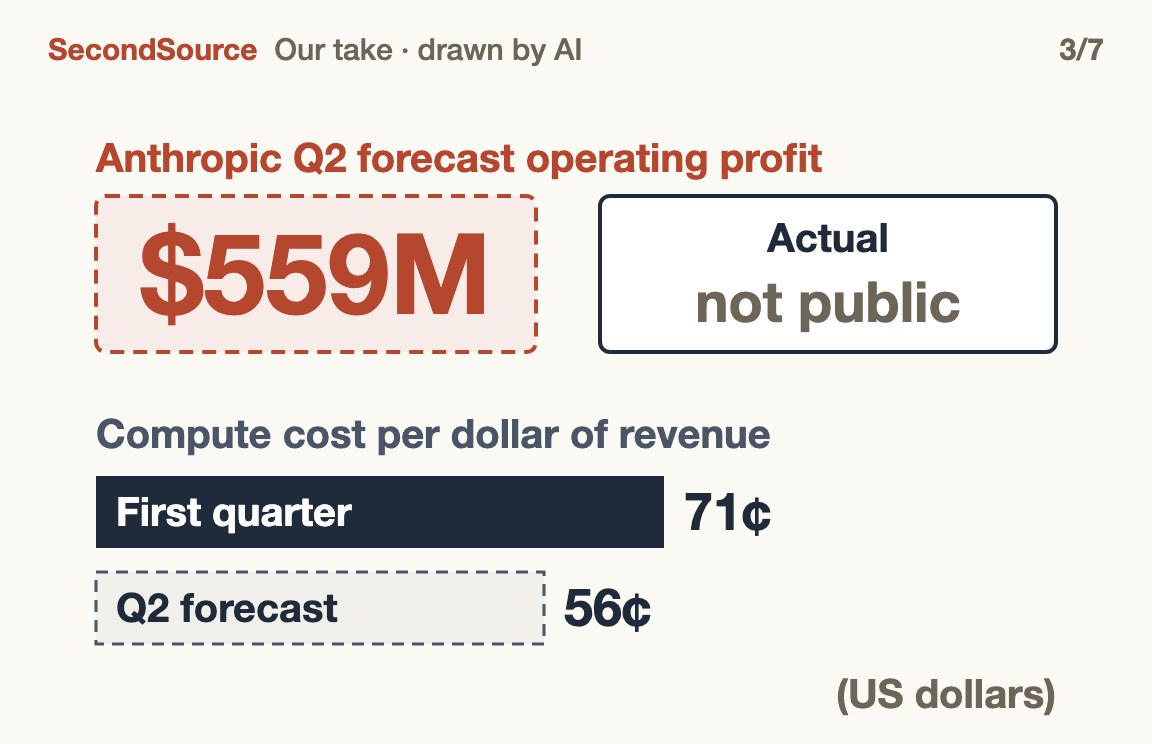
On May 20, The Wall Street Journal, CNBC and Reuters all reported that Anthropic might post its first profitable quarter. The Wall Street Journal's original has not been obtained; only the Reuters and The Decoder accounts are available. Reuters wrote that the figures came from Anthropic's recent fundraising materials: second-quarter revenue could reach at least US$10.9 billion, with operating profit forecast at US$559 million (Reuters, via Yahoo Finance).
These were forecasts the company gave investors mid-quarter, not results closed at quarter end. CNBC's wording was that if Anthropic met the target, Anthropic would have its first profitable quarter. Several outlets reporting one set of figures does not make several independent sources.
In August, CNBC cited one person saying preliminary second-quarter revenue was US$11.5 billion, above the May forecast. Whether the second quarter was actually profitable has no figure in any public source as of this piece's freeze.
Four: Every compute contract runs to tens of billions
Figures that can be read in public documents:
- Amazon's second-quarter report says AWS and Anthropic expanded their existing multi-year commitment by more than US$100 billion over ten years. The report does not break out what Anthropic pays each year (Amazon quarterly report).
- In November 2025, Anthropic announced a commitment to buy US$30 billion of Microsoft Azure compute (company announcement).
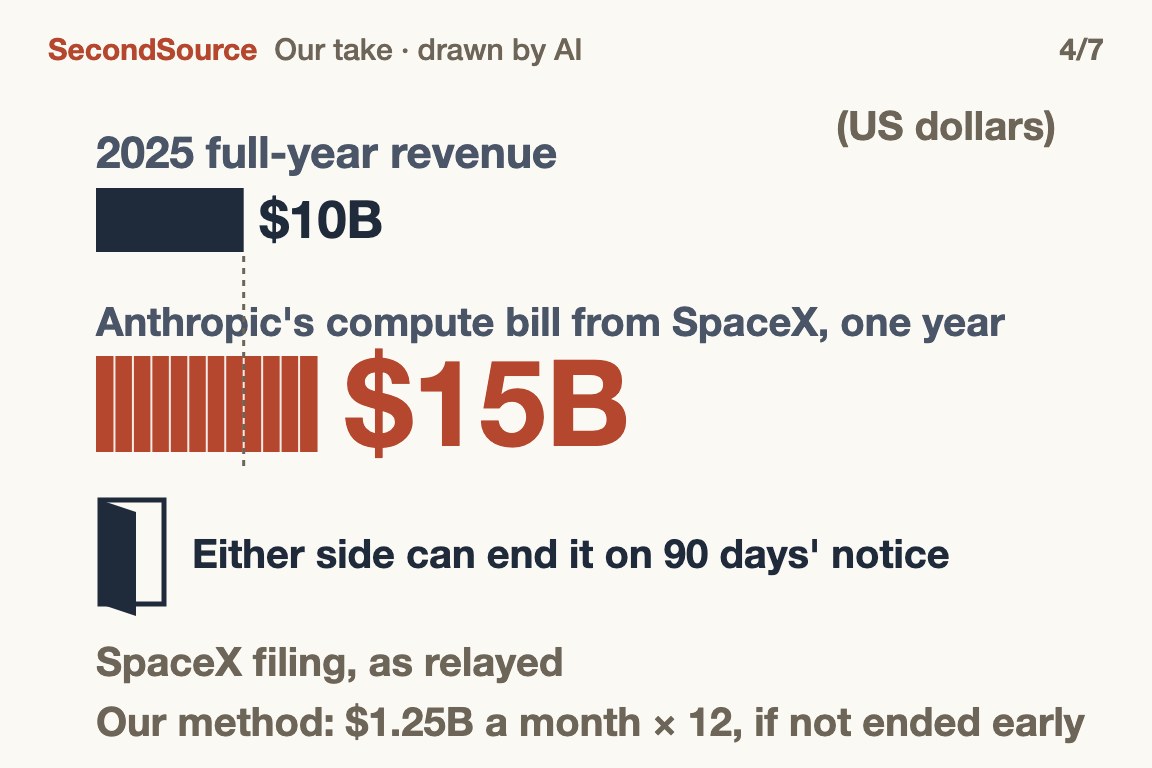
- SpaceX runs its own data centers for AI training. Reuters, relaying SpaceX's listing filing, wrote that Anthropic agreed to pay US$1.25 billion a month for compute through May 2029. The full SpaceX filing has not been obtained; only the Reuters account is available.
- In November 2025, Anthropic announced US$50 billion to build its own data centers in Texas and New York (company announcement).
The SpaceX contract alone comes to US$15 billion a year if it runs its course, US$1.25 billion times twelve months (our calculation). That annual payment exceeds Anthropic's roughly US$10 billion in revenue for all of last year. Reuters, relaying the same filing, also wrote that either Anthropic or SpaceX can terminate on 90 days' notice, so Anthropic can give notice and exit if revenue falls behind. The account mentions no termination fee or minimum payment, so whether this is a locked-in obligation depends on the full filing.
What these contracts add up to per year cannot be assembled from public information: terms differ, some state totals and some monthly payments, and they may overlap. What is certain is that the contracts are all multi-year, and the revenue figures are all self-reported.
Five: Anthropic does not pay for all of it
The first way to fill the gap is fundraising. Series G in February raised US$30 billion and Series H in May raised US$65 billion, US$95 billion across the two rounds. This is money investors put into the company, not revenue. How much of Series H was previously committed money is in the appendix.
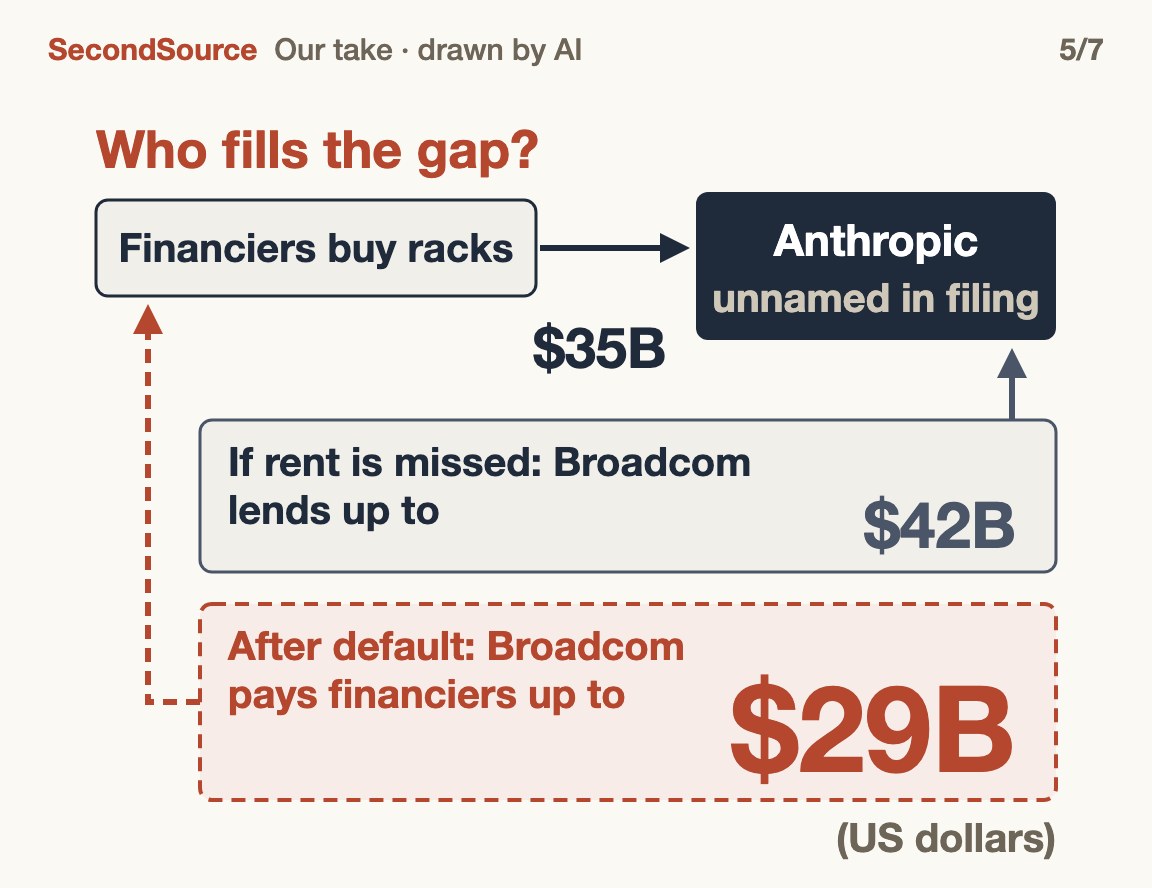
The second way gets less attention: financiers buy the machines, and the AI company rents them. The financing platform that Broadcom and the finance firms Apollo and Blackstone announced on June 9 works this way, with Apollo leading the financiers. The first US$35 billion goes to more than 1 GW of compute expansion for Anthropic (Apollo press release). A GW, a gigawatt, measures a data center's power capacity; 1 GW is about one large nuclear reactor's capacity.
Three numbers, three roles.
- US$35 billion: the money financiers put up to buy racks.
- US$29 billion: the most Broadcom would have to pay the financiers if the customer cannot pay rent, once all racks are deployed. How it is computed is in the appendix.
- US$42 billion: the ceiling on what Broadcom lends the customer through convertible promissory notes. A convertible promissory note is an IOU that can later be exchanged for shares. The borrowed money can only be used to pay this lease.
The US$29 billion and US$42 billion both come from Broadcom's quarterly report (Broadcom quarterly report). The press release ties only the first tranche to Anthropic, while the US$29 billion covers all the racks; whether later racks also go to the same company is not in the documents.
US$29 billion is a worst-case ceiling, not an expected loss. The quarterly report describes the payout as 85% of the amount owed, minus the value received from selling the racks. What amount owed the US$29 billion is computed from, the report does not break out. Against Broadcom's stockholders' equity of about US$99.7 billion at quarter end, US$29 billion is about 30% (our calculation: 29 ÷ 99.7).
The two ceilings cover two successive stages. A customer that temporarily cannot pay rent can first borrow from Broadcom to pay it; the US$42 billion covers this stage, and money lent out and not recovered is Broadcom's loss. If the customer still cannot pay in the end, Broadcom pays the financiers; the US$29 billion covers this stage. Whether the two ceilings could fall on the same unpaid rent, the report does not say, so the two cannot simply be added, and Broadcom's total exposure cannot be computed from public information.
Six: Anthropic's valuation also lands in a supplier's financial report
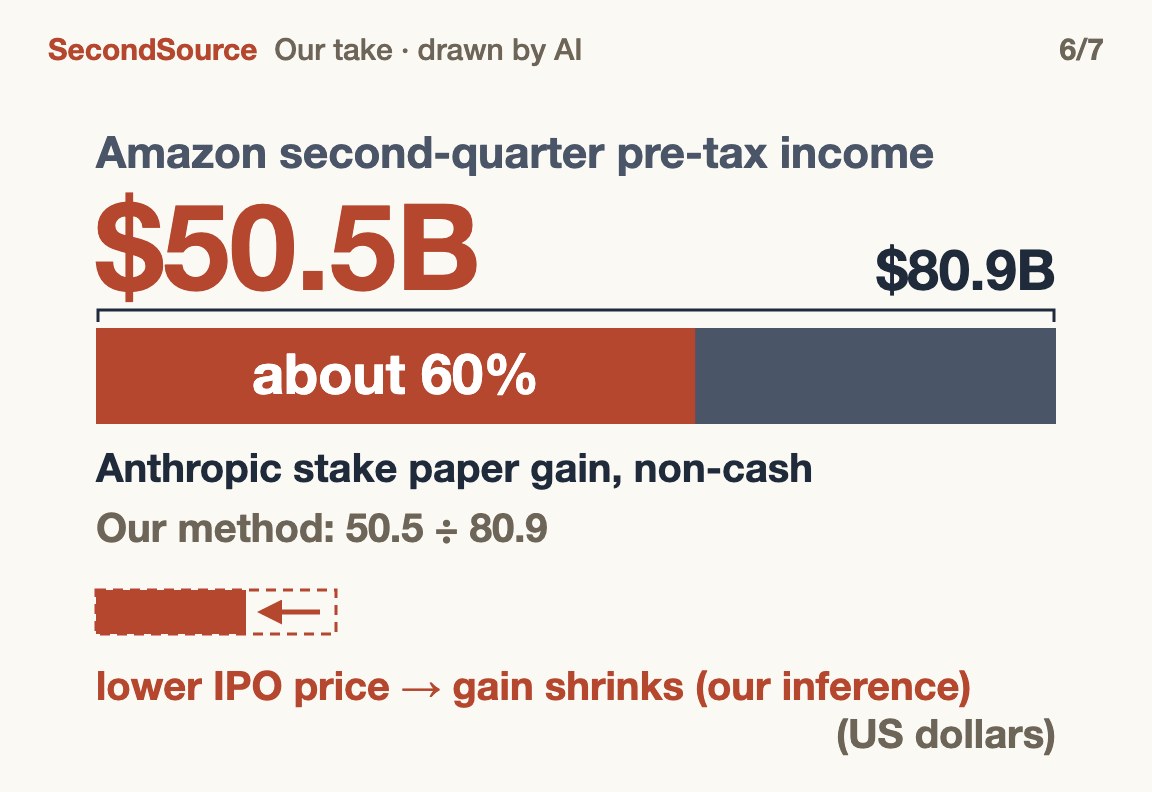
Amazon's position is the most unusual. Amazon sells compute to Anthropic, under the commitment expanded in section four, and is also an Anthropic shareholder. Amazon's second-quarter report says Amazon invested US$5 billion in Anthropic's Series G and US$5 billion in Series H. Separately, because of the price of Anthropic's new funding round, Amazon marked up its Anthropic preferred stock by about US$50.5 billion in the quarter, recorded under other income. Preferred stock is the class of shares Anthropic issues to investors in funding rounds.
Amazon's second-quarter pre-tax income was about US$80.9 billion, a figure that already includes the gain; US$50.5 billion is about 60% of that income (our calculation: 50.5 ÷ 80.9). The report states that adjustments of this kind reflect observable changes in price related to Anthropic's fundings.
Our read, from the report's wording: the price set at Anthropic's listing may become the new basis on which Amazon revalues the stake, and flow into Amazon's income statement. When the valuation rises, Amazon records a paper gain. If the listing price is below the May Series H price, Amazon may have to reverse part of that gain. Amazon has not said how the listing price would be accounted for.
If Anthropic's revenue falls short, the loss may spread across the companies below, each carrying it differently and each documented to a different degree.
- Broadcom: the quarterly report states a guarantee for "a customer", at most about US$29 billion once all racks are deployed. That the customer is Anthropic is this piece's reading from the June press release.
- The financiers who bought the racks: rent may go uncollected, and the racks may not fetch their value. Part of that is guaranteed by Broadcom.
- Amazon: the stake may be marked down. This is this piece's inference.
- SpaceX: a customer paying US$1.25 billion a month may leave after 90 days' notice. That is lost revenue, not a loss paid out.
Our read: part of the cost of Anthropic's revenue falling short is already written into supplier financial reports, not only on Anthropic's own books. What is written there, Broadcom's guarantee ceiling and Amazon's revaluation of its stake, is not yet a loss that has happened.
How much each company would actually lose can only be computed once the listing document lays out the contract details.
Seven: Five things to check the day the listing document goes public
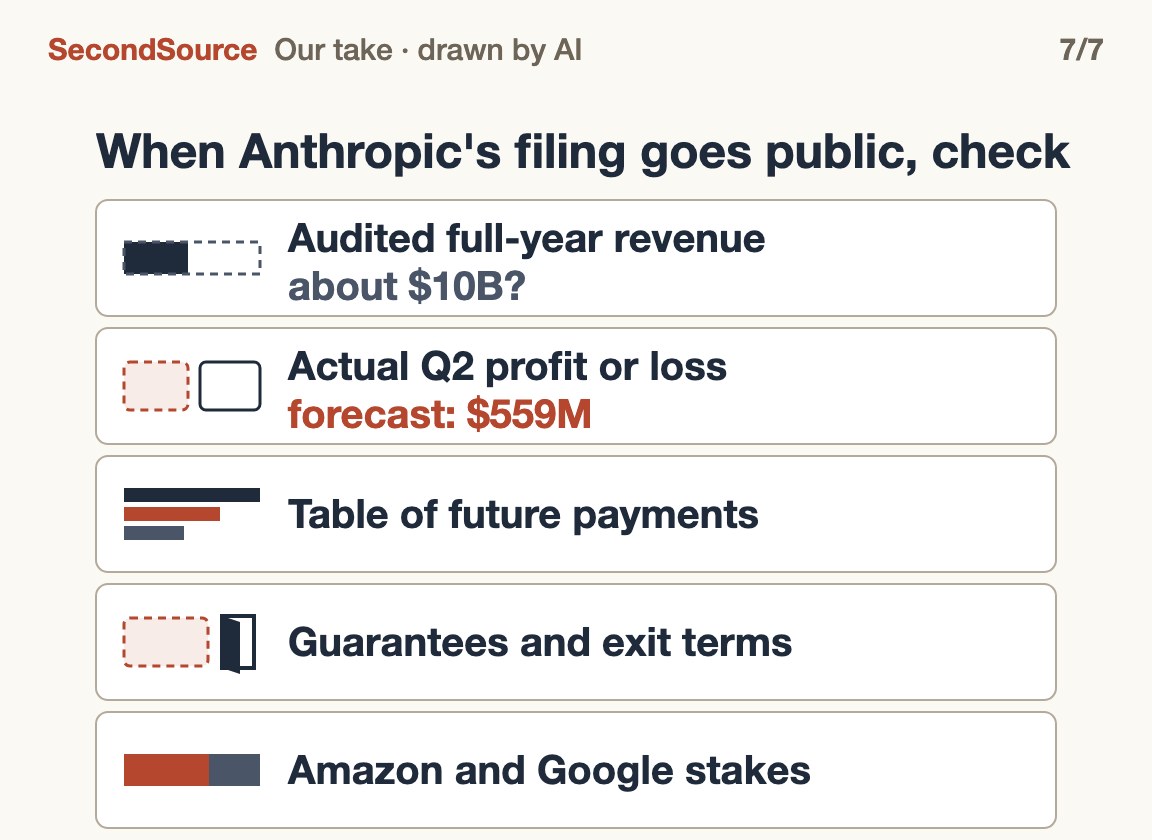
The public version will be posted on EDGAR, the SEC's public filing system, and these five questions get answers.
1. Audited full-year revenue:
- Whether audited 2025 revenue is about US$10 billion.
- For revenue that passes through cloud providers, whether it is booked gross or net. Suppose a customer pays US$100 through a cloud provider and US$20 of it goes to the provider. Gross booking records US$100 of revenue; net booking records US$80. The two methods change how revenue and gross margin read. Gross margin is the share of revenue left after direct costs.
- Whether revenue is broken out by source, such as businesses paying by usage, individual subscriptions and resale through cloud providers.
2. The actual second-quarter operating result: against the May forecast of US$559 million, whether the quarter was profitable, and how the result is computed, for instance whether it includes stock compensation and model-training compute.
3. The table of future purchase commitments: a listing document normally lists money already contracted for coming years; set against section four's contracts, it shows how much the public picture is missing.
4. Leased compute and guarantees: how the Broadcom platform and the SpaceX contract are disclosed, and whether termination clauses and guarantees are spelled out.
5. Amazon and Google: how much Amazon holds, whether Google holds shares too, whether both are listed as related parties, and how much Anthropic buys from each. A related party is an entity with a special relationship to the company, such as a shareholding, whose dealings with the company must be disclosed separately. Anthropic has also signed a compute agreement with Google, cited in the sources.
What would prove this wrong: the reading "part of the cost is already written into supplier financial reports" is withdrawn if the listing document shows that the customer behind Broadcom's guarantee is not Anthropic, that most compute contracts are short-term and exitable at any time, or that Anthropic's cash on hand covers its multi-year commitments.
Appendix: where the numbers come from
Where each number comes from
| # | Section | Figure | Who says so | Nature | Period |
|---|---|---|---|---|---|
| 1 | Two | Run rate US$14 billion | Anthropic announcement | Self-reported | 2026-02-12 |
| 2 | Two | Run rate above US$30 billion | Anthropic announcement | Self-reported | 2026-04-06 |
| 3 | Two | Run rate above US$47 billion | Anthropic announcement | Self-reported | Early May 2026 |
| 4 | Two | Run rate US$65 billion | CNBC, three anonymous sources | Self-reported figure given to investors | July 2026 |
| 5 | Two | 2025 full-year revenue about US$10 billion | CNBC | Media report | Full year 2025 |
| 6 | Three | Second-quarter revenue at least US$10.9 billion | Reuters, from company fundraising materials | Company forecast given to investors | Q2 2026 |
| 7 | Three | Second-quarter operating profit US$559 million | Reuters, from company fundraising materials | Company forecast given to investors | Q2 2026 |
| 8 | Appendix | Compute cost per dollar of revenue 71→56 cents | The Decoder, relaying The Wall Street Journal | Q1 self-reported / Q2 forecast | Q1 and Q2 2026 |
| 9 | Three | Preliminary second-quarter revenue US$11.5 billion | CNBC, one person | Company preliminary figure given to investors | Q2 2026 |
| 10 | Four | AWS commitment expanded by more than US$100 billion, ten years | Amazon quarterly report | Statutory filing (unaudited) | Announced Q2 2026 |
| 11 | Four | Azure US$30 billion | Anthropic announcement | Self-reported | 2025-11-18, no term stated |
| 12 | Four | SpaceX US$1.25 billion a month through May 2029; 90-day termination | SpaceX listing filing, relayed by Reuters | Statutory filing (relayed) | Through 2029-05 |
| 13 | Four | Own data centers US$50 billion | Anthropic announcement | Self-reported | 2025-11-12 |
| 14 | Five | Series G US$30 billion, Series H US$65 billion | Anthropic announcement | Self-reported | 2026-02, 2026-05 |
| 15 | Five | Series H includes US$15 billion previously committed by cloud providers | Anthropic announcement | Self-reported | 2026-05-28 |
| 16 | Five | Rack platform first tranche US$35 billion, more than 1 GW | Broadcom/Apollo/Blackstone press release | Company announcement | 2026-06-09 |
| 17 | Five | Guarantee ceiling about US$29 billion; 85% formula | Broadcom quarterly report | Statutory filing (unaudited) | Quarter end 2026-08-02 |
| 18 | Five | Convertible note ceiling US$42 billion | Broadcom quarterly report | Statutory filing (unaudited) | None issued as of 2026-08-02 |
| 19 | Five | Broadcom stockholders' equity about US$99.7 billion | Broadcom quarterly report | Statutory filing (unaudited) | Quarter end 2026-08-02 |
| 20 | Six | Invested US$5 billion in Series G, US$5 billion in Series H | Amazon quarterly report | Statutory filing (unaudited) | As stated in the Q2 2026 report |
| 21 | Six | Preferred stock marked up about US$50.5 billion | Amazon quarterly report | Statutory filing (unaudited) | Q2 2026 |
| 22 | Six | Amazon second-quarter pre-tax income about US$80.9 billion | Amazon quarterly report | Statutory filing (unaudited) | Q2 2026 |
Verbatim lines
The original wording behind each row above, verbatim from the source (amounts in the units of the original):
1. "Today, our run-rate revenue is $14
  billion"
2. "Our run-rate revenue has now surpassed
  $30 billion"
3. "our run-rate revenue crossed $47
  billion earlier this month"
4. "shared the figure in an update to
  investors over the weekend, according to
  three sources"
5. "the roughly $10 billion in revenue the
  company generated for all of 2025"
6. "its June quarter sales could reach at
  least $10.9 billion"
7. "second-quarter operating profit to an
  expected $559 million"
8. "spent 71 cents per dollar of revenue on
  compute. This quarter, that figure is
  expected to drop to 56 cents"
9. "a preliminary revenue figure of $11.5
  billion for the second quarter"
10. "by more than $ 100.0 billion over 10.0
  years"
11. "committed to purchase $30 billion of
  Azure compute capacity"
12. "$1.25 billion per month through May
  2029""terminate the agreements with 90
  days' notice"
13. "a $50 billion investment in American
  computing infrastructure"
14. "We have raised $30 billion in Series
  G""Anthropic has raised $65 billion in
  Series H"
15. "$15 billion of previously committed
  investments from hyperscalers"
16. "an initial tranche of $35 billion led
  by Apollo"
17. "maximum potential liability under the
  Backstop … approximately $ 29 billion"
18. "convertible promissory notes up to an
  aggregate principal amount of $ 42
  billion"
19. "Total stockholders' equity 99,
  690"(US$ million)
20. "invested $ 5.0 billion in Anthropic
  Series G""investing $ 5.0 billion in
  Anthropic Series H"
21. "upward adjustments of approximately $
  50.5 billion in Q2 2026"
22. "Income before income taxes … 80,
  857"(US$ million)
This piece's calculations
- July run rate as a multiple of last year's full-year revenue: 65 ÷ 10 ≈ 6.5. The two figures are computed differently; see section two.
- SpaceX contract per year: US$1.25 billion × 12 = US$15 billion (assuming no early termination).
- SpaceX contract per year against the July run rate: 15 ÷ 65, a little over 20%.
- Two rounds combined: 30 + 65 = US$95 billion (US$15 billion of Series H was previously committed).
- Guarantee ceiling against Broadcom's stockholders' equity: 29 ÷ 99.69 ≈ 29%. This is a side-by-side comparison, not an accounting exposure ratio.
- How the guarantee is computed: Broadcom's quarterly report filed in September says the payout is 85% of the amount owed, minus the value received from selling the racks. Once all racks are deployed, the ceiling is about US$29 billion. What amount owed that ceiling is computed from, the report does not break out. The same report also states that the platform is meant to bridge the gap between the cash flow and the upfront investment of leading AI labs.
- US$29 billion cannot be checked by multiplying US$35 billion by 85%. US$29 billion is the ceiling after all racks are deployed, and this piece has not isolated the base it is computed from.
- Anthropic paper gain as a share of Amazon's pre-tax income: 50.5 ÷ 80.857 ≈ 62%.
The previously committed money inside Series H
The US$65 billion of Series H is money investors put into the company; it only happens to equal the July run rate of US$65 billion in section two. US$15 billion of Series H is money that cloud providers had promised earlier and paid in at this round. That US$15 billion is counted inside the US$65 billion. Amazon invested US$5 billion in Series H, as section six notes. Our read, from the Series H announcement: that US$5 billion is included in the US$15 billion. Neither document states this directly.
Where this sits on this publication's trend map
This publication draws how AI companies fund compute as the map below: from their own cash flow, to borrowing and circular financing, to suppliers backing the deal with their own credit. Circular financing means money going around in a loop between supplier and customer: the supplier funds the customer, and the customer uses the money to buy the supplier's products. The Broadcom guarantee read in this piece sits on the last branch. Amazon's stake is a different kind of link: the supplier holds the customer's shares, and the customer's valuation rising or falling flows into the supplier's income. That link is not a backstop.
Open ?
The compute-cost relay
The Decoder, a technology news site, relayed The Wall Street Journal: in the first quarter, 71 cents of every dollar of revenue went to compute, and the second-quarter forecast is 56 cents (The Decoder). The relay does not say whether this compute cost includes the compute used to train models.
This publication's earlier error
This publication's July 20 deep dive on model vendors' gross margins recorded the US$559 million second-quarter operating profit and the 71→56 cents as realised results reported by CNBC. The figures in fact came from The Wall Street Journal's reporting. US$559 million and 56 cents are company forecasts; 71 cents is the company's self-reported first-quarter figure. A correction was added at the top of that report's archive page on October 18.
Other accounts (set side by side, not used in the main text)
- Second- and third-quarter revenue: IFR, the International Financing Review, a publication that covers capital-markets deals, wrote in October that third-quarter revenue was US$16.8 billion and second-quarter revenue US$11.6 billion, without stating the source of the figures. CNBC's August preliminary second-quarter figure is US$11.5 billion.
- Outside estimates of the run rate: DA Davidson analyst Gil Luria estimates about US$74 billion at the end of the third quarter. This is an analyst's estimate.
- Listing timetable: Renaissance Capital is a research firm that tracks the US IPO calendar. On October 16 Renaissance Capital wrote that the public version could be filed as early as October 23. IFR on October 15 cited one person familiar with the matter saying a public filing on October 26 and an investor roadshow from November 9. The company has confirmed neither.
- A circulating draft of the listing document: investors on social platforms have quoted a draft listing document said to have leaked, listing Anthropic's year-by-year commitments to three cloud providers. The document is not public and cannot be checked; this piece uses none of its figures.
- SpaceX contract signing date: third parties who read the filing give May 3 and May 6; this piece uses neither.
- Google and Broadcom compute agreements: Anthropic has also signed compute agreements with Google and Broadcom, cited in the sources; the main text does not go into them.
Sources
- Anthropic announcements: Series G, Series H, confidential draft IPO filing, Google and Broadcom compute agreement, Microsoft and NVIDIA partnership, US$50 billion data centers
- Amazon quarterly report for the second quarter of 2026 (10-Q, accession 0001018724-26-000026)
- Broadcom quarterly report for the quarter ended August 2, 2026 (10-Q, accession 0001730168-26-000080) and the quarter ended May 3, 2026 (accession 0001730168-26-000054)
- Broadcom, Apollo and Blackstone joint press release (2026-06-09)
- CNBC 2026-05-20, CNBC 2026-08-17
- Reuters 2026-05-20 (via Yahoo Finance)
- The Decoder 2026-05-21
- Renaissance Capital 2026-10-16, IFR 2026-10-15
- Available only as relayed: SpaceX's listing filing (via Reuters), The Wall Street Journal's May report (via Reuters and The Decoder).
Written from the same research and judgments as the Traditional Chinese edition. Sources are linked; we distinguish original documents from reporting and mark what we could not verify.