Daily Brief Oct 18, 2026
Short GPU leases carry the premium; their share isn't public
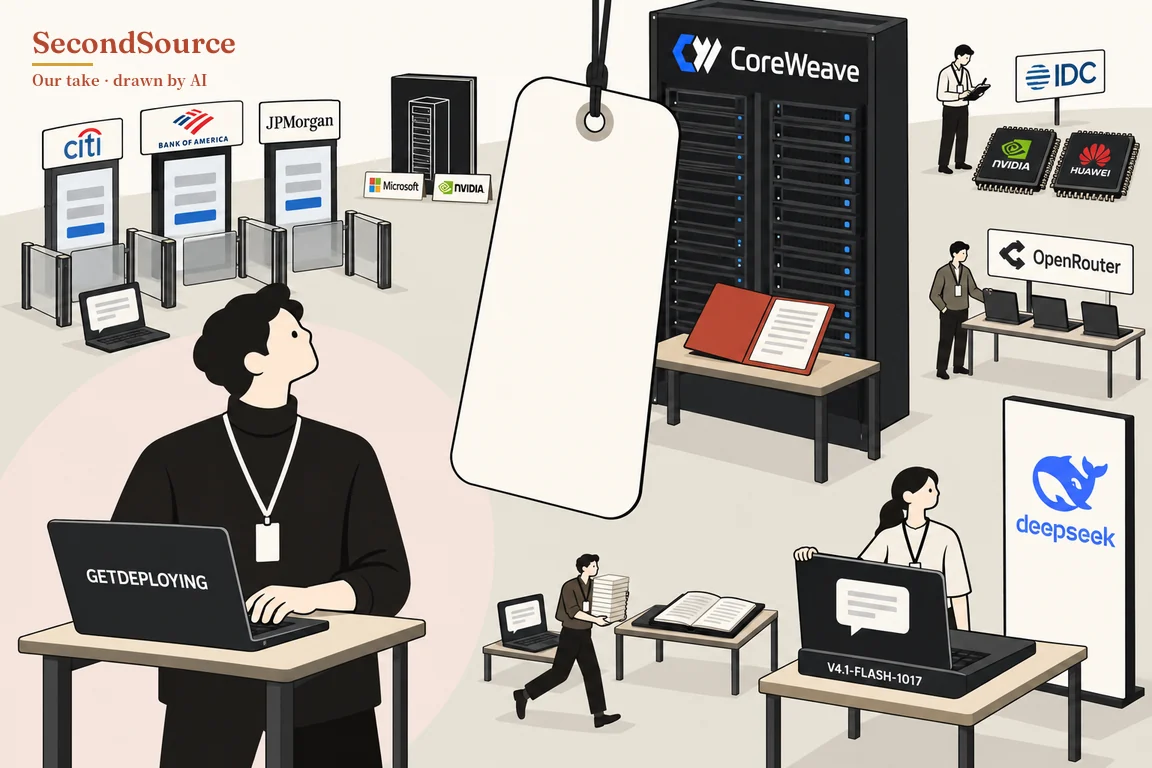
At a glance
1. SecondSource's deep-dive column rechecked a September call. CoreWeave, a cloud company that rents out GPUs, self-reports about US$40 million per megawatt of data-center power per year on short leases. That is roughly 2.5 to 4 times the US$10 million to US$16 million on five-year deals. The long-lease figures are SecondSource's own arithmetic, and part of the gap may come from a different GPU mix. CoreWeave's CFO reported a roughly 25% price rise in July, which most likely applies to contract prices. getdeploying's index, up 9% in four weeks, measures listed prices, so the 25% and the 9% can't be subtracted.
2. DeepSeek releases the weights of V4.1-Flash-1017 under the MIT license and self-reports beating GPT-5.6 Sol on 9 of 11 benchmarks while trailing Opus 5 on 7; the whole table is self-reported, with no third-party rerun.
3. The Financial Times reports that Citi, Bank of America and JPMorgan Chase are restricting third-party AI agents from logging into online banking; the full story is paywalled and only relayed accounts are available. Our read: when AI agents pay on a user's behalf, the bank may be the first place they get blocked.
Also today: #5 — OpenCode's term "distillation attack."
This week's column: Claims & Receipts
Every Sunday: we pick one AI claim making the rounds and check it against the original documents.
No new claim was added for checking this week; this issue only settles one older call that came due.
Did Kimi K3's effective price fall into DeepSeek's range by October 15?
The short version: on July 31 SecondSource recorded a prediction asking whether Kimi K3's effective price would fall into DeepSeek's range by October 15. The result: the prediction didn't come true, because K3's price didn't drop.
Kimi K3 is an open-weight model from the Chinese company Moonshot. In late July, Moonshot set K3's API list price far above DeepSeek's range. The prediction recorded on July 31 asked whether that price would fall into DeepSeek's range by October 15. The bar was a blended effective price below US$0.50 per million tokens, a threshold SecondSource set when recording the call. The blended price weights three list prices, cached input, regular input and output, at 7:2:1.
On October 15, Moonshot's official pricing page listed, per million tokens, US$0.30 for cached input, US$3 for regular input and US$15 for output. At those weights the blended price comes to about US$2.31, the same as the reading when the call was opened in July. That figure is computed from official list prices, not from what users actually pay; discounts and promotions aren't included.
How to use it. This result shows only that Moonshot's official API hasn't cut its price; it isn't enough to judge the claim that "open weights inevitably push prices down." This column checks Moonshot's official list price, not what other hosts charge for K3; other hosts' prices aren't in this reading. The case for "open weights inevitably push prices down" is that other providers can also host the model and compete on price. The readings so far don't show why the high price holds. One possibility is that Moonshot is short of compute and uses a high price to ration usage. Another is that Moonshot really has pricing power. Both are SecondSource's conjectures; the column contains no data on Moonshot's compute or capacity expansion. If Moonshot announces an expansion and the list price falls with it, the first explanation fits better; if the price holds after an expansion, the second does.
Still missing today. There are only two readings between late July and October 15, and no record of whether the price changed in between. DeepSeek's list price on the same day wasn't checked alongside this reading.
All of SecondSource's calls and their verdict dates → the full ledger
Today's main line
1. [Today] (deep-dive column, October 18) GPU rental prices have no single "rise" figure: CoreWeave's 25% most likely sits in contract prices, the public index measures listed prices, and the two can't be subtracted

Why it matters: Our read: CoreWeave's new short leases cost far more than its five-year deals. Public list-price indexes track listed prices, so they don't show that gap.
Read the full item
The September 18 issue carried a call: the premium from tight GPU compute sits in newly signed short leases, invisible in public listed prices and in fleet averages. What is new today is that SecondSource's deep-dive column rechecked that call sentence by sentence. The core judgment: GPU compute in autumn 2026 is tight, and the tightness takes the form of a term premium; a buyer that won't sign a long contract pays more.
CoreWeave is a newer cloud company that rents out GPUs. CoreWeave's CFO said in August that prices across all SKUs rose about 25% in July. CoreWeave's September convertible-note presentation put short leases of three to six months signed in the third quarter at about US$40 million per megawatt of data-center power per year (CoreWeave 8-K presentation, 2026-09-17). 98% of CoreWeave's revenue comes from committed contracts. Its website's pay-as-you-go list prices, read directly on October 18, match a third party's August reading. So both figures most likely apply to contract prices. The company hasn't said what they cover.
getdeploying, a third-party site that compiles GPU price lists, measures the median pay-as-you-go listed price. In the week of October 12 that index was up 9% over four weeks and 18% over a year (getdeploying index). Nebius, another newer cloud, raised list prices on four GPU generations by 17% to 21% from October (Investing.com, 2026-09-17). The index doesn't break down how much each provider contributes.
Our read: one ruler measures contract prices and the other measures listed prices, so the gap between them can't be read as a measure of tightness. The time windows differ too: 25% is the July increase, 9% is the last four weeks. Short leases run about US$40 million per MW; five-year deals run about US$10 million to US$16 million, so short leases cost roughly 2.5 to 4 times as much. The long-lease figures are SecondSource's calculation: total contract value divided by term and announced capacity. The GPU generation mix and capacity definitions on the two sides may not match, so part of the multiple may be a product-mix difference.
Why recheck now: the public index started rising in October. The September call said public listed prices don't show the premium; once the index moves, the call needs another look.
The tree below is SecondSource's map of the debate over whether AI capex pays off. GPU rental prices are one reading in that debate.
Open ?
What would prove this wrong: within 14 days of CoreWeave's third-quarter earnings release, take quarterly revenue times four and divide by in-service power at quarter end. If the result is US$10 million per MW per year or more, the reading changes to a broad repricing. The second-quarter figure was about US$6.9 million, by SecondSource's arithmetic. The 14-day window and the US$10 million bar are conditions SecondSource set. Verdict date: CoreWeave's third-quarter results, date not yet announced.
Not proven yet: that the 25% sits in contract prices is an inference; CoreWeave hasn't said what it covers How we checked →
Judgment update: The September 18 call stands, with a scope added: short leases are priced like cancellable large orders, and five-year deals sit one price level lower. No newer cloud discloses what share of new contracts are short leases. "Invisible in public listed prices" narrows: CoreWeave-style increases that touch only contract prices stay invisible, while Nebius-style list-price increases do show. New-contract prices reach revenue only when old contracts expire and renew, and CoreWeave's CFO said capacity due for renewal soon is only a small part of the fleet.
2. [Today] (event date October 17) DeepSeek releases V4.1-Flash-1017 weights under the MIT license, self-reporting wins over GPT-5.6 Sol on 9 of 11 benchmarks
Why it matters: DeepSeek self-reports Terminal-Bench 4.0 up 11.1 points, from 31.2 to 42.3, in a release about a month after the previous one. One month-long gap between releases is too little to show a pattern.
Read the full item
On October 17 DeepSeek released the weights of V4.1-Flash-1017 on Hugging Face under the MIT license, and the model card calls it a "minor update" (DeepSeek model card, 2026-10-17). The card's table has 11 benchmarks, with Kimi K3, GLM-5.3, GPT-5.6 Sol and Opus 5 in the comparison columns. By SecondSource's column-by-column count, the model beats GPT-5.6 Sol on 9 and beats Opus 5 on 4 while trailing it on 7.
Against V4.1-Flash from a month earlier, the largest gains are Terminal-Bench 4.0, from 31.2 to 42.3, and ProgramBench, from 20.3 to 29.1. Terminal-Bench 4.0 tests whether a model can finish tasks in a terminal. ProgramBench asks a model to rebuild a program from compiled binaries and documentation. The whole table is DeepSeek's own report. The card doesn't say whether rival scores were run by DeepSeek or taken from published figures. The comparison set is a generation behind: the card compares against Opus 5 and GPT-5.6 Sol, while evaluation tables compiled the same week by Paweł Huryn and others already compare Opus 5.5 and GPT-6 Astra.
DeepSeek calls the release "a Pareto improvement in performance and cost" (DeepSeek, 2026-10-17). Susan Zhang, an AI researcher, notes that DeepSeek shipped again after about a month, while V4 to V4.1 took about five months (Susan Zhang, 2026-10-17). Her post gives no start dates for either interval.
There is outside evidence beyond the table. BugBunny, a vulnerability evaluator, built its own set of 100 pull requests containing bugs. The 1017 release found 54 for US$7.53; the previous version found 44 for US$12.79 (BugBunny, 2026-10-17). That is a separate test, not a rerun of DeepSeek's table.
Our read: DeepSeek is competing on price-performance in its cheapest tier, Flash, moving forward through small dated refreshes rather than waiting for the next flagship. Another explanation isn't ruled out: the V4.1-Pro flagship hasn't shipped, so the Flash refresh may just be filling the gap.
Not proven yet: all 11 benchmarks are self-reported, with no third-party rerun How we checked →
Judgment update: Our read: to gauge the pressure Chinese models put on API prices and agent workloads, the thing to watch is how often the low-price tier refreshes and how far each refresh moves, not flagship rankings. There is only one interval, September 10 to October 17, which isn't enough of a sample. The checkable markers are whether the next dated refresh appears within six weeks, and whether Terminal-Bench 4.0 approaches Opus 5's 51.8.
3. [Today] (report relayed October 16) The Financial Times reports that Citi, Bank of America and JPMorgan Chase are restricting third-party AI agents from online banking; the full story is paywalled
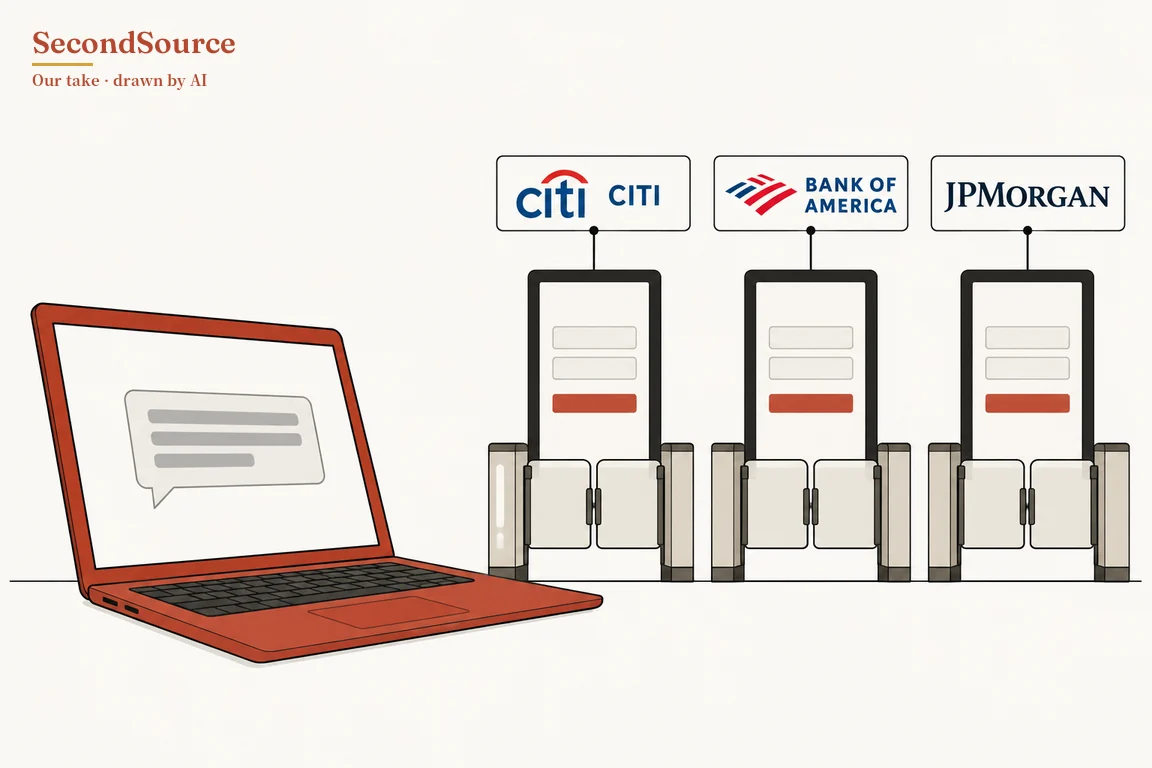
Why it matters: Our read: big banks are starting to block agent logins, so agent payments may stall at the bank before model ability matters. Every account of the bank moves comes through relays of a paywalled story.
Read the full item
The Financial Times reports that Citi bars third-party AI agents from logging into customer accounts or moving money, and that Bank of America and JPMorgan Chase are also restricting them; the story says price-comparison agents would move checking deposits into higher-yield accounts, and that paying 3% on the big three's roughly US$1.6 trillion in non-interest-bearing deposits would cost about US$47 billion a year, a hypothetical scenario from the Financial Times. The full story is paywalled; only relayed accounts are available (Rohan Paul, 2026-10-16; Jigar Shah, 2026-10-17; The Next Web, 2026-10-16).
Not proven yet: the full story is paywalled, and every figure comes through relays How we checked →
Judgment update: Agents can pay on a user's behalf through three channels. Our call: the near-term bottleneck is who controls the channel, not model ability. The first channel is logging into online banking to move money, and banks are starting to block it. Agents can also use the user's card number on a merchant's checkout page; xAI's Grok Bot takes this route, and the only evidence is a user post Musk reposted on October 17 (Elon Musk, 2026-10-17). A platform can also pay out of pocket as a subsidy. The pizza promotion from Hark, a consumer assistant, is one; Hark's founder, Brett Adcock, self-reports more than 203,500 browser sessions during the promotion, with no completion rate or payout disclosed (Brett Adcock, 2026-10-17). Only the first channel has public evidence of tightening. This issue's material contains no public statement from card networks or merchant platforms. Upgrading the call would take the Financial Times original and a formal statement from at least one bank.
Chips & semiconductors
1. [Today] (weekly roundup October 16) IDC data relayed by Reuters and the trade outlet Semiconductor Engineering: in the first half of 2026, NVIDIA's AI accelerator shipments in China fell 44% year on year, and NVIDIA's share by units shipped was 34% against Huawei's 28%. This is a three-step relay; neither the Reuters original nor the IDC report has been reviewed (Semiconductor Engineering, 2026-10-16; Reuters, 2026-10-13). The 34% against 28% counts units shipped, not revenue or compute share. The 44% drop is the change in NVIDIA's China shipment volume. First-half 2025 shares aren't given, so how much the gap narrowed can't be computed. The original doesn't separate US controls on the supply side from Chinese customers switching orders on the demand side.
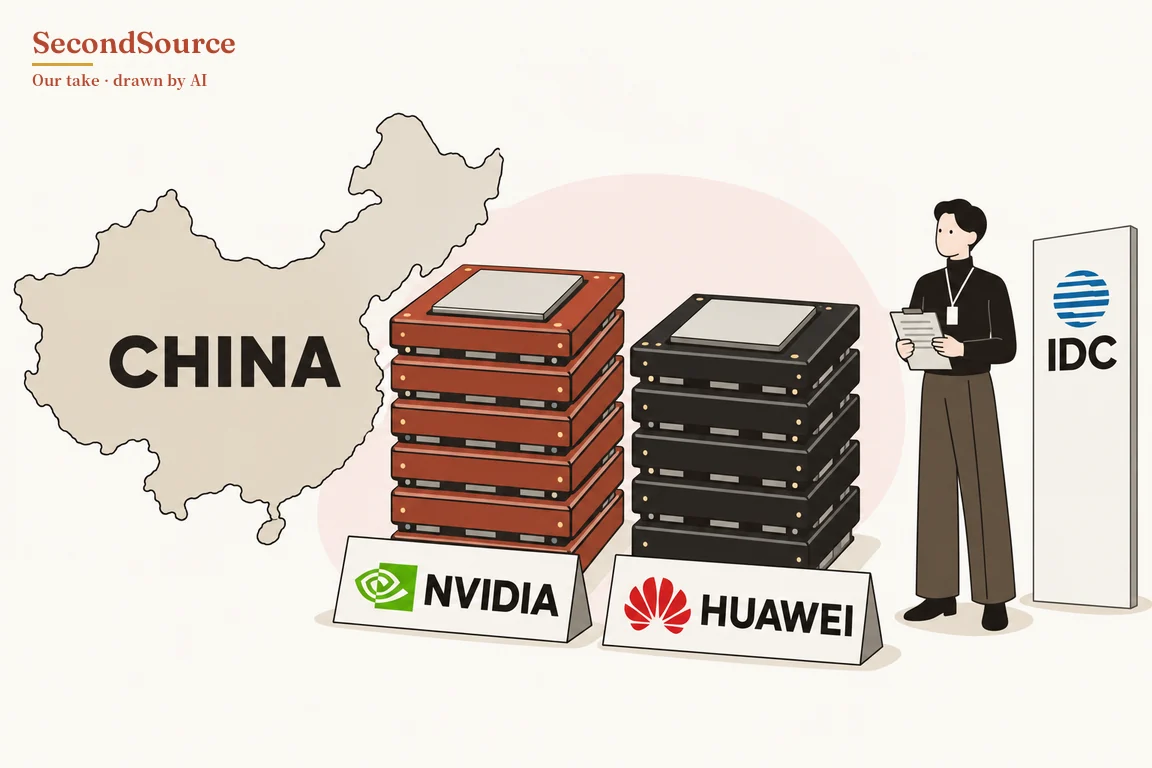
The same week, Saif Khan, founder of the think tank Center for Technology and Statecraft, argued on the ChinaTalk show that the key is not NVIDIA but DUV immersion lithography tools. Khan said on the show that these are the most advanced exposure tools after EUV, that Huawei uses them to make 7nm chips, and that only Japan and the Netherlands build them. Khan's model estimates that a full sales stop today would let the US keep a 10x to 100x lead in annual AI chip output into the mid-2030s, while continued exports could make the two sides' output overlap (ChinaTalk, 2026-10-17). That is a scenario estimate from an advocacy organization; Khan concedes the error bars are wide, and his think tank is pushing for a DUV export ban.
The IDC figure is new evidence for the "export controls and Chinese self-sufficiency" trend SecondSource tracks. The existing call: still in progress, no winner yet. On the US-China gap, controls still work. On Chinese self-sufficiency, several sources already report China refusing to buy NVIDIA and ordering domestic chips, so the controls are acting as a catalyst. Chip smuggling weakens both effects.
Open ?
Judgment update: the IDC figure adds weight to the Chinese self-sufficiency side. Huawei's unit share closing in on NVIDIA's is a structural signal, but IDC doesn't separate supply from demand. The US-China gap side has no new number this issue; the October 13 issue's archive pick cited Epoch's estimate of an average seven-month overall gap between US and Chinese models. What would prove this wrong: if Chinese cloud providers resume large NVIDIA purchases and actual H200 sales pick up, that would overturn the part of the call saying China itself has stopped buying NVIDIA, taking over from the US embargo. The verdict date is tied to IDC's next full-year data, around early 2027. How we checked →
Named commentary
1. [Today] (posts October 16 to 17) François Chollet, creator of Keras and co-founder of ARC-AGI, says agents now write almost all code, yet engineers are more numerous and busier than in 2025 and employers' P&L usually hasn't moved; Box CEO Aaron Levie responds that software demand isn't fixed and engineering's weight in the economy is rising. Chollet's explanation is systems thinking: automating one step creates new friction and moves the bottleneck elsewhere (François Chollet, 2026-10-16). Levie quoted that post and rejected its premise that software demand is fixed and that automation therefore reduces labor demand. Levie's reasoning is that agents can use tools, operate computers and write software on the fly, so problems that couldn't be digitized before can now be solved with software (Aaron Levie, 2026-10-16). Neither attached data, and the pairing is SecondSource's; both agree demand for engineers is growing. Box sells an enterprise content platform for agents to use, so "everything becomes software" aligns with Box's business interest.
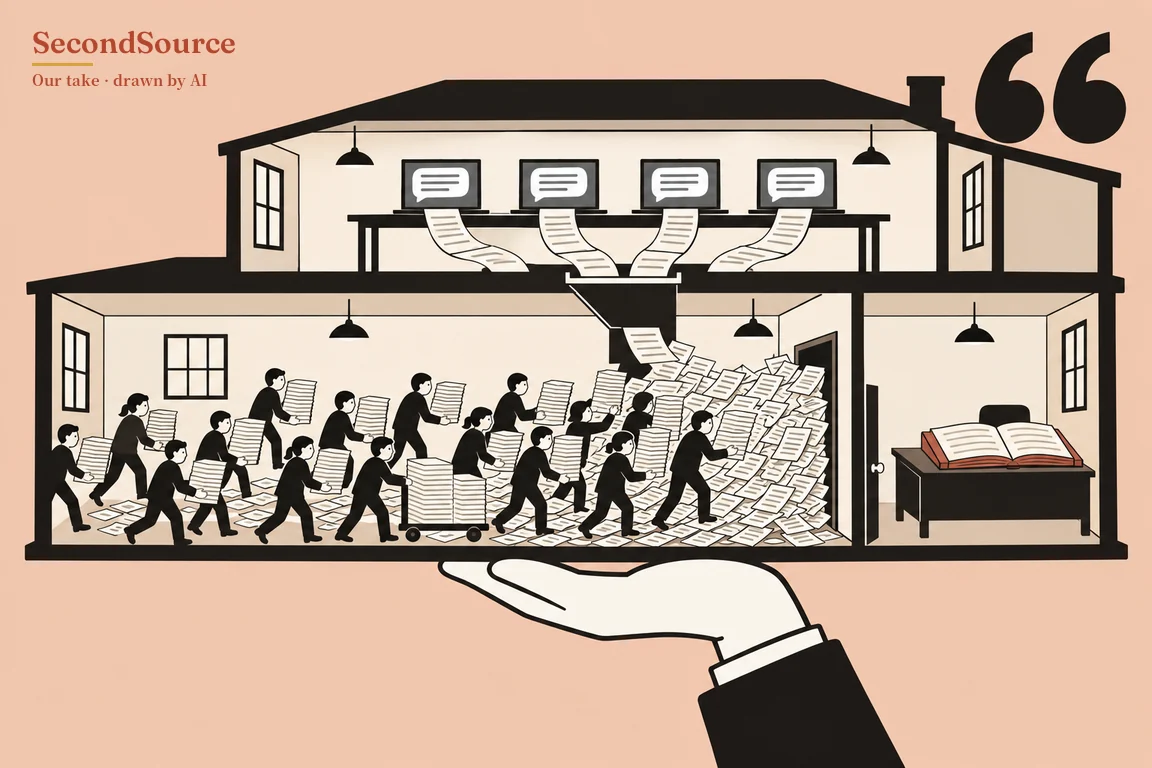
Two other industry figures gave numbers. One is a recollection and one is relayed, and the populations differ, so they can be read side by side but not compared. Epic Games CEO Tim Sweeney recalls that writing Unreal Engine 1 was about 70% typing and refactoring and 30% hard problems; Sweeney says the surprise is that AI is starting to solve the 30% (Tim Sweeney, 2026-10-17). Harry Stebbings of the venture firm 20VC relays LangChain CEO Harrison Chase: LangChain's spending on coding tools is about 30% of engineering payroll, and that share has fallen over the past two months while token usage rose, thanks to caching, routing and the execution harness LangChain controls (Harry Stebbings, 2026-10-16). The 30% is one company's self-report, relayed, and whether the denominator grew with hiring isn't stated. How we checked →
Model watch
1. [Evidence update] (blog August 25, read directly on October 18) OpenRouter's official blog says the 13.8x rise in daily token usage during the August discount belongs to GPT-5.6 Luna alone. Terra grew 5.6x, and the undiscounted Sol grew 1.1x over the same period. In the same promotion window, the deeper a model's discount, the more its usage rose, and Sol, with no discount, barely moved. OpenRouter is a routing platform that dispatches requests to many model providers. The September 1 issue, based on an OpenRouter post from August 28, wrote that token usage for two GPT-5.6 variants, Terra and Luna, grew 13.8x while both were "heavily discounted" on the platform. The blog says the 13.8x belongs to Luna alone: "Daily Terra token usage rose 5.6x during the discount window, while daily Luna token usage jumped 13.8x. The Sol model, which remained a list price, saw only a gentle bump of 1.1x over the same period" (OpenRouter blog, 2026-08-25).
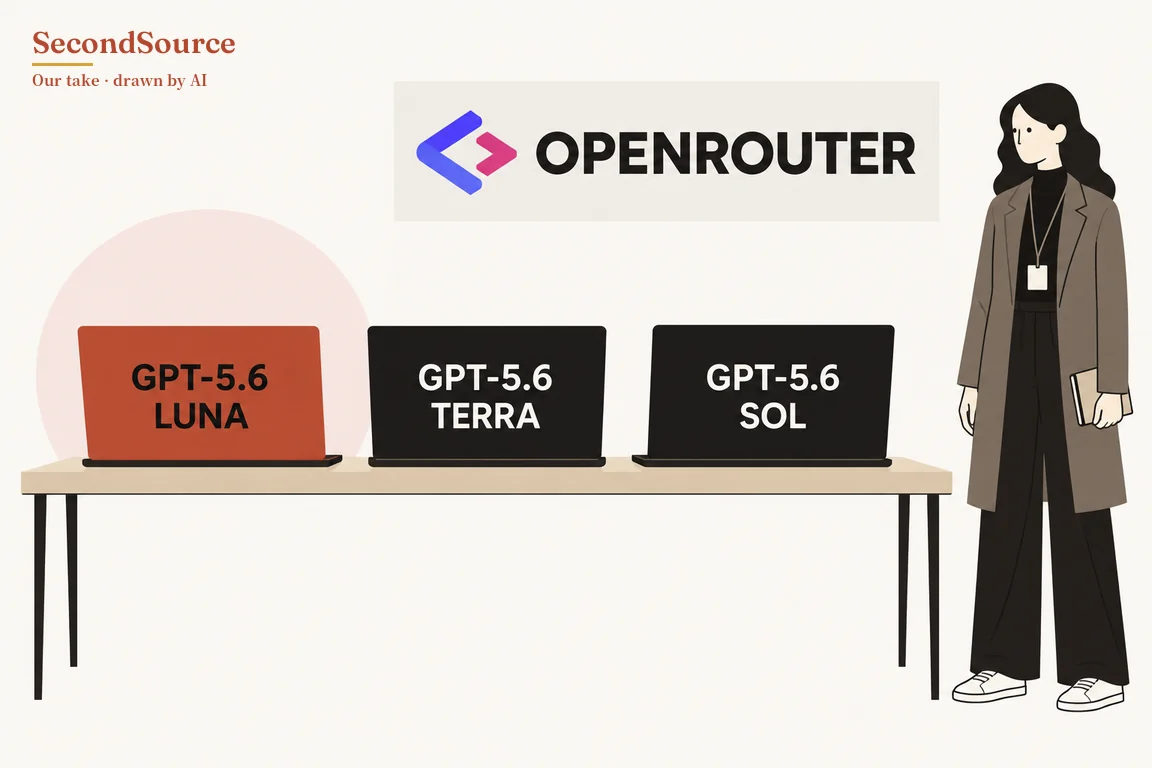
The blog also gives the discount sizes the September 1 issue lacked: OpenRouter first cut prices by half, then OpenAI cut its own list prices on July 30, Luna by 80% and Terra by 20%, and the two stacked. By SecondSource's conversion, Luna's effective price was about a tenth of the original with 13.8x usage, and Terra's about four-tenths with 5.6x. The rough log elasticity over the promotion window is about −1.1 for Luna and about −1.9 for Terra (our calculation, not OpenRouter's measure). The more negative the number, the more usage responds to a price cut. Sol's 1.1x is the only control. The blog has no sentence on revenue or gross margin. The multiples don't net out organic growth, the window includes one-off arbitrage, and they can't be extended into a long-run demand curve; the figures are one platform's self-report. How we checked →
Also happened
1. Not verified by us yet: [Today] (posts October 16 to 17) Policy advocate Nathan Calvin read a leaked draft of Anthropic's federal AI bill and points to two things. First, federal restrictions on frontier models apply only to an "imminent risk of a catastrophic harm," defined as more than 50 deaths or more than US$1 billion in damage. Second, the shutdown power state courts had before is removed. Commentator Zvi Mowshowitz calls the draft "unacceptable." The full draft hasn't been reviewed. Calvin and Mowshowitz both belong to the strong-regulation camp (Nate Soares reposting Calvin, 2026-10-16; Nathan Calvin, 2026-10-16; Zvi Mowshowitz, 2026-10-17).
2. Not verified by us yet: [Today] (post October 16) Amjad Masad, CEO of the coding platform Replit, says Replit still supports multiple models and users can choose Anthropic, but OpenAI is now the "preferred partner" powering Replit Agent. The full TechCrunch story hasn't been reviewed, and Masad didn't say which provider was the default before (Amjad Masad, 2026-10-16; TechCrunch, 2026-10-16).
3. Not verified by us yet: [Today] (relayed October 16) Data from the market researcher IDC, relayed by I/O Fund analyst Beth Kindig: global smartphone shipments in the third quarter fell 22% year on year to 255.3 million units, the largest single-quarter annual drop on record, which IDC attributes to rising memory prices. The original report hasn't been reviewed (Beth Kindig, 2026-10-16).
4. Not verified by us yet: [Today] (relayed October 16) a16z co-founder Ben Horowitz relays Amazon CEO Andy Jassy as saying AWS supply shortages won't ease until after 2028; Horowitz says a16z doesn't invest in newer clouds because of debt risk. The show and date of the interview are unclear, and there is no first-hand record of Jassy's words (Fireside Alpha, 2026-10-16).
5. Not verified by us yet: [Today] (event date October 16) OpenCode, an agent platform that writes code for engineers, says it had a security breach related to "a large scale distillation attack." Affected users were those connected to outside model providers, about 1.4% of OpenCode Console users. The attack claim is OpenCode's own, and whether it was key theft, resale of access or training distillation can't be told (OpenCode, 2026-10-17).
Research watch
1. [Trend] (preprint October 9) TheoPhysEval, 50 unpublished research-level theoretical physics problems with verifiable answers: the paper says the best agent scores 98% accuracy at under US$3 per problem, yet there is still no agent-led breakthrough in theoretical physics. The paper was submitted by 34 authors from multiple institutions (arXiv 2610.16733, 2026-10-09); only the abstract was read. Per the paper, the best agent is "GPT-6-Astra harnessed in Codex," meaning GPT-6-Astra run inside Codex, OpenAI's coding agent, with tools for literature search and numerical scripting. Disabling web search and background papers moved each agent's accuracy only slightly, which the authors read as significant memorization of the literature. Every problem is a computation with a verifiable answer, not open-ended discovery; 50 problems is a small sample, from one source, not peer-reviewed. In judging progress in AI for Science, "solving problems" and "making discoveries" need to be counted separately.
2. [Trend] (preprints October 15) Two papers measure multiple-choice decisions inside agents, such as which tool to use or which step to take next. One paper, JevAgentHarness, hands those decisions to a 4-billion-parameter small model. It cuts agent cost by 81.1% to 89.0% on in-distribution tasks and loses under 3 percentage points of success rate. The other, Prism-1, looks at the current approach, where a large model picks an option in one inference pass. Shuffling the option order once changes 12% to 20% of its answers. Both were read only as abstracts, are self-reported by their authors and aren't peer-reviewed (arXiv 2610.21412, 2026-10-15; arXiv 2610.22066, 2026-10-15). JevAgentHarness first sets a confidence threshold, and the small model decides only when its confidence clears it. The abstract also gives the downside: handing everything to the small model without fitting that threshold first drops success by 19 percentage points, rather than the under 3 points after fitting. From context, the cost baseline is a harness that calls a large model at every step; the abstract doesn't say so word for word. Prism-1's fix is to read out a score for each option separately, so neither shuffling nor adding irrelevant options changes the choice. Both the reliability risk and the cost that can be saved are measurable, and each rests on a single self-reported paper.
Product moves
1. [Business] (announcement October 16) Microsoft and NVIDIA jointly publish a white paper on managing risk from open-weight models in enterprises; its core sentence is "weight openness alone does not determine an AI system's risk," with risk sorted into five categories and the focus on the model layer. Microsoft's Michael Scovetta announced it on the Azure blog as the first paper in a series (Microsoft Azure blog, 2026-10-16). The five categories are security, data protection, content, human-AI interaction and bias, aligned with ISO standards and the US NIST AI Risk Management Framework; the ISO numbers aren't given. The original says this paper "focuses primarily on model-layer risks," with later papers extending to the runtime environment and application layer. On responsibility, an enterprise hosting an open-weight model itself "may take on controls otherwise provided by a managed service." The white paper argues that deployment, not whether weights are open, is what to look at. The parties saying so are Microsoft, which sells managed cloud, and the chipmaker NVIDIA. Both are interested parties: Microsoft's post promotes the evaluation and content-safety controls in Foundry, Microsoft's AI development platform, and NVIDIA has its own line of open-weight models. The white paper itself hasn't been reviewed, only the announcement; there is no enterprise adoption or incident data. How we checked →
From the archive
This section gives its space to the main line today; read it on the site. "[Looking back] (same topic as the October 17 issue) Does the draft of China's Ministry of Commerce Announcement No. 48 cover open weights? MOFCOM answered in a Q&A with reporters." (MOFCOM Q&A with reporters, 2026-10-16).
Correction: the October 17 issue said Epoch's conversion method for its cyber index and its full leaderboard "either hadn't been reviewed or didn't exist publicly." Epoch's data page from the same day does give them: the "six to seven months" comes from the release dates of the two closed models whose scores bracket GLM-5.3, GPT-5.4 and Anthropic's Mythos Preview, and the page lists scores of 157.04 for GPT-5.4 and 160.10 for GLM-5.3. The site's archive pages in Chinese, English and Japanese have been updated.
SecondSource isn't a news digest: each day it hunts the AI firehose for the insights that matter and the practitioner judgments worth tracking over time, and shows how every item was verified. The point is always which judgment got harder and who's been right, not what happened today.
Written from the same research and judgments as the Traditional Chinese edition. Sources are linked; we distinguish original documents from reporting and mark what we could not verify.