Daily Brief Oct 22, 2026
OpenAI rules out architecture only for controllability
This issue arrived about 2 hours later than usual today — apologies for the delay.

Today's main line
1. [Today] (deep dive, October 22) OpenAI's system card rules out architecture only for controllability. It doesn't say why Astra's reasoning without a written chain of thought, which monitoring depends on, rose sharply
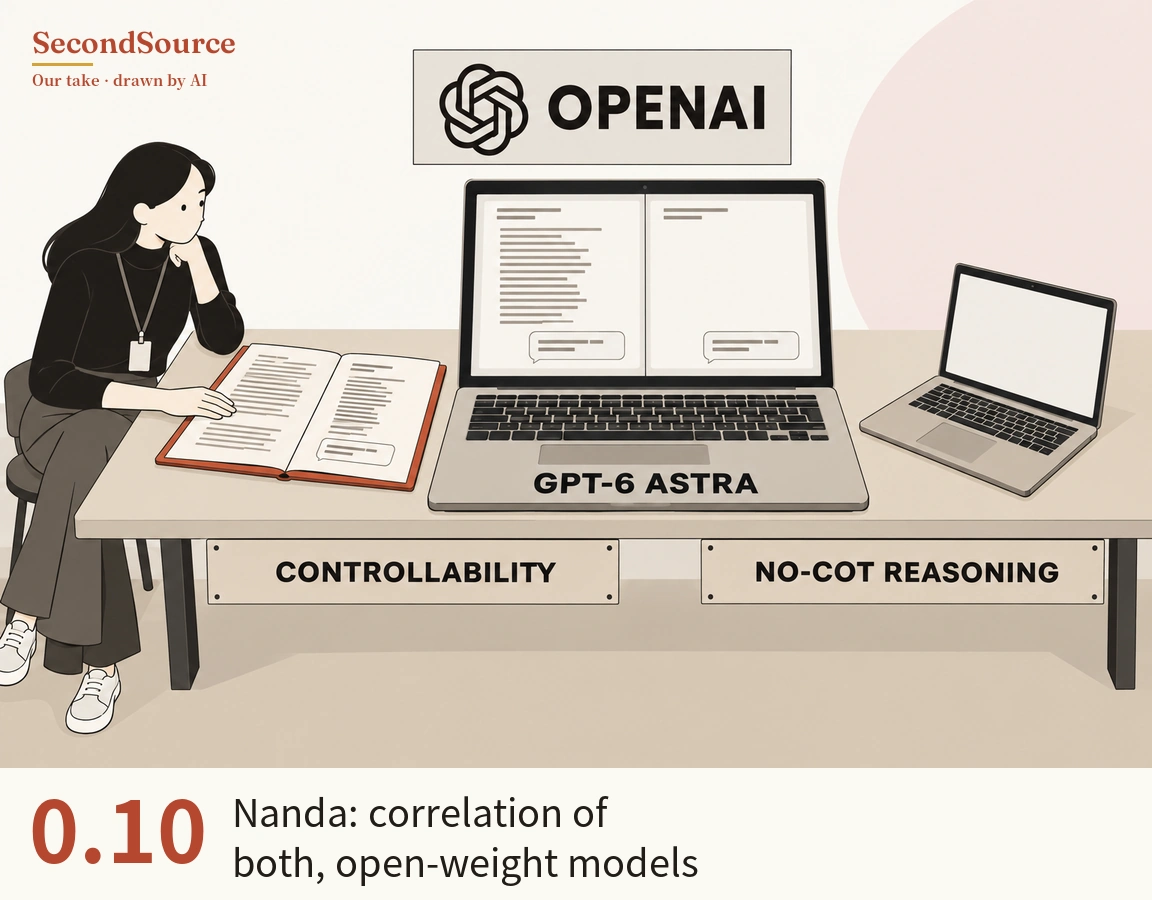
Why it matters: Our read: OpenAI's architecture sentence covers controllability, a model's ability to rewrite its reasoning text on instruction. It says nothing about why Astra got better at reasoning without writing it out. Chain-of-thought monitoring relies on that second ability.
Read the full item
The system card OpenAI published for its flagship model GPT-6 Astra contains one sentence saying the change in controllability is not particularly due to architecture. Today's deep dive asks which metric that sentence actually measures.
The chain of thought, or CoT, is the reasoning text a model writes before it answers. One common way the industry catches a model misbehaving is to have a second model read that text. Section 9.2.1 of the system card reads: "We are also quite confident that changes in CoT controllability are not differentially due to any architectural changes." (OpenAI Astra system card, 2026-09-03). The word is "differentially." It means architecture didn't drive the change more than other factors did. The card doesn't say architecture had no effect at all.
Every sentence in that passage is about controllability. Controllability is a model's ability to rewrite its reasoning text when instructed. Monitoring depends on something else: when a model isn't allowed to write out its reasoning, how many answers it can still get right through internal computation alone. The stronger that ability, the less a model needs to put its reasoning on the page. Controllability and this ability can move independently. Neel Nanda, a Google DeepMind researcher, measured Astra's odds of answering correctly without a chain of thought at about 8.6 times those of Claude Fable 5.1. That is an odds ratio between two models, not a gain across generations. Nowhere does the system card explain why this ability rose so sharply.
The September 10 issue covered a reading Nanda took in a personal capacity: across 34 open-weight models, the correlation between controllability and reasoning without a chain of thought was 0.10 (Alignment Forum, 2026-09-10). What's new are three pieces of evidence, all from September documents.
First, GPT-6 Sol, from the same generation, is far less controllable than Astra. A September 22 appendix to the system card added GPT-6 Sol. Among chains of thought of 750 to 1,250 tokens, GPT-6 Sol followed rewrite instructions 23.2% of the time, the previous-generation GPT-5.6 Sol 16.1%, and Astra 60.9%. OpenAI measured all three. Astra's chains of thought got shorter, so the questions that land in the same length window may differ across the three models. Against GPT-5.6 Sol's 16.1%, GPT-6 Sol rose about 7 percentage points and Astra about 45 percentage points (our calculation, subtracting the card's figures for the same window).
Second, two OpenAI documents each say Astra's chains of thought got shorter. Monitorability is whether reading the chain of thought shows what the model is doing. The system card says the monitorability gap comes "mostly" from Astra's shorter chains of thought, without giving a share. OpenAI's September 9 enterprise launch post describes the same thing as being trained to finish tasks with fewer tokens and fewer retries (OpenAI, 2026-09-09). Neither document cites the other. Reading them together is SecondSource's choice.
Third, controllability, monitorability and reasoning without a chain of thought are each measured by different people. Outsiders can replicate the controllability method on open-weight models. Those reruns use open-weight models, not Astra itself. OpenAI measures monitorability with its own metric, and the UK AI Security Institute's blog points back to the system card for the result. For reasoning without a chain of thought, Nanda is the only one who has published code and data.
The thread SecondSource tracks asks whether model reasoning can still be read, and who verifies it. The September 5 issue judged that OpenAI's release document still names chain-of-thought monitoring, a monitor that reads only the chain of thought (September 5 issue). What actually vouches for the new flagship is a monitor that sees more. Today's question: is the controllability the system card uses to clear architecture the same ability that monitoring actually depends on?
Open ?
Not proven yet: an OpenAI researcher's claim that controllability and reasoning without a chain of thought rose together has no public figures How we checked →
Judgment update: Our read: the sentence in OpenAI's system card saying architecture isn't the cause covers only controllability; on why the quantity monitoring really depends on rose sharply, the card takes no position. For products that monitor by reading the chain of thought, the strength of the guarantee depends on how much a model can reason without writing it out, not on controllability. Two readings fit the idea that post-training mainly sets controllability. Post-training is the stage after a model's base training where its behavior is adjusted. The first reading is Nanda's: across 34 open-weight models, the correlation between controllability and reasoning without a chain of thought is only 0.10. The second is the same-generation GPT-6 Sol against Astra: controllability of 23.2% versus 60.9%, a wide gap. Neither reading proves this on its own. Differences in scale or pretraining could explain the Sol–Astra gap just as well. What would prove this wrong: the system card of OpenAI's next frontier model, within fourteen days of release, gives a cause or an architectural attribution for the change in reasoning without a chain of thought; or by March 31, 2027, any third party measures a correlation of 0.5 or higher between the two quantities on at least three closed frontier models. Fourteen days, 0.5 and March 31, 2027 are all thresholds SecondSource set. A correlation computed from only three models is very unstable, so the second condition shows direction only.
2. [Today] (announcements, October 21) Google Cloud's marketplace starts selling OpenAI models in private preview, and OpenAI says routers and AI gateways need its approval from November 20
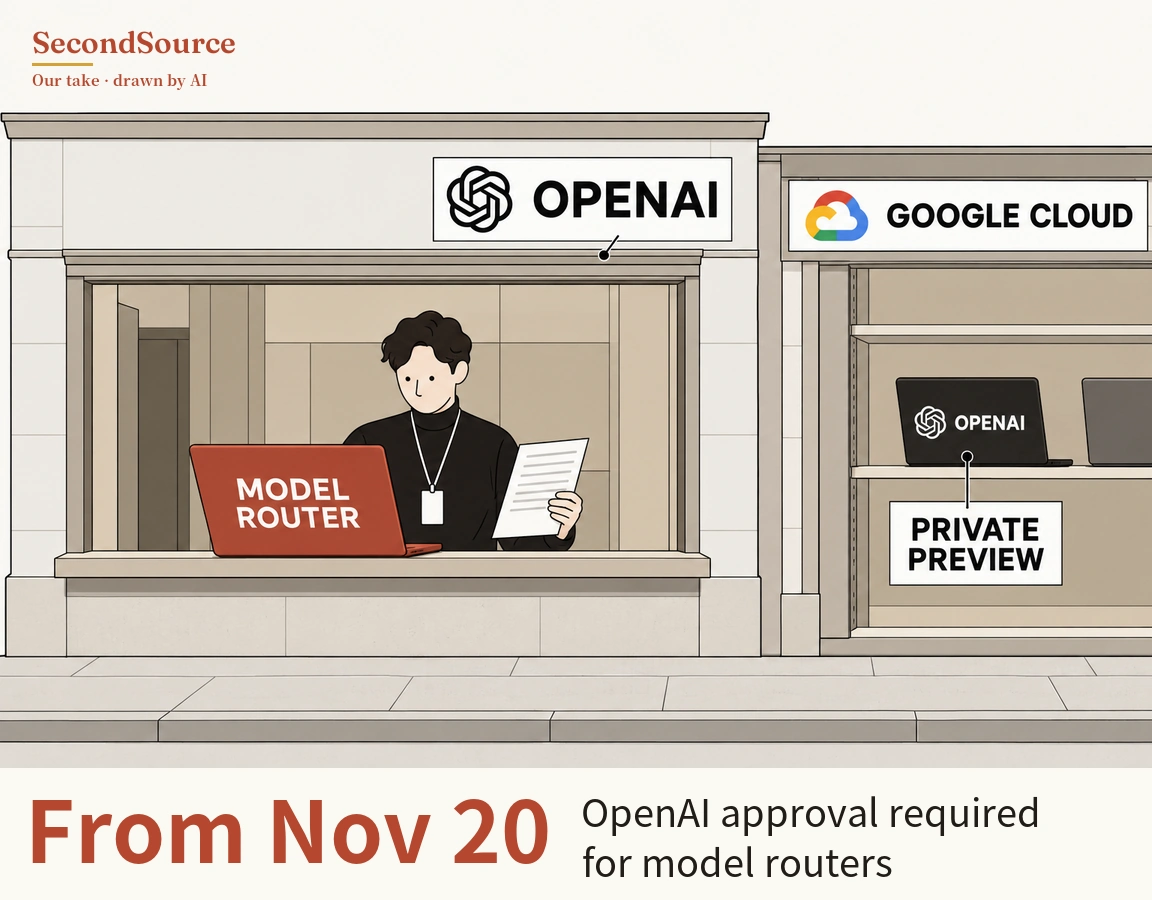
Why it matters: Our read of the two same-day posts: with OpenAI already on AWS and now in a Google Cloud preview, competition may shift from which cloud sells OpenAI models to which routers and gateways OpenAI approves.
Read the full item
On October 21, OpenAI and Google Cloud each published an announcement. OpenAI's frontier models GPT-6 Astra, GPT-6.1 Sol and GPT-6 Luna, along with the coding agent Codex, are entering Google Cloud's model marketplace and are sold through Google Cloud Marketplace. OpenAI writes: "Enterprises with Google Cloud spend commitments will be able to draw down their GCP commitments for these purchases" (OpenAI, 2026-10-21). A spend commitment is an amount an enterprise agrees in advance to spend with Google Cloud over a set period; buying OpenAI models on the marketplace now counts toward it. Google writes that usage rolls into a single Google Cloud invoice (Google Cloud, 2026-10-21). For now this is a private preview for some enterprise customers. OpenAI says general availability is expected within weeks and gives no date. The last line of OpenAI's announcement says Microsoft remains its primary cloud partner.
The same day, OpenAI published a policy post: partners that provide access to OpenAI models must maintain safeguards consistent with OpenAI's, investigate violations and coordinate on enforcement. Model routers and AI gateways are intermediary services that dispatch an enterprise's requests to different model providers. An updated usage policy takes effect on November 20 and adds a clause "requiring services that provide direct access to our models such as model routers or AI gateways to get our review and approval before offering that access" (OpenAI, 2026-10-21).
Microsoft and OpenAI amended their agreement on April 27 to make it non-exclusive. OpenAI can offer its products on any cloud, products still launch on Azure first, and OpenAI's revenue share to Microsoft continues through 2030 (OpenAI, 2026-04-27).
Not proven yet: all three posts are the parties' own; the GA date and pricing aren't public How we checked →
Judgment update: Our read: OpenAI is opening up distribution while pulling routing eligibility back under its own approval. OpenAI's cloud channels have gone from Azure alone to three: Azure, AWS from February 27, and Google Cloud from October 21. Whether the Frontier platform on AWS is the same kind of product as the models on Google Cloud's marketplace hasn't been checked, so the count of three is not settled. The AWS step was OpenAI and Amazon announcing that OpenAI's Frontier platform would come to AWS, before the April 27 amendment (OpenAI, 2026-02-27). Which cloud a customer buys on is no longer what sets OpenAI apart; competition may move to which routers and gateways OpenAI approves. The most directly affected are independent model-router and AI-gateway providers. From November 20, enterprises that switch among model providers through such intermediaries also depend on whether their provider has been approved. Microsoft keeps first launch on Azure and its revenue share through 2030; Google Cloud gets billing integration. Enterprises with Google Cloud commitments can buy GPT, Gemini and Claude out of the same commitment and compare the costs on one invoice, so far only for private-preview customers. Ben Thompson, a technology strategy analyst, argued in Stratechery in June 2025 that Microsoft should keep its exclusive right to sell OpenAI models on Azure (Stratechery, June 2025). That is SecondSource's paraphrase of the piece's direction, not a quote. April's amendment went the other way: Microsoft's exclusive selling right is gone. SecondSource leaves this as an open disagreement. What would prove this wrong: OpenAI models on Google Cloud are still not generally available by December 31, 2026; or by January 31, 2027, no independent router or AI-gateway provider has applied for approval under the November 20 policy or stopped offering OpenAI models. Both dates are observation windows SecondSource set; OpenAI says only that general availability is expected within weeks.
Chips & semiconductors
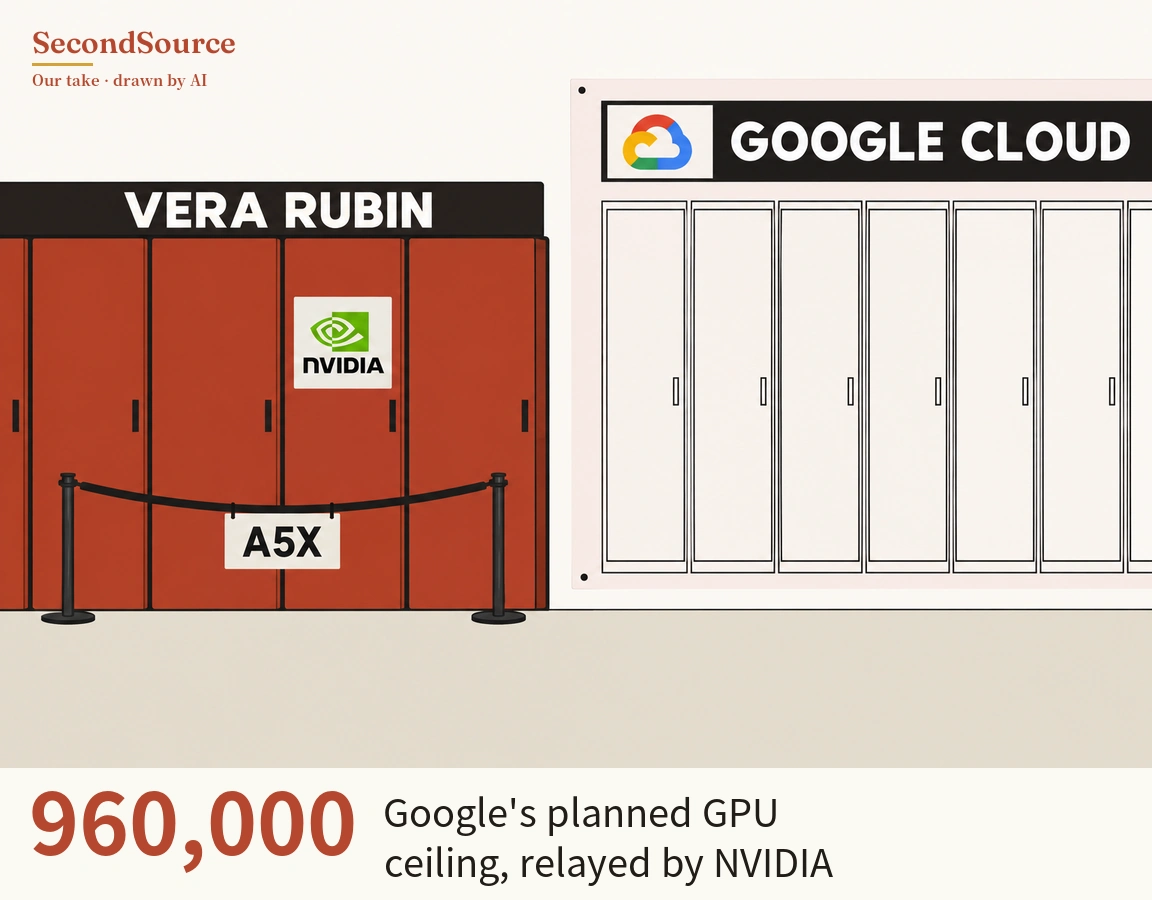
1. [Today] (announcement October 21) NVIDIA writes that Google Cloud's Vera Rubin instance A5X goes generally available next month, and that Google plans to scale to as many as 960,000 Rubin GPUs, a planned ceiling rather than a deployed count. A5X is a Google Cloud instance built from NVIDIA Vera Rubin NVL72 racks. The October 21 issue reported that Google had opened its TPU software to PyTorch the day before, so in-house chips and NVIDIA purchases are moving forward in parallel. NVIDIA's post: "Google Cloud plans to scale its Vera Rubin-based infrastructure to as many as 960,000 Rubin GPUs across multiple sites." (NVIDIA, 2026-10-21). The post gives no timeline or deployed count for the 960,000, and doesn't say whether all of them are A5X. Ineffable Intelligence, founded by AlphaGo author David Silver to do large-scale reinforcement learning, is A5X's first customer. An Ineffable co-founder said on October 13 that Ineffable was among the first customers of "GCP's largest cluster." NVIDIA's post confirms the first-customer status and the November timing; NVIDIA doesn't use the word "largest," and neither side gives the cluster's size. The same post says Google Cloud will be among the first clouds to offer NVIDIA rack-scale confidential computing on bare metal. That bare-metal item is also Google's plan as relayed by NVIDIA; Google's own blog post hasn't been reviewed. Whether A5X reaches general availability in November, as NVIDIA says, is the next checkable point. How we checked →
Named commentary
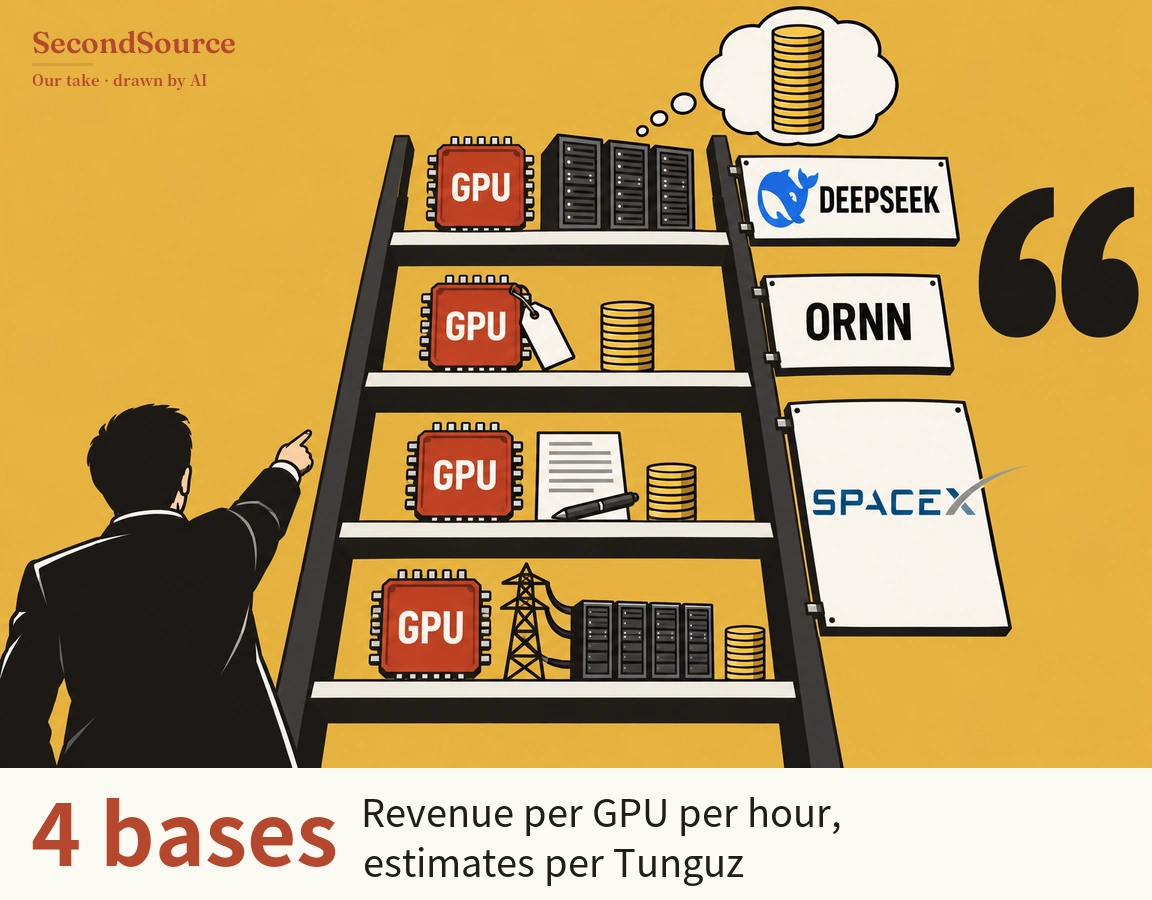
1. [Today] (article October 21) Tomasz Tunguz, a partner at the venture firm Theory Ventures, ranks revenue per GPU per hour on a four-rung ladder of US$38, US$8.77, US$5.27 and US$2.44; the four figures use four different bases, and Tunguz notes that all are estimates. Tunguz has long written financial analysis of SaaS and AI. Our reading: whether inference pays back at today's prices depends on which rung one stands on, and any single figure needs its basis checked before it is cited. The four rungs, in order (Tomasz Tunguz, 2026-10-21): US$38 is DeepSeek's own calculation of a single cluster's ceiling, which Tunguz labels a "theoretical maximum." US$8.77 is the October 20 B200 spot rental price on the ORNN index, a GPU-cloud transaction-price index Tunguz cites. US$5.27 is the contract price in SpaceX's listing documents, US$1.25 billion for 325,000 GPUs; Tunguz treats that sum as a month of 730.5 hours for those 325,000 GPUs and converts it to a per-card hourly rate. US$2.44 is Tunguz's calculation from SpaceX's annualized third-quarter AI-segment revenue divided by 1.7 GW of installed capacity, which is installed capacity, not capacity in use. Converting GW into a GPU count requires an assumed power draw per card, and Tunguz doesn't give that number. Each rung is 40% to 77% below the one above. Because the bases differ, this is not one price falling step by step. Tunguz writes, "Every figure here is an estimate." The October 21 issue described the US$38 as "off-peak realized revenue," while Tunguz's table labels it a theoretical ceiling; which basis is right can't be settled because DeepSeek's original page hasn't been reviewed. SpaceX's original filing hasn't been reviewed either. Tunguz is a venture investor, and the article doesn't disclose holdings. How we checked →
Model watch
1. [Today] (research post October 21) Anthropic writes that Claude led the design of proteins that bind scorpion toxins: two labs tested 211 designs and 17 met the binding bar; whether they neutralize venom in a cellular setting is unconfirmed, and Anthropic says plainly this is not an antivenom. Anthropic's post: "We have not confirmed whether these binders neutralize scorpion venom in a cellular environment, so we do not claim to have produced an antivenom." (Anthropic, 2026-10-21). Of the 211 designs, Claude selected 180 and the human team added 31; Anthropic reports these figures. The 17 that met the bar are 8.1% of 211 (our calculation). The 17 span four scorpion toxins. Of 60 single-toxin designs, 11 met the bar; the post's breakdown doesn't say which category the other 6 successful designs belong to. None of the 151 multi-toxin designs bound more than one toxin at once. Testing was done by Adaptyv Bio and Twist Bioscience, two contract labs Anthropic commissioned. The bar: binding in every replicate at both labs, with a dissociation constant (KD) no higher than 1 µM; a lower KD means tighter binding. The two best designs reached single-digit nM, while the three antibodies the post uses for comparison are all below 1 nM. Claude ran autonomously for the first 24 hours; the Anthropic team then added four more rounds of prompts, and most selected designs came after the third added prompt. Our reading: so the 17 designs that met the bar can't be credited to Claude working on its own. The technical report hasn't been reviewed. How we checked →
Also happened
1. Not verified by us yet: [Today] (announcement October 21) SAP's third-quarter results: Cloud ERP Suite revenue grew 29%, or 28% at constant currency, and CFO Dominik Asam says quarterly revenue topped €10 billion for the first time. The 2026 outlook is described as "updated" without saying whether it went up or down; the press release doesn't state the comparison period or accounting basis, and the quarterly report PDF hasn't been reviewed (SAP News, 2026-10-21).
2. Not verified by us yet: [Today] (announcement October 21) At GTC Berlin, NVIDIA says its modular AI factory DSX POD cuts on-site deployment "from six months to just 14 days once site utilities are ready," and pledges nearly US$10 billion of investment in Europe without breaking down the uses. All of this is NVIDIA's own account (NVIDIA, 2026-10-21).
3. Not verified by us yet: [Today] (announcement October 21) NVIDIA relays that Nscale, a UK GPU cloud provider, used DSX MaxLPS, NVIDIA software that coordinates power allocation with load demand, on GB300 NVL72 to fit 37% more GPUs within the same configuration's power budget and get nearly 50% more total inference throughput. The baseline and workload aren't described (NVIDIA, 2026-10-21).
4. Not verified by us yet: [Today] (announcement October 21) Mistral writes that Mistral Large 4 was trained on 3,800 Grace Blackwell GPUs in Mistral's own European data centers, and that its compute roadmap targets 1 GW of capacity by 2030. That is a self-set target, not deployed capacity (Mistral, 2026-10-21).
5. Not verified by us yet: [Today] (customer story October 21) In a Cloudflare customer story published by OpenAI, Cloudflare's president of revenue Mark Anderson says four developers rebuilt a product with Codex in three days for US$1,100 in tokens, against an original estimate of several months. This is a single self-reported account; Cloudflare's own blog hasn't been reviewed (OpenAI, 2026-10-21).
6. Not verified by us yet: [Today] (announcement October 21) Patches for php2shell, two PHP engine flaws rated 9.2, were released on October 21. Wiz found both; OpenAI says its partner Calif also found one of them. Our call: Wiz found both php2shell flaws, OpenAI says Calif independently found one, and "mixing two companies' models" describes Wiz's tooling alone. Some reports relaying the news merged the two companies' accounts into one sentence (Wiz Research, 2026-10-21).
7. Not verified by us yet: [Today] (announcement October 21) ChatGPT ads expand to 26 more countries, 89 in total. An OpenAI engineering post says the ad system is separate from answer generation. The ad model reads conversation context, and draws on past conversations when a user opts into personalized ads. Our call: ChatGPT's ad isolation runs one way: the answer path doesn't touch ads, while OpenAI's posts give no specification for how much conversation the ad system retains or for how long (OpenAI, 2026-10-21).
Research watch
1. [Trend] (preprint October 17) Snowflake AI Research's Arctic-SWE, with no new algorithm, trains the 4-billion-parameter Qwen3.5-4B to a 62.0% solve rate on the coding benchmark SWE-bench Verified, 0.5 points above the FrogNano baseline the authors measured, as the paper self-reports. SWE-bench Verified is a coding benchmark built from real GitHub issues. The authors write: "On raw R2E-Gym data, without new algorithms or data work, Arctic-SWE trains Qwen3.5-4B to 62.0% pass@1 on SWE-bench Verified" (arXiv 2610.24914, 2026-10-17). pass@1 is the solve rate with a single attempt per problem. R2E-Gym is an existing public training environment. The baseline, FrogNano, also synthesizes tasks online and scores 61.5%. The scores differ by only 0.5 percentage points, and Arctic-SWE uses about one-sixth of FrogNano's training samples. With data filtering, the 4B model's Verified score reaches 65.0%. This is a single self-reported paper, posted on October 17, and any independent replication falls outside this issue's sources. Scores move with data filtering and test strength. Our reading: further gains for small models on this benchmark may hinge on the reinforcement-learning system and data quality rather than algorithms. This item doesn't compare against the strongest current models' scores on the same benchmark.
2. [Trend] (preprint October 19) Two preprints point in different directions on whether gains in Lean theorem proving come from the harness or the base model: Maestro says swapping in its orchestration harness on the same base model solves 34 of 48 problems against 19 for native agents, while mini-Lean says a generic coding agent with a minimal harness is enough. Lean is a formal language for mathematical proofs. Maestro is a harness that coordinates several agents, and arXivLean is a set of Lean problems. Maestro self-reports solving 34 of the 48 problems in the June 2026 edition of arXivLean, against 19 for the native agents Claude Code or Codex; the paper doesn't list the authors' affiliations (arXiv 2610.25920, 2026-10-19). Maestro says both sides used the same base model. On October 12, mini-Lean, by Sanjeev Arora of Princeton and colleagues, wrote that "a generic coding agent with a minimal harness can already achieve strong performance on Lean benchmarks," self-reporting that on the 12 problems of Putnam 2025, Gemini 3.8 Flash solved 7 against 4 for the rival AxProverBase (arXiv 2610.17331, 2026-10-12). The two papers use different harness designs and problem sets, so one doesn't rebut the other on the same test. Both problem sets are small: with 12 and 48 problems, a few answers either way would change the conclusion. Our reading: current evidence can't yet say whether a harness is worth development resources. Only a retest with the same harness design and a larger problem set would separate gains from the harness and from the base model.
Product moves
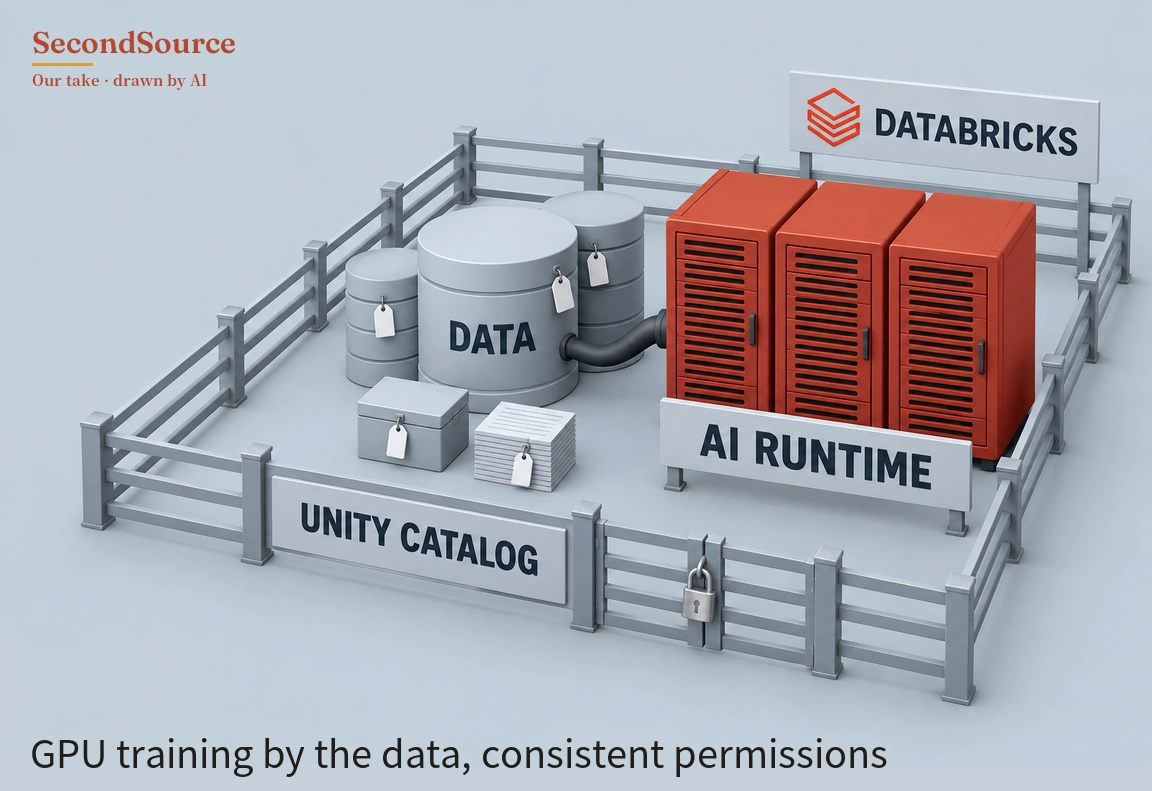
1. [Today] (announcement October 21) Databricks announces general availability of AI Runtime, which brings managed GPU training straight onto its data platform so training data stays inside the governance boundary; the announcement gives no pricing or GPU models. Databricks is a data and AI platform company. The announcement: "bringing fully managed GPU infrastructure directly into Databricks so customers can train their most demanding models where their enterprise data already lives" (Databricks, 2026-10-21). AI Runtime is for training and fine-tuning, not inference serving. It is serverless and can span multiple machines, and GPU jobs fall under Unity Catalog, the data-governance layer, so read and write permissions for data, checkpoints and logs stay consistent. Databricks self-reports "hundreds of companies" using it and names six, including Robinhood, Merck and FactSet. Databricks also says training Qwen on AI Runtime took one-sixth the time of its earlier setup, a comparison against Databricks' own prior configuration. The announcement doesn't say how much of this general-availability release is a renamed preview. Our reading: the most direct users are enterprises whose data already sits on Databricks and that train or fine-tune their own models. Whether a data platform moving into managed GPU training competes head-on with GPU clouds depends on pricing and GPU models, and the announcement gives neither. How we checked →
From the archive
This issue's space goes to the main line; this section is on the website today. "[Looking back] (SecondSource deep dive, July 23) The yardstick of how many hours AI can work in a row was stirred up within one quarter by the very models it measures" (SecondSource deep dive, 2026-07-23).
Correction: the August 13 issue said Nebius's second-quarter adjusted EBITDA had "turned positive for the first time," and that the prior quarter was still negative US$53.7 million. In fact the negative US$53.7 million was the figure for the first quarter of 2025, and Nebius has been positive for three straight quarters since the fourth quarter of 2025 (US$15 million, US$129.5 million and US$236.2 million). The "first time positive" half is withdrawn; the other half of the conclusion stands: capital spending this quarter was about 9.7 times revenue, and full-year revenue guidance was not raised. The archive pages in all three languages now carry a correction note.
SecondSource isn't a news digest: each day it hunts the AI firehose for the insights that matter and the practitioner judgments worth tracking over time, and shows how every item was verified. The point is always which judgments are now harder to hold and who has been right, not what happened today.
Written from the same research and judgments as the Traditional Chinese edition. Sources are linked; we distinguish original documents from reporting and mark what we could not verify.