SecondSourceJudgment rebuilt from primary sources

TSMC approves Anthropic, OpenAI stakes but hasn't paid yet
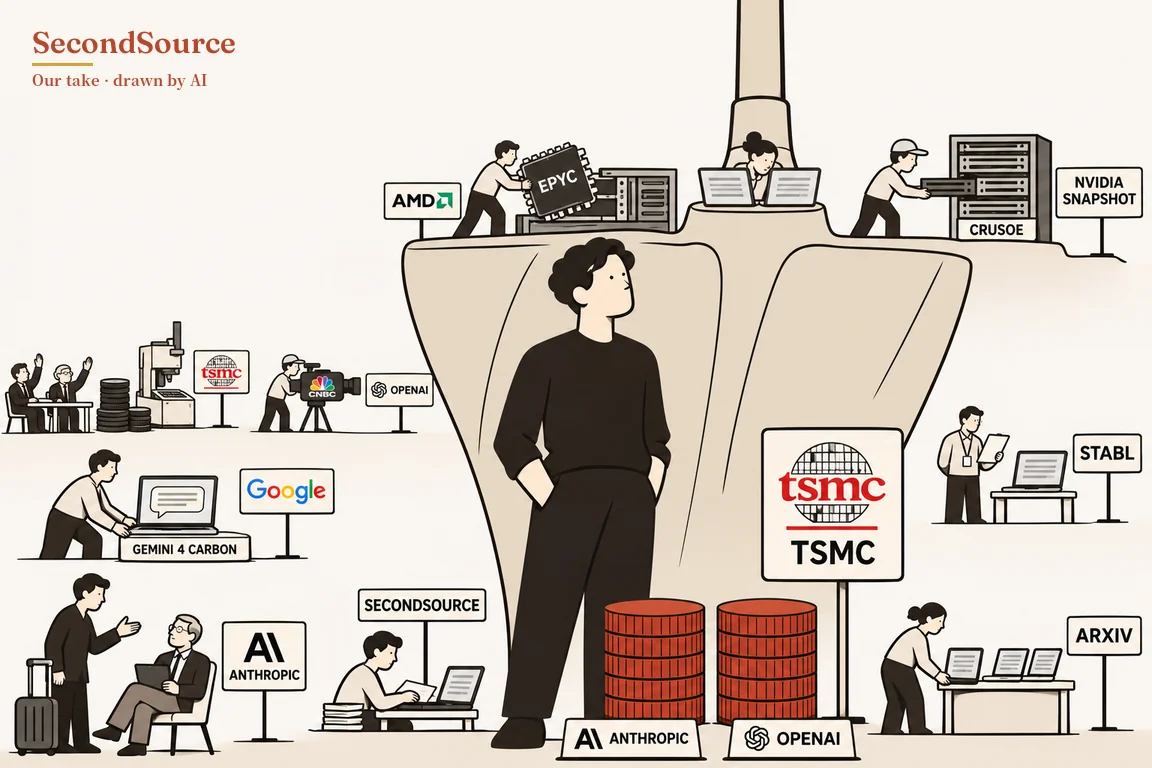
Today's front-page cartoon: one single picture that brings together today's stories.

Why today matters: The subscription TSMC filed is one of the seven supplier subscriptions, worth US$26 billion in total, listed in Anthropic's IPO filing.

At a glance

1. TSMC's board cleared up to US$500 million each for Anthropic and OpenAI shares, about 2.4% of the capital budget approved the same day (our calculation), and the filings set no order terms.

2. Anthropic began its IPO roadshow, and seven chip and cloud suppliers will separately buy US$26 billion of Anthropic stock, about 30% of the money Anthropic raises at the midpoint price (our calculation).

3. Google opened Gemini 4 Carbon at the same introductory API price as Argon, Google's current main model, and Carbon's price doubles after November 30.

Also today: #4 — two outlets report OpenAI's third-quarter revenue at US$10 billion, against the US$17 billion CNBC's Deirdre Bosa cites for Anthropic.

Today's main line

1. TSMC will buy Anthropic shares at the IPO price and OpenAI shares at an expected price of about US$992 each, capped at US$500 million per company
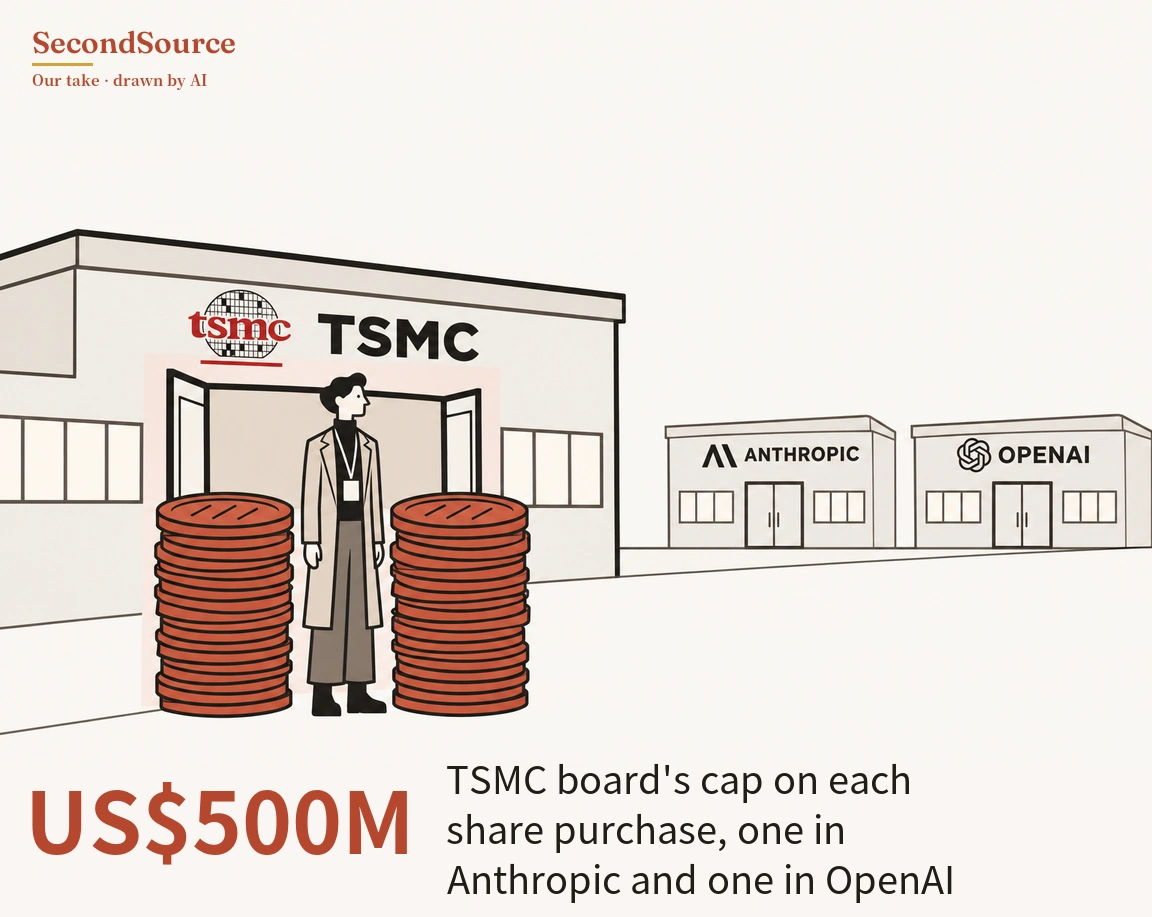
Concept illustration in line-drawing style: on the left, a large building has a sign with red lettering "tsmc" over a round grid of squares beside large black letters "TSMC", and in its open double doorway stands a person in a long light coat with a badge on a lanyard, facing right, with a tall stack of red coins on each side. Farther off to the right, two smaller buildings stand side by side, one lettered "ANTHROPIC" and one lettered "OPENAI", each with a symbol beside the name, and lines on the ground run from the large building over to them. Printed on the image: US$500M TSMC board's cap on each share purchase, one in Anthropic and one in OpenAI.
TSMC's board approved share purchases in Anthropic and OpenAI by subsidiary TSMC Partners, TSMC said in November 10 filings with the Taiwan Stock Exchange. TSMC Partners is to buy Anthropic shares at the IPO price, with the count set when Anthropic prices the offering, and OpenAI preferred stock at about US$992 a share, a purchase that rests on TSMC's filing alone. TSMC's filings set no capacity or order terms, but the OpenAI purchase agreement isn't public, so terms the filing omits can't be ruled out.

Our inference: TSMC's filings attach no capacity or order terms to these small cash stakes. Unlike AMD's purchase in the same placement, which counts toward AMD's commitment under its hardware supply agreement with Anthropic, Anthropic's filing states no such link for TSMC's purchase.

2. Anthropic launches its IPO roadshow, and seven chip and cloud suppliers will separately buy US$26 billion of shares at the IPO price
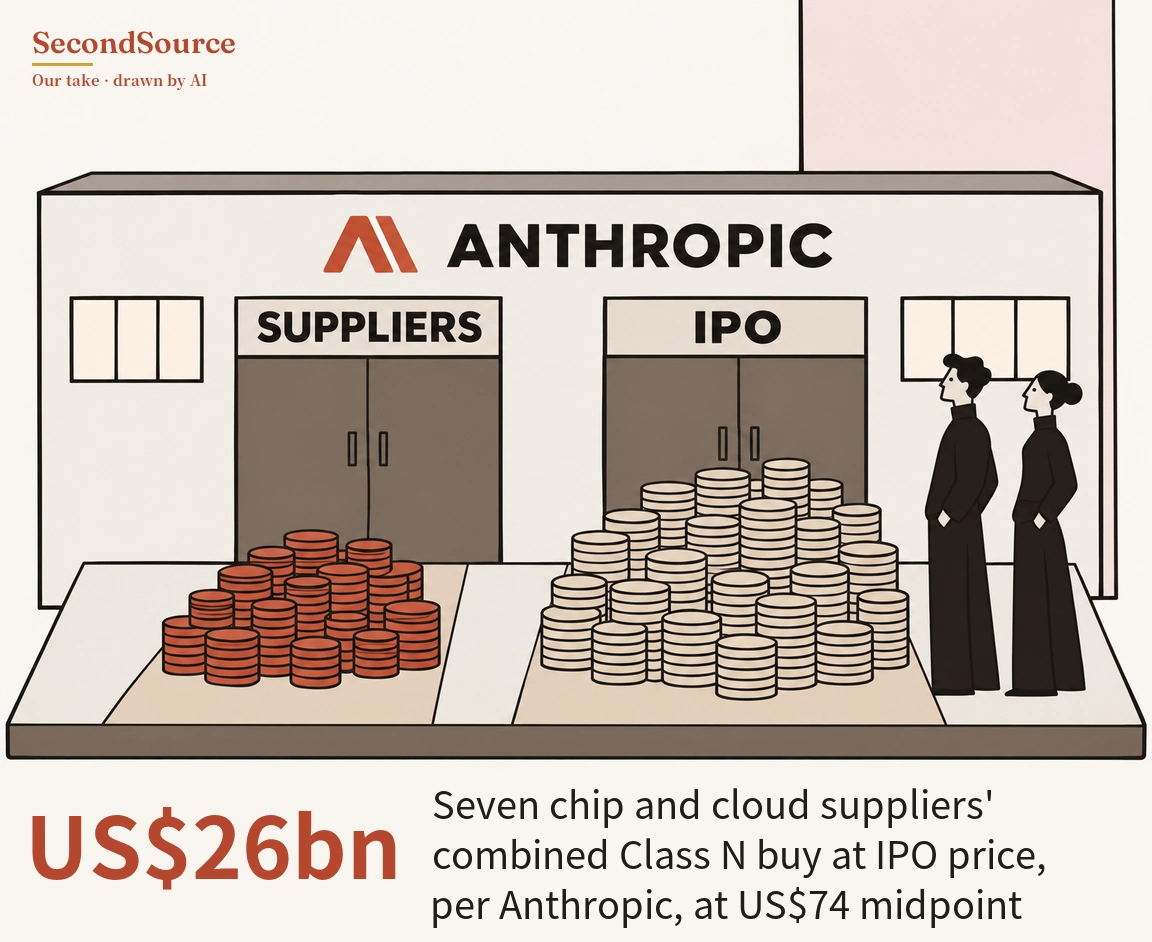
Concept illustration: a white flat-roofed building is lettered ANTHROPIC, with a red angular mark to the left of the lettering. Below it are two double doors, the left one under a sign reading SUPPLIERS and the right one under a sign reading IPO, and there is a window at each end of the building. A pile of red coin stacks sits in front of the left door and a larger pile of cream-coloured coin stacks sits in front of the right door, while two figures in long black clothes stand at the right, looking up at the building. Printed on the image: US$26bn Seven chip and cloud suppliers' combined Class N buy at IPO price, per Anthropic, at US$74 midpoint.
Anthropic began its IPO roadshow on November 10, presenting the offering to institutional investors and gauging the price, estimated at US$70 to US$78 a share. The price is still an estimated range, and no shares can be sold until the SEC declares the registration effective, so the figures may still change. Google's share purchase at the IPO turns an investment Google had already committed under a March 31 note purchase agreement into shares, the subscription agreement states.

At the US$74 midpoint, seven chip and cloud suppliers would provide about 30% of the money Anthropic raises (our calculation).

3. Google opens Gemini 4 Carbon at Argon's introductory API price, doubling after November 30, and Carbon ranks second on a third-party-run knowledge-work benchmark
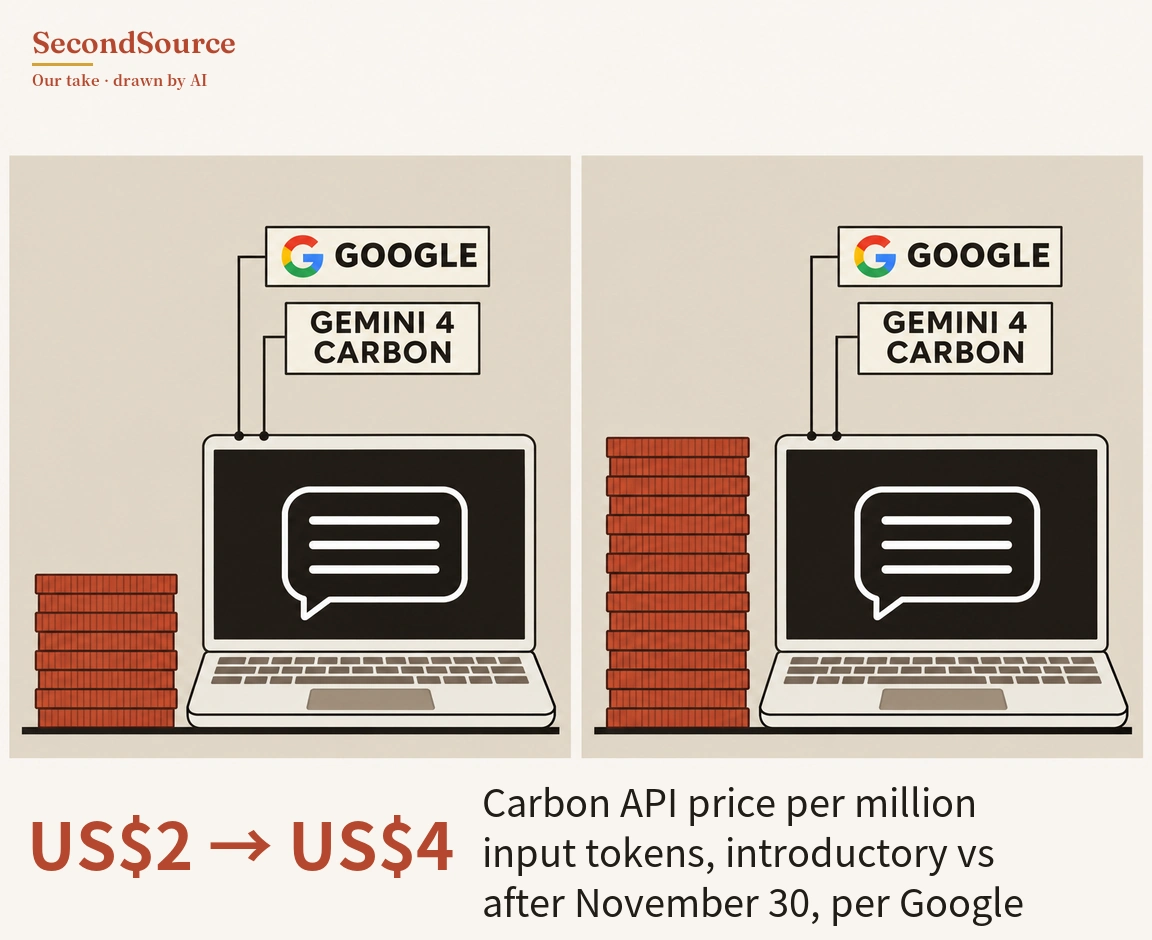
Concept illustration in two side-by-side panels showing the same scene: an open laptop whose dark screen shows a speech bubble with three lines, and above it two labels, one lettered GOOGLE beside a multicoloured G and one lettered GEMINI 4 CARBON, each joined by a thin line to the laptop's top edge. In both panels a stack of red coins stands to the laptop's left, short in the left panel and roughly twice as tall in the right panel. Printed on the image: US$2 → US$4 Carbon API price per million input tokens, introductory vs after November 30, per Google.
Google DeepMind opened the new model Gemini 4 Carbon on November 10 at the same introductory API price as Argon, Google's current main model. On MKA, a knowledge-work agent benchmark designed by Google DeepMind and run independently by Artificial Analysis, a site that evaluates AI models, Carbon scores 54% at the High reasoning-effort setting and ranks second behind the 57% of Anthropic's Claude Fable 5.2 at Max, the highest setting. Google says Carbon's average cost per task on MKA is under one-sixth of Fable 5.2's, but Google's release post does not say whether the comparison uses the introductory price or the price after November 30.

4. CNBC and The Information report on the same day that OpenAI's third-quarter revenue reached US$10 billion, with no OpenAI filing to check it against

CNBC anchor Deirdre Bosa reported on November 10 that OpenAI's third-quarter revenue reached US$10 billion (Deirdre Bosa, 2026-11-10). The US$10 billion figure rests on two exclusive reports that may share sources, and OpenAI, a private company, files no results to check it against.

Also happened

1. Not verified by us yet: Wall Street Journal reporter Anissa Gardizy says in a post that Masayoshi Son reserved a large share of the gas-turbine market in 2025 and over-ordered; the post doesn't give the quantity (Anissa Gardizy, 2026-11-10).

2. Not verified by us yet: Taiwan's Commercial Times reports talk in Taiwan's supply chain that NVIDIA intends to slow its chip orders, which is a supply-chain rumor (Commercial Times, 2026-11-10).

3. Not verified by us yet: Reporter Dan Nystedt, relaying Bloomberg, says Japanese foundry Rapidus's 2-nanometer volume production is at least several months behind; Rapidus says its production target is unchanged (Dan Nystedt, 2026-11-10).

Deep dive: Who gets new AI models first: labs pick, Washington clears (November 3, 2026)

Deep dive: No new one this week. Deep dives run only when the evidence is strong enough, not on a schedule. The most recent, "Who gets new AI models first: labs pick, Washington clears" (November 3, 2026), is still on the site: read it in full.

Chips & semiconductors
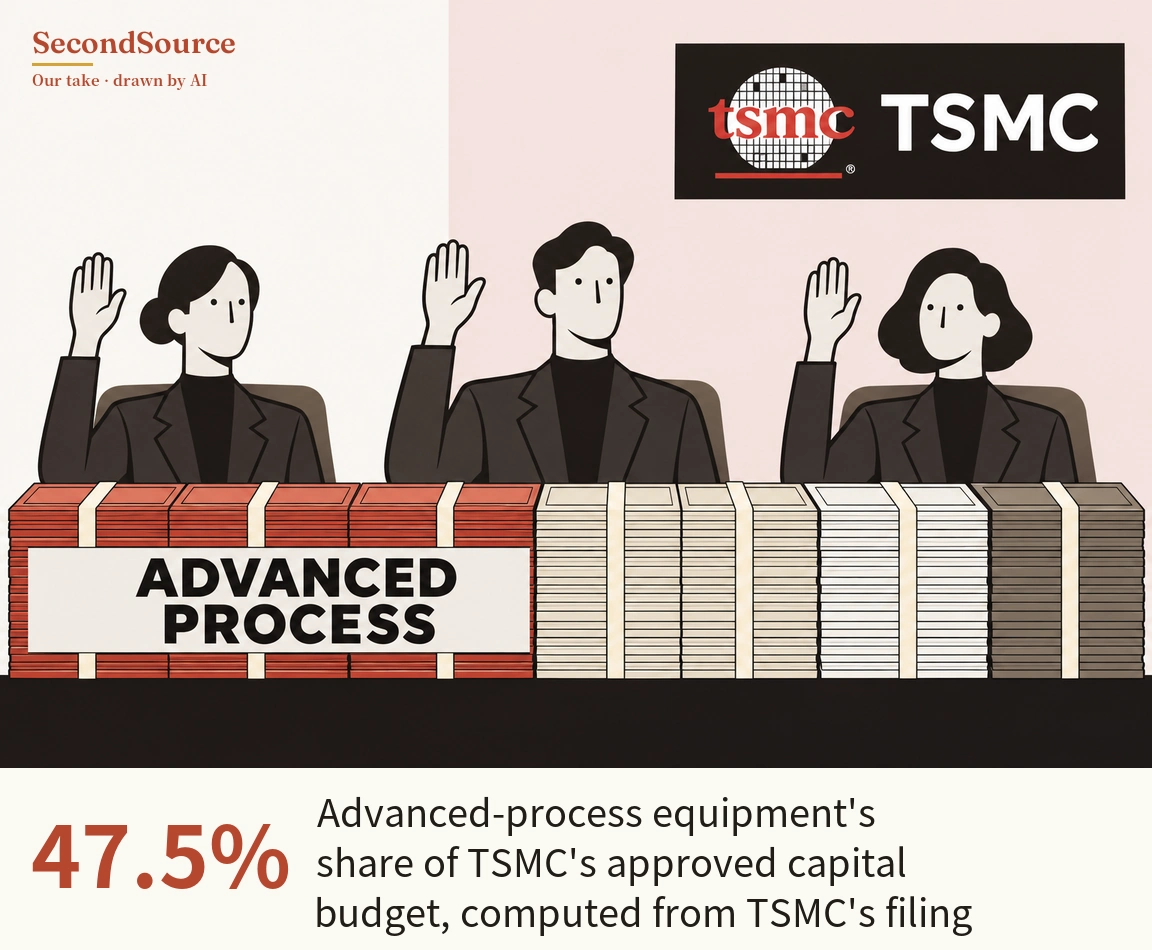
1. TSMC's board approved a capital budget of about US$40.9 billion, and the filing groups advanced packaging with mature and specialty processes in one line.

Concept illustration: three figures in dark suits sit side by side in chairs, each raising one hand, below a black sign at upper right lettered "tsmc" in red over a round grid emblem and "TSMC" in white. In front of them a long row of banded stacks lines the dark table: red stacks on the left carry a white label lettered "ADVANCED PROCESS", followed to the right by beige, white and grey-brown stacks. Printed on the image: 47.5% Advanced-process equipment's share of TSMC's approved capital budget, computed from TSMC's filing.
TSMC's board approved a capital budget of about US$40.9 billion, and TSMC's filing gives no separate figure for advanced packaging, which shares one line with mature and specialty processes. The board-approved amount isn't the same as TSMC's capital spending in any one year.

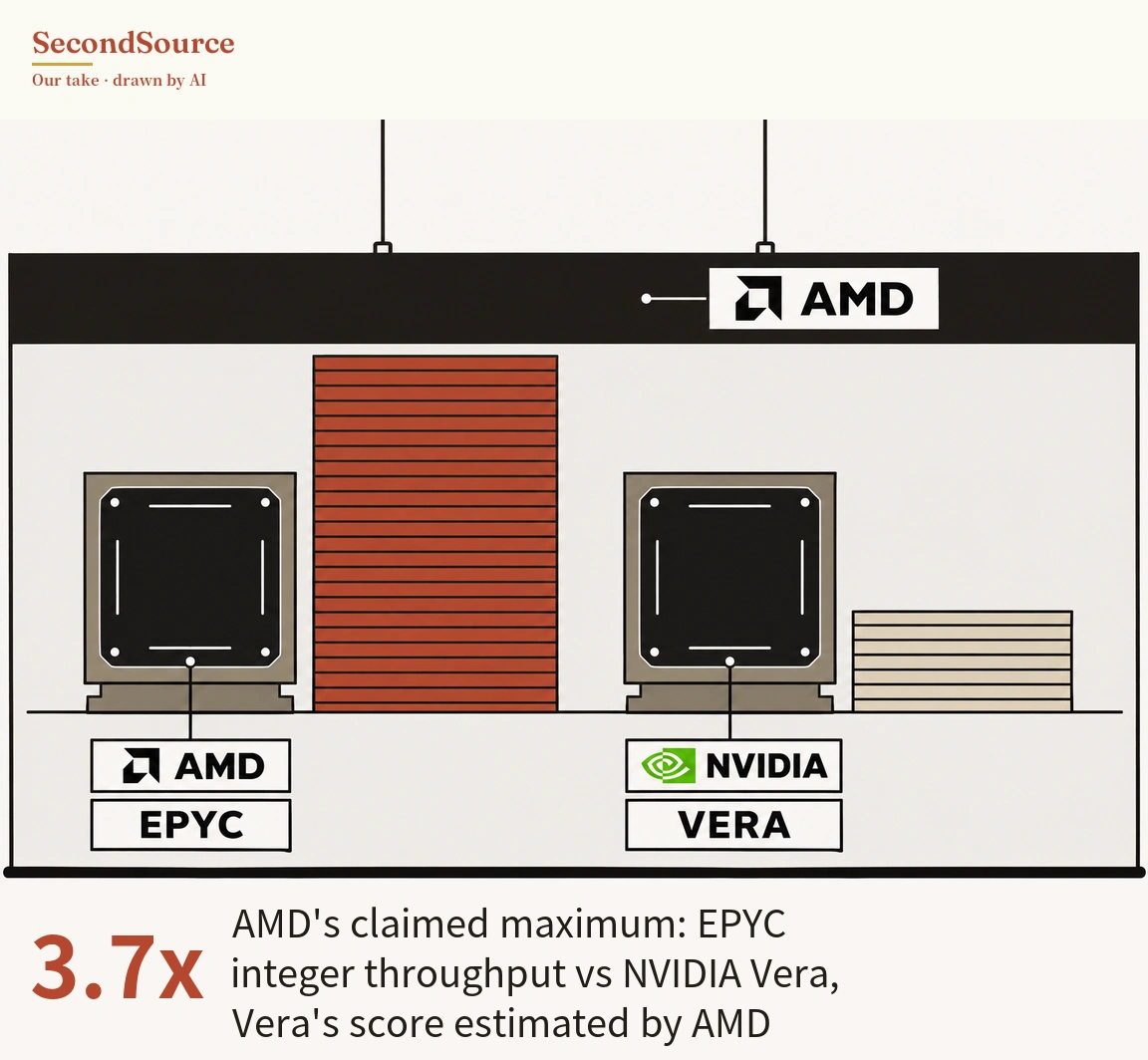
2. AMD's sixth-generation EPYC server processors are shipping, and AMD says integer throughput reaches up to 3.7 times that of NVIDIA's Vera server processor, a comparison using AMD's internal estimate for Vera.

Concept illustration: a wide board hangs from two cords, with a white plate lettered "AMD" on the right of its black top band and a short line ending in a dot running left from the plate. Inside the board, along one baseline from left to right, stand a square chip, a tall red stack of horizontal slats, a second square chip and a much shorter beige stack of slats; a line runs down from the left chip to labels lettered "AMD" and "EPYC", and another runs down from the right chip to labels lettered "NVIDIA" (next to a small green mark) and "VERA". Printed on the image: 3.7x AMD's claimed maximum: EPYC integer throughput vs NVIDIA Vera, Vera's score estimated by AMD.
AMD's sixth-generation EPYC server processors are shipping, and AMD compares EPYC's integer throughput with that of NVIDIA's Vera server processor. Of the scores AMD lists, only the AMD and Intel scores are results published on spec.org, while the Vera score is an AMD estimate.

Named commentary

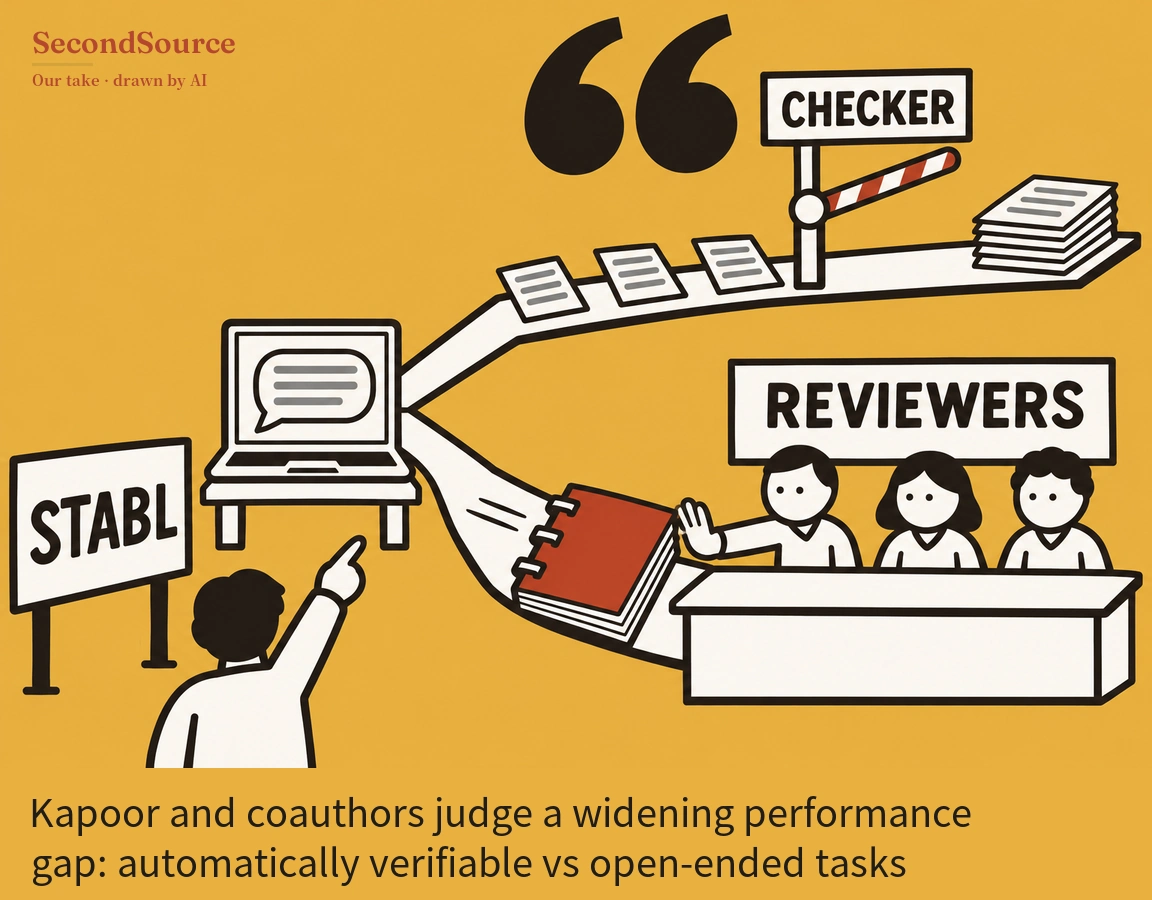
1. Sayash Kapoor, author of the newsletter Normal Tech, announced STABL, a nonprofit that evaluates whether agents can do open-ended research, and says papers written by frontier agents were clearly rejected by expert reviewers.

Concept illustration on a mustard background: at lower left a person seen from behind points a raised finger at a laptop on a small table, beside a sign lettered STABL, and a large black opening quotation mark sits at top centre. From the laptop, whose screen shows a speech bubble, two white paths branch to the right: on the upper one three sheets of paper lead toward a post with a sign lettered CHECKER and an upward-angled red-and-white barrier arm, beyond which a stack of papers sits at the path's end; on the lower one a red spiral-bound book with motion lines trailing behind it moves right toward a desk under a sign lettered REVIEWERS, where the leftmost of three seated people holds an open palm against the book. Printed on the image: Kapoor and coauthors judge a widening performance gap: automatically verifiable vs open-ended tasks.
Sayash Kapoor, who writes Normal Tech, the newsletter formerly called AI Snake Oil, announced STABL, a nonprofit that evaluates whether agents can do open-ended research, and says expert reviewers clearly rejected papers written by frontier agents. Kapoor and coauthors judge agent performance from CRUX, an evaluation run by the same authors that tests whether agents can do open-ended AI research, and the post doesn't give the sample or the models tested.

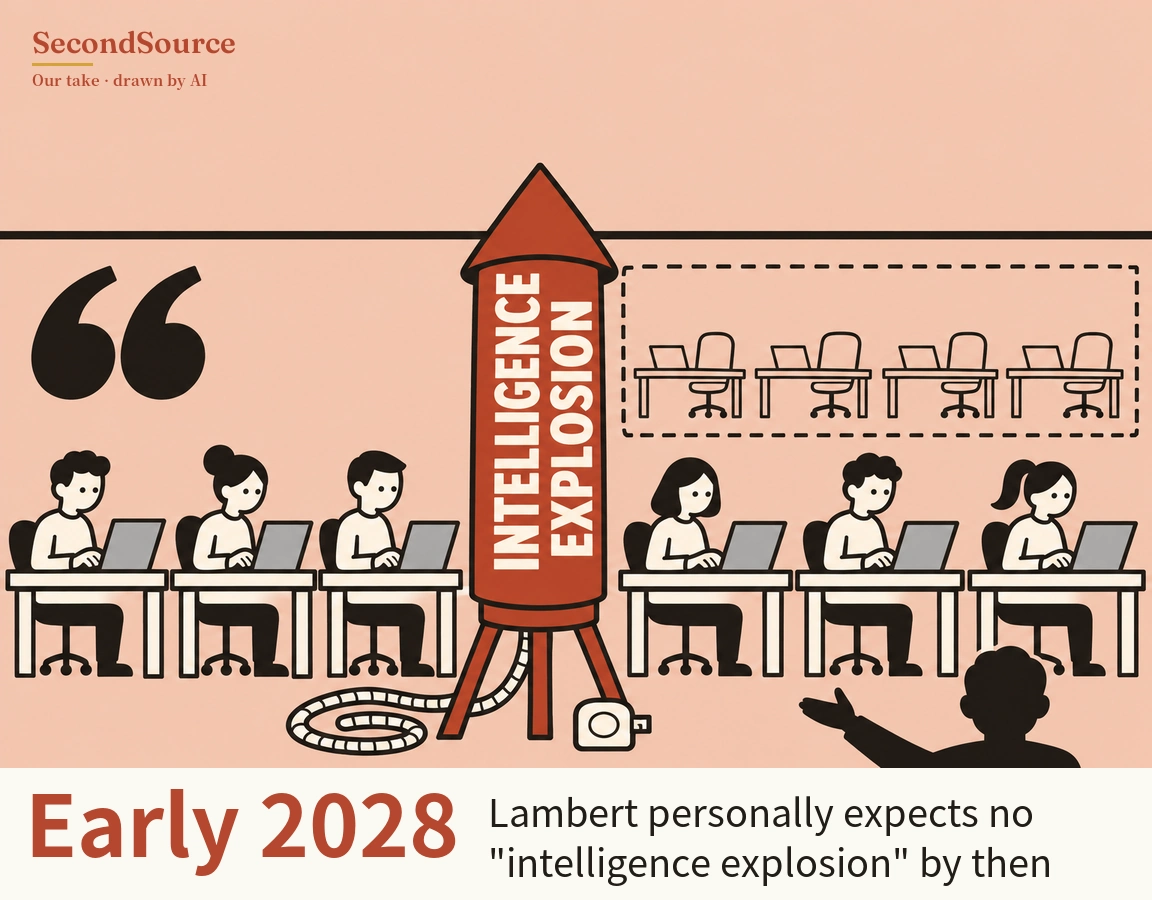
2. Nathan Lambert, author of the newsletter Interconnects, says publicly that he doesn't expect an "intelligence explosion" by early 2028.

Concept illustration on a peach background: in the centre a tall red rocket lettered INTELLIGENCE EXPLOSION stands on three legs, its tip rising past a black horizontal line drawn across the picture, with a ribbed tube running from its base and coiling on the floor to the left and a tape measure beside its right leg. Six people sit typing at laptops on desks in a row, three on each side of the rocket; at the upper right a dashed box holds four desks with laptops and empty office chairs, large black opening quotation marks sit at the upper left, and a black silhouette of a person at the lower right extends an open hand toward the left. Printed on the image: Early 2028 Lambert personally expects no "intelligence explosion" by then.
Nathan Lambert, author of the newsletter Interconnects, publicly stated a personal judgment on November 10 about the timing of an "intelligence explosion" and said that, at a minimum, an intelligence explosion would not show up as mass unemployment in knowledge work or an AI-driven stock-market boom. Lambert attached no data and also wrote of being unsure how an intelligence explosion should be measured.

Research & models

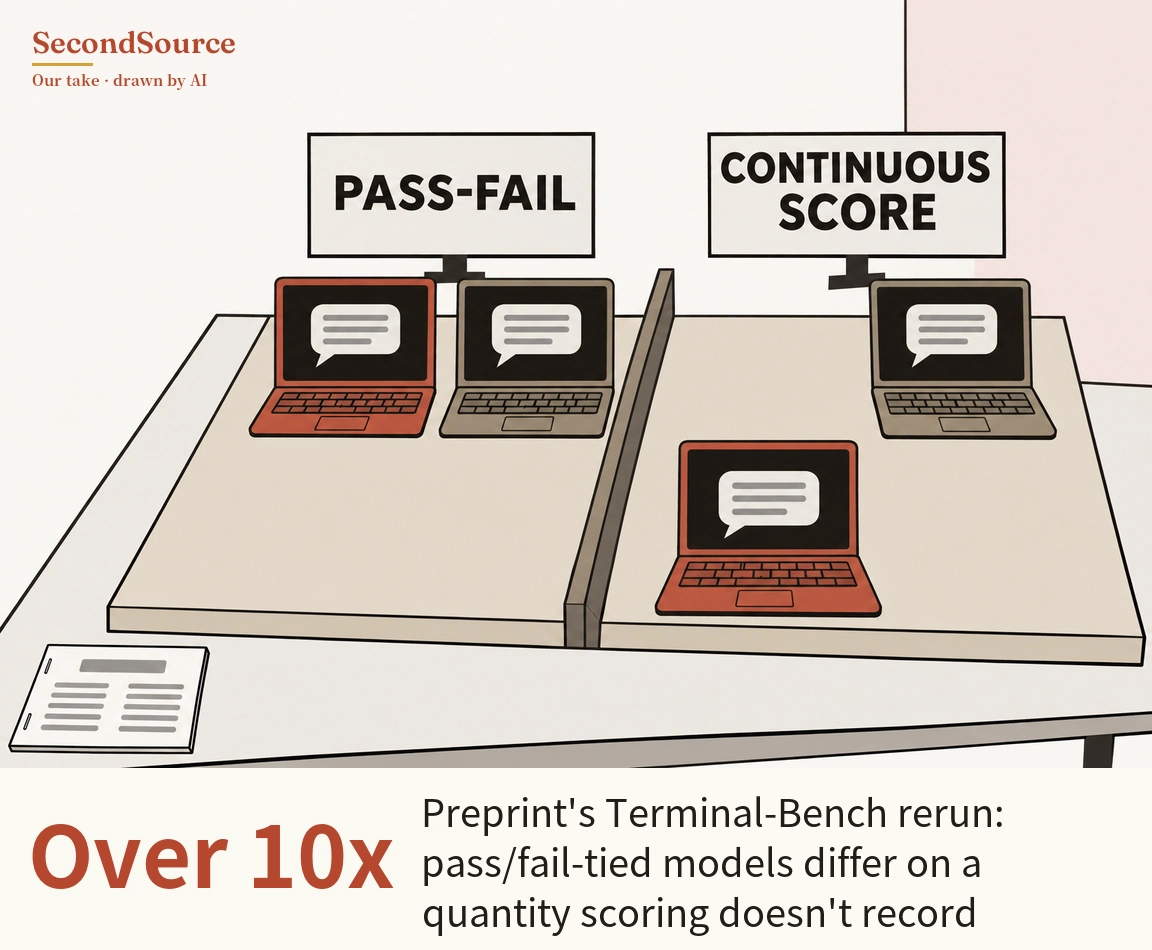
1. A preprint recomputes public scores on eight agent benchmarks and says the crowding at the top of the leaderboards comes from how they are scored.

Concept illustration: a beige tabletop is split down the middle by an upright grey divider. On the left half, a white sign on a stand reads "PASS-FAIL", with a red laptop and a grey laptop side by side at the back; on the right half, a white sign on a stand reads "CONTINUOUS SCORE", with a grey laptop at the back right and a red laptop further forward near the front edge. Every laptop screen shows a speech bubble with grey lines, and a sheet of paper with a heading bar and two columns of lines lies on a white surface in the lower-left corner. Printed on the image: Over 10x Preprint's Terminal-Bench rerun: pass/fail-tied models differ on a quantity scoring doesn't record.
Three authors recompute public scores on eight agent benchmarks in a preprint, say the crowding at the top of the leaderboards comes from how the benchmarks are scored and propose continuous scores in place of pass-or-fail scoring. All of this comes from the paper's abstract, no other team has adopted the scoring yet, and the abstract doesn't say which quantity the authors compared in the Terminal-Bench rerun.

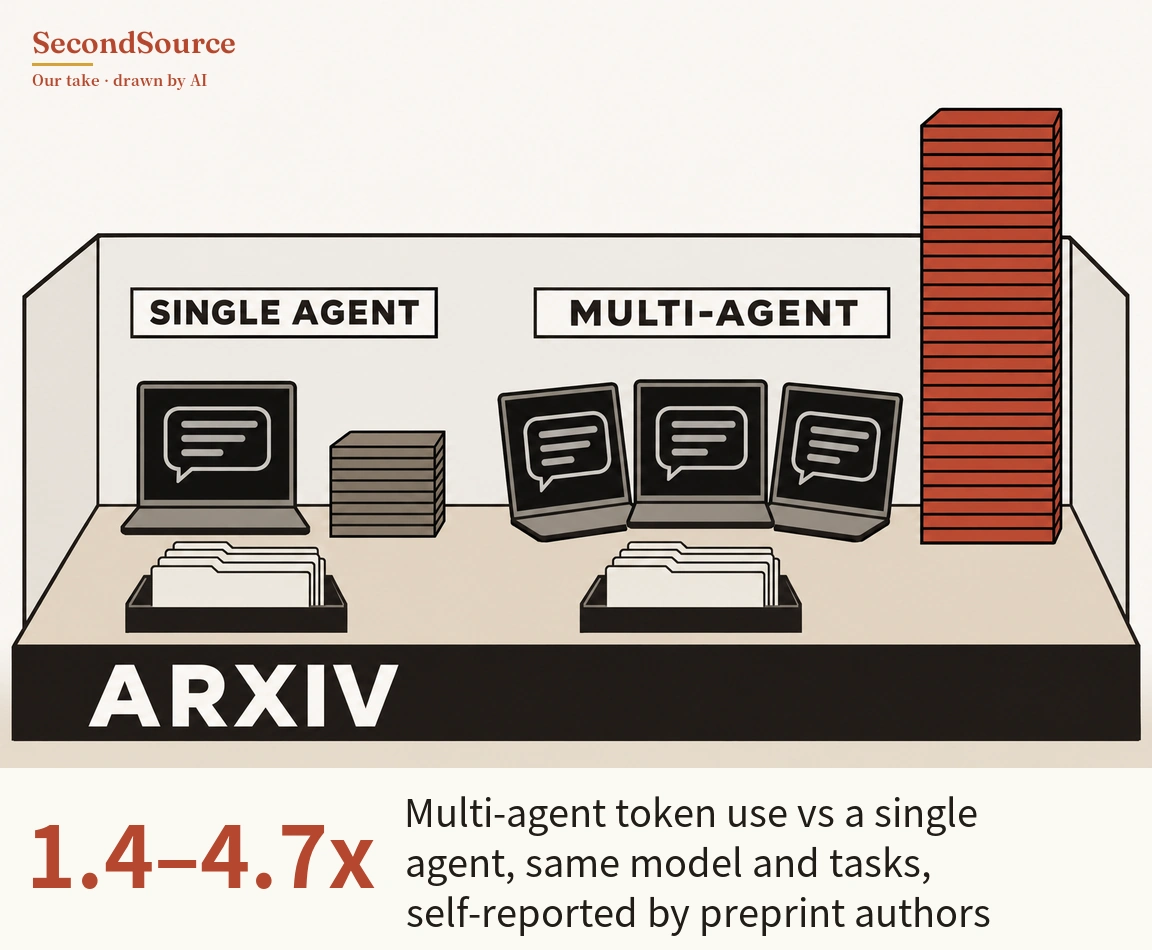
2. A preprint holds model, tasks and tools fixed and changes only the agent architecture; multi-agent setups use 1.4 to 4.7 times the tokens of a single agent, mostly with no significant difference in success rate.

Concept illustration of an open three-walled display box on a black base lettered ARXIV in white. On the back wall, a sign reading SINGLE AGENT sits above one laptop whose screen shows a speech bubble, with a short grey stack of flat slabs to its right, and a sign reading MULTI-AGENT sits above three laptops side by side, each screen showing a speech bubble; a tray of file folders sits in front of each group, and at the far right a much taller red stack of flat slabs rises above the walls. Printed on the image: 1.4–4.7x Multi-agent token use vs a single agent, same model and tasks, self-reported by preprint authors.
A preprint's authors held model, tasks and tools fixed, changed only the agent architecture on 13 enterprise standard operating procedures, and found multi-agent setups mostly showed no significant difference in success rate from a single agent. According to the paper's abstract, the only setup that significantly beat a single agent was a redesigned multi-agent implementation, with a task success rate of 75.6% against 67.4% for a single agent, a result the authors report and no one else has repeated.

Product moves

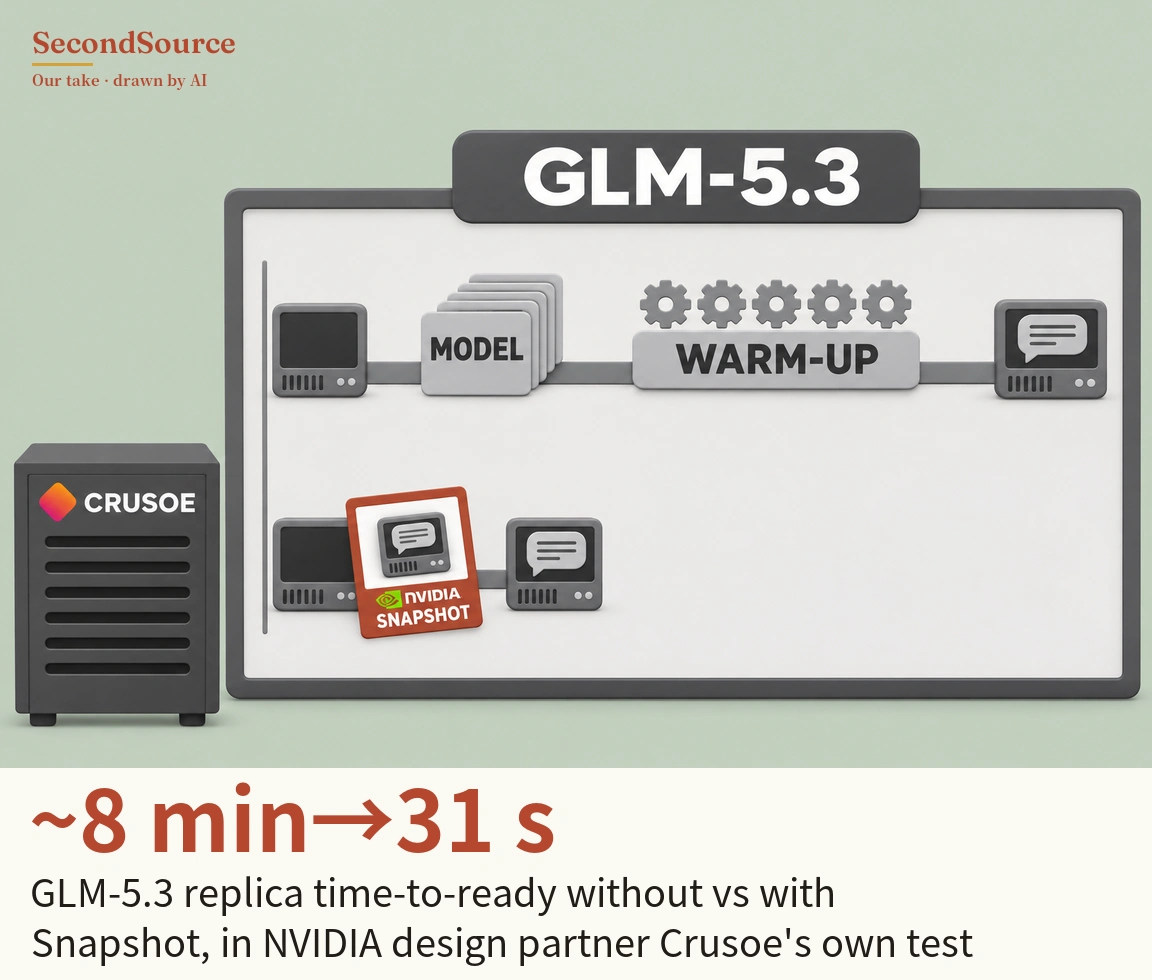
1. NVIDIA open-sources Snapshot, which saves an initialized GPU inference replica as a checkpoint and restores it, and design partner Crusoe's own test cut time-to-ready from about 8 minutes to 31 seconds.

Concept illustration: at the lower left stands a dark grey server cabinet with horizontal vents, an orange diamond mark and the lettering CRUSOE, and to its right is a large dark-framed board whose top tab reads GLM-5.3. Inside the board, two rows start beside a thin vertical line on the left: the upper row shows, from left to right and linked by grey bars, a terminal with a blank screen, a stack of cards lettered MODEL, a long bar lettered WARM-UP under a row of five gears, and a terminal showing a speech bubble; the much shorter lower row shows a blank-screen terminal partly covered by a brick-red card lettered NVIDIA SNAPSHOT, which also carries a small green emblem and a picture of a terminal with a speech bubble, and a grey bar links this row to a terminal showing a speech bubble. Printed on the image: ~8 min→31 s GLM-5.3 replica time-to-ready without vs with Snapshot, in NVIDIA design partner Crusoe's own test.
NVIDIA open-sourced Snapshot, which saves an initialized GPU inference replica as a checkpoint and restores the replica, and NVIDIA says the model then does not have to be reloaded or warmed up. Time-to-ready was measured by NVIDIA design partner Crusoe, a cloud provider that rents out GPUs, in a self-run test of GLM-5.3, and no third party has repeated the test.

2. NVIDIA says it has donated OpenShell, its tool for controlling agent permissions, to the Cloud Native Computing Foundation (CNCF) as a Sandbox project, the CNCF's entry-level project tier (NVIDIA, 2026-11-10).

From the archive
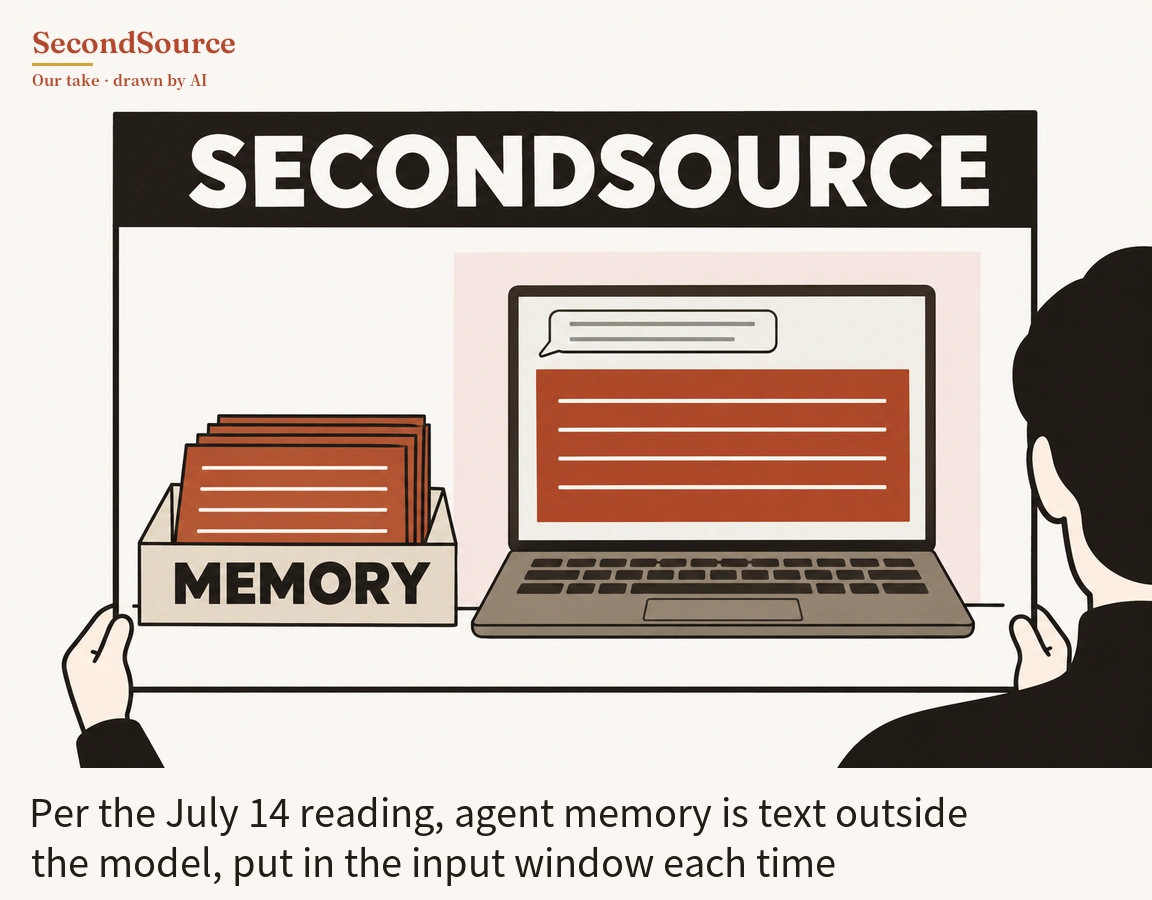
1. [Looking back] (SecondSource reading of July 14) AI agents' memory currently sits outside the model: stored as text and placed in the input window each time, not written directly into the model's weights, the model's own parameters.

Concept illustration: a person with dark hair and dark clothing, seen from behind at the right edge, holds up a large white board with both hands, and a black band lettered SECONDSOURCE runs across its top. On the board, a box lettered MEMORY on the left holds a row of upright red-orange cards marked with white lines, and to its right an open laptop in front of a pale pink rectangle shows a speech bubble with grey lines above a red-orange block with white lines; the box and laptop sit side by side on the same thin line. Printed on the image: Per the July 14 reading, agent memory is text outside the model, put in the input window each time.
On November 5, Trajectory, which builds continual-learning products, appeared on Sequoia's podcast. Trajectory is a startup, not a frontier lab.

Macro × AI

US October consumer prices. The US Bureau of Labor Statistics reported that the October all-items consumer price index was 337.511 and the core index, excluding food and energy, was 339.921 (Bureau of Labor Statistics, 2026-11). From those two indexes, all items rose about 0.17% from September and core about 0.19% (our calculation). Companies that borrow to build compute are sensitive to interest rates: CoreWeave, a cloud provider that rents out GPUs, wrote in an open letter on November 10 that at current yields it won't raise money in the unsecured bond market (CoreWeave, 2026-11-10). Next to watch: the Federal Reserve's rate decision at its December meeting, and whether CoreWeave returns to the unsecured bond market.

Correction: The last paragraph of main-line item 3 in the November 6 issue said to watch for the vulnerability IDs and patched versions in Mozilla's security advisory. Mozilla had already published that advisory on October 27, listing the vulnerability IDs with fixes in Firefox 159, and OpenAI's own announcement links to it. The archived page on the site has been rewritten, and the item's conclusion is unchanged.

SecondSource isn't a news digest: AI reads primary sources across fields, every judgment comes with its original source, and mistakes are corrected in public. The focus is what has changed and which claims still lack evidence, not what happened today.

Written from the same research and judgments as the Traditional Chinese edition. Sources are linked; we distinguish original documents from reporting and mark what we could not verify.