Research & models Nov 11, 2026
A preprint holds model, tasks and tools fixed and changes only the agent architecture; multi-agent setups use 1.4 to 4.7 times the tokens of a single agent, mostly with no significant difference in success rate.
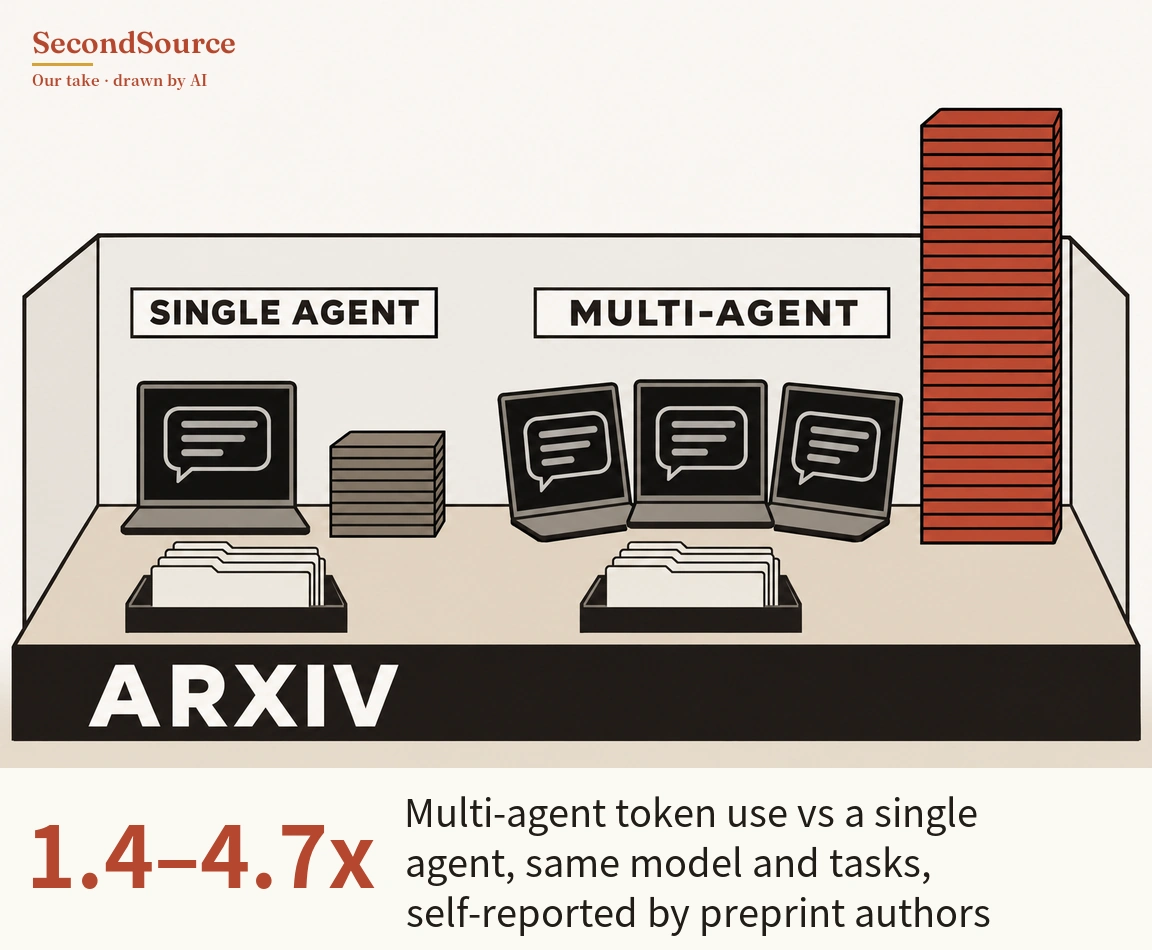
According to the paper's abstract, the only setup that significantly beat a single agent was a redesigned multi-agent implementation, a result the authors report and no one else has repeated. That setup's task success rate was 75.6%, against 67.4% for a single agent. The authors ran eight configurations of four designs on 13 enterprise standard operating procedures. Coordinated configurations had 2.6 to 5.8 times the latency of a single agent. The setup with a high-quality skill library reached 73.1%, and the one with a poor skill library fell below 67.4%. The abstract doesn't say which model was used (arXiv 2611.12953, 2026-11-07). How we checked →
Source and checks
This item ran in the brief of Nov 11, 2026, alongside 15 other items. How we checked it, the quote checks and what was still missing that day are on that issue's How we checked page.
Cite this item
SecondSource (2026). "A preprint holds model, tasks and tools fixed and changes only the agent architecture; multi-agent setups use 1.4 to 4.7 times the tokens of a single agent, mostly with no significant difference in success rate.." https://secondsource.io/en/research/2026-11-11-2/. Accessed access date.