This quarter · arXiv preprint, October 2026
SAFARI pushes HBM2 power 23.6% past JEDEC; HBM3E is untested
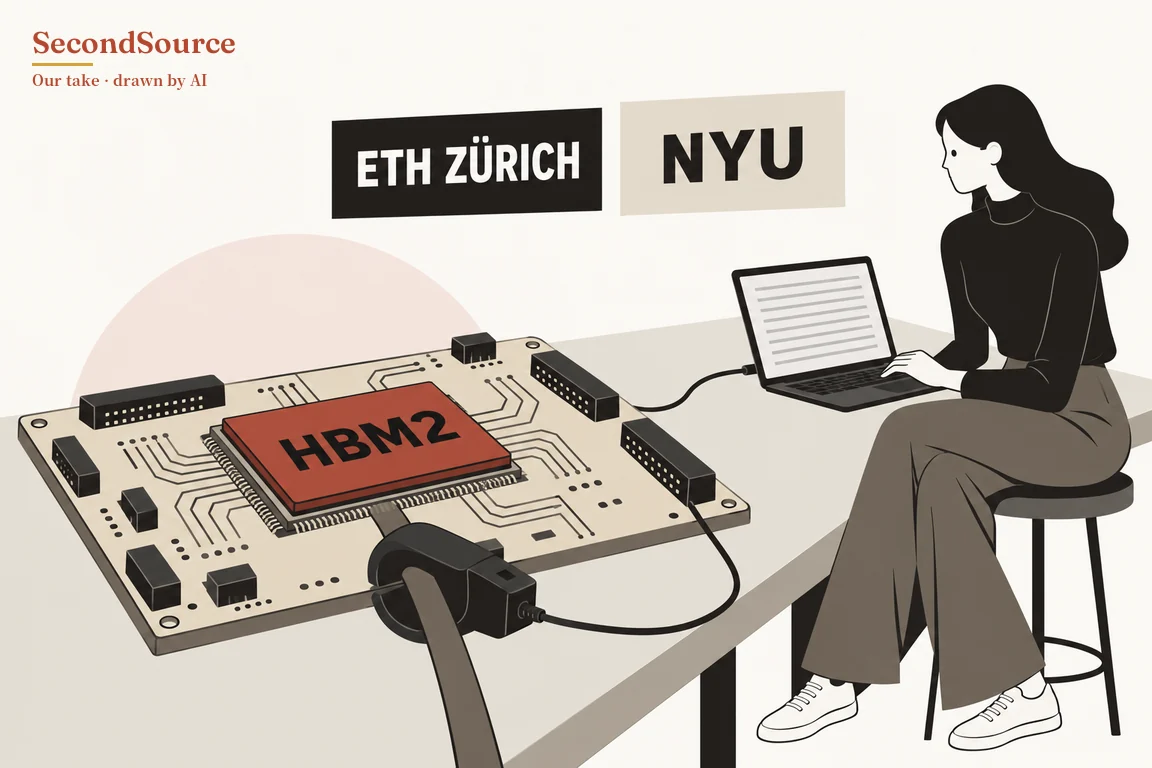
ETH Zürich and NYU's SAFARI group test 36 HBM2 chips and find an access pattern that draws 23.6% more power than the highest-power measurement loop in the JEDEC memory standard, averaged across the 36 chips. The abstract says: "we engineer an access pattern that yields 23.6% higher power consumption on average across 36 tested HBM2 chips than the highest-power-consuming JEDEC-specified current measurement loop" (arXiv 2610.14244). In a second comparison, toggling the bus signals of every bank group draws 29.4% more than holding them constant. The authors validated their new power model against three NVIDIA H200s, with errors of 2.4% to 5.3%. Only HBM2 was tested, not HBM3E or HBM4. The abstract doesn't say whose chips the 36 are or at what temperature and frequency they were measured, and the full paper hasn't been reviewed. Our reading: for HBM2, a deliberately designed access pattern can exceed the power of JEDEC's measurement loops. The abstract doesn't answer whether real workloads come close to that level, or whether HBM3E and HBM4 behave the same way. How we checked →
Source and checks
This item ran in the brief of Oct 16, 2026, alongside 19 other items. How we checked it, the quote checks and what was still missing that day are on that issue's How we checked page.
Cite this item
SecondSource (2026). "SAFARI pushes HBM2 power 23.6% past JEDEC; HBM3E is untested." https://secondsource.io/en/news/2026-10-16-7/. Accessed access date.