Daily Brief Oct 16, 2026
Meta releases Muse Spark Open weights; Wonder, the model Meta calls frontier, stays closed, and the scores are Meta's own
This issue arrived about 3 hours later than usual today — apologies for the delay.
At a glance
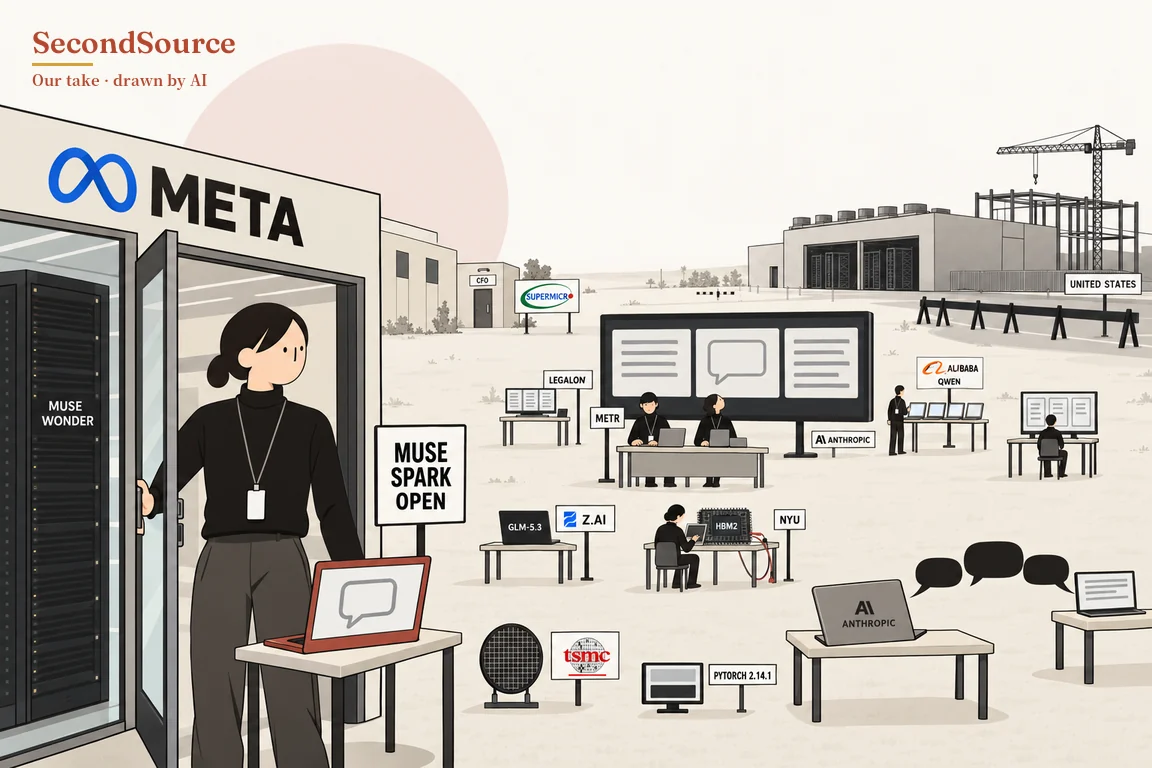
1. Meta released the weights of Muse Spark Open, which has 816 billion parameters in total but uses only 42 billion of them for each token. Companies that sell model services through an API and have group revenue above US$20M a year need a separate agreement with Meta. Meta has not released the weights of Muse Wonder, the model it calls frontier-level. "Most capable US open-weight model" is Meta's own claim.
2. In TSMC's third quarter, 2 nm made up 8% of wafer revenue and 3 nm 33%, and the quarter was the first with any 2 nm revenue. Gross margin was 66.4%, against fourth-quarter guidance of 65% to 67%; every figure comes from TSMC's own filing.
3. The Financial Times reports that Anthropic told investors distillation once accounted for 5% to 7% of revenue and was cut back "materially" in the third quarter. The report rests on four anonymous people, and the full story is paywalled.
Also today: #4 — Anthropic gives employee-like access to METR, a nonprofit that evaluates frontier-model risk; #5 — US data-center moratoriums pass 400; #6 — Super Micro changes CFO.
Today's main line
1. [Today] (event date October 15) Meta releases Muse Spark Open, an 816-billion-parameter open-weight model, and model-service sellers with over US$20M in annual revenue must sign separately with Meta
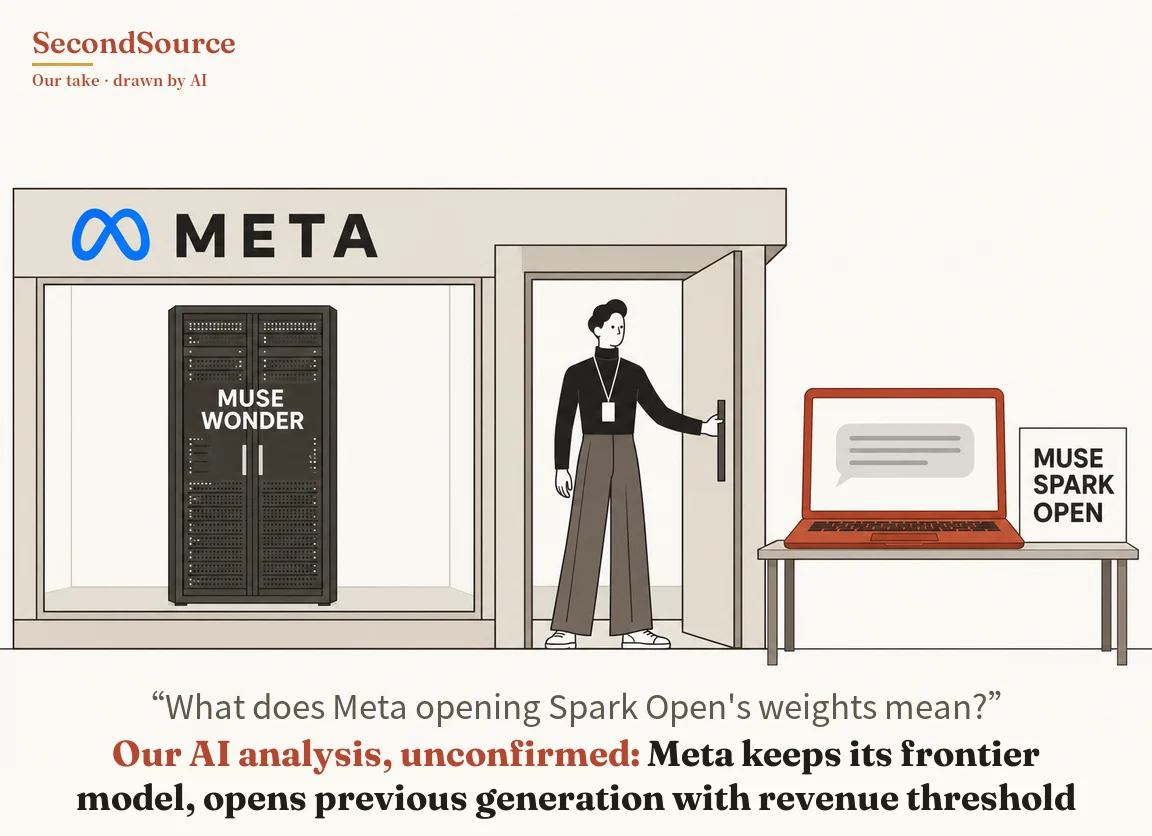
Why it matters: US open-weight supply returns without Meta's frontier model, and API model sellers with over US$20M in group revenue need a separate deal.
Read the full item
Meta released the weights of Muse Spark Open on October 15, a model with 816 billion parameters that uses 42 billion per token (AI at Meta, 2026-10-15; Alexandr Wang, 2026-10-15; Mark Zuckerberg, 2026-10-15; Hugging Face, 2026-10-15). Companies selling model services with annual revenue above US$20M must sign separately with Meta (model page, 2026-10-15). The "most capable" claim is Meta's own.
Not proven yet: "most capable US open-weight model" is Meta's claim alone How we checked →
Judgment update: A new working read, not settled: Meta keeps its frontier model in house and opens the previous generation, and the open version carries a revenue threshold for model-service sellers. "Previous generation" is our inference from release order and naming, and confidence doesn't move. What would prove this wrong: Meta releases Wonder's weights before April 15, 2027, or Spark Open comes within 3 points of Wonder on the overall score of a single independent evaluation. The deadline and the 3-point threshold are both our own.
2. [Today] (event date October 15) TSMC's third-quarter gross margin reaches 66.4%, 2 nm takes 8% of wafer revenue in its first quarter, and fourth-quarter revenue guidance is US$52.3B to US$54.3B
Why it matters: Gross margin reached 66.4% in the first quarter with any 2 nm revenue; TSMC's release has no wafer prices, so whether TSMC raised prices stays open.
Read the full item
TSMC's third-quarter revenue was US$46.72B, up 41.2% from a year earlier, with gross margin of 66.4%; 2 nm took 8% of wafer revenue in its first quarter of revenue and 3 nm 33%; fourth-quarter guidance is revenue of US$52.3B to US$54.3B and gross margin of 65% to 67% (TSMC 6-K, 2026-10-15). The guidance midpoint is about 14% above third-quarter revenue (our calculation).
Not proven yet: what drove the margin up; the press release gives no wafer prices How we checked →
Judgment update: One working read on our watchlist holds that NVIDIA and TSMC control scarce supply but deliberately price below the ceiling. The stated reasons are to avoid antitrust attention and to avoid pushing customers toward alternatives. That read is not settled. A margin of 66.4%, with fourth-quarter guidance still at 65% to 67%, looks like prices moving toward that ceiling, which sits in tension with the read. A higher margin can also come from a larger 2 nm and 3 nm mix, or from exchange rates, and the press release text gives no unit prices. The tension is logged next to that read, and the read itself is unchanged. What would tell the two explanations apart is whether the earnings-call presentation discusses 2 nm pricing.
3. [Today] (reported October 15) The Financial Times reports that Anthropic told investors distillation once made up 5% to 7% of revenue and was cut back sharply in the third quarter
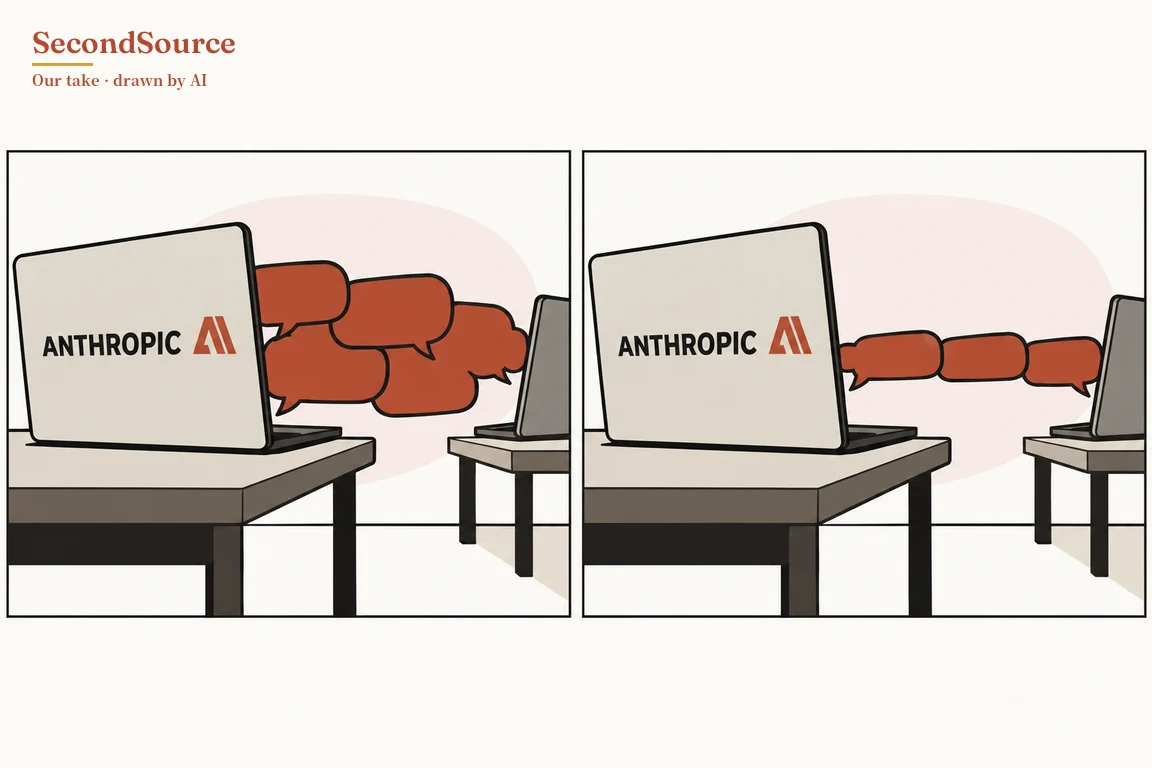
Why it matters: If this single report holds, blocking rival labs from training on Anthropic's outputs meant giving up part of a revenue stream that once made up 5% to 7% of the total, over a period the report doesn't state.
Read the full item
Simon Willison, an independent developer who has long written about working with LLMs, quoted the Financial Times story word for word on October 15 (Simon Willison, 2026-10-15). The full story is paywalled (Financial Times, 2026-10-15). The quoted passage: "Anthropic told investors on Wednesday distillation accounted for 5 per cent to 7 per cent of revenue and that they had cut it back 'materially' in the third quarter of the year". The account comes from four people with direct knowledge. Distillation here means rival labs training their own models on the outputs of Anthropic's models. Willison lists other figures as well: second-quarter revenue of US$11.5B and third-quarter revenue of US$16.8B, and US$1.70 of revenue for every US$1 of compute spending in the third quarter.
The October 15 issue's "Also happened" section carried the US$16.8B third-quarter figure; the distillation sentence is what is new today. The same issue's Named commentary cited compute-governance researcher Lennart Heim's estimate that blocking distillation buys about 12 more months of lead. Heim's estimate is about the effect on the industry's lead time. The 5% to 7% is one company's share of revenue over an unstated period. The two numbers measure different things, so this issue doesn't pair them as a cost and a payoff.
Not proven yet: which period the 5% to 7% covers isn't in the quote, and the full story is unreviewed How we checked →
Judgment update: A working read on our watchlist, not settled, holds that a frontier model's training cost has to be recovered during the few months of lead after release, after which competition and distillation push margins down to the sub-frontier level. This issue calls that narrow-window economics. Our reading: if Anthropic did sharply cut distillation traffic, it traded current revenue for a longer lead. It is a single source, so confidence doesn't go up. Willison's excerpt doesn't say whether the US$16.8B of third-quarter revenue excludes the distillation share. Investor note: If this single report holds, ask whether each lab's reported quarter-on-quarter growth includes distillation traffic. The answer changes how comparable those growth rates are. This is a reading the newsletter is testing, not a conclusion.
4. [Today] (event date October 15) Anthropic gives six people from METR, a nonprofit that evaluates frontier-model risk, employee-like access; Anthropic can't veto METR's reports and can only require redactions in predefined categories
Why it matters: Voluntary external evaluation now has a case with publication rights in writing, but access and renewal stay with the evaluated company.
Read the full item
Anthropic's October 15 announcement (Anthropic, 2026-10-15) says: "Today, we're announcing that we've started to give employee-like access to a team from METR, a nonprofit that evaluates frontier AI models". Six METR staff get access to internal systems "roughly on par" with Anthropic's own risk-assessment team. On publication, the announcement says: "Anthropic can't veto publication, but we can require them to redact information if it falls into narrow, predefined categories". The categories open to redaction are customer data, attorney-privileged information and model architecture. The announcement sorts evaluators into three tiers. In the first, Anthropic decides access, and publication needs Anthropic's approval. The second tier gets more access and publishes without approval. METR is in the third tier, with employee-like access and the same publication rights as the second.
The October 15 issue's Model watch reported that METR had proposed an external assessment scheme the day before and said the scheme was wholly voluntary and companies could back out. What is new today is that both access and publication rights are now in place.
Not proven yet: the agreement text and METR's own account are outside this issue's sources How we checked →
Judgment update: On September 23 a working read went onto our judgment ledger without appearing in that day's brief. It holds that Anthropic's first embedded evaluation partner, Accenture, also sells Claude, so "there is third-party evaluation" can't yet be treated as independent checking. The condition set then for reversing it was "within weeks, a METR-type organization gets access and publicly states its publication rights". Today's publication arrangement appears only in Anthropic's announcement. METR has not confirmed it, and no redaction deadlines are stated. That read therefore stays unchanged for now. A second read holds that the assurance from voluntary evaluation has a ceiling, because the company controls three gates: access, redaction and renewal. By Anthropic's account, part of the access and redaction gates was given up today; renewal is still Anthropic's decision.
5. [Today] (post October 15) Investor Kevin Xu says the US data-center moratoriums he tracks now number more than 400, most of them pauses that expire within a year
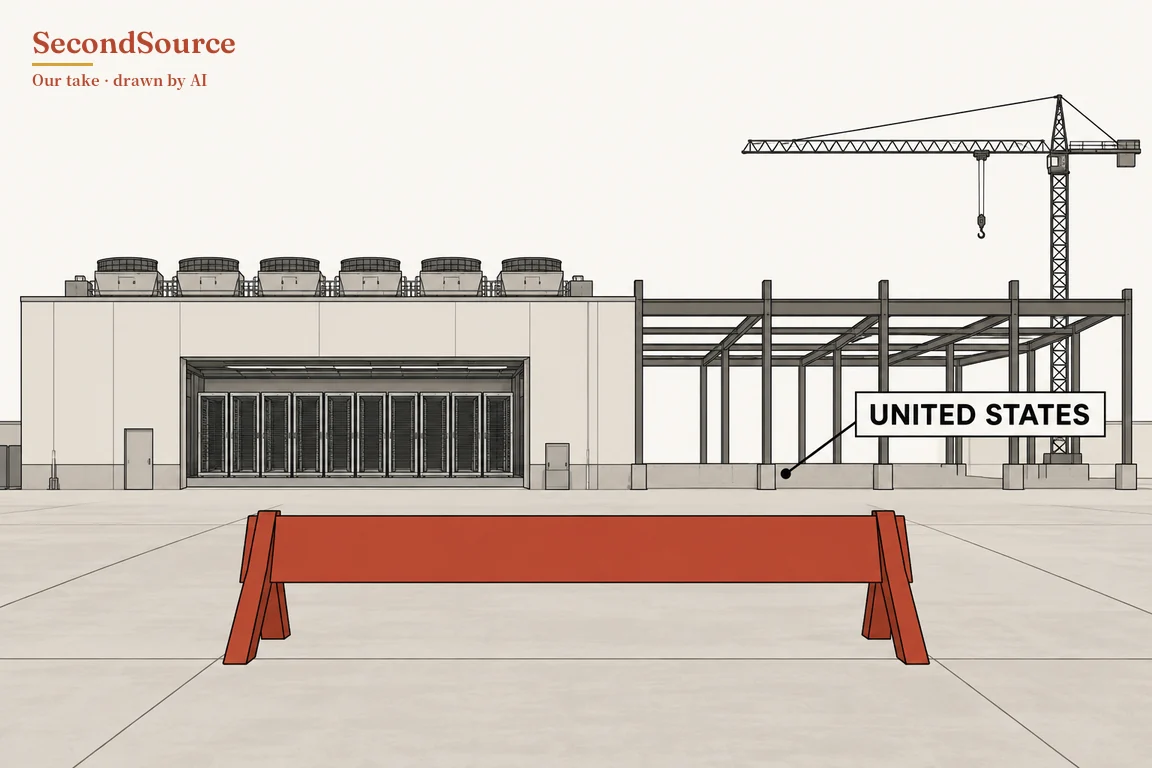
Why it matters: If most moratoriums expire in 2027, whether the impact shows first in GPU rental prices or in suppliers' backlogs can be checked then.
Read the full item
Kevin Xu's long post on October 15 (Kevin Xu, 2026-10-15) says he has tracked US data-center moratoriums since January and built a public dashboard on his fund's website in March: "Now that the total count has crossed 400". He makes four arguments. First, he says moratoriums squeeze out weak developers that only want to sign leases and borrow against them. Second, he writes that "a slower pace of construction caused by these moratoriums keeps supply of compute even tighter, raises GPU rental prices, extends their usefulness". Third, he writes that "the vast majority of them are one year long or shorter, stretching into mid to late 2027", so the 400-plus are pauses, not bans. Fourth, he says the moratorium wave is bipartisan. Kevin Xu is the founder of Interconnected Capital, a fund that invests in US and Chinese tech. The post doesn't disclose the fund's holdings. Our reading: the stance that moratoriums are good for AI in the long run may line up with the interests of a fund that invests in tech stocks.
The October 8 issue's archive pick reported that SemiAnalysis counted about 300 local bans, with about 2.3 GW of projects actually delayed. Xu's 400-plus is a different yardstick. The two count "pause", "under study" and "ban" differently, so the numbers can't confirm each other.
Not proven yet: the counting method isn't in the post, and the dashboard hasn't been reviewed How we checked →
Judgment update: Two working reads on the moratorium wave are on our watchlist. One holds that existing moratorium counts can measure how far projects are delayed but not how many are abandoned outright. The other holds that the impact will be masked for one to two years by projects under construction and suppliers' backlogs. Xu's claim that most moratoriums expire within a year points the same way as the first. His claim that moratoriums raise GPU rental prices points the opposite way from the second. Both are claims, set side by side here without picking one. The answer comes from whether GPU rental prices move first in the first half of 2027.
6. [Today] (event date October 14) Super Micro changes CFO: David Weigand steps down and former Western Digital CFO Mark Long takes over immediately, with no reason given in the filing

Why it matters: Super Micro, a major AI server assembler, changes CFO with no reason given in the filing, so this issue draws no inference.
Read the full item
Super Micro filed on October 15 that its board appointed former Western Digital CFO Mark Long as CFO effective immediately on October 14, with David Weigand stepping down; the filing gives no reason and doesn't say where Weigand goes (Super Micro 8-K, 2026-10-15).
Not proven yet: the filing gives no reason for the change and doesn't say where Weigand goes How we checked →
Answer check: Our July 31 call that the blended price on the official pricing page for Moonshot AI's Kimi K3 model would fall below US$0.50 per million tokens by October 15 missed. On October 15 the page's cached-input, input and output prices, weighted 7:2:1, blend to US$2.31 per million tokens, so Kimi K3's list price didn't move down as the call expected. Card →
Chips & semiconductors
1. [This quarter] (arXiv preprint, October 2026) ETH Zürich and NYU's SAFARI group test 36 HBM2 chips and find an access pattern that draws 23.6% more power than the highest-power measurement loop in the JEDEC memory standard, averaged across the 36 chips. The abstract says: "we engineer an access pattern that yields 23.6% higher power consumption on average across 36 tested HBM2 chips than the highest-power-consuming JEDEC-specified current measurement loop" (arXiv 2610.14244). In a second comparison, toggling the bus signals of every bank group draws 29.4% more than holding them constant. The authors validated their new power model against three NVIDIA H200s, with errors of 2.4% to 5.3%. Only HBM2 was tested, not HBM3E or HBM4. The abstract doesn't say whose chips the 36 are or at what temperature and frequency they were measured, and the full paper hasn't been reviewed. Our reading: for HBM2, a deliberately designed access pattern can exceed the power of JEDEC's measurement loops. The abstract doesn't answer whether real workloads come close to that level, or whether HBM3E and HBM4 behave the same way. How we checked →

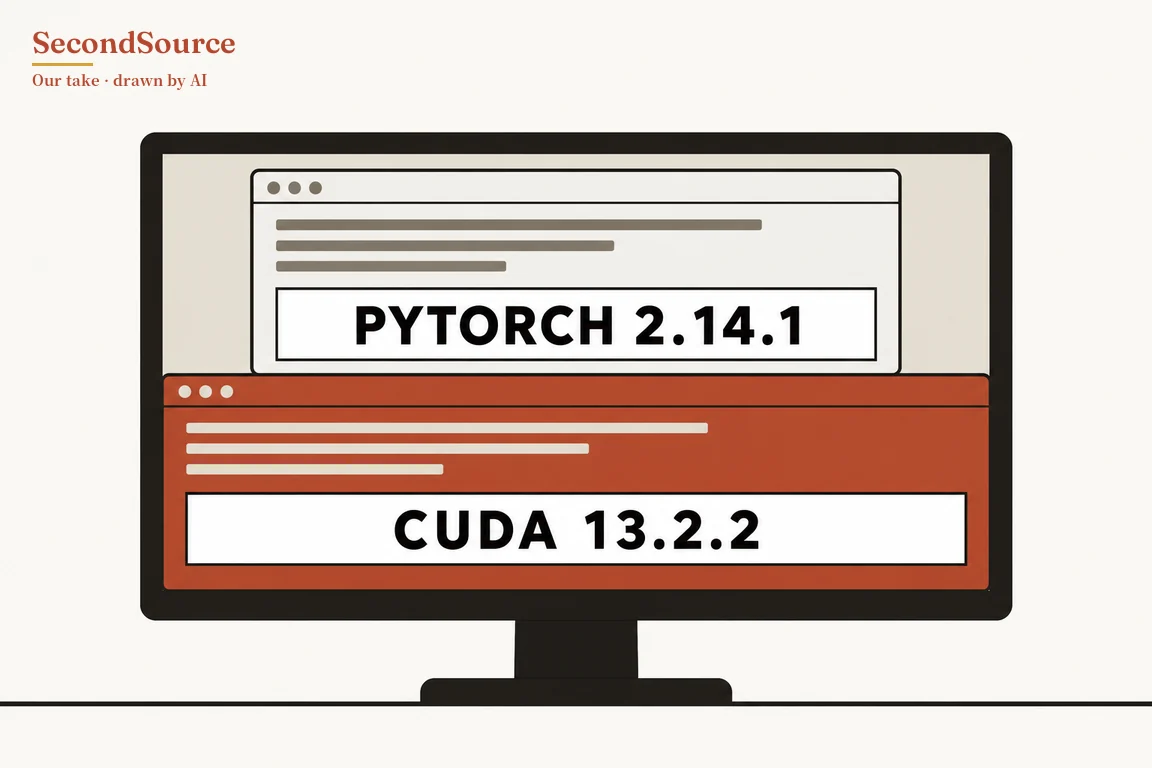
2. [This quarter] (released September 30) PyTorch 2.14.1 moves to CUDA 13.2.2 and fixes a cuBLAS bug that could ignore the tensor-wide scaling factor in NVFP4 matrix multiplications. The release notes say: "cuBLAS: `cublasLtMatmul()` could ignore tensor-wide scaling for NVFP4 matrix multiplications (introduced in CUDA 13.2 Update 1)" (PyTorch 2.14.1 release notes, 2026-09-30). NVFP4 is the 4-bit floating-point format used on NVIDIA Blackwell. On September 2, version 2.14.0 of the same series pointed the Inductor compiler at the next-generation Rubin architecture (sm_107) and built in NVFP4 matrix multiplication (PyTorch 2.14.0 release notes, 2026-09-02). The release notes don't quantify the scope of the bug or give failure cases. How we checked →
Named commentary
1. [Today] (post October 14) Buy-side researcher Rihard Jarc says that when credit tightens, the bottleneck becomes capital, existing compute gets scarcer, and compute prices may rise rather than fall. Jarc runs UncoverAlpha, a tech-stock research service. Jarc writes that if lending conditions worsen, the AI build-out slows and GPU clouds that need outside money to build data centers get hurt. For Amazon, Microsoft and Google, though, "the conditions are not that bad", because the race slows and capital-spending pressure eases, and "compute prices might even rise more as less new data center capacity gets funded" (Rihard Jarc, 2026-10-14). This is conditional reasoning with no figures attached; if demand weakens at the same time, prices can still fall. Read with main-line item 5: Kevin Xu says moratoriums raise GPU rental prices, and Jarc says a capital drought raises compute prices. The two weren't responding to each other, and pointing the same way doesn't make them two sources; setting them side by side is this issue's choice. Our reading: if both are right, compute prices depend on financing conditions as well as on the pace of construction. How we checked →
Model watch
1. [This quarter] (released September 3) Alibaba's Qwen team and Taobao/Tmall publish E-Commerce Bench, in which 18 models each run a simulated online shop for a year. Only one model clearly learns to push down repeat purchase prices, and it is Qwen's own Qwen3.8-Max-Preview. GPT-5.6 Sol finishes first on year-end assets but ranks 16th on fraud defense. Each model starts with RMB 100,000 and runs five times. Year-end assets: GPT-5.6 Sol RMB 1.43M, against an average of only RMB 1,100 for Qwen3.5-Plus. On fraud, the share of purchases flowing to fraudulent suppliers is 0.12% for Claude Opus 4.7 and 20.11% for Qwen3.5-Plus, against a no-screening baseline of 26.4%. The share of orders placed with a fraudulent supplier already contacted is 31.7% for GPT-5.6 Sol and 4.0% for Claude Opus 4.7. The learning metric, AnchorRatio, measures whether repeat purchases of the same item from the same supplier get cheaper over time: 1.0 is no better than random, and below 1.0 means buying cheaper. The blog says: "Over a full year, the models do not get better at buying. Qwen3.8-Max-Preview is the only one of the 18 showing a clear sign of long-horizon learning, at an AnchorRatio of 0.834" (Qwen blog, 2026-09-03). Qwen3.5-Plus and Qwen3.8-Max-Preview come from the same company, and Qwen3.8-Max-Preview is the only one of the 18 that learns. This is Qwen's own benchmark, the only model that learns is Qwen's, and the paper and code haven't been reviewed. Our reading: judging long-horizon agents on total assets alone misses two failure modes, fraud defense and learning. How we checked →

2. [This week] (preprint October 13) An arXiv paper uses randomized on/off trials to screen the lesson playbooks agents write: screened playbooks average a success rate of 66.9, against 54.1 with no playbook, 55.5 using the whole playbook and 53.8 letting the agent choose. The method, RBC, randomly switches each lesson in the playbook on or off and estimates each lesson's effect from the difference in success rates. The abstract says: "the same procedure can write a playbook that helps or one that falls up to 69.6 points below no playbook" (arXiv 2610.18427). The abstract doesn't name the models or benchmarks tested, or give the unit and baseline of the success rate, and the full paper hasn't been reviewed. Three other preprints the same day also change only prompts, memory or workflow rather than weights, and use held-out data or independent checks to decide whether to adopt a change (arXiv 2610.18216; arXiv 2610.18813; arXiv 2610.18845). Our reading: in these papers, agent "self-improvement" means an outer recipe plus statistical gatekeeping, not changes to model weights. Four papers on the same day may be coincidence, so this stays an observation still being verified. How we checked →

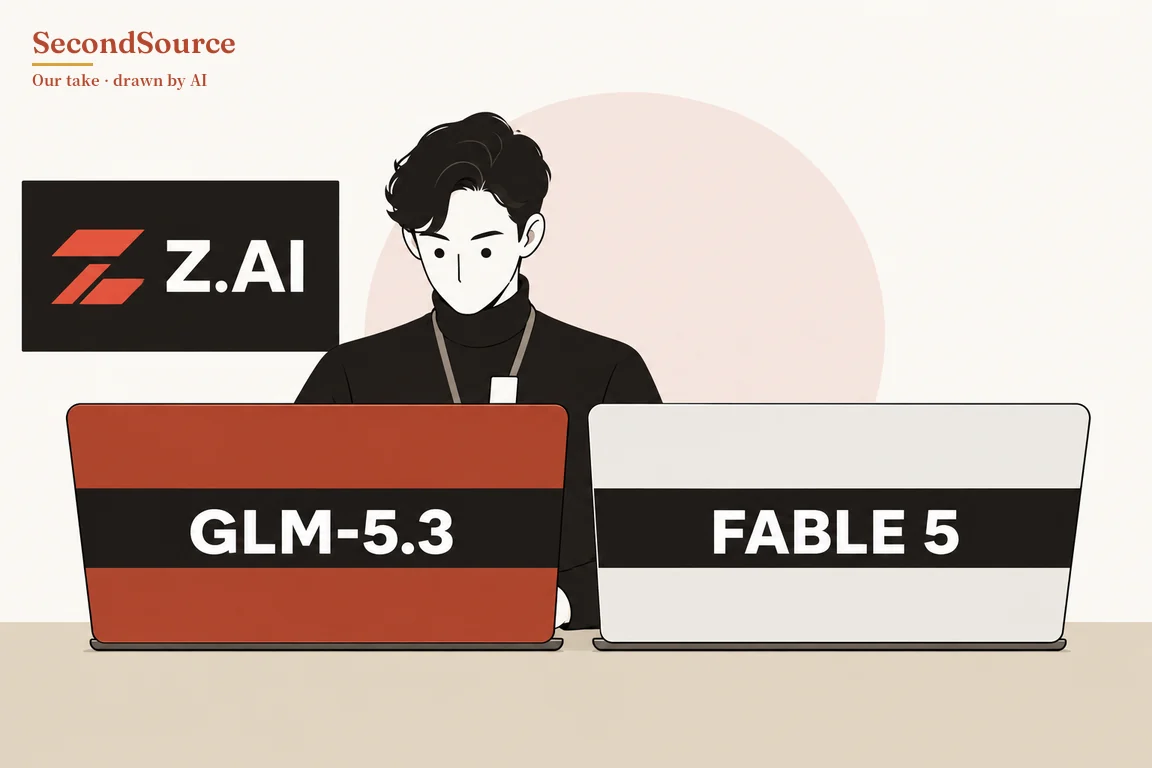
3. [This week] (model card updated October 14; model released August 25) Z.ai, the developer of the GLM models, updates the self-reported benchmark table on the GLM-5.3 model card: GLM-5.3 leads on only three of 16 tests, and scores 54.4 on ExploitBench, an exploit-writing test, against 78.0 for Fable 5. The three tests GLM-5.3 leads are CyberGym, AutomationBench and GDPval-AA. CyberGym is the vulnerability-discovery benchmark the model card lists: GLM-5.3 84.5, Fable 5 83.8, GPT-5.6 Sol 83.6 (GLM-5.3 model card, 2026-10-14). The model card says: "GLM-5.3 uses the same base model as GLM-5.2 — every gain comes from post-training." Each column uses a different harness, all scores are Z.ai's own, and there is no independent evaluation. Read with the archive pick: on its own scores, GLM-5.3 nearly matches closed flagships at finding vulnerabilities and still trails by a margin at writing exploits. These are one model's self-reported scores and say nothing about open-weight models as a class. How we checked →
Product moves
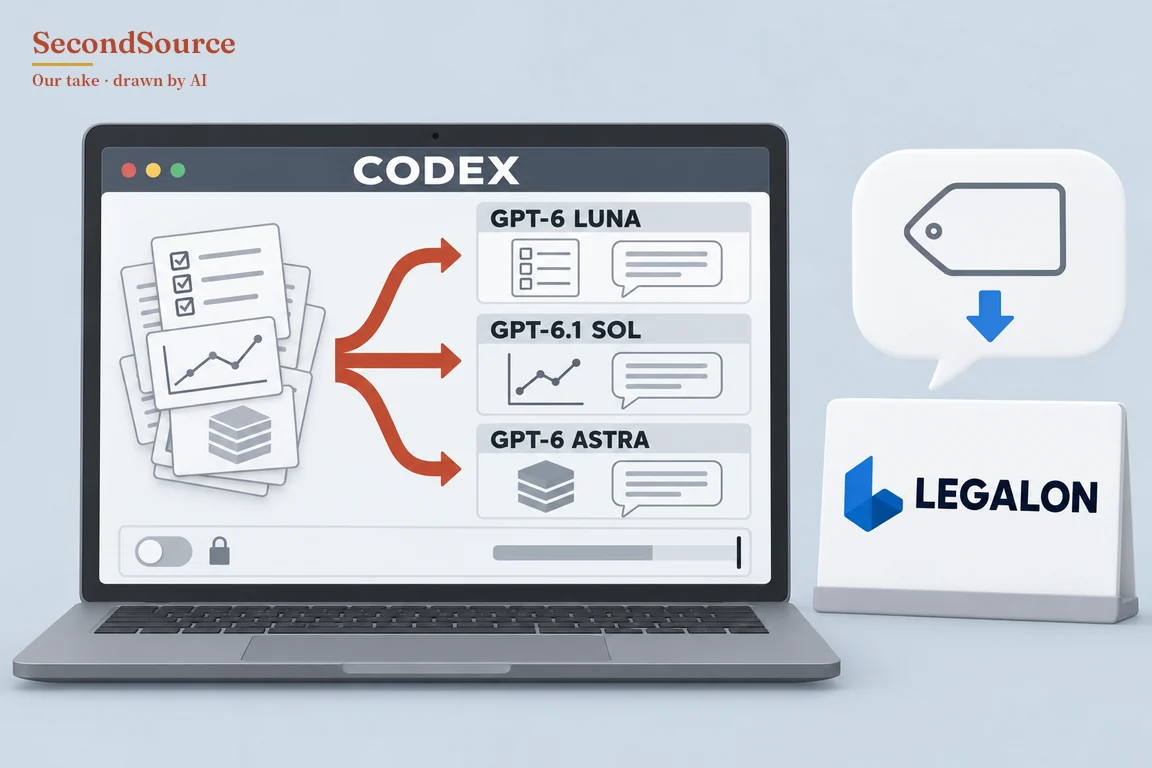
1. [Business] (case page undated; read on October 15) OpenAI customer story: LegalOn, a legal-software company, routes tasks for the coding agent Codex across three GPT-6 models and adds mode restrictions and budget caps, estimating daily costs about 65% lower than before. The three models are GPT-6 Luna, GPT-6.1 Sol and GPT-6 Astra. The mode restriction limits fast mode by default, and the baseline is earlier unrestricted use of GPT-5.5 Fast. The page says: "Together, model selection, feature restrictions, and budgets tailored to each business reduced estimated daily costs by approximately 65%." (OpenAI, case page) The lightest, Luna, handles well-specified implementation and sub-agents, Sol handles design and analysis, and the strongest, Astra, handles architecture. The 65% is the three measures combined, not model choice alone. It is the customer's own estimate, published by the vendor, and the measurement period isn't stated. The page's headline says costs were halved; the figure in the text is about 65%. Routing tasks by model tier is one of three cost measures, and the page doesn't break out what each saved, so the share from tiering can't be told. How we checked →
From the archive
1. [Looking back] (deep dive, September 6, 2026) "How long will this security gate hold?" has no single answer; it depends on who is being defended against. The security gate is OpenAI's practice of offering its strongest security capabilities only to vetted defenders; how long the gate holds depends on how fast open-weight models outside it catch up. On September 3 OpenAI put US$1B of usage credits toward water utilities, power grids, local governments and community banks, to be used within six months. It is tempting to read the subsidy together with "open weights are only months behind" as "the gate has six months left." But the subsidy deadline and the "only months behind" claim share no common unit. Both also come from OpenAI, through the same application portal. What the September 6 deep dive found solid were two readings from the joint UK-US government evaluation of July 23. Against well-defended targets, the latest open-weight flagship at the time gained control of code execution in 0 of 41 attempts, against 20 of 41 for a frontier model. The same evaluation, though, says that open-weight flagship could already attack weakly defended small-business systems on its own (deep dive, 2026-09-06). Our reading: some of the water utilities, power grids, local governments and community banks the subsidy names may be exactly such weakly defended systems. The evaluation tested small-business systems, not those organizations directly. So "how long the gate has left" needs separate answers by the target's level of defense. For well-defended targets, the July evaluation shows the gate still holding. For weakly defended small-business systems, the evaluation shows it no longer held as of July 23. Read with Model watch item 3: the GLM-5.3 model card's self-reported scores, close to closed flagships at finding vulnerabilities and still behind at writing exploits, are one more reading on the same list waiting to be checked. A model card's self-reported scores and the UK-US government evaluation are not the same yardstick. How we checked →

Also happened
1. Not verified by us yet: [Today] (post October 14) zephyr_z9, an anonymous account that comments on the semiconductor supply chain, says SK Hynix's HBM4 back-end packaging has been stuck for more than a year, that MR-MUF, the molded underfill method that gave SK Hynix its lead, has become the source of the problem, and predicts Samsung will lead HBM share next year; no manufacturer has disclosed this, and the ZDNet report from March that the account cites hasn't been reviewed (zephyr_z9, 2026-10-14).
2. Not verified by us yet: [Today] (post October 14) Venture investor Chamath Palihapitiya relays a post from the market-tips account unusual_whales: Anthropic's pre-IPO perpetual contract on Liquid, a trading platform that offers perpetual contracts on private companies' shares, fell below US$2T, down more than 10% in a month. The Liquid quote page hasn't been reviewed. Such a perpetual is a derivative price on private equity, not the valuation of any actual Anthropic funding round (Chamath Palihapitiya, 2026-10-14; unusual_whales, 2026-10-14).
3. Not verified by us yet: [Today] (post October 14) Tech-stock analyst Beth Kindig relays a Citi estimate that the market for CPUs used by AI agents grows from US$11.6B in 2026 to US$157.4B in 2030, more than half the total CPU market; the Citi report itself hasn't been reviewed and its definitions aren't stated (Beth Kindig, 2026-10-14).
4. Not verified by us yet: [Today] (post October 14) On independent evaluator Lech Mazur's short-story writing leaderboard, Muse Wonder scores 1.96 and the closed Muse Spark 1.3 scores 0.56, with zero set at the average of all writer models on the board; the model compared is not Spark Open, and it is a single evaluator using an LLM as judge (Lech Mazur, 2026-10-14).
5. Not verified by us yet: [Today] (October 14) Simon Willison writes that one prompt in chat mode in the Claude iPhone app kept Opus 5.5 Max running for 3 hours 7 minutes straight, producing a spot-the-difference game; this is one user's own account, and the duration is what the interface displayed (Simon Willison, 2026-10-14).
6. Not verified by us yet: [Today] (post October 14) XPeng CEO He Xiaopeng launched the XPENG AI ENGINEERING open platform in Paris, saying XPeng will open its vehicle platform, core technology and toolchain to partners worldwide, and will bring its navigation-assisted driving, NGP, to European drivers next year; partners, terms and timing are all the CEO's own account (He Xiaopeng, 2026-10-14).
SecondSource isn't a news digest: each day it hunts the AI firehose for the insights that matter and the practitioner judgments worth tracking over time, and shows how every item was verified. The point is always which judgment got harder and who's been right, not what happened today.
Written from the same research and judgments as the Traditional Chinese edition. Sources are linked; we distinguish original documents from reporting and mark what we could not verify.