Today · filing, October 26
Anthropic compute owed regardless of use; S-1 omits schedule
Anthropic's filing shows its Amazon, Google and Microsoft compute deals must be paid whether used or not, while 80% of revenue is usage-based (deep dive)
Our AI analysis, unconfirmed: When revenue can't cover the compute bills, Anthropic's cash fills the gap first and the suppliers come after, by SecondSource's reading of the terms Check back when when an amended S-1 discloses the year-by-year payment schedule for contract obligations
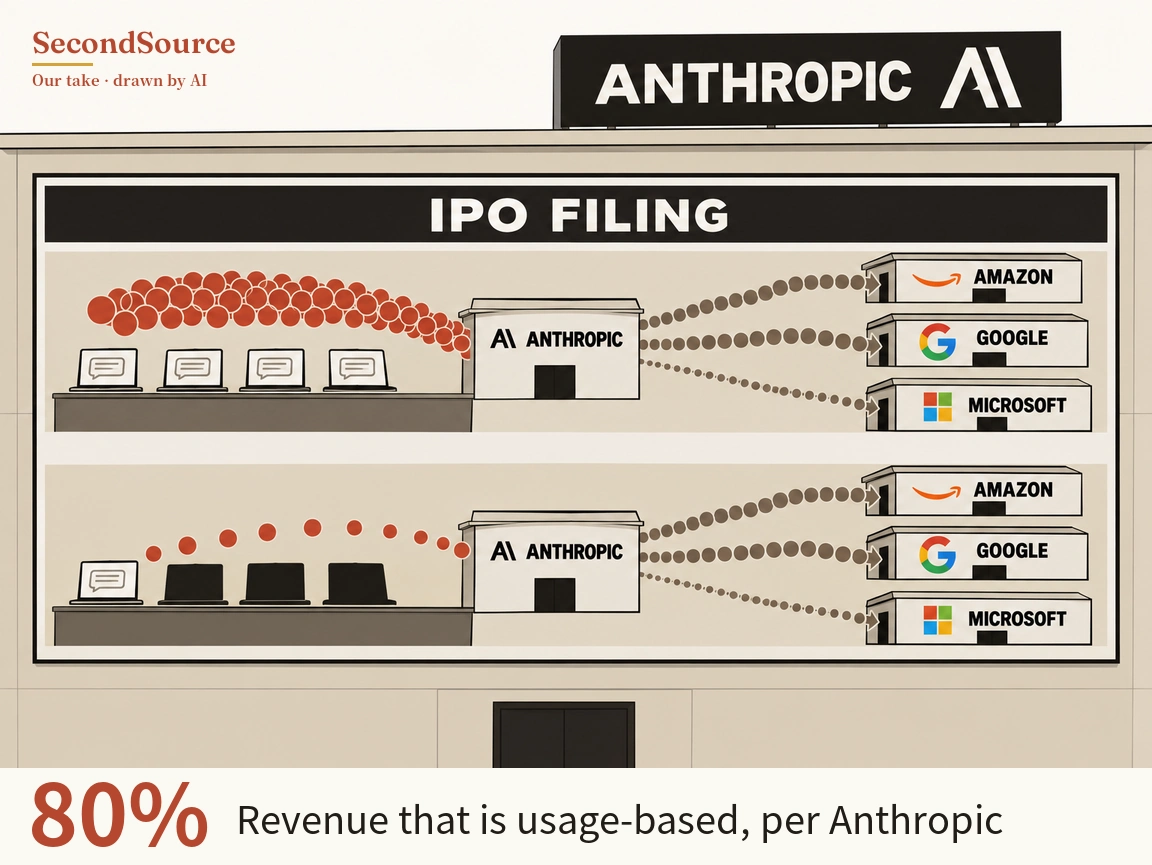
Why it matters: Anthropic's compute bills have fixed minimums, but most of its revenue moves with usage. By SecondSource's reading of the terms, Anthropic's own cash, and so its shareholders, covers any gap before the suppliers do.
Anthropic filed its S-1 IPO registration statement on October 26 (SEC EDGAR, 2026-10-26). It sets floors on three cloud compute contracts: at least US$110.0 billion with Amazon, at least about US$114.5 billion with Google and at least US$44.9 billion with Microsoft, all owed "regardless of actual usage." The Amazon and Google contracts also require Anthropic to pay the difference if its spending falls short. 80% of Anthropic's first-half 2026 revenue was usage-based. Tomasz Tunguz of Theory Ventures added up seven of the contracts to US$637 billion (Tunguz, 2026-10-26); the S-1 gives no total, and Tunguz labels the sum his own arithmetic.
Not proven yet: the first S-1 doesn't list how much is due in each year How we checked →
A leaked draft relayed by the press in late September put the compute commitments at about US$518 billion, about 80% of them non-cancellable (TechCrunch, 2026-09-28). The filing's two relevant parts add up to about US$510 billion (our calculation). The first part is about US$265.6 billion of fixed or minimum commitments as of June 30. The second is about US$245 billion of minimum payments under contracts signed or amended after that date. The two parts are computed differently and may overlap, so their sum is a rough scale only. It isn't evidence that the filing matches the leaked draft. The filing gives no "about 80%" share.
Judgment update: SecondSource's October 21 deep dive held that if revenue fell short, the only parties outside Anthropic that might book a loss were Broadcom and Amazon. Checked against the S-1, the order in which parties absorb a revenue shortfall needs rewriting. The three cloud contracts are owed regardless of usage, and the Broadcom rack leases can't be cancelled before they end, yet 80% of first-half revenue moves with usage. So Anthropic's own cash covers any revenue shortfall first. At the end of June, Anthropic held about US$131.7 billion in cash and short-term investments, and in September it added a US$15 billion revolving bank credit line.
Broadcom has agreed to lend up to US$42 billion and Google to provide up to US$20 billion. These are financing commitments Anthropic can draw on if it runs short of money, but their terms depend on revenue. If growth falls below a threshold, the annual rate on the Broadcom loan rises from 9% to 13%. The price at which that loan converts into Anthropic shares drops from a 10% discount to market to a 15% discount, and lending stops if Anthropic keeps missing the threshold.
Our reading: at least while cash plus revenue can cover the bills, the cost of a revenue shortfall lands first on Anthropic's shareholders. What would prove this wrong: an amended S-1 showing that the suppliers' financing keeps flowing on the same terms when revenue falls short. The amended filing should settle two things: the year-by-year payment table and the offering price range. Full deep dive
Investor note: If the order SecondSource reads from the terms holds, buyers of the IPO shares carry not only the question of whether growth keeps up but also the gap that opens when bills come due ahead of revenue; the suppliers are exposed only after that, if Anthropic can no longer pay.
Source and checks
This item ran in the brief of Oct 27, 2026, alongside 12 other items. How we checked it, the quote checks and what was still missing that day are on that issue's How we checked page.
Cite this item
SecondSource (2026). "Anthropic compute owed regardless of use; S-1 omits schedule." https://secondsource.io/en/news/2026-10-27-1/. Accessed access date.