SecondSourceJudgment rebuilt from primary sources

Anthropic owes for idle compute; yearly sums aren't listed
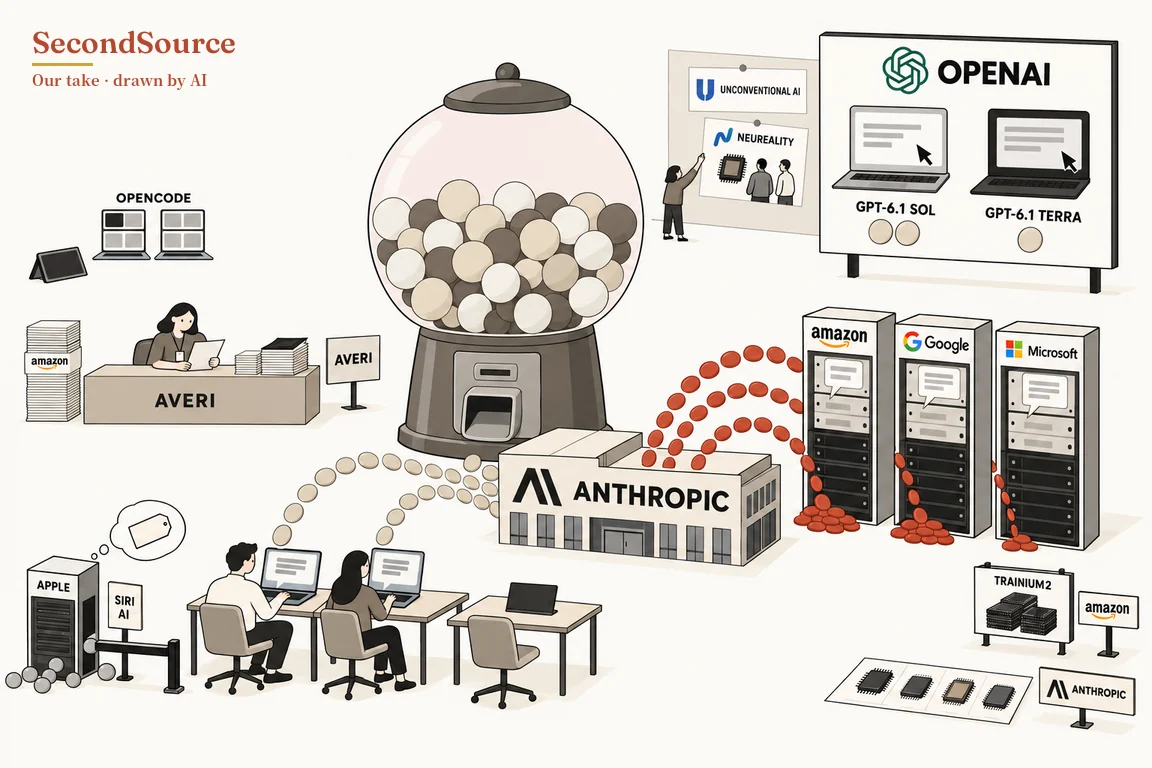
Today's front-page cartoon: one single picture that brings together today's stories.

At a glance

1. Anthropic's IPO filing shows it owes Amazon at least US$110 billion for compute whether or not the capacity is used, and its Google and Microsoft deals carry the same clause. Meanwhile, 80% of Anthropic's first-half 2026 revenue rises and falls with usage. The filing doesn't list the year-by-year payments (deep dive).

2. OpenAI prices GPT-6.1 Terra at US$1 per million input tokens and US$5 per million output tokens and says that is 50% below GPT-5.6 Terra; every capability figure is OpenAI's own.

3. AVERI, a nonprofit that pushes for third-party AI audits, reviewed 800 safety test prompts that Amazon drew from its internal test set and concluded that some model refusals may be set off by surface wording; Amazon says it is making four changes to the test set.

Today's main line

1. [Today] (filing, October 26) Anthropic's filing shows its Amazon, Google and Microsoft compute deals must be paid whether used or not, while 80% of revenue is usage-based (deep dive)

Our AI analysis, unconfirmed: When revenue can't cover the compute bills, Anthropic's cash fills the gap first and the suppliers come after, by SecondSource's reading of the terms Check back when when an amended S-1 discloses the year-by-year payment schedule for contract obligations
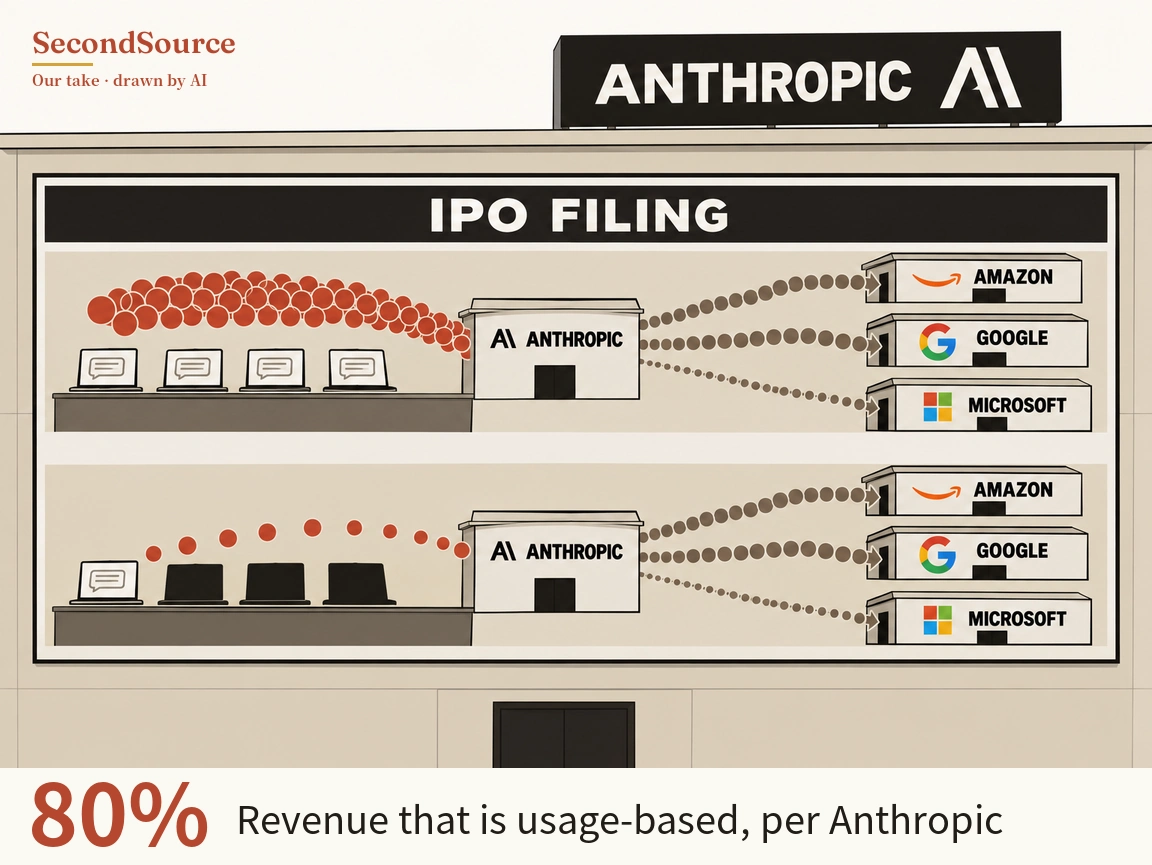
Concept illustration: a building topped by a black sign lettered ANTHROPIC has a large wall panel headed IPO FILING, split into two rows; in the top row, four laptops showing speech-bubble icons sit on a counter at left, and a dense stream of many red dots flows from them into a small central building lettered ANTHROPIC, from which three arrowed lines of grey dots run to three small buildings at right lettered AMAZON, GOOGLE and MICROSOFT. The bottom row repeats the layout, but only one laptop shows a speech-bubble icon while the other three have dark screens, and only a sparse line of a few red dots reaches the ANTHROPIC building, while the same three grey dotted lines still run to AMAZON, GOOGLE and MICROSOFT.
Anthropic's IPO filing commits Anthropic to minimum payments on three cloud compute contracts with Amazon, Google and Microsoft even if the capacity goes unused, while the filing shows 80% of Anthropic's first-half 2026 revenue was usage-based. Our read of the terms: when revenue can't cover the compute bills, Anthropic's cash fills the gap first, and the suppliers are exposed only after that. The first version of the filing doesn't say how much is due in each year.

Why it matters: Anthropic's compute bills have fixed minimums, but most of its revenue moves with usage. By SecondSource's reading of the terms, Anthropic's own cash, and so its shareholders, covers any gap before the suppliers do.

Read the full item → How we checked →

2. [Today] (launch, October 26) OpenAI launches GPT-6.1 Terra as a mid-priced tier for computer use; every capability figure is OpenAI's own

Our AI analysis, unconfirmed: OpenAI is pitching computer use at a mid-priced tier, and only OpenAI's figures show whether a task now costs less Check back when when a third party measures cost per task on the same computer-use tasks
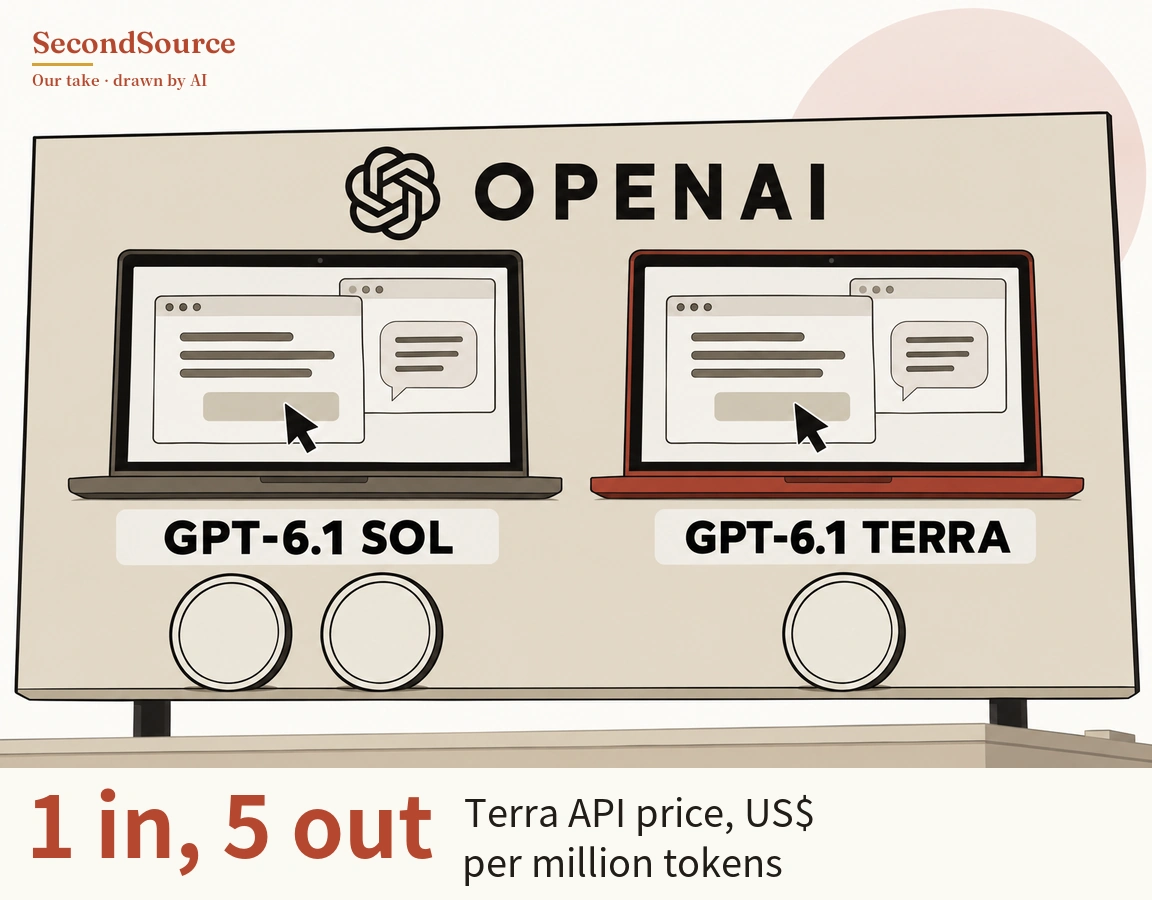
Concept illustration: a large billboard on posts above a rooftop is lettered OPENAI in black beside an interlaced knot-shaped symbol, with a pale pink circle behind its top-right corner. On it, two open laptops sit side by side, a dark grey one on the left labelled GPT-6.1 SOL and a red one on the right labelled GPT-6.1 TERRA; each screen shows two overlapping windows, one with grey text lines and a button with a mouse pointer on it and one with a speech bubble, and there are two blank round discs below the left label and one below the right.
OpenAI launched GPT-6.1 Terra as a mid-priced tier for computer use, with a standard API price of US$1 per million input tokens and US$5 per million output tokens; every capability figure is self-reported by OpenAI. OpenAI writes that GPT-6.1 Terra brings cost per task down to about one-ninth of Claude Opus 5.5's, at max reasoning effort on Agents' Last Exam, a set of professional tasks that OpenAI built and measured. Our read: whether enterprises switch tiers turns on cost per task, not the per-token list price.

Why it matters: OpenAI is pitching computer use at a mid-priced tier. Teams choosing an agent model can't yet tell whether a task really costs less, because only OpenAI has measured it.

Read the full item → How we checked →

3. [Today] (post, October 26) AVERI reviewed 800 prompts from Amazon's internal AI safety test set and found some refusals may hinge on surface wording; Amazon is changing four things

Our AI analysis, unconfirmed: An outside review of Amazon's safety tests is a new format, but Amazon still controls the sample and the fixes Check back when when AVERI publishes its full report or a second company opens a similar review
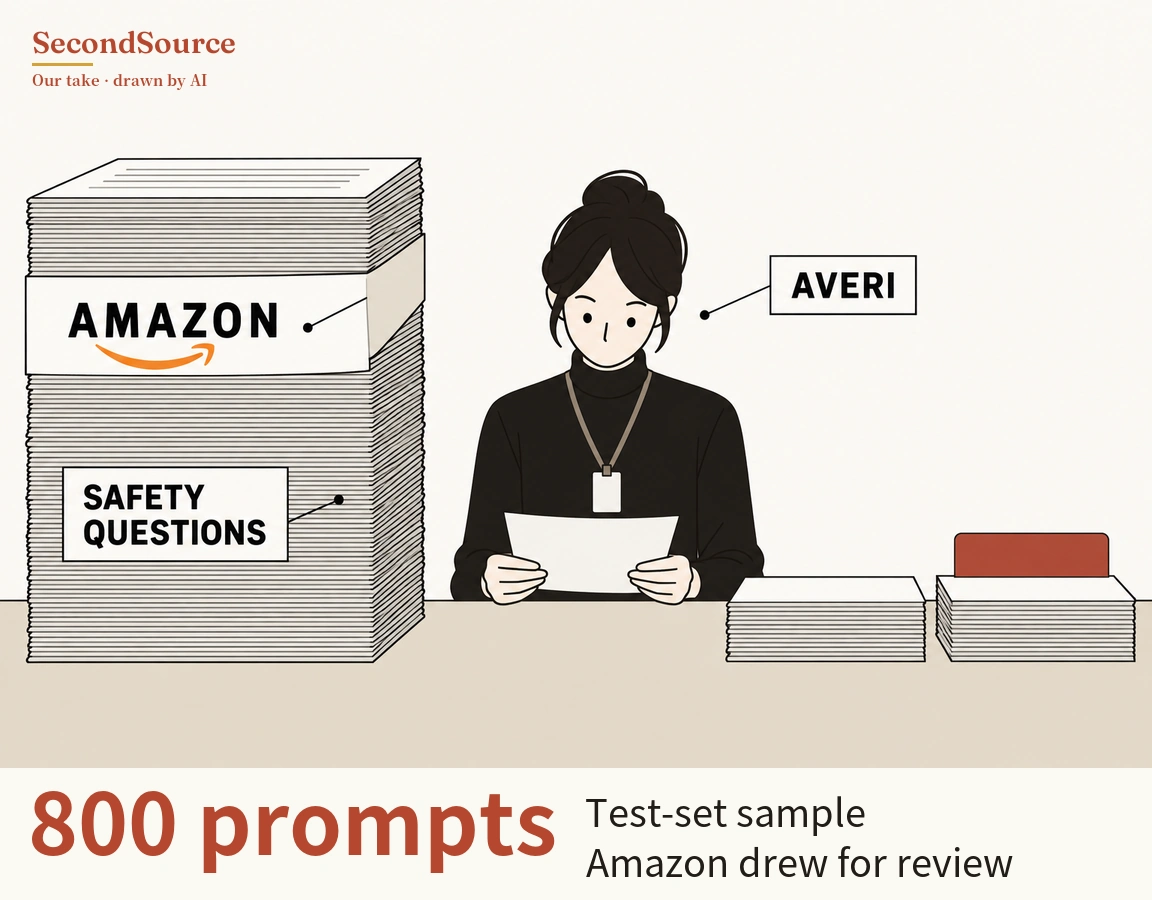
Concept illustration: on the left of a desk stands a tall stack of papers wrapped by a band lettered "AMAZON" with an orange curved line under the letters, and a label reading "SAFETY QUESTIONS" points to the stack by a line; in the centre a person with dark hair in a bun, a black turtleneck and a badge on a lanyard holds a sheet of paper in both hands, with a label reading "AVERI" pointing to them by a line. On the right of the desk are two shorter stacks of papers, the rightmost one topped by an upright red rectangular block.
AVERI, a nonprofit that pushes for third-party AI audits, reviewed 800 prompts from Amazon's internal safety test set and found some refusals may hinge on surface wording rather than safety reasoning. Amazon responded with four changes: removing redundant prompts and adding harder ones, grading prompts by difficulty, expanding multilingual coverage across all categories and reviewing the test set every quarter. The review covered only the prompts, not any model, with Amazon choosing the sample, describing the fixes and holding approval rights over publication.

Why it matters: An outside group examined Amazon's safety tests and published the weaknesses. Amazon chose the 800 prompts, described the fixes and had approval rights over publication, so the review says little about how safe Nova 2 is.

Read the full item → How we checked →

Chips & semiconductors

1. [Today] (announced October 26) Unconventional AI, a startup founded by former Databricks executive Naveen Rao to build AI chips on an unconventional architecture, has agreed to acquire NeuReality, an Israeli AI inference chip company; the price wasn't disclosed.
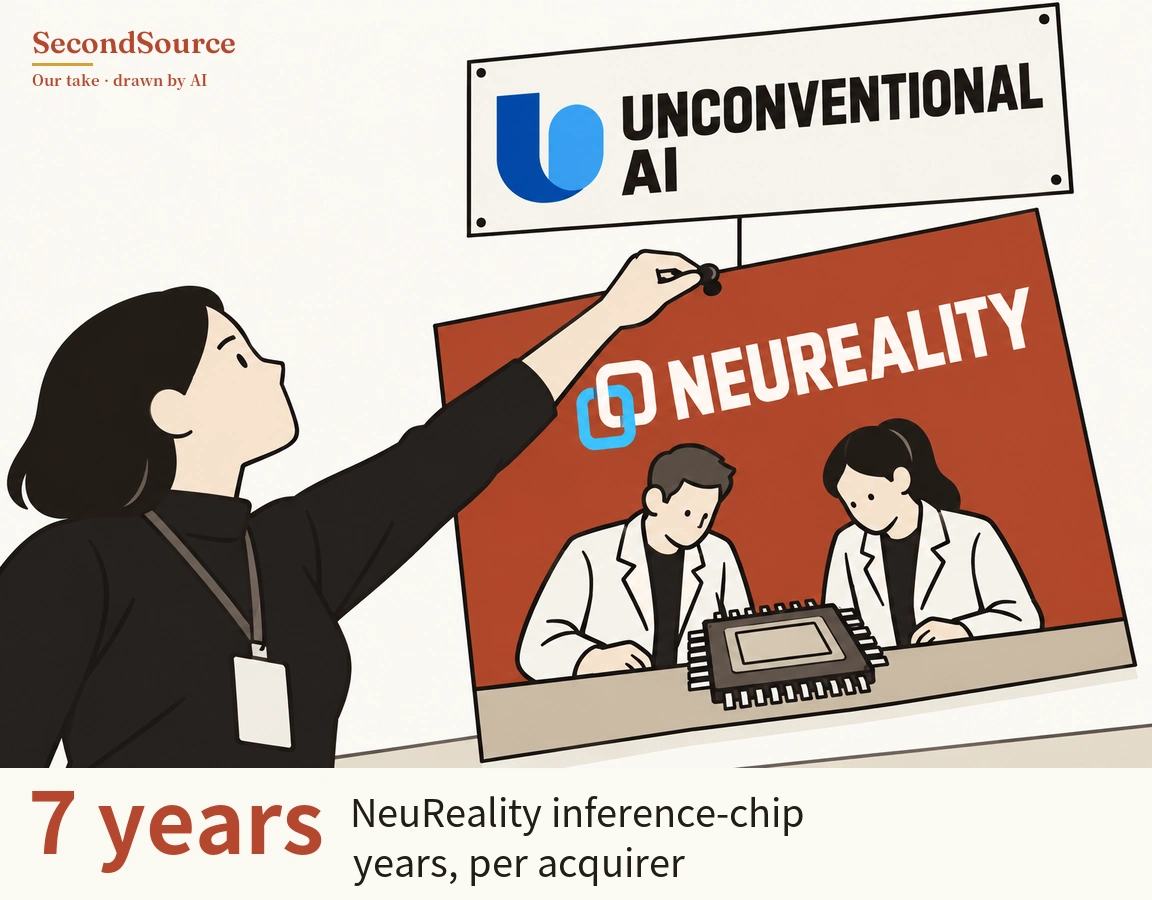
Concept illustration: a white sign at the top, lettered "UNCONVENTIONAL AI" beside a blue U-shaped mark, is joined by a thin vertical line to a tilted red panel below. The panel is lettered "NEUREALITY" beside a blue mark of two linked squares and shows two people in white lab coats at a counter looking down at a large square chip with pins, while on the left a woman in a black top with a lanyard badge reaches up and holds a black round-headed pin at the panel's top edge.
Unconventional AI, a startup building AI chips on an unconventional architecture, has agreed to acquire NeuReality, an Israeli company that makes AI inference chips, for an undisclosed price; closing is expected in the fourth quarter of 2026. Unconventional AI says the aim is to gain NeuReality's seven years of inference-chip work and NeuReality's engineers to shorten Unconventional AI's path to production systems, an account that so far comes only from the acquirer.

Read the full item → How we checked →

2. [Evidence update] (filing, October 26) Amazon said in October 2025 that Project Rainier, an AWS compute cluster, gives Anthropic nearly 500,000 of Amazon's own Trainium2 chips for training and inference, but Anthropic's IPO filing gives no chip count.
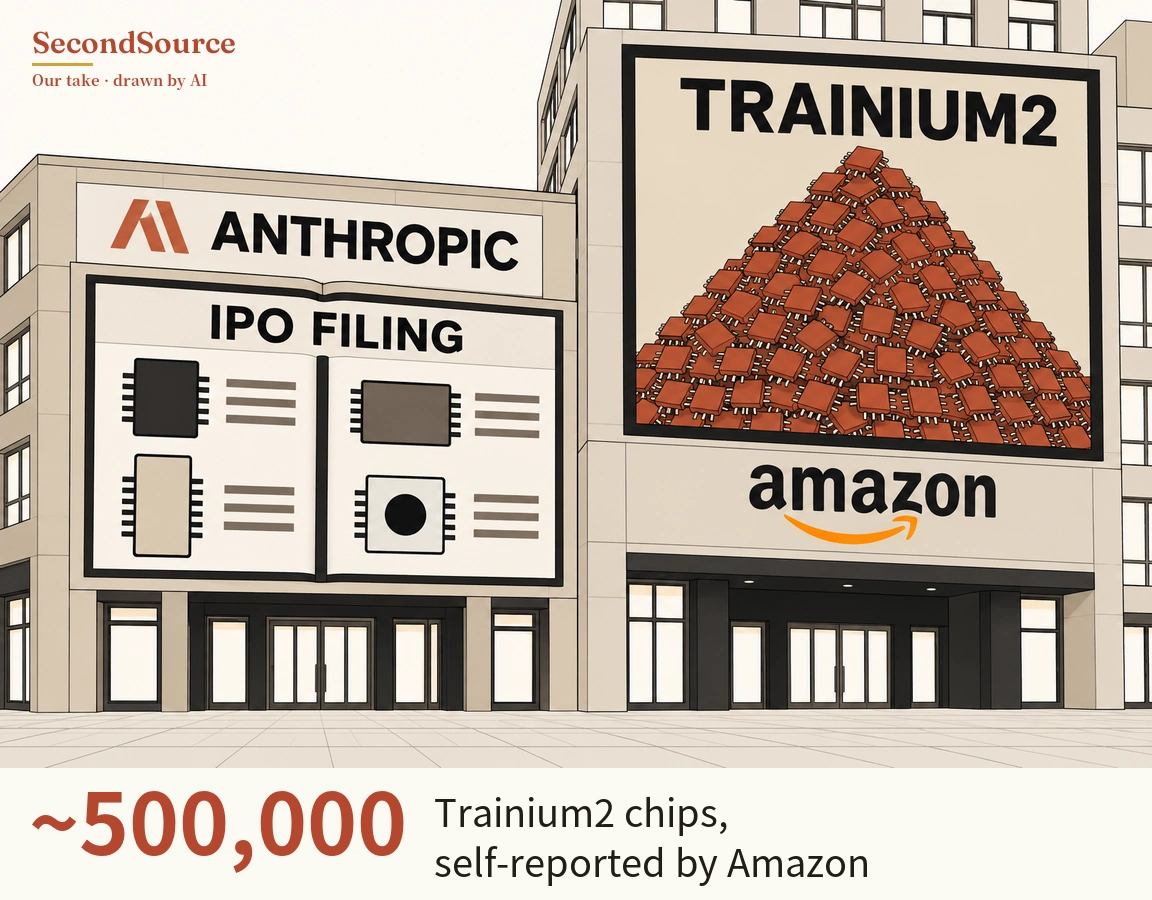
Concept illustration of two adjoining buildings on a paved plaza: the left one has a sign lettered ANTHROPIC beside a red-orange angular mark, and below it a large board shaped like an open book, headed IPO FILING, showing four chip icons, each next to a few short gray lines. The taller building on the right has a large billboard headed TRAINIUM2 filled with a big heap of red-orange chips, with the lettering amazon above an orange curved arrow beneath it, and both buildings have glass doors at street level.
Amazon said in October 2025 that nearly 500,000 of Amazon's in-house Trainium2 chips serve Anthropic through Project Rainier, an AWS compute cluster for training and inference, but Anthropic's October 26 S-1 IPO filing lists four chip types and gives no count. For gauging how far AWS's in-house chips are displacing NVIDIA, the figure still comes from Amazon alone, and the S-1 states compute contracts only in dollars, so the filing can neither confirm nor refute the figure.

Read the full item → How we checked →

Named commentary

1. [This week] (post, October 26) Jamin Ball, who writes the software-stock newsletter Clouded Judgment, worked out from Anthropic's IPO filing that the gross margin on serving customers rose from 12% in the first half of 2025 to 85% in the first half of 2026.
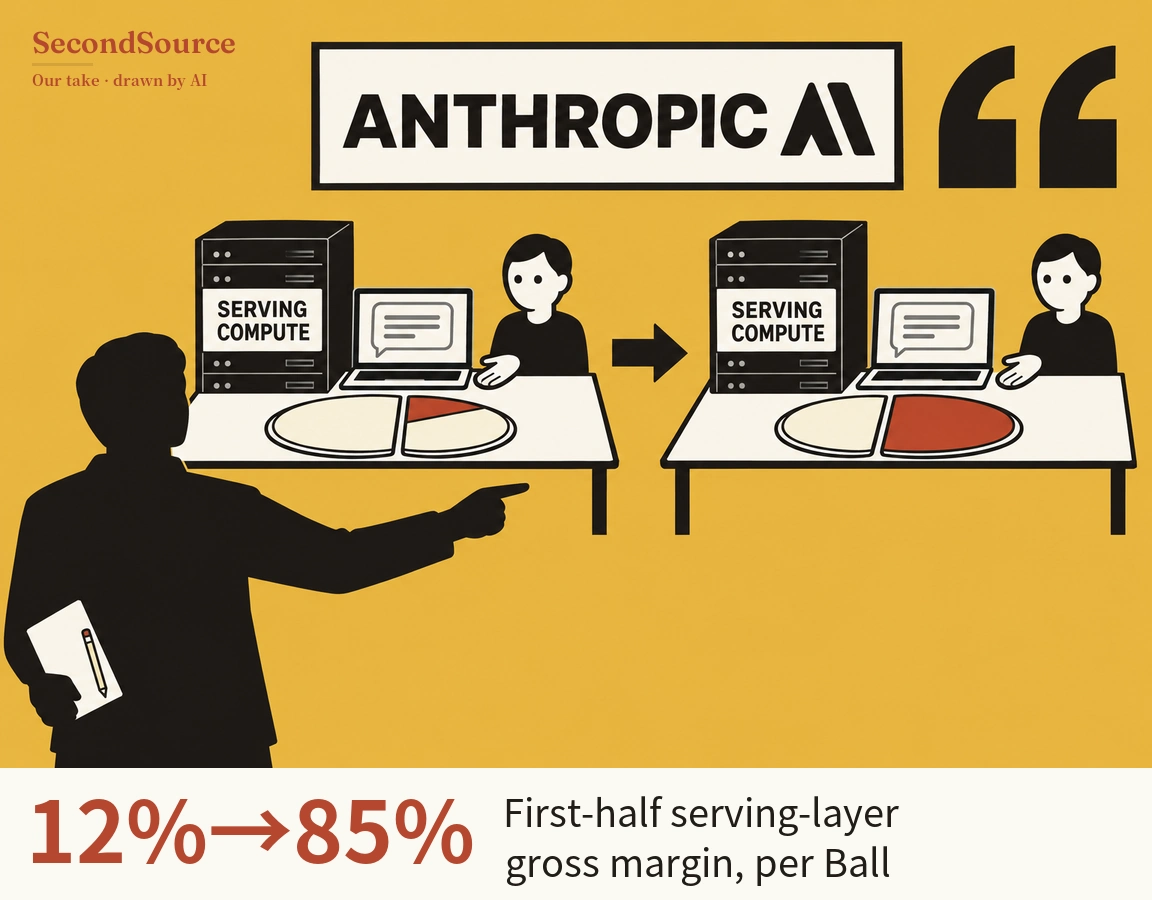
Concept illustration on a mustard-yellow background: at the top, a white framed sign lettered ANTHROPIC with a black angular mark, next to large black quotation marks; below, two matching tables joined by a black arrow pointing right, each holding a server tower labelled SERVING COMPUTE, a laptop showing a speech bubble, a person seated behind it, and a round disc split into a cream part and a red part, with the red part small on the left table and much larger on the right. In the left foreground, a dark silhouette of a person holding a notepad and pencil points toward the tables.
Jamin Ball, who writes the software-stock newsletter Clouded Judgment, worked out from Anthropic's IPO filing that Anthropic's gross margin on serving customers rose from 12% in the first half of 2025 to 85% in the first half of 2026. Ball's margin covers only the serving layer, with compute for model development and research counted separately under R&D and left out of the 85%.

In another post Ball wrote "$134b of cash today." That figure is the June-end total of cash, short-term investments and restricted cash; the US$131.7 billion in main-line item 1 excludes restricted cash. How we checked →

Read the full item →

Research & models

1. [Trend] (preprint, October 23) A preprint by Shao Zhang, Hangfan Zhang and co-authors tested 4 general-purpose coding-agent harnesses with 4 models on 6 benchmarks, 52,168 runs in all, and found that harness rankings change with the model and benchmark underneath.
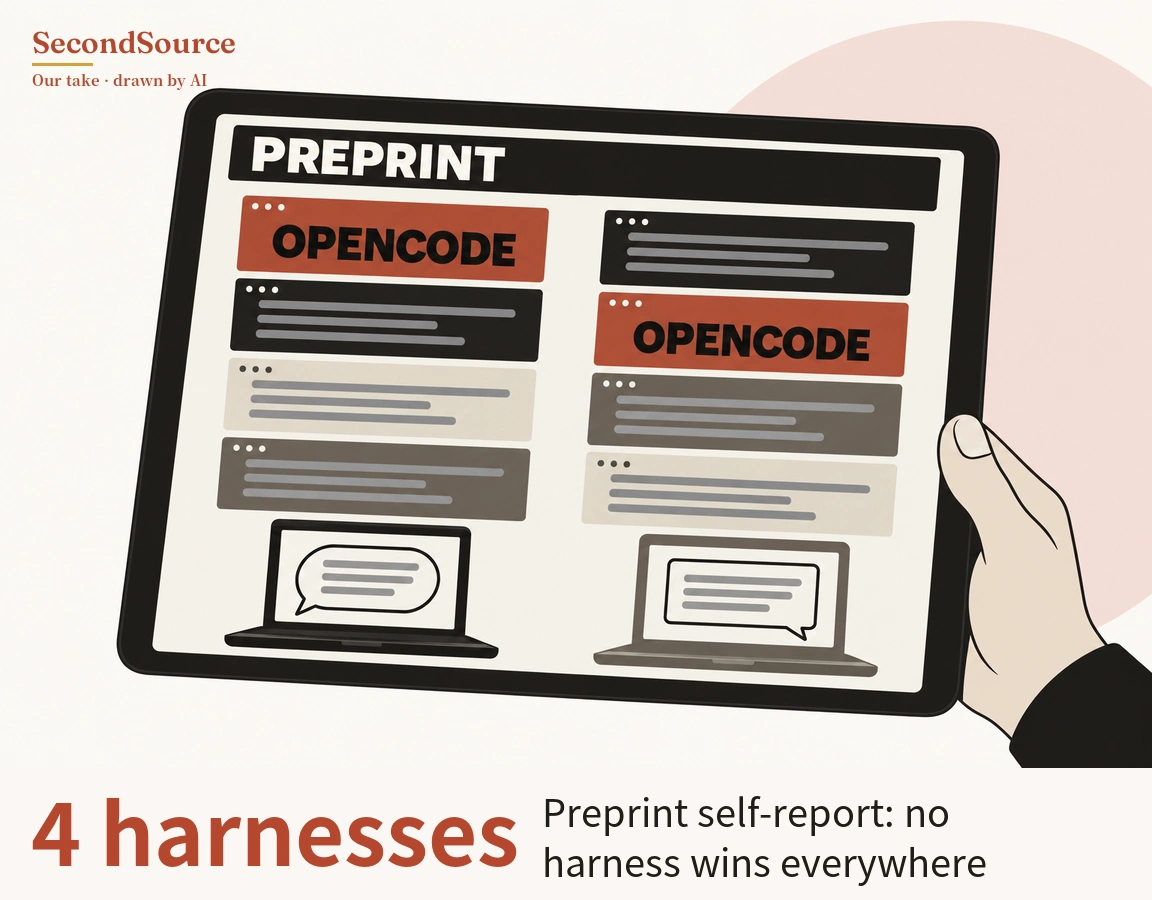
Concept illustration of a hand on the right holding a tablet whose screen shows a black header bar lettered PREPRINT above two side-by-side columns of four stacked window cards, each with three small dots and grey lines. The left column runs, from top, a red card lettered OPENCODE, then black, beige and grey-brown cards; the right column runs black, a red card lettered OPENCODE, grey-brown and beige. Below each column is a laptop, black on the left and grey on the right, each screen showing a speech bubble filled with grey lines, with a pale pink circle in the background at upper right.
In a preprint, Shao Zhang and co-authors found across 52,168 runs that coding-agent harness rankings change with the underlying model and benchmark, and no harness wins everywhere. Which harness works best depends on the model underneath, though the finding comes from a single self-reported preprint whose abstract lists no scores.

Read the full item → How we checked →

2. [Trend] (preprint, October 24) A Nanjing University preprint by Changlian Ma and Limin Wang had an LLM agent spend 20 days building a simulator for Hearthstone Battlegrounds and training a specialist agent, whose average placement over its last 20 games beat the server's top-10 players. The authors conclude that LLM agents do far better as builders than as players.
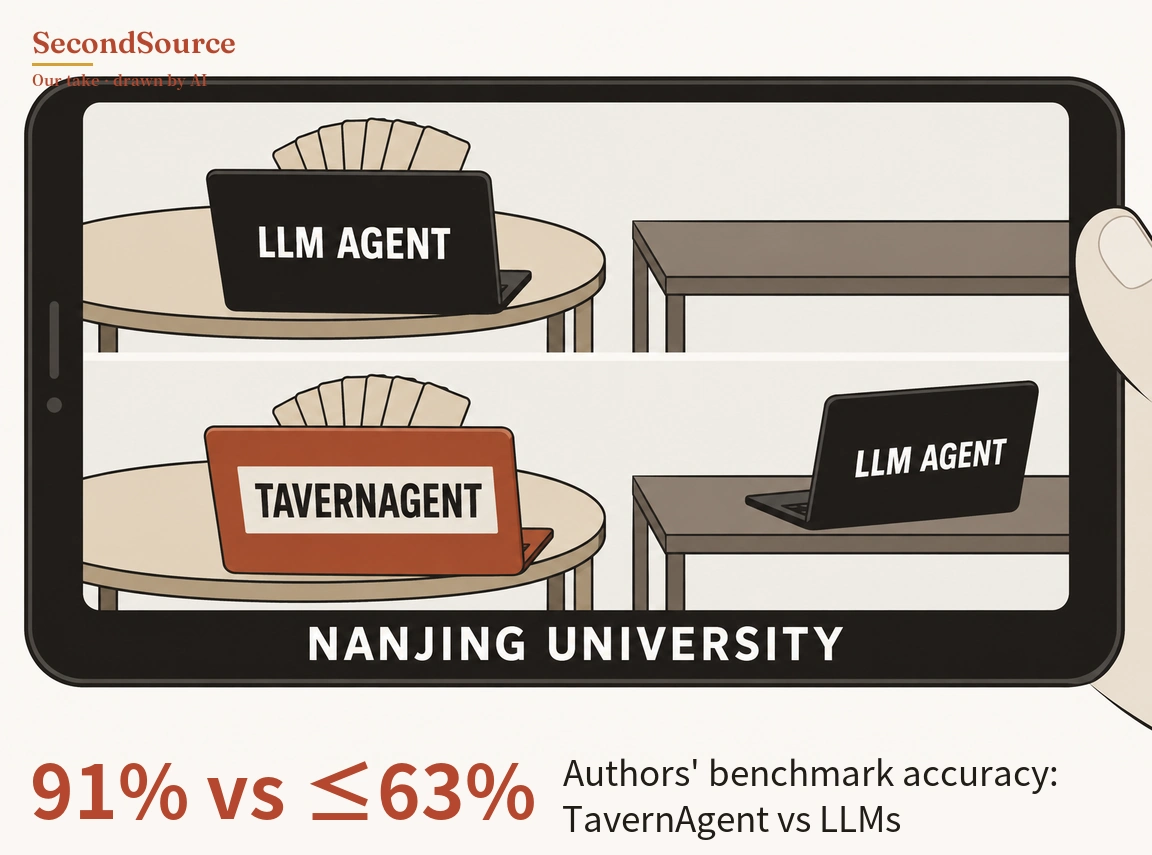
Concept illustration of a hand holding a smartphone sideways, its screen split into two stacked panels, with the lettering NANJING UNIVERSITY on the phone's black bottom bezel. In the top panel a black laptop lettered LLM AGENT sits on a round table on the left in front of a fan of cards, next to an empty rectangular table on the right; in the bottom panel a red laptop lettered TAVERNAGENT sits on the round table in front of a fan of cards, and a black laptop lettered LLM AGENT sits on the rectangular table.
A Nanjing University team says in a preprint that an LLM agent spent 20 days building a simulator for Hearthstone Battlegrounds, an eight-player auto-battler with hidden information, and training a specialist agent that beat the server's top-10 players on average placement over only 20 games. Our read: an agent's value may lie in building and training offline rather than in live decisions, though the evidence is one game with an environment and benchmark the authors built, and the abstract does not report how much people intervened.

Read the full item → How we checked →

3. [Trend] (preprint, October 25) In a preprint, Haoyu Zhao and co-authors from UCL, UNC and other institutions built a "continual learning exam" to measure whether frontier LLM agents improve from experience, and the best system passed 47.7% of the stages.
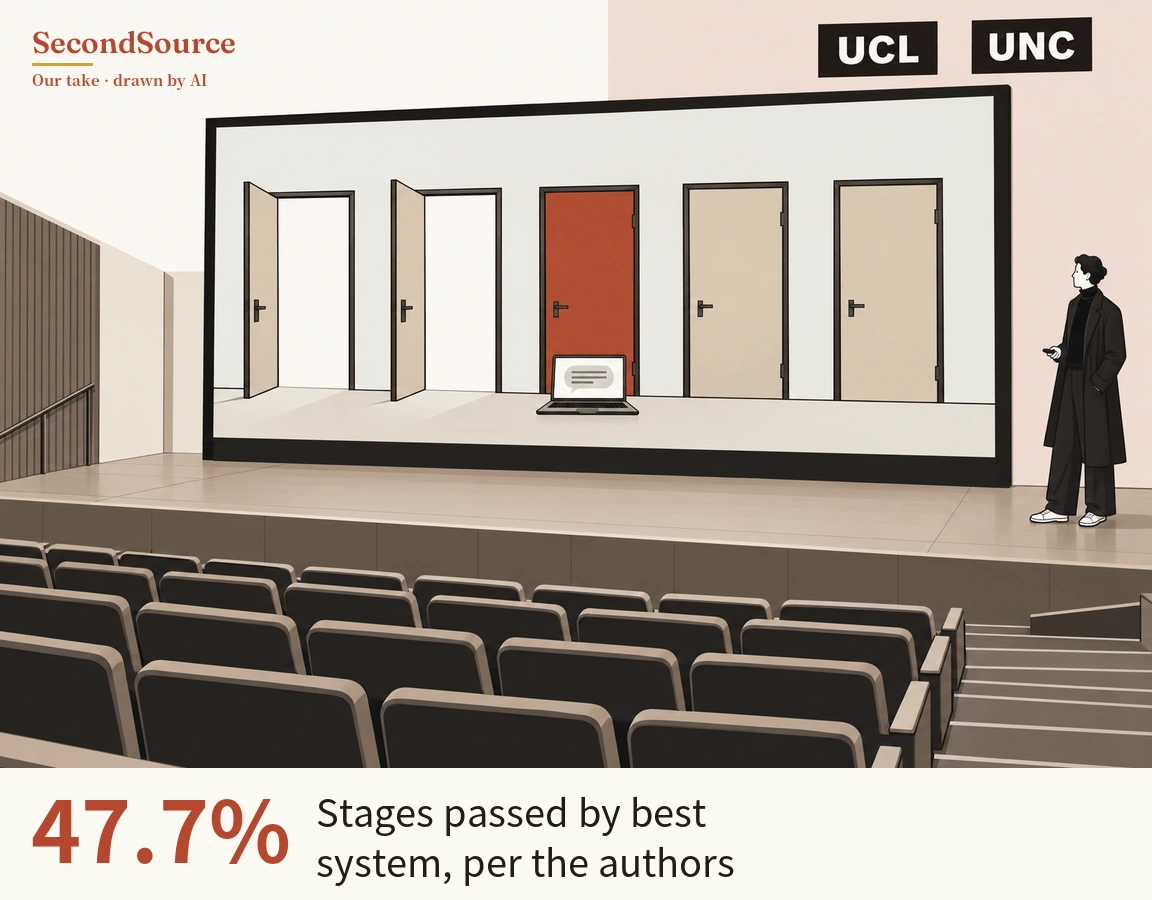
Concept illustration: seen from behind rows of auditorium seats, a large screen on a stage shows five doors in a row; the two on the left stand open, the middle red door is closed with a laptop on the floor in front of it showing a speech-bubble icon, and the two beige doors on the right are closed. A person in a long dark coat holding a small device stands at the right of the stage looking at the screen, below two black signs at the upper right lettered "UCL" and "UNC".
On a continual learning exam where each of 600 stages unlocks only after the previous one is passed and later stages need experience gathered earlier, Haoyu Zhao and co-authors found that frontier LLM agents pass at most 47.7% of stages, the best result among 17 harness-and-model pairings. Our read: agent products sold on getting smarter with use now have a ceiling to compare against on this benchmark, though the result comes from a single self-reported preprint with grading by an evaluator agent.

Read the full item → How we checked →

Product moves

1. [Today] (announced October 26) Apple expanded Siri AI from English to five more languages, French, Japanese, Korean, Portuguese and Spanish, and the announcement says server-side AI features have daily usage limits, with expanded use to be offered for a fee later.
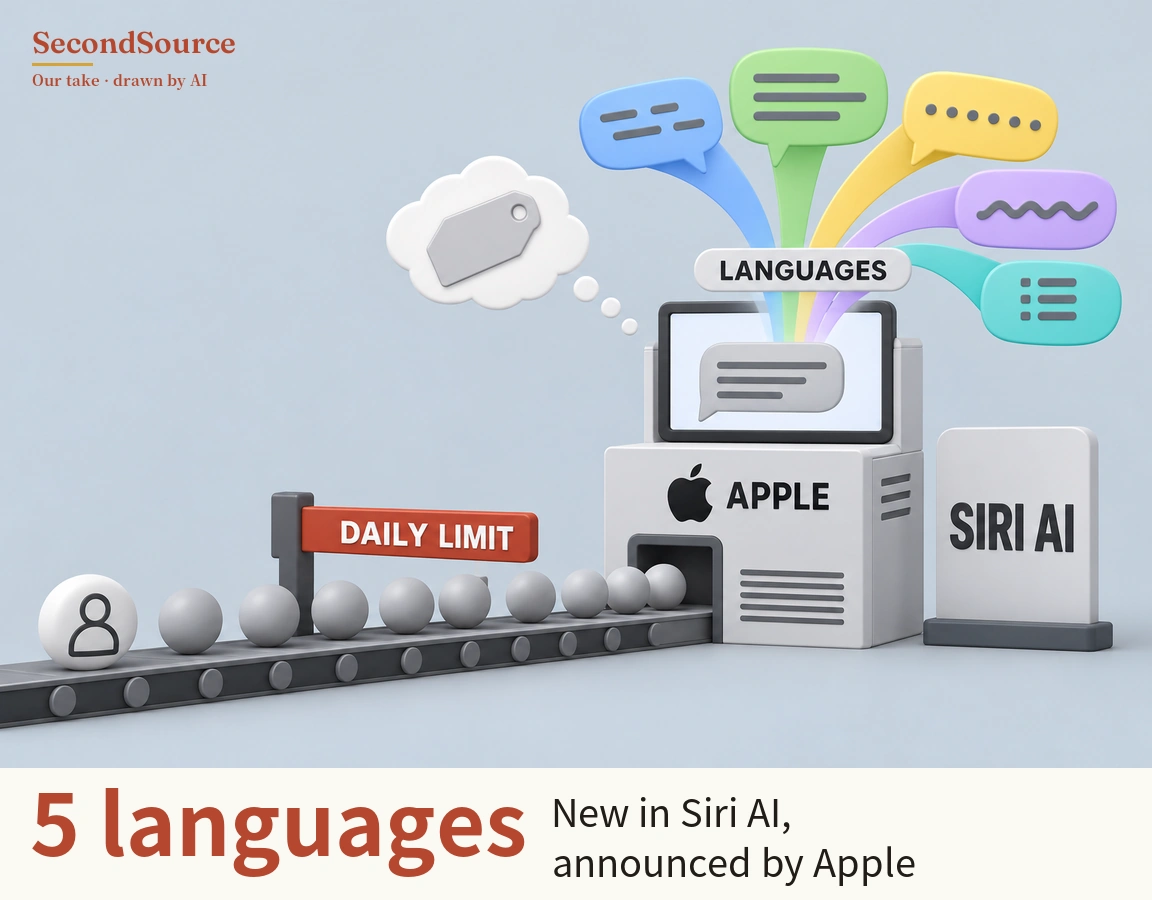
Concept illustration: on a light grey-blue background, a conveyor belt at lower left carries a white ball marked with a person icon and a row of grey balls into an opening at the base of a white box, and above the belt a post holds a red sign lettered DAILY LIMIT. The box shows an apple-shaped symbol and the lettering APPLE, and to its right stands a light grey slab on a dark base lettered SIRI AI. On top of the box a screen shows a grey speech bubble, with a label lettered LANGUAGES above it. Five ribbons in blue, green, yellow, purple and teal rise from the screen, each to a speech bubble of the same colour with line, dot or wave marks, while at upper left a thought cloud, linked to the screen by small dots, holds a blank grey tag.
Apple added five languages to Siri AI, including French and Japanese, and wrote that server-side AI features have daily usage limits and that expanded use will come for a fee later. Our read: the cloud compute cost of consumer AI may start shifting to users, though Apple's announcement gives no limit values or prices, so the shift is only a direction for now.

Read the full item → How we checked →

From the archive

1. [Looking back] (SecondSource deep dive, October 18) How tight GPU compute is shows up in contract prices; public list-price indexes can't read it.
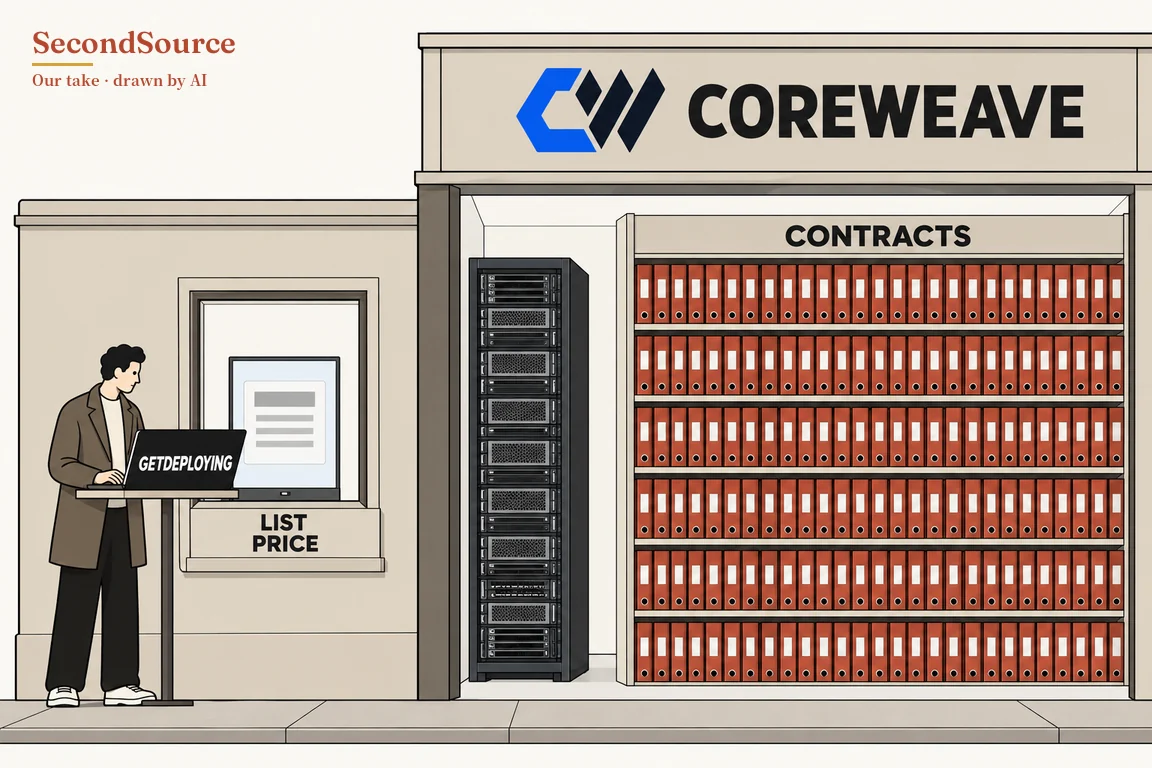
Concept illustration: on the left, a person in a long brown coat stands at a tall counter in front of a small window in a low beige wall, typing on a laptop lettered GETDEPLOYING; the window shows a screen with grey lines, and a sign below it reads LIST PRICE. On the right, the adjoining larger storefront has a sign lettered COREWEAVE beside a blue-and-black geometric emblem, and its open front shows a tall black server rack next to rows of shelves packed with red binders under a label reading CONTRACTS.
The CFO of CoreWeave, a cloud provider that specializes in renting out GPUs, said prices rose about 25% across all models in July, while getdeploying, a public index compiling list prices from dozens of providers' websites, showed only a 5% rise over the year; the two figures cover different periods and different kinds of price. Our read, from the October 18 deep dive: the July rise landed in contract prices, so a list-price index alone makes AI compute look looser than contract prices show, a reading still to be checked against CoreWeave's November results.

CoreWeave's second-quarter report shows 98% of revenue came from committed contracts that are paid whether used or not, with pay-as-you-go at only about 2%. CoreWeave's website price for H100, US$6.16 per GPU-hour, is exactly the price the index picks up. The 25% most likely landed on newly signed and renewed contracts; that is the deep dive's reading from the quarterly report and the website, and the CFO didn't say which price it applied to. After other providers raised list prices in October, the index's one-year rise climbed to 18%.

Reading only a public list-price index to judge whether AI compute is in surplus makes the market look looser than it is; what matters is how fast new contract prices pull up the average across all contracts. The next check is CoreWeave's third-quarter results in November. SecondSource's October 26 issue, "B200 deals top Nebius list price; only Ornn's index shows it," reported that one index provider had measured transaction prices above list, pointing the same way (full deep dive). How we checked →

Read the full item →

Also happened

1. Not verified by us yet: [Today] AWS launched a public preview of TorchNeuron, an open-source PyTorch backend that lets models run on Trainium2 and Trainium3 with a one-line configuration change; AWS gives no performance or adoption figures (AWS News Blog, 2026-10-26).

2. Not verified by us yet: [This week] (announced October 20) Cursor, which makes AI coding tools, made its Agent SDK generally available: an agent is written as a folder of code and can be deployed on Cursor or on the user's own infrastructure (Cursor, 2026-10-20).

SecondSource isn't a news digest: AI reads primary sources across fields, every judgment comes with its original source, and mistakes are corrected in public. The focus is what has changed and which claims still lack evidence, not what happened today.

Written from the same research and judgments as the Traditional Chinese edition. Sources are linked; we distinguish original documents from reporting and mark what we could not verify.