Deep Dive Oct 27, 2026
Anthropic's S-1, checked: if revenue lags, Anthropic and its shareholders take the loss first
This report crosses: IPO filings and financial-statement accounting, compute purchase contracts, equipment-lease financing, investment accounting. Primary documents read: 10.
Published October 27, 2026.
Key takeaways
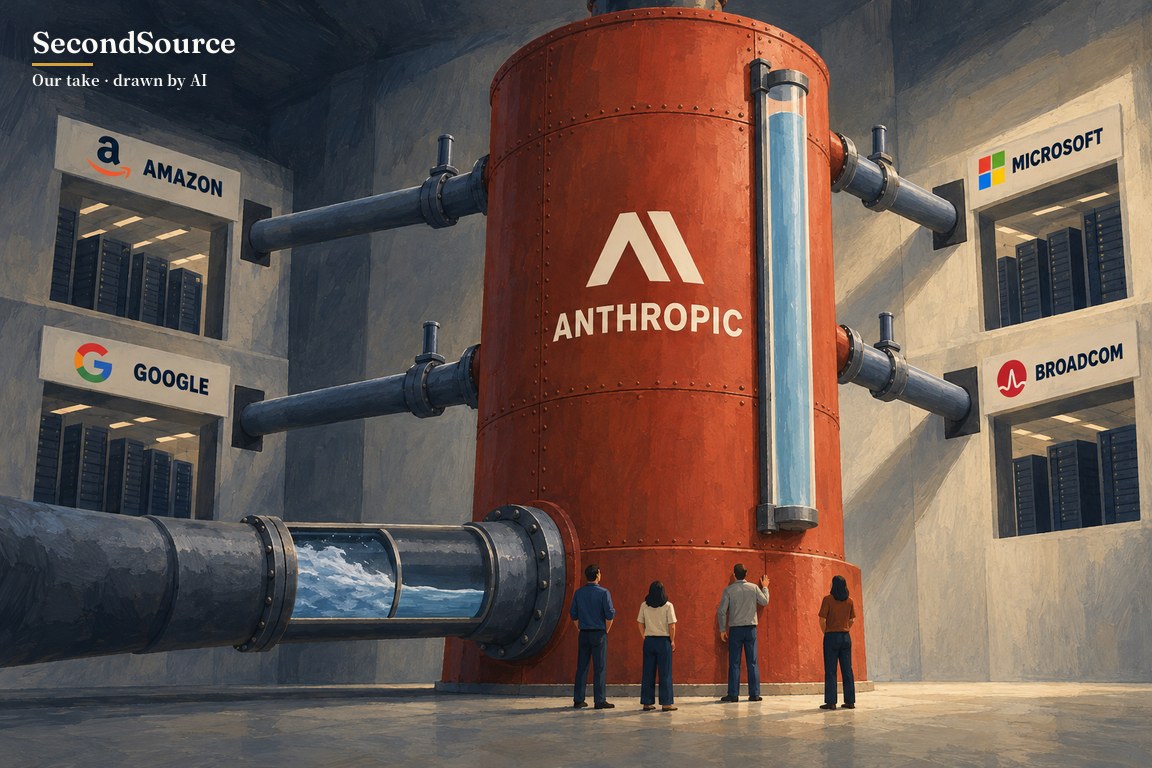
This report asks one question. An AI company has signed years of compute bills, and its revenue does not keep up: who takes the loss? Compute here means the chips and data centers that train and run AI models. Anthropic buys compute from three cloud providers, Amazon, Google and Microsoft. Anthropic also leases AI racks, whole cabinets of AI servers, from the chipmaker Broadcom. The part of the bills that revenue cannot pay is the shortfall.
The short answer: if revenue falls short, Anthropic and its shareholders take the loss first. That is our read. It rests on Anthropic's S-1, made public on October 26. An S-1 is the prospectus a company files with US regulators to go public. The S-1 states the terms of five compute contracts, and four of them must be paid however much compute Anthropic actually uses: the three cloud contracts and the Broadcom leases. Cash covers a shortfall first. Anthropic held about US$131.7 billion in cash and short-term investments at the end of June, and the S-1 says that cash plus revenue will last at least 12 months. The first S-1 does not show who pays after that.
SecondSource's October 21 deep dive held that, if revenue lagged, only two companies outside Anthropic might book extra losses: Broadcom and Amazon. Finance firms paid for the racks. Broadcom guarantees the rack leases to those finance firms, so a lease default leaves Broadcom paying them. Amazon owns Anthropic shares. An IPO price below the last funding round could force Amazon to mark that stake down.
The S-1 shows money promised for a cash crunch. Suppliers and large shareholders have agreed to lend or invest if Anthropic runs short; this report calls it standby money. Broadcom has agreed to lend up to US$42 billion, usable only for rack rent. If Anthropic's revenue growth drops below a set threshold, the loans get dearer. Each loan can be swapped for Anthropic shares, and the swap price falls too. Broadcom then receives more shares, and every other shareholder's stake shrinks. That shrinking is called dilution. The list of companies named on October 21 also gains a third: Google, a large shareholder, has promised up to US$20 billion of standby money.
SpaceX also sells compute to Anthropic. Its contract is the only one of the five that can be exited. Its two no-cancellation periods end in January and March 2027. After either ends, either side can cancel on 90 days' notice. One correction: the October 21 deep dive put Anthropic's 2025 revenue at about US$10 billion. The audited figure is US$4.585 billion.
One: Anthropic's S-1 holds three kinds of numbers, and this report keeps them apart
The S-1's numbers come in three kinds. The first is historical financial statements. The annual figures for 2023 through 2025 are audited, meaning an outside accounting firm checked them. The 2026 quarters are not audited, though Anthropic prepared them on the same basis. The second kind is contract terms and management's expectations. The third is SecondSource's own inference, marked as such throughout.
Sorted into these three kinds, the 61 figures the October 21 deep dive gathered while it was being written are checked here one by one. That deep dive also closed with five things to look for once the filing went public: audited revenue, second-quarter operating profit, a full table of future compute commitments, rented compute and the guarantees behind it, and the Amazon and Google stakes. Both checks are in the appendix.
Two: Anthropic's 2025 revenue was less than half the October 21 figure, while the bills are much larger
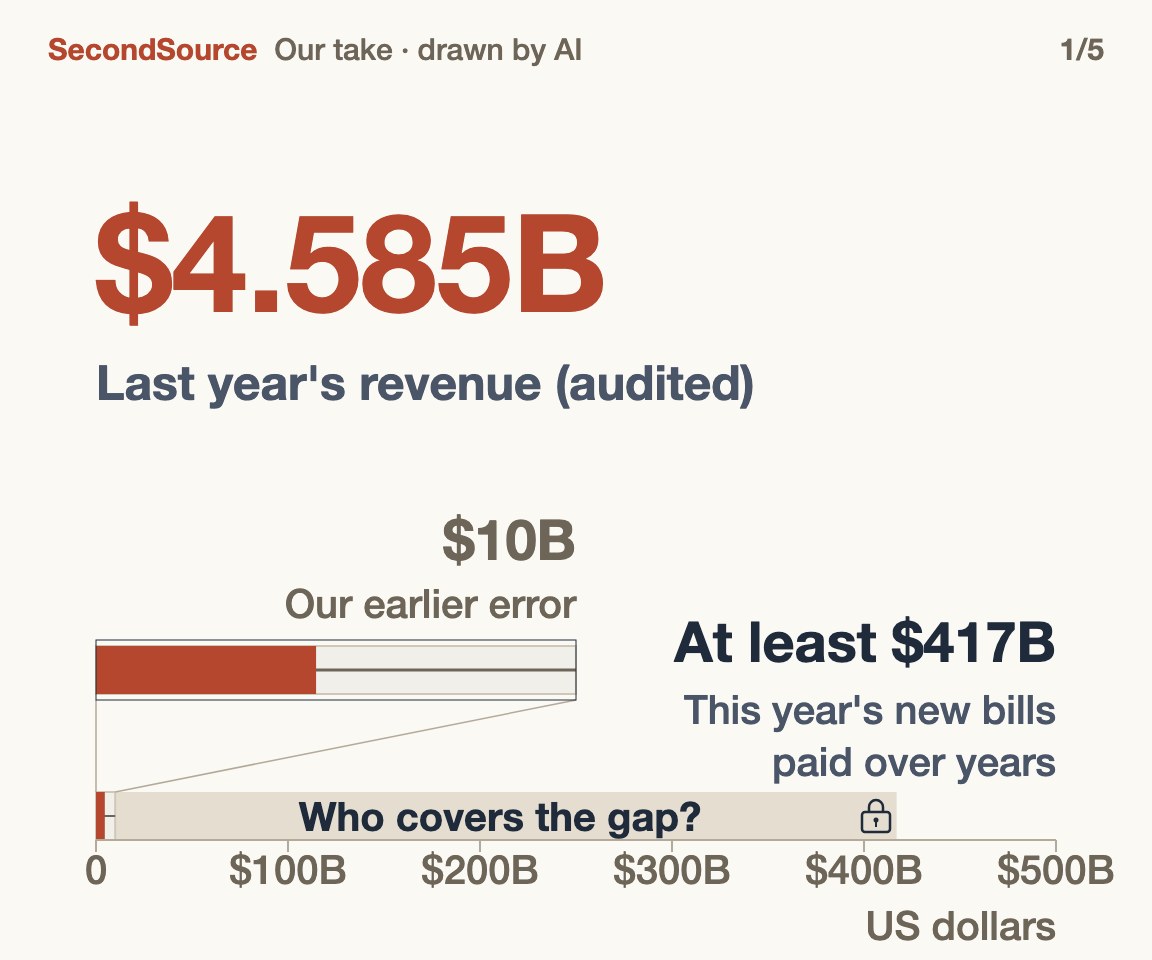
The October 21 deep dive, citing a CNBC report of August 17, put Anthropic's full-year 2025 revenue at about US$10 billion. Anthropic's audited 2025 revenue in the S-1 is US$4.585 billion, less than half. That was SecondSource's error. Two multiples built on that figure were wrong as well: SpaceX's annual bill as a multiple of 2025 revenue, and July annualized revenue as a multiple of 2025 revenue. The recalculation is in appendix ③.
Revenue is growing fast. Anthropic's second-quarter 2026 revenue was US$11.555 billion, against US$4.731 billion in the first quarter; neither quarter is audited. Operating profit is what is left of revenue after operating costs such as compute and staff. The second quarter brought Anthropic's first operating profit in any period the S-1 covers, US$974 million, above the estimate reported in May. The first half as a whole still shows an operating loss of US$693 million. The second-quarter net loss was US$66.3 billion, mostly from an accounting charge that involves no cash (section five).
Anthropic splits revenue into two kinds: usage-based billing and subscriptions. In the first half of 2026, usage-based billing brought in US$13.1 billion, 80% of revenue.
The bills grew faster. Compute contracts Anthropic signed or amended between January and June 1 commit it to at least about US$417 billion of future payments. After the end of June, Anthropic added about US$245 billion more, on terms of up to 20 years.
Three: The compute bills don't depend on revenue, so Anthropic carries the loss first
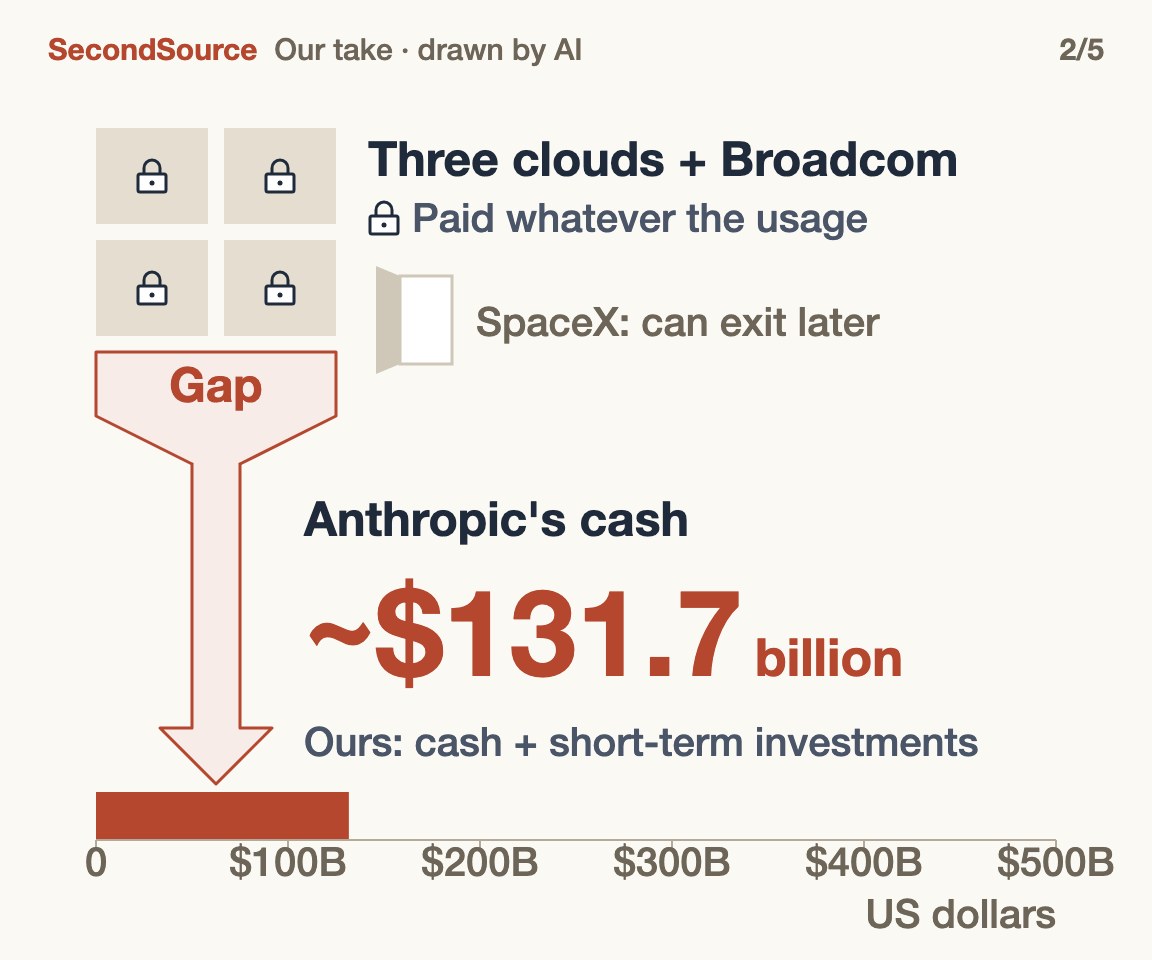
Amazon's contract requires Anthropic to pay at least US$110 billion from May 2026 to April 2036. Google's requires at least about US$114.5 billion through July 2033, and Microsoft's at least US$44.9 billion through May 2033. All three must be paid regardless of how much compute Anthropic actually uses. The Amazon and Google contracts also require Anthropic to make up the difference when usage falls short. Neither of those two can be cancelled, unless Amazon or Google commits a serious breach.
Broadcom's rack leases are more than one, with total rent of about US$161.2 billion. The 2026 lease is a five-year lease with rent of about US$125.2 billion. Neither side can cancel these leases midway. The tenant is a subsidiary Anthropic set up to lease the racks. Anthropic's parent company guarantees the leases, and the racks serve as collateral. What a default triggers is in appendix ②.
The October 21 deep dive judged that, if revenue lagged, every company selling compute to Anthropic would collect less revenue. The three cloud contracts and the Broadcom leases must be paid whatever the usage. Only SpaceX's contract, of the five, lets either side cancel on 90 days' notice, once no-cancellation periods ending in January and March 2027 are over. Our read: the October 21 judgment holds at most for SpaceX, and not before 2027. The S-1 does not draw that conclusion.
About 80% of Anthropic's revenue moves with usage, and these bills do not. So whatever part of the bills revenue cannot cover falls on Anthropic's cash. At the end of June, Anthropic's cash and short-term investments totaled about US$131.7 billion. In September Anthropic also obtained a US$15 billion revolving credit line from banks. A revolving line can be drawn, repaid and drawn again. One condition for drawing it is that Anthropic's liquidity stays at or above US$5 billion.
Four: Broadcom's and Google's standby money depends on revenue; if growth slows, Broadcom's loans cost more, then stop
The October 21 deep dive said that if Anthropic briefly could not pay its rent, it could borrow from Broadcom through convertible notes. A convertible note is an IOU that can later be swapped for Anthropic shares. The cap is US$42 billion, the same in the S-1 as on October 21 (note purchase agreement). The notes can pay only the racks' quarterly rent, and none had been issued at the end of June.
Broadcom's quarterly report describes the lender's side without naming the customer. The S-1 names Broadcom as the counterparty to the notes. Broadcom's report dates the deal June 8. In the S-1, June 8 is the day Anthropic and Broadcom signed a registration-rights agreement, not the note agreement. A registration-rights agreement lets Broadcom later sell, on the public market, the shares it receives from the notes. Our read: the two filings describe the same arrangement. No evidence points the other way so far.
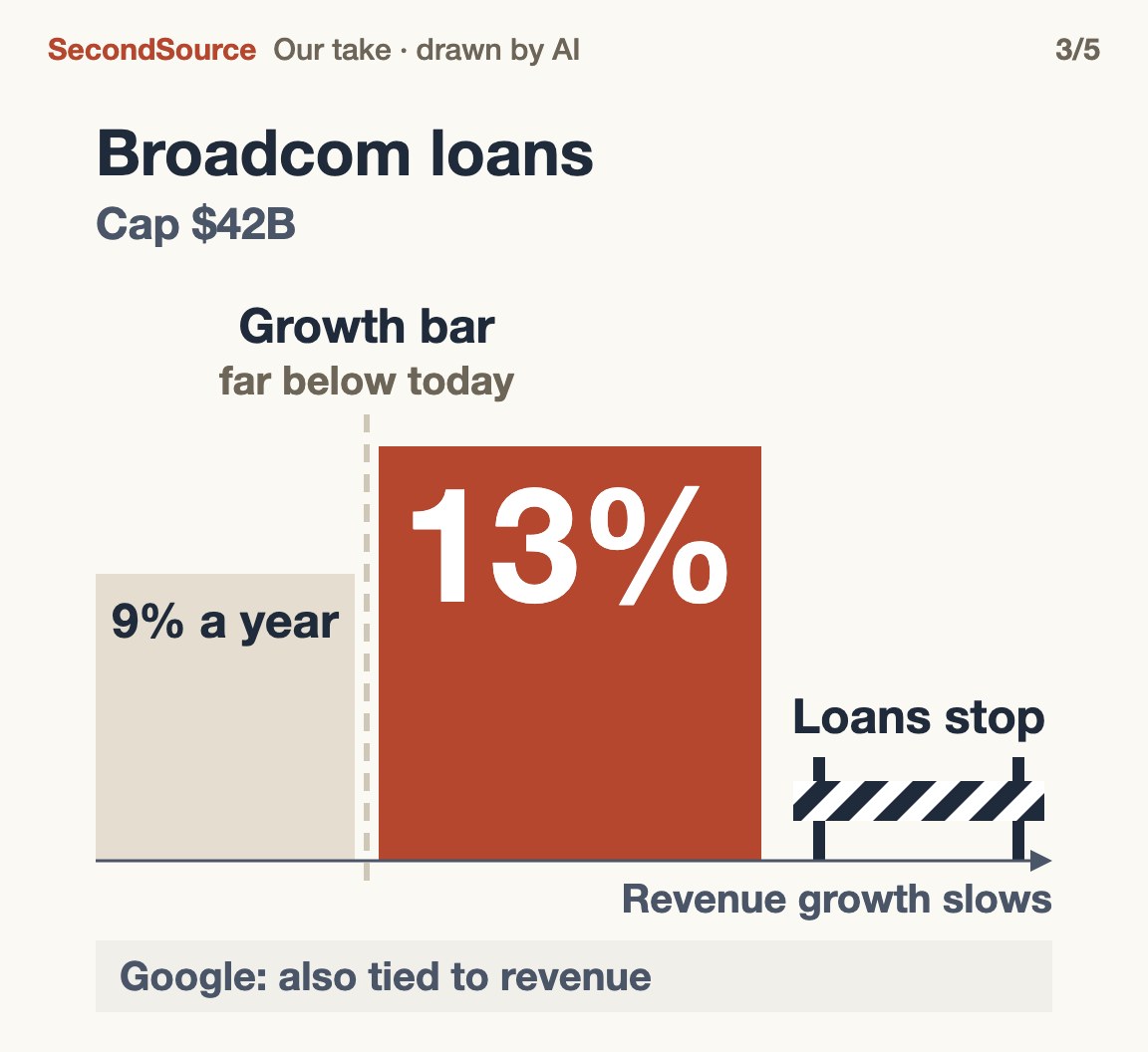
Anthropic can borrow only on conditions. Revenue growth must stay above a threshold, liquidity must stay at or above US$5 billion, and the leases must be paid as due. The S-1 says only that the threshold sits far below Anthropic's actual growth rate in every quarter since 2025, without giving the number. So growth would have to slow sharply to reach it. Notes issued while growth is below the threshold carry 13% annual interest instead of 9%. Their swap price also drops, from 90% of the market price to 85%. If the conditions keep failing, Anthropic loses the right to issue notes.
Google's US$20 billion also depends on revenue. One condition for drawing it is a revenue target over the past 12 months, and Google can delay the funding.
Our read: under these terms, the order in which losses fall has to be rewritten. In the October 21 version, Broadcom would first lend Anthropic the rent money. If the leases still defaulted, Broadcom would then compensate the finance firms. Under the S-1's terms there are two cases. In the first, revenue still grows but the growth rate falls below the threshold; the cost is dearer loans and then no loans, as above. In the second, revenue cannot pay the bills. Anthropic can then pay Broadcom's quarterly rent with notes while the conditions hold, and the other bills fall on Anthropic's cash and bank line (section three). Which comes first, notes or cash, the S-1 leaves open.
Broadcom's quarterly report says that if the leases default, Broadcom owes the finance firms at most about US$29 billion. The S-1 gives neither that figure nor whether Anthropic's parent, which guarantees the subsidiary, or Broadcom pays first. One thing is certain: Broadcom pays only after a lease default.
Five: On the books, Amazon's gain waits on the IPO price, and Google is a major shareholder too
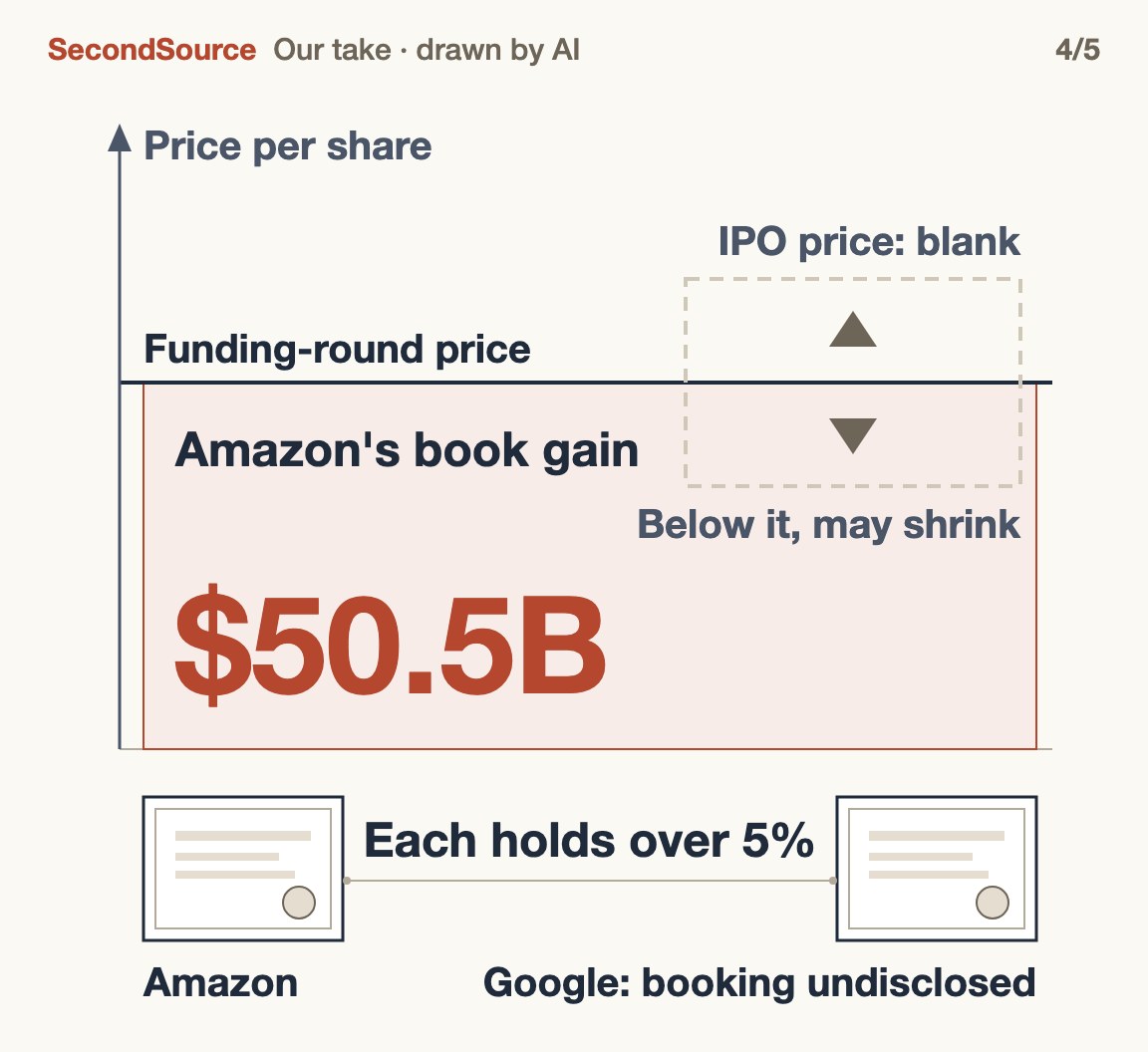
The stakes come next. The October 21 deep dive said Amazon marked its Anthropic investment up to the latest funding price, booking a gain of about US$50.5 billion in the second quarter. An IPO price below that funding price could force the mark back down. Amazon's US$50.5 billion gain is in Amazon's quarterly report. The S-1 shows only Anthropic's side of the books, not the holder's.
The May funding round, Series H, pushed up Anthropic's valuation. That made the convertible notes and related contracts Anthropic owes investors more expensive. These IOUs can be swapped for shares, so a higher valuation makes the shares they convert into worth more, and the liability on Anthropic's books grows. Anthropic booked the increase as an expense of about US$68 billion. No cash changed hands, and that expense is the main reason for the second-quarter net loss. Whether Amazon's gain gets reversed waits on the IPO price, and the first S-1 leaves the offer price blank.
Once their shares and notes convert at the IPO, Amazon and Google will each hold more than 5% of Anthropic, according to the S-1. Alphabet's quarterly report does not name Anthropic, and the S-1 does not say how Google accounts for its stake.
Some of Anthropic's data-center arrangements rely on credit support from a third party that is also an Anthropic competitor. The support goes to companies that build data centers or supply equipment for Anthropic. The S-1 gives neither the third party's identity, the amount nor the triggers, so this report does not count that party among those who might book extra losses.
The October 21 deep dive said public documents showed no other compute seller advancing money or giving guarantees. Google's US$20 billion in section four means that sentence is withdrawn.
Six: Back to the opening question: Broadcom and Amazon are still on the list, but Anthropic comes first
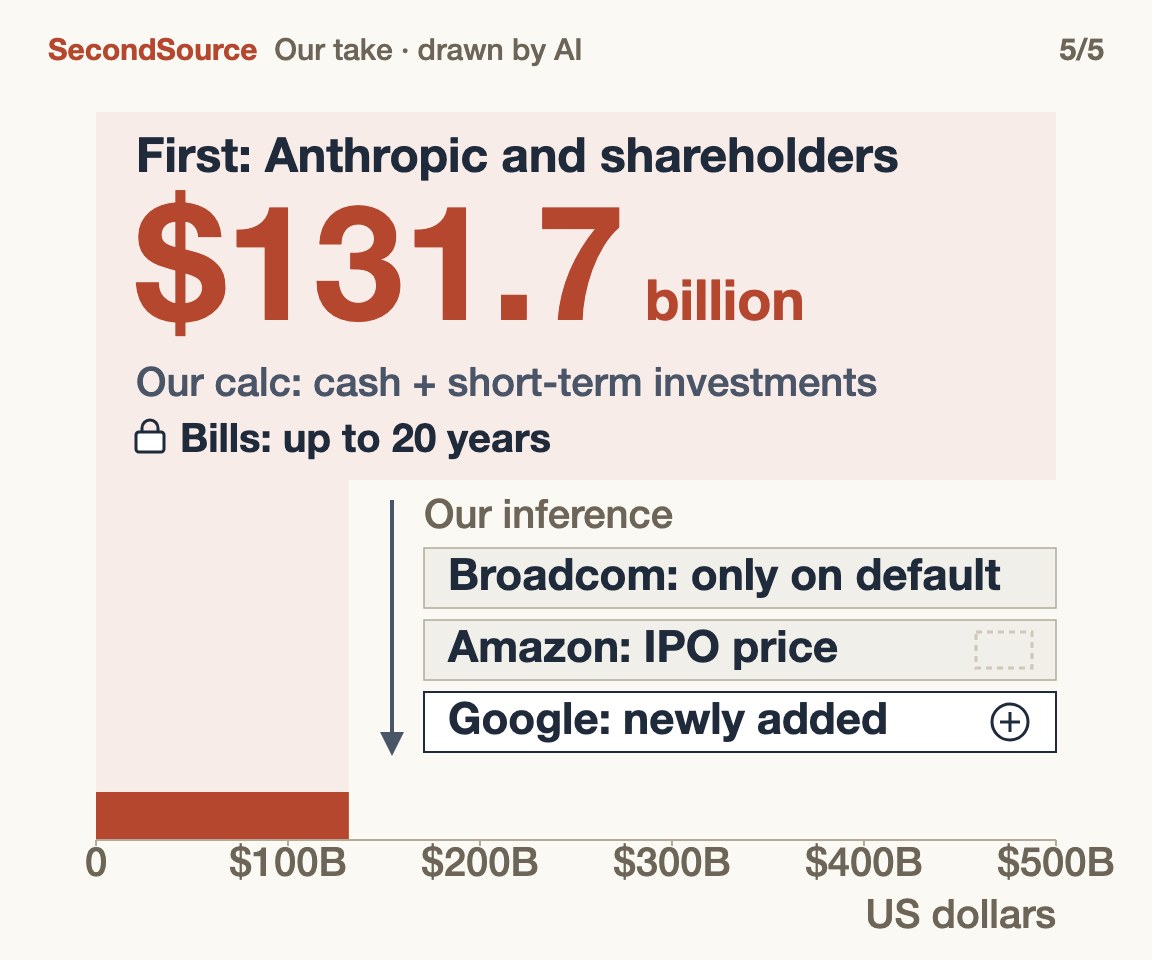
Back to the opening question: if revenue lags, who carries the loss? Both companies the October 21 deep dive named, Broadcom and Amazon, are still on the list. That deep dive ended with three conditions that would overturn its call. Checked against the S-1, the first two have not occurred, and the third cannot be judged yet.
The first condition was that the customer in Broadcom's quarterly report is not Anthropic. No evidence shows that; the basis is in section four. The second was that most compute contracts are short and can be exited at any time. That has not occurred: Anthropic's contracts are mostly long (section three). The third was that Anthropic's cash is enough to pay years of commitments. That cannot be judged yet. This year's new bills add up to far more than the US$131.7 billion of cash in section three, but they are spread over as long as 20 years, and the first S-1 does not show how much falls due each year.
What changed is the order, and Google joins the list.
Our call
The three cloud providers' and Broadcom's bills do not depend on revenue, while Broadcom's loans and part of Google's standby money do. The cost of a revenue shortfall had looked partly shared with suppliers. Our read of the S-1's terms: at least while cash plus revenue covers the bills, that cost falls mostly on Anthropic's shareholders. The S-1 does not say so.
Three figures in an amended S-1 will test this call.
1. The year-by-year schedule of contract payments. The first year in which the bills exceed cash plus revenue is the year Anthropic needs new money, and the revenue conditions on the standby money become decisive.
2. The offer price range. Anthropic's May round, Series H, priced shares at US$589.0095, about US$58.90 after the ten-for-one stock split in September. If the offer price and the trading price after listing fall below that, part of Amazon's mark-up to the Series H price could be reversed.
3. Third-quarter revenue, against the second quarter's US$11.555 billion. Whether growth hits Broadcom's revenue threshold can be measured only once an amended S-1 gives the threshold.
What would prove this wrong: if an amended S-1 or a later filing shows suppliers funding as usual while revenue falls, without regard to revenue, section four's finding that Broadcom's and Google's standby money depends on revenue would be withdrawn.
Appendix: where the numbers come from
① The 61 figures, row by row
The overall result first. The October 21 deep dive gathered 61 figures while it was being written, and its published appendix listed 31 of them. Of the 61, 14 match, 8 are right in direction but off in size or conditions, 1 is the opposite of the S-1 (2025 full-year revenue), and the other 38 are not in the S-1 or are measured differently there. The October 21 deep dive ended with five things to look for once the filing went public. Four now have answers; only the table of compute commitments is blank in the first S-1. The item-by-item check is the last bullet of appendix ②.
The table below checks the 61 figures against the S-1 and its exhibits. There are four rulings:
- Match: the same quantity, period and definition, equal within rounding.
- Off: right direction, wrong size or conditions (a single-number estimate more than 2% away counts as Off), or half right and half wrong.
- Wrong: the S-1 says the opposite.
- Not in the filing: the S-1 does not disclose it, leaves it blank in the first filing, or discloses only a differently measured figure that cannot be compared directly.
Three further rules:
- Last-digit difference: a figure slightly beyond rounding, within 2% and off by one unit in the reported number's last digit, also counts as Match.
- For wording such as "at least", "as early as" or "more than", an actual result inside the bound counts as Match.
- When one row holds two figures, one not in the filing and one the opposite of the S-1, the row is ruled Wrong and the ruling column says which half (N25).
"Type at the time" is where the figure came from before October 21. In "What the S-1 says", the parenthesis gives the type of the S-1 figure. The location column gives S-1 main-text pages; F- pages are the financial statements and II- pages are Part II. Rows marked † turn on how the measures are lined up (estimate against actual, before against after an amendment, or an unclear period). The table takes the cautious ruling, and an amended S-1 may change it.
| # | Original claim and figure | Type at the time | What the S-1 says (type) | Ruling | Location |
|---|---|---|---|---|---|
| N01 | Series G raised US$30B | Company announcement | Series G in January–February raised US$30.2B in total at US$259.1364 a share (unaudited) | Match | F-62, F-46 |
| N02 | Series G post-money valuation US$380B | Company announcement | Per-share price only; no valuation | Not in the filing | II-3 |
| N03 | February annualized revenue US$14B | Company announcement | Gives only the method for annualized revenue; its only date, October 31, is blank | Not in the filing | 3, 194 |
| N04 | Claude Code annualized revenue above US$2.5B | Company announcement | Revenue not broken out by product | Not in the filing | 195 |
| N05 | Series H raised US$65B | Company announcement | Series H in the second quarter raised US$65.2B in total at US$589.0095 a share (unaudited) | Match | F-46 |
| N06 | Series H post-money valuation US$965B | Company announcement | Says only that Series H raised the valuation; no amount | Not in the filing | 159 |
| N07 | The US$65B Series H includes US$15B committed earlier by cloud providers (US$5B of it from Amazon) | Company announcement | In May Google put US$10B and Amazon US$5B into Series H, drawn down from financing both had promised earlier, inside the US$65.2B (unaudited) | Match | F-40, F-42 |
| N08 | May annualized revenue above US$47B | Company announcement | No May annualized revenue | Not in the filing | 194 |
| N09 | New compute: Amazon 5 GW, Google and Broadcom 5 GW, and others | Company announcement | Contracts are given only in dollars; GW appears nowhere. GW is a unit of power capacity used to size data centers | Not in the filing | 171 |
| N10 | Confidential draft filed June 1 | Company announcement | The main text does not discuss the filing process; the SEC filing record lists a draft submitted June 1 | Not in the filing | Exhibit 23.1 |
| N11 | Second-quarter revenue estimate US$10.9B | Estimate given to investors (CNBC) | Second-quarter revenue US$11.555B (unaudited) | Off | 157 |
| N12 † | If met, the second quarter is the first profitable quarter | Media report | Operating profit US$974M, the first positive figure in the S-1's periods; net loss of US$66.309B in the same quarter (unaudited) | Off | 157, 159 |
| N13 | First-quarter revenue US$4.8B | Media report (one person) | US$4.731B, slightly beyond rounding, a last-digit difference (unaudited) | Match | 157 |
| N14 † | CNBC wrote that 2026 revenue had reached US$10B | Media report (period unclear) | The line comes from a separate CNBC article of May 20; the S-1 has no year-to-May revenue; audited 2025 revenue is US$4.585B; not the same line as N25, which is the 2025 full-year figure printed in section two of the October 21 deep dive | Not in the filing | 22 |
| N15 | Revenue figures first reported by The Wall Street Journal | Media report (sourcing) | Does not discuss which outlet reported first | Not in the filing | — |
| N16 † | SpaceX: US$1.25B a month to May 2029 (relayed by CNBC) | Media relay of a SpaceX filing | The package after the May–October additions and amendments: up to US$120.5B, about US$3.1B a month once fully delivered, term extended to 2029 (contract terms) | Not in the filing | 171 |
| N17 | Second quarter at least US$10.9B, first quarter US$4.8B (Reuters) | Estimate given to investors | US$11.555B and US$4.731B (unaudited) | Match | 157 |
| N18 † | Second-quarter operating profit estimate US$559M | Estimate given to investors | Operating profit US$974M (unaudited) | Off | 157 |
| N19 | The Wall Street Journal reported first that day | Media report (sourcing) | Does not discuss which outlet reported first | Not in the filing | — |
| N20 † | SpaceX: US$1.25B a month to May 2029; either side can end the deal on 90 days' notice (Reuters) | Media relay of a SpaceX filing | The same package as N16: after no-cancellation periods ending in January and March 2027, either side may cancel on 90 days' notice; the terms of the original May contract are not given separately (contract terms) | Not in the filing | 171 |
| N21 † | Compute cost per US$1 of revenue: 71 cents in the first quarter, 56 cents estimated for the second | Media relay of The Wall Street Journal | Compute and infrastructure expense as a share of revenue: 72% in the first quarter, 48% in the second, covering all uses including training (unaudited) | Off | 158 |
| N22 † | Second-quarter operating profit estimate US$559M (The Decoder) | Estimate given to investors | Operating profit US$974M; adjusted operating profit US$2.235B (unaudited) | Off | 157, 160 |
| N23 | End-July annualized revenue US$65B | Company figure given to investors | No July annualized revenue | Not in the filing | 194 |
| N24 | Preliminary second-quarter revenue US$11.5B | Preliminary figure given to investors | US$11.555B, slightly beyond rounding, a last-digit difference (unaudited) | Match | 157 |
| N25 † | May annualized revenue above US$47B; 2025 full-year revenue about US$10B | Company announcement; media report | 2025 full-year revenue US$4.585B (audited); annualized revenue not given | Wrong (the 2025 full-year half) | 62, F-7 |
| N26 | Rack financing platform: first tranche US$35B, over 1 GW | Three companies' press release | Platform not mentioned; Broadcom lease rent totals about US$161.2B (contract terms) | Not in the filing | 171 |
| N27 | Platform target above 20 GW by 2028 | Three companies' press release | No GW; TPU compute partly online in 2026, more from 2027. A TPU is an AI chip Google designs | Not in the filing | 171 |
| N28 | Broadcom guarantee cap about US$29B | Broadcom quarterly report (unaudited) | No amount or formula; says only, in general terms, that partners guarantee leases for some data centers; says the parent guarantees, and that the 2026 lease's five-year rent is about US$125.2B (contract terms) | Not in the filing | 74, 172, 205 |
| N29 | Guarantee formula: 85% of the amount owed, minus what selling the racks recovers | Broadcom quarterly report | Not given; says only that most of the rent comes due early on default | Not in the filing | 74 |
| N30 | Convertible note cap US$42B, none issued yet | Broadcom quarterly report | US$42B, usable only for quarterly rent, none issued at end-June (contract terms) | Match | 58, 166 |
| N31 | The platform exists to fill top AI labs' cash gaps | Broadcom quarterly report | No such line; says Anthropic does not depend on this facility, with cash of US$112.4B at end-June | Not in the filing | 74 |
| N32 | Broadcom shareholders' equity about US$99.7B | Broadcom quarterly report | Outside the S-1's scope | Not in the filing | — |
| N33 | Broadcom's previous quarterly report: agreed June 8, cap US$29B | Broadcom quarterly report | No US$29B; the registration-rights agreement with Broadcom was signed June 8 | Not in the filing | 172, Exhibit 4.6 |
| N34 † | SpaceX filing excerpt: US$1.25B a month to May 2029 | Filing excerpt, quoted secondhand | Same as N16 | Not in the filing | 171 |
| N35 | SpaceX contract signed May 3 | Third-party relay | Says only between May and October | Not in the filing | 171 |
| N36 | SpaceX gives Anthropic all the compute at Colossus, SpaceX's compute facility | SpaceX letter to the SEC | Colossus not mentioned | Not in the filing | 171 |
| N37 | Lambda, which sells compute to Anthropic: contract US$35B over six years | Media report | August agreement about US$34.9B; three agreements total about US$41.3B, billed only after compute is delivered (contract terms) | Match | 171 |
| N38 | Parties to the Lambda contract did not respond | Media report | Not discussed; the S-1 formally discloses the Lambda agreements | Not in the filing | 171 |
| N39 | Hut 8: two 15-year leases, US$19.6B | Media relay of a Hut 8 filing | Not in the main text; the Broadcom lease exhibit names only one Hut 8 acknowledgment agreement, which cannot be tied to these two leases | Not in the filing | Exhibit 10.11 |
| N40 † | Azure commitment US$30B, plus a separate deal for up to 1 GW | Company announcement | After amendments in February and October 2026, at least US$44.9B from November 2026 to May 2033; the original amount is not given separately (contract terms) | Not in the filing | 170 |
| N41 | NVIDIA and Microsoft invest up to US$10B and US$5B | Company announcement | Microsoft is listed among equity investors, NVIDIA is not; neither amount is given | Not in the filing | 73 |
| N42 | Google and Broadcom: multi-GW next-generation TPUs, online from 2027 | Company announcement | Online from 2027 matches; no GW | Not in the filing | 171 |
| N43 † | April annualized revenue above US$30B; about US$9B at end-2025 | Company announcement | No annualized revenue at either date | Not in the filing | 194 |
| N44 | October 2025: up to a million Google TPUs, worth tens of billions of dollars | Company announcement | None of the three quantities given | Not in the filing | 204 |
| N45 | Amazon put US$8B into convertible notes, 2023–2025 | Amazon quarterly report | Itemized receipts add up to US$8B (audited) | Match | F-40 |
| N46 | Amazon put US$5B into Series G in the second quarter, plus a facility of up to US$20B | Amazon quarterly report | In April Amazon bought about US$5B of Series G non-voting stock (shares that carry no vote at shareholder meetings) and committed up to US$20B | Match | F-63 |
| N47 | Amazon put US$5B into Series H, leaving US$15B of the facility | Amazon quarterly report | In May Amazon put US$5B into Series H, and the facility fell to US$15B | Match | F-42 |
| N48 | Amazon's gain from marking up preferred stock: US$50.5B in the second quarter, US$62.8B in the first half | Amazon quarterly report | The holder's side of the books, not disclosed in the S-1; only funding prices | Not in the filing | 282 |
| N49 | Amazon carries Anthropic preferred stock at US$92.5B and notes at US$97.9B | Amazon quarterly report | The same notes are about US$108.6B on Anthropic's books (issuer side, unaudited) | Not in the filing | F-5 |
| N50 † | AWS commitment expanded by more than US$100B over 10 years | Amazon quarterly report | At least US$110B from May 2026 to April 2036, regardless of usage (contract terms); Match applies to the agreement total only, since US$110B falls within "more than US$100B"; if the original claim meant the increase, the S-1 does not give it | Match | 171 |
| N51 | Whether Alphabet's quarterly report mentions Anthropic | Alphabet quarterly report (no name given) | Cannot check Alphabet's side; the S-1 says Google's stake will exceed 5% | Not in the filing | 116 |
| N52 | US$50B investment in US data centers | Company announcement | A hosting agreement with Fluidstack, which runs data centers for Anthropic; the first data center comes online this year; no US$50B | Not in the filing | 205 |
| N53 | Public filing as early as October 23 | Media report | Filed October 26, after the earliest date | Match | Cover, II-8 |
| N54 | Public filing October 26, roadshow from November 9 | Media report (one person) | Filed October 26; roadshow date not given | Match | Cover |
| N55 | Raise up to US$100B at a US$2T valuation | Media report (one person) | Offer price, share count and proceeds blank in the first filing | Not in the filing | 124 |
| N56 † | Third-quarter revenue US$16.8B, second quarter US$11.6B | Media report | Second quarter US$11.555B; third quarter blank in the first filing | Not in the filing | 157, 183 |
| N57 | Annual recurring revenue of US$74B at the end of the third quarter | Analyst estimate | Metric not used; October 31 annualized revenue blank | Not in the filing | 3 |
| N58 † | Leaked draft: Amazon US$11B a year for 10 years, Google US$15B for 7, Azure US$5B for 6 | Relay of a leaked document (no public original to check against) | Totals: Amazon US$110B, Google about US$114.5B, Microsoft US$44.9B (contract terms) | Off | 170–171 |
| N59 | Leaked draft: clouds US$31B a year combined, Broadcom US$161B, non-cancellable commitments US$413B | Relay of a leaked document (no public original to check against) | Broadcom rent about US$161.2B matches; total non-cancellable commitments blank in the first filing; the gap in the annual cloud total comes from the Microsoft item, as in N58 (contract terms) | Off | 171 |
| N60 † | SecondSource calculation: the three cloud totals plus Broadcom, about US$406B | SecondSource calculation (gathered while writing, not published) | Recomputed with S-1 figures: about US$430.6B | Off | 170–171 |
| N61 | SecondSource calculation: guarantee cap about 29% of Broadcom shareholders' equity | SecondSource calculation | Neither input is in the S-1 | Not in the filing | — |
Totals: 14 Match, 8 Off, 1 Wrong, 38 Not in the filing.
② Measurement notes
- Three kinds of revenue: annualized revenue, quarterly revenue and full-year revenue are three different quantities. The S-1 defines annualized revenue (Run-Rate Revenue) as usage-based billing in the 28 days before the measurement date times 13, plus monthly subscription fees at that time times 12. Twenty-eight days times 13 is about a year. The S-1 uses only one date, October 31, and leaves it blank in the first filing. Anthropic also says that about 5% to 7% of revenue in the first nine months of 2026 came from customers later found to have violated its usage policy (page 145). The US$14 billion, US$30 billion and US$47 billion Anthropic announced earlier, and the US$65 billion reported in the press, cannot be checked; the table rules them Not in the filing and does not compare them with quarterly revenue times four.
- Audit: Ernst & Young audited the 2025 financial statements (F-2), and Grant Thornton audited 2023 and 2024 (F-4). The 2026 quarterly figures are unaudited; the S-1 says they were prepared on the same basis as the audited statements.
- Revenue sold through cloud platforms: Anthropic says it is the principal in these sales and books the full amount the customer pays (F-21). This answers the second part of the first item in section seven of the October 21 deep dive.
- How revenue is split: Anthropic splits revenue into usage-based billing and subscriptions. Usage-based billing was US$3.8 billion in 2025, 83% of revenue, and US$13.1 billion in the first half of 2026, 80% (page 138). There is no further split by sales channel.
- Operating profit: the US$974 million is after US$1.261 billion of employee stock compensation. Anthropic separately reports adjusted operating profit, which adds back stock compensation and other items, at US$2.235 billion (page 160). The May report's US$559 million did not say which measure it used; the table compares it with operating profit. The first half still shows an operating loss of US$693 million because the first quarter lost US$1.667 billion.
- Second-quarter net loss: the main cause of the US$66.3 billion net loss is fair-value changes, the difference that results from revaluing financial instruments at the latest valuation. The higher the valuation, the more Anthropic's IOUs to investors, which can convert into shares, are worth, and the larger the liability on its books; the increase is booked as an expense. That expense, about US$68 billion, is larger than the net loss; the second quarter's US$974 million operating profit and other income and expense make up the difference. Within the net loss, fair-value changes on convertible notes, related derivative liabilities and SAFEs were US$59.6 billion, and fair-value changes on assets and liabilities tied to the note purchase agreements were US$8.4 billion (pages 157, 160). A SAFE is a contract under which early investors pay now and receive shares later. Neither item involves cash. At the end of June, all notes outstanding were Amazon's rolled-over notes, with US$6.2 billion of principal and a book fair value of about US$108.6 billion (page 164, F-5).
- Compute as a share of revenue: the S-1's "compute and infrastructure" expense covers all compute used for research, training, serving customers and internal use. The reported 71 cents and 56 cents did not say whether training was included. The S-1's first-quarter figure is 72% (71.6% by the dollar amounts), only a last-digit difference from 71 cents. The second quarter is 48%, below the 56-cent estimate, so the row is ruled Off.
- Estimates against actuals: N11, N17, N18 and N22 were estimates given to investors at the time. A single-number estimate more than 2% away is ruled Off; that marks a difference in size, not a reporting error. For "at least", "as early as" and "more than", an actual result inside the bound is ruled Match (N17, N50, N53).
- SpaceX: the reports cited the May agreement. The S-1 describes the whole package after the May–October additions and amendments, a different scope. The S-1 also mentions neither "May 2029" nor Colossus. The monthly fee and the 90-day cancellation terms both come from that package, so N16, N20 and N34 are all ruled Not in the filing.
- Microsoft: the announced US$30 billion is the original contract of November 2025. The S-1 gives at least US$44.9 billion after amendments in February and October 2026 and does not list the original contract separately.
- The two US$15 billion figures: the Series H announcement said the US$65 billion included US$15 billion committed earlier by cloud providers, US$5 billion of it from Amazon. The S-1 says that in May Google put US$10 billion and Amazon US$5 billion into Series H, drawn down from the financing both promised in March and April, inside the US$65.2 billion; that matches (F-40, F-42). Separately, in March and April the two companies bought about US$10 billion and US$5 billion of non-voting stock at the Series G price of US$259.1364 a share, closing in the second quarter. So preferred stock sold in the second quarter totals about US$80.2 billion (US$65.2 billion of Series H plus the US$15 billion at the Series G price).
- Broadcom's guarantee and Anthropic's rent sit on two different sets of books: US$29 billion is Broadcom's maximum liability to the finance firms, from Broadcom's quarterly report. US$161.2 billion (US$125.2 billion of it for the 2026 lease) is the rent Anthropic must pay. The two figures cannot check each other. The S-1 gives neither the US$29 billion nor the guarantee formula. On page 205 it says only, in general terms, that partners guarantee the leases for some data centers that house those partners' chips, with no names or amounts. In the master lease in Exhibit 10.11, Broadcom is the lessor and Anthropic's subsidiary AI Infrastructure OpCo II is the lessee. In the second quarter Broadcom transferred part of its rights under one master lease to a third party, which the S-1 does not name. The master lease says that, apart from a few listed exceptions, the lessee's duty to pay rent is absolute and unconditional, with no reduction or offset. A default has no cure period, and most of the rent then comes due early. A default on other debt also counts as a default on this lease. In April Anthropic set aside US$2.5 billion of restricted cash for this lease (F-63), and may have to set aside more. Restricted cash can be used only for this lease and cannot be moved elsewhere.
- Conditions on the Broadcom notes: the S-1 says only that the revenue threshold is far below Anthropic's actual growth rate in every quarter since 2025, without giving the number. The other two conditions are meeting the bank line's minimum liquidity (at least US$5 billion at each quarter end from the fourth quarter of 2026) and keeping the leases current. If the conditions keep failing, the right to issue notes ends; the S-1 does not say for how long. In a default with no cure, Anthropic may lose the right to pay these amounts with notes (page 74).
- Amazon's and Google's standby money: Amazon's remaining US$15 billion opens in US$5 billion steps as Anthropic buys compute from Amazon, and settles in stock after the IPO. Conditions on Google's US$20 billion include progress on third-party compute contracts and a revenue target over the past 12 months, and Google can delay the part tied to revenue (pages 165–168). The chipmaker AMD has also committed to buy up to US$5 billion of Anthropic stock after GPU delivery milestones (page 163).
- The unnamed provider of credit support: the S-1 describes credit support from a third party that is also an Anthropic competitor, for companies that build data centers or supply equipment for Anthropic. Anthropic has no direct contractual rights or obligations under that support (page 75). The S-1 also says that cloud providers and chip partners fund, or provide credit support for, part of the compute build-out (pages 141, 161).
- Holder side and issuer side: the same Amazon notes were about US$97.9 billion on Amazon's books at the end of June and about US$108.6 billion on Anthropic's. Each company values them separately, so the gap is not a contradiction.
- Leaked draft (N58–N60): the October 21 deep dive said plainly that it would not use figures from the leaked draft, and its main text did not. They are listed here only for completeness. The leaked draft may predate Microsoft's October amendment, so the gap in the Microsoft item may come from different versions.
- Related parties: the S-1's related-party section lists transactions with directors, officers and holders of more than 5% of voting stock. Amazon and Google do not appear; both hold non-voting stock.
- Blank in the first filing: third-quarter revenue, October 31 annualized revenue, the year-by-year table and total of contract obligations, how much is due in the next 12 months, the offer price range and share count, and each shareholder's stake after conversion all wait for an amended S-1.
- The five items in section seven of the October 21 deep dive: ① Audited revenue: US$4.585 billion for 2025; revenue through cloud platforms is booked in full; revenue is split only into usage and subscriptions. ② Second-quarter operating profit: US$974 million, after employee stock compensation. ③ Full table of future purchase commitments: blank in the first filing; only segment subtotals in the notes (see ③). ④ Rented compute and guarantees: the Broadcom leases, the parent guarantee, the note conditions and SpaceX's cancellation terms are all disclosed; Broadcom's guarantee to the finance firms is not. ⑤ Amazon and Google: after conversion each holds more than 5%; Anthropic's minimum purchases from them are US$110 billion and about US$114.5 billion; neither appears among related-party transactions.
③ SecondSource's calculations
- SpaceX's annual bill against 2025 revenue: US$1.25 billion a month × 12 = US$15 billion (assuming no early termination); ÷ US$4.585 billion ≈ 3.3 times. The October 21 deep dive used US$10 billion and got 1.5 times. Under the S-1's amended package, a year once fully delivered is about US$37.2 billion (US$3.1 billion × 12), but from early 2027 either side can cancel on 90 days' notice.
- Second-quarter operating profit against the May estimate: 9.74 ÷ 5.59 ≈ 1.74, so the actual figure was about 74% above the estimate.
- Cash and short-term investments at end-June: US$112.4 billion + US$19.3 billion ≈ US$131.7 billion; about US$2.5 billion of restricted cash is not counted.
- Second-quarter valuation-related expense: US$59.597 billion + US$8.448 billion ≈ US$68 billion.
- Series H price per share after the split: 589.0095 ÷ 10 ≈ US$58.90. Basis: the S-1 says common stock split ten for one on September 17, with preferred conversion ratios adjusted to match. The S-1 also gives a February employee share transfer price of US$25.9136, exactly one tenth of the Series G price of US$259.1364.
- Third-quarter revenue estimate: the S-1 says third-quarter revenue was 86 times that of the fourth quarter of 2024, which was US$197 million; multiplied out, about US$16.9 billion. Both figures are rounded, so the range is about US$16.8 billion to US$17.1 billion. The S-1 does not give this number directly; the actual figure in an amended S-1 takes precedence. International Financing Review (IFR) reported third-quarter revenue of US$16.8 billion in October. The S-1 also says about 5% to 7% of revenue in the first nine months came from customers that violated the usage policy, without a quarter-by-quarter split.
- Microsoft's increase from the amendments: 44.9 − 30 = US$14.9 billion.
- Preferred stock sold in the second quarter: US$65.2 billion (Series H) + US$15 billion (at the Series G price) = US$80.2 billion.
- Leaked figures recomputed (N60): 110 + 114.5 + 44.9 + 161.2 ≈ US$430.6 billion, about US$24.6 billion more than the US$406 billion computed at the time from the leaked figures. The US$406 billion appeared only among the figures gathered while the October 21 deep dive was written and was not published. The four contracts run for different periods, so the sum shows only the order of magnitude.
- July annualized revenue against 2025 revenue: the second graphic and the appendix of the October 21 deep dive gave 65 ÷ 10 ≈ 6.5. With the audited figure it is 65 ÷ 4.585 ≈ 14.2. The US$65 billion figure cannot be checked against the S-1.
④ Corrections to earlier SecondSource reporting
1. 2025 full-year revenue. Section two of the October 21 deep dive said: "The same report puts Anthropic's revenue for all of 2025 at roughly US$10 billion, money actually collected over the year." The source was CNBC's report of August 17, 2026. Anthropic's audited 2025 revenue in the S-1 is US$4.585 billion (page 62, F-7). Two multiples built on that figure were wrong as a result: SpaceX's annual bill as a multiple in section four, and the 6.5-times July annualized revenue in the second graphic and the appendix. The recalculation is in ③. On September 28, TechCrunch, relaying a draft prospectus seen by Reuters and the Financial Times, put 2025 revenue at about US$4.6 billion. The October 21 deep dive did not check its figure against that one or against any second source for CNBC's number. The October 21 text stays as published, with a correction note added to the page; this report is the correction.
2. How the rack leases are structured. The October 21 deep dive wrote: "The financiers lease the racks to Anthropic." The S-1's exhibits show that Broadcom is the lessor under the master lease, signed with an Anthropic subsidiary, and that in the second quarter Broadcom transferred part of its rights under one lease to a third party. The more precise statement: Broadcom leases the racks and has transferred part of its lease rights.
3. Statements the S-1 rewrites or adds conditions to (written at the time from public information):
- "If revenue lags, every company selling compute to Anthropic collects less revenue": of the contracts whose terms the S-1 states, the three cloud contracts and the Broadcom leases must be paid regardless of usage; only SpaceX's can be cancelled on 90 days' notice after its no-cancellation periods (section three).
- "For the other compute sellers, public documents show no arrangement to advance money or give guarantees": the S-1 discloses Google's financing commitment of up to US$30 billion (US$10 billion already used for Series H, US$20 billion left), and says some data-center arrangements rely on credit support from a third party that is also an Anthropic competitor (section five).
- SpaceX's contract "can be ended by either side on 90 days' notice": under the amended package in the S-1, the no-cancellation periods ending in January and March 2027 must pass first; the S-1 does not say separately whether the original May contract had those periods.
Sources
- Anthropic, PBC, Form S-1 registration statement, filed October 26, 2026, accepted by the SEC at 13:00:11 UTC, accession 0001628280-26-067168: main document; exhibits 4.3, stock purchase and convertible note facility agreement with Amazon, 4.4, note purchase agreement with Broadcom, 4.5, note purchase agreement with Google, 4.6, registration rights agreement with Broadcom, 10.11, Broadcom master equipment lease; filing index
- Broadcom quarterly report for the quarter ended August 2, 2026 (10-Q, accession 0001730168-26-000080)
- Amazon quarterly report for the second quarter of 2026 (10-Q, accession 0001018724-26-000026)
- Anthropic announcements: Series H funding; partnerships with Microsoft and NVIDIA
- CNBC, 2026-08-17 (source of the roughly US$10 billion 2025 revenue figure)
- TechCrunch, 2026-09-28 (relaying a draft prospectus seen by Reuters and the Financial Times; 2025 revenue about US$4.6 billion)
- Reuters, 2026-05-20 (via Yahoo Finance) (second-quarter revenue and operating profit estimates)
- IFR, 2026-10-15 (filing and roadshow dates)
- SecondSource deep dive of October 21, "Before Anthropic's IPO: who pays for the compute, and who carries the loss if revenue lags": https://secondsource.io/en/deep/2026-10-21/
Written from the same research and judgments as the Traditional Chinese edition. Sources are linked; we distinguish original documents from reporting and mark what we could not verify.