Today
Alphabet spent US$9.065 billion more than its cash flow
Alphabet's equipment spending last quarter ran US$9.065 billion past what its operations brought in, and it sold US$28.7 billion of bonds plus new shares in the same quarter
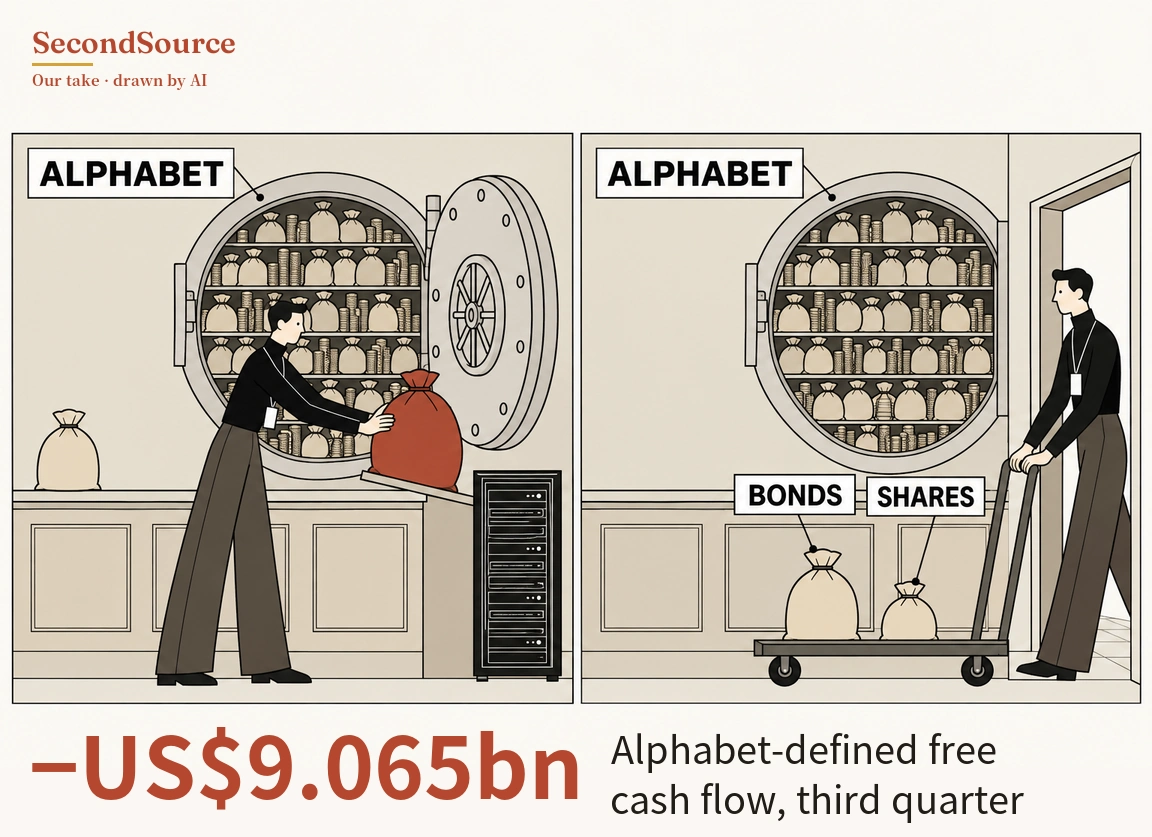
Why it matters: Our inference: Alphabet now pays for part of its build with bonds and new stock, so investors forecasting its build pace have to assume that outside money stays available, not only that cash flow holds.
Alphabet filed its third-quarter results with the US Securities and Exchange Commission on October 28, for the quarter ended September 30.
Spending on equipment ran ahead of the cash the business generated. The cash flow statement in the filing shows net cash from operating activities of US$42.29 billion and purchases of property and equipment of US$51.355 billion. Alphabet defines free cash flow as operating cash flow minus equipment purchases, and by that definition the quarter came to −US$9.065 billion. The measure is not part of generally accepted accounting principles. The previous quarter was also negative, at −US$5.855 billion, and the trailing twelve months add up to only US$19.747 billion (Alphabet 8-K, 2026-10-28). The quarter's US$51.355 billion is more than double the US$23.953 billion of a year earlier, and the first nine months total US$131.953 billion.
In the same quarter Alphabet raised money from outside. It issued senior unsecured notes for net proceeds of US$28.7 billion; the filing gives the use as general corporate purposes. It also sold new Class A and Class C shares for net proceeds of US$12.4 billion. The shares went out through an at-the-market program, which sells stock into the market in installments, and the program has US$27.6 billion of capacity left. A year earlier Alphabet bought back US$11.5 billion of its own stock; this quarter the figure was zero. Taken together, net cash from financing activities was an inflow of US$29.4 billion, against an outflow of US$18.4 billion a year earlier.
Google Cloud revenue rose 103% to US$30.7 billion. Total revenue rose 25% to US$127.6 billion. The filing credits demand for enterprise AI infrastructure and AI solutions, and says outside sales of TPU systems, Google's own AI chips, contributed significantly to growth. Google Cloud's segment operating income rose from US$3.594 billion a year earlier to US$11.121 billion. The filing doesn't break out how much of the 103% came from outside TPU system sales, or whether that will continue.
Microsoft reported results the same day. According to analyst Patrick Moorhead's account of the earnings call, Microsoft currently relies mainly on leases, hasn't taken on debt for this buildout, and will tap outside money only when it makes economic sense (Patrick Moorhead on X, after the call). That differs from Alphabet selling both bonds and stock in the same quarter. Microsoft's earnings press release shows Azure revenue of US$33.165 billion for the quarter ended September 30, up 48% year on year, and cash purchases of property and equipment of US$39.367 billion (Microsoft Investor Relations, 2026-10-28). Moorhead reads this as Azure accelerating on less capital spending than expected (Patrick Moorhead on X, 2026-10-28). The expectation he refers to, about US$46 billion, comes from @wallstengine, an earnings-summary account on X (@wallstengine on X, 2026-10-28). The press release has no such figure.
Not proven yet: negative free cash flow isn't an inability to pay; Alphabet holds about US$265 billion How we checked →
Next to watch: whether Amazon's third-quarter capital spending and free cash flow move in the same direction, and Alphabet's free cash flow and outside financing in its next quarterly report. If Alphabet's free cash flow stays negative next quarter but Alphabet stops selling bonds or new stock, the reading that Alphabet's build pace now depends on outside money has to change.
Source and checks
This item ran in the brief of Oct 29, 2026, alongside 16 other items. How we checked it, the quote checks and what was still missing that day are on that issue's How we checked page.
Cite this item
SecondSource (2026). "Alphabet spent US$9.065 billion more than its cash flow." https://secondsource.io/en/news/2026-10-29-7/. Accessed access date.