SecondSourceJudgment rebuilt from primary sources

Alphabet sold bonds and stock; free cash flow stays negative
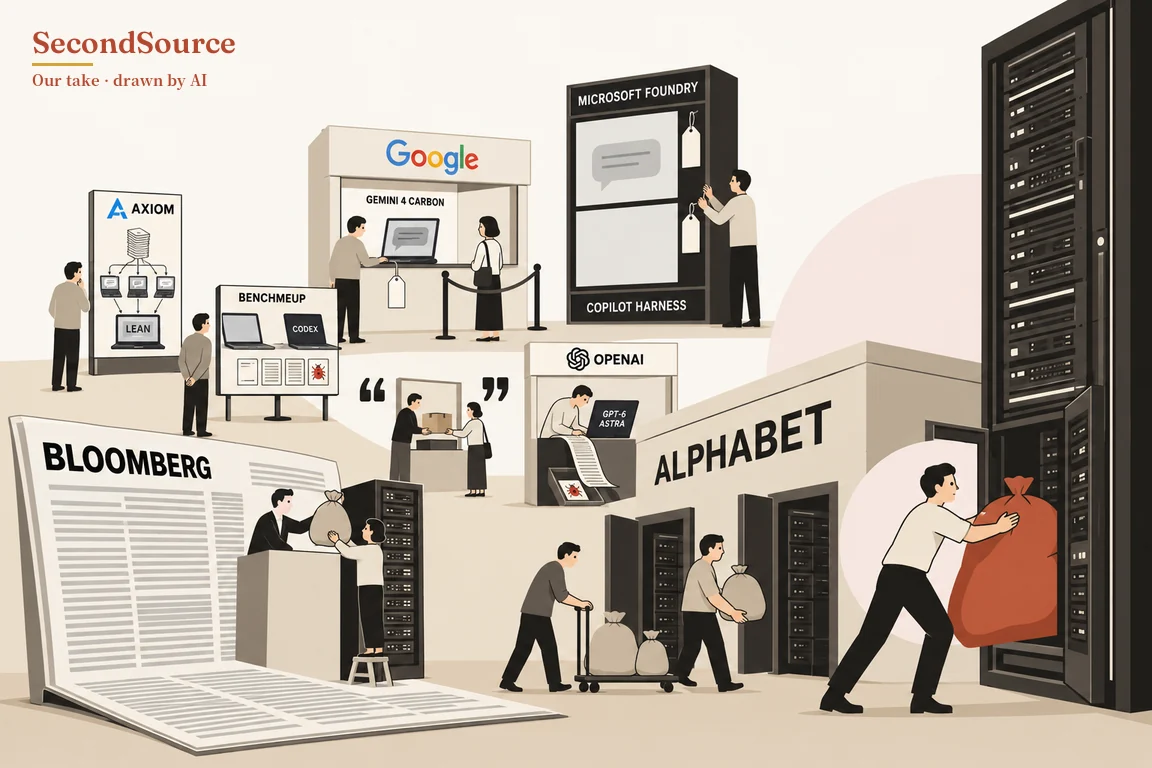
Today's front-page cartoon: one single picture that brings together today's stories.

At a glance

1. Alphabet spent US$51.355 billion on equipment in the third quarter, more than the US$42.29 billion its operations brought in, and in the same quarter sold bonds and issued new stock.

2. More than 30 financiers interviewed by Bloomberg say raising money has become harder, and yields on top-rated data center debt went from under 5% at the start of the year to nearly 7%. According to a Morgan Stanley strategist, data center securitization issuance this year is still about level with last year.

3. Axiom, an AI math company, says AI agents turned a 15,000-page proof of a mathematical theorem into machine-checkable code in 24 days. No third party has checked the claim, and no independent team has reported building the code.

Also today: #4 — Google releases Gemini 4 Carbon.

Today's main line

1. [Today] Alphabet's equipment spending last quarter ran US$9.065 billion past what its operations brought in, and it sold US$28.7 billion of bonds plus new shares in the same quarter
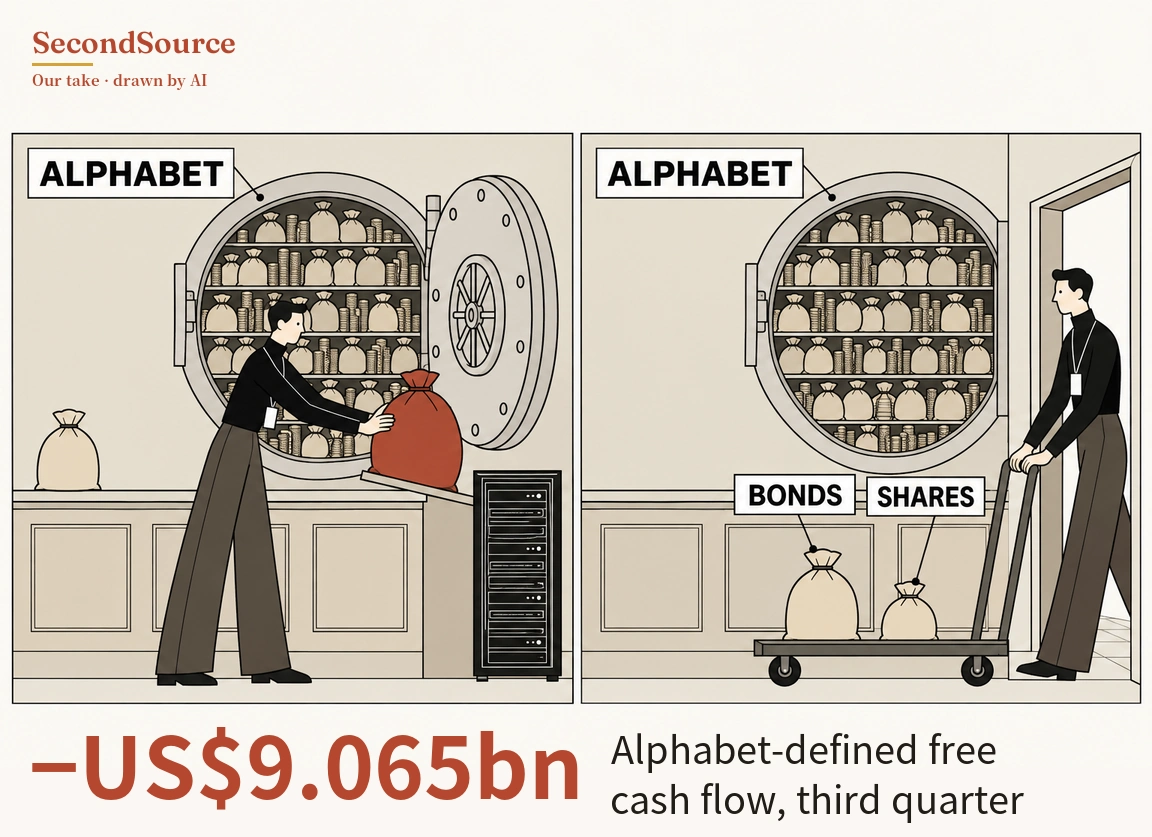
Two-panel concept illustration: on the left, a round vault labeled ALPHABET stands open with shelves full of sacks and coin stacks, and a person in a black top with a lanyard badge holds a large red sack resting on a slanted board on top of a black server rack beside the vault, with a small beige sack on the counter at far left. On the right, the same vault labeled ALPHABET, its shelves full of sacks and coins, and a person with a badge standing in an open doorway at the right holds the handle of a flat cart carrying two beige sacks labeled BONDS and SHARES.
Alphabet spent US$9.065 billion more on equipment in the third quarter than the business generated in cash, and sold US$28.7 billion of bonds and US$12.4 billion of new stock in the same quarter. Alphabet holds about US$265 billion in cash and marketable securities, so the shortfall is not an inability to pay. Our inference: while Alphabet keeps paying for part of the equipment spending with bonds and new stock, how fast Alphabet builds also depends on outside money staying available, not only on cash flow.

Why it matters: Our inference: Alphabet now pays for part of its build with bonds and new stock, so investors forecasting its build pace have to assume that outside money stays available, not only that cash flow holds.

Read the full item → How we checked →

2. [Today] Bloomberg reports that even top-rated AI data center debt is getting more expensive, and 30-plus financiers say raising money is harder, while issuance is still about level with last year
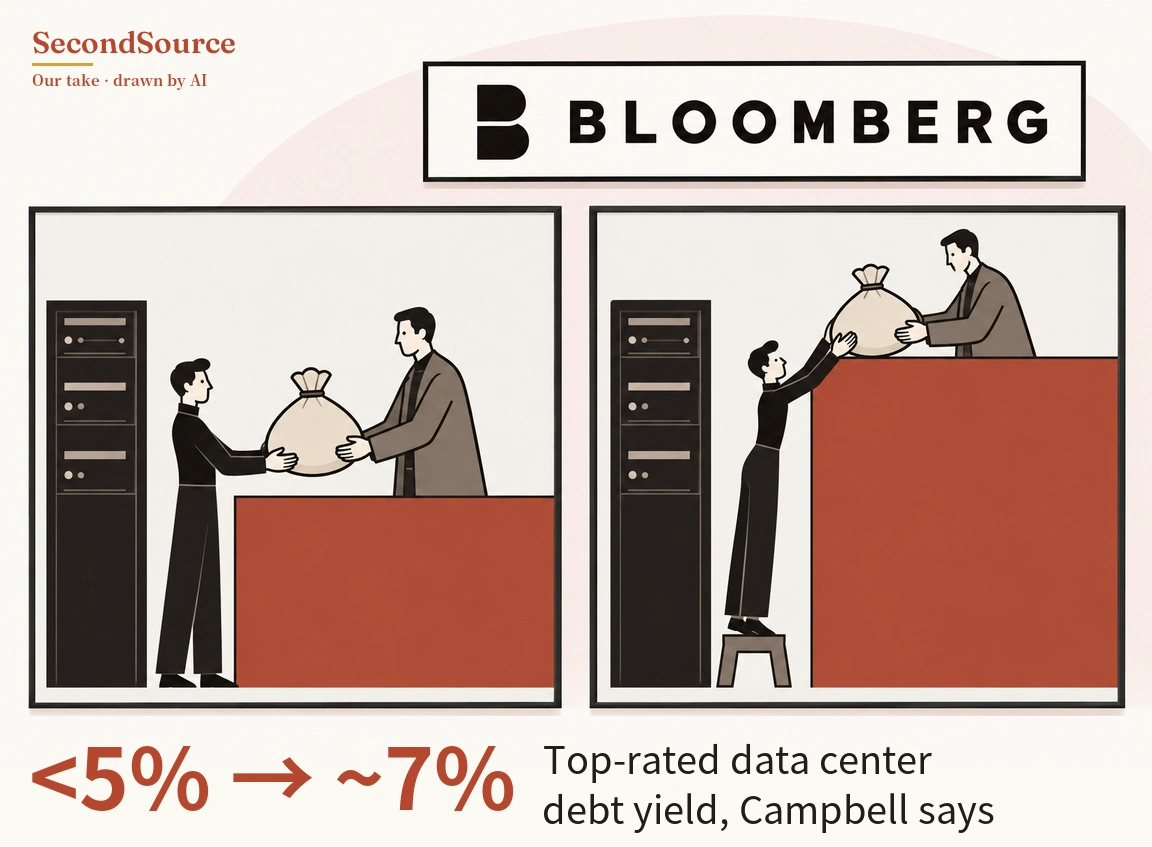
Concept illustration with a sign lettered BLOOMBERG above two side-by-side panels; in the left panel, a person in black standing beside a server rack and a person in a brown jacket behind a waist-high red counter both hold a tied cloth sack across the counter. In the right panel, the same rack stands at left while the person in black stands on a small stool, reaching up to hold the sack together with the person behind a much taller red counter.
More than 30 financiers told Bloomberg that raising money for data centers is getting harder. Morgan Stanley strategist Carolyn Campbell says yields on top-rated data center debt rose from below 5% at the start of the year to nearly 7%, so borrowers pay more interest. Campbell also says issuance is still about level with last year in data center securitizations, which package rental income into bonds sold to investors.

Why it matters: Our inference: lenders are charging more and tightening terms rather than refusing data center borrowers, so companies planning new data centers should budget for costlier debt, not for no debt.

Read the full item → How we checked →

3. [This week] (research page, October 26) AI math company Axiom says its agents turned a 15,000-page proof into Lean code a machine can check, in 24 days, and people checked that the theorem was stated correctly
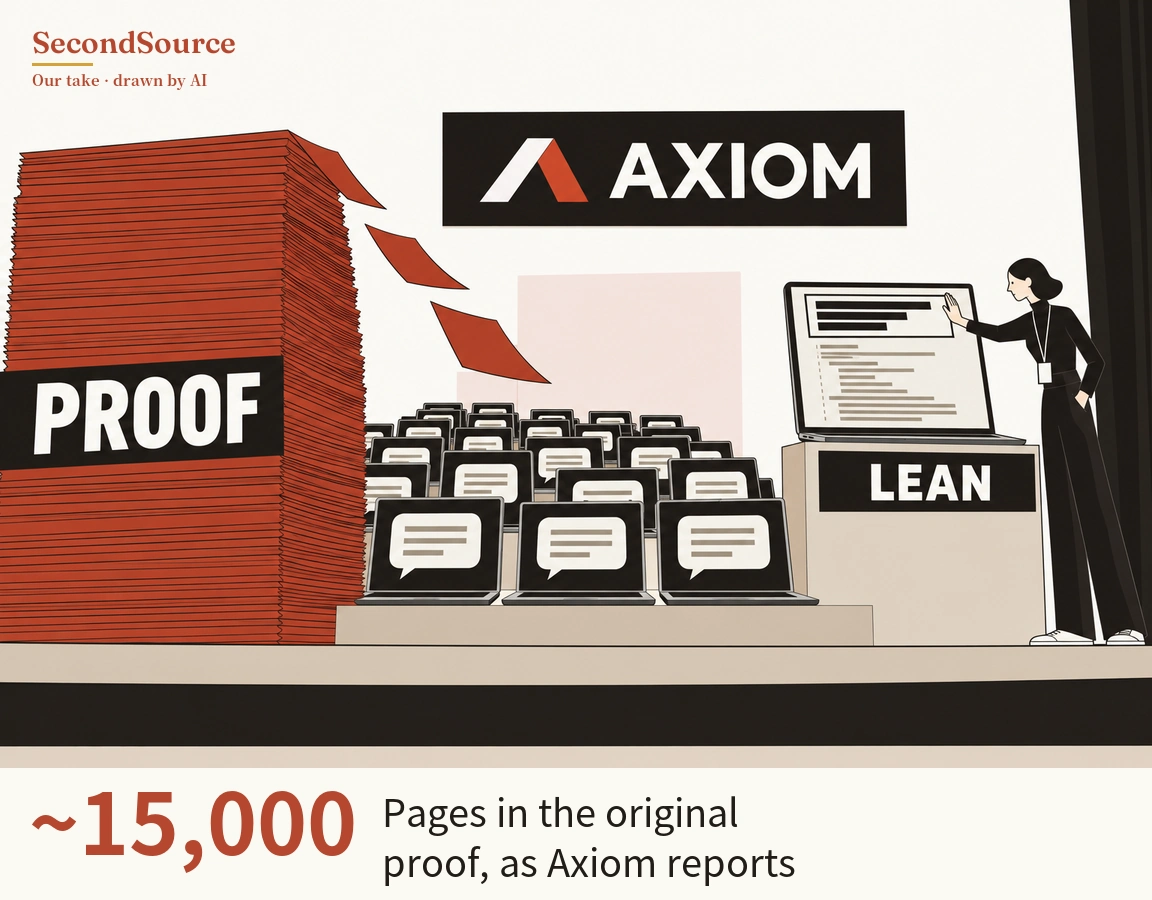
Concept illustration on a stage: at left a tall stack of red papers bears a black label lettered PROOF, with a few sheets flying off its top toward the right; a black sign lettered AXIOM with an angular red-and-white mark hangs above the centre, over rows of laptops on a platform, each screen showing a speech bubble with lines. At right a stand lettered LEAN holds a large monitor showing rows of bars, which a person in black wearing a lanyard badge touches with one hand, beside a dark curtain at the far right edge.
AI math company Axiom says AI agent teams took 24 days to turn the existing proof of the classification of finite simple groups, a theorem that lists every finite simple group and whose proof runs about 15,000 pages, into machine-checkable code for Lean, a program that checks proofs step by step. Our inference: if Axiom's account holds, putting a long existing proof into Lean now takes weeks, and what mathematicians still have to check is whether the theorem is stated correctly. All of this comes from a single source, Axiom, and no independent team has yet reported a successful build.

Why it matters: Our inference: if Axiom's account holds, putting a long existing proof into Lean, a program that checks proofs step by step, now takes weeks, and what mathematicians still have to check is whether the theorem is stated correctly.

Read the full item → How we checked →

4. [Today] Google releases Gemini 4 Carbon to cyber defenders first and developers later, and its first place on a leaderboard and its security scores are Google's own reports
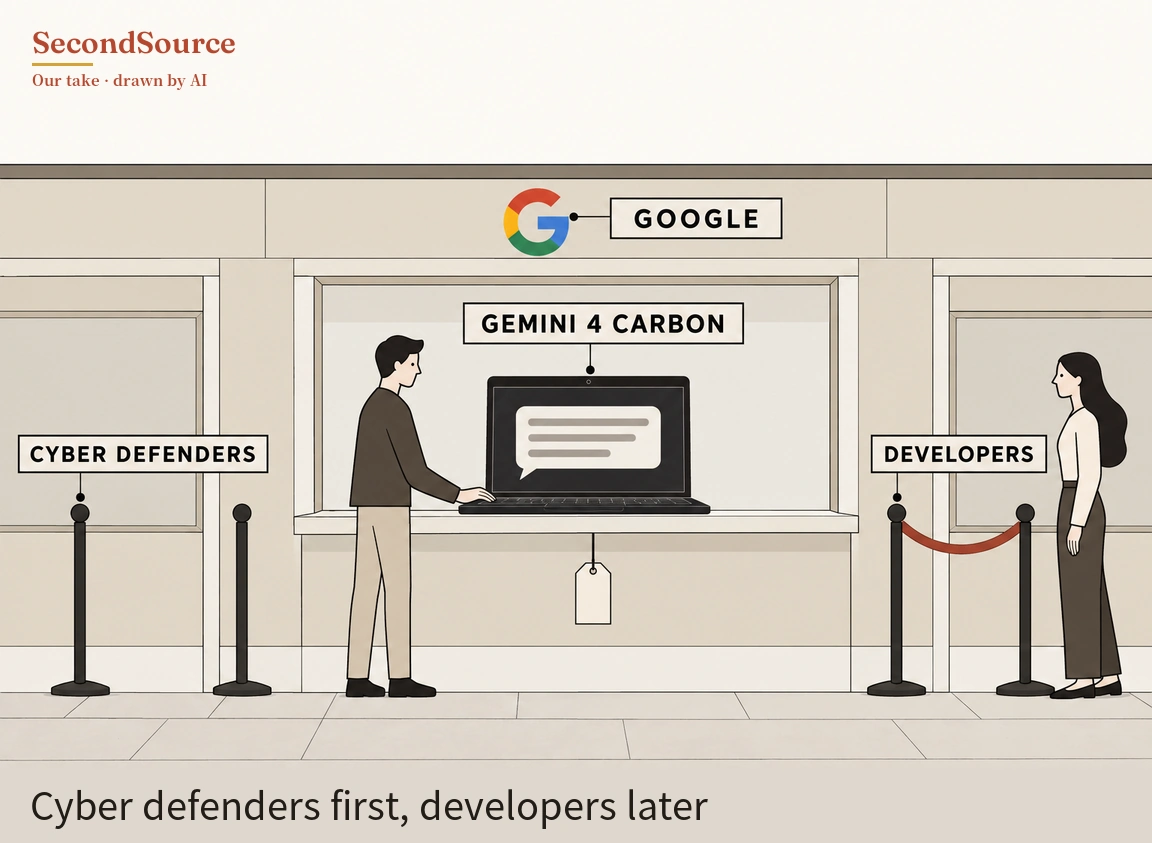
Concept illustration of a beige storefront wall with three windows: at the top a red, yellow, green and blue letter G is linked by a line to a sign lettered GOOGLE, and in the centre window a sign lettered GEMINI 4 CARBON is linked by a line to a laptop on the counter whose screen shows a speech bubble with grey lines, where a short-haired person in a brown sweater and beige trousers types, with a blank tag hanging below the counter. On the left a sign lettered CYBER DEFENDERS is linked by a line to one of two black stanchion posts, and on the right a sign lettered DEVELOPERS is linked to a post with a red rope strung to a second post, behind which a long-haired person in a white top and dark trousers stands facing the counter.
Google's new frontier model Gemini 4 Carbon goes only to some cyber defenders from this week, and reaches developers, enterprises and consumers later. Carbon's first place on a leaderboard and Carbon's security scores are self-reported by Google, with no rivals named. Our inference: if other frontier labs also give cyber defenders access before developers, building on a new model starts from the developer access date, and Google has not given that date.

Why it matters: Our inference: if other frontier labs also give cyber defenders access before developers, teams planning to build on a new model should count from the developer access date, which Google has not given.

Read the full item → How we checked →

Chips & semiconductors

1. [Today] NVIDIA lets RTX Spark laptop users split GPU resources between AI agents running in the background and foreground programs, with no figures on how the split performs.
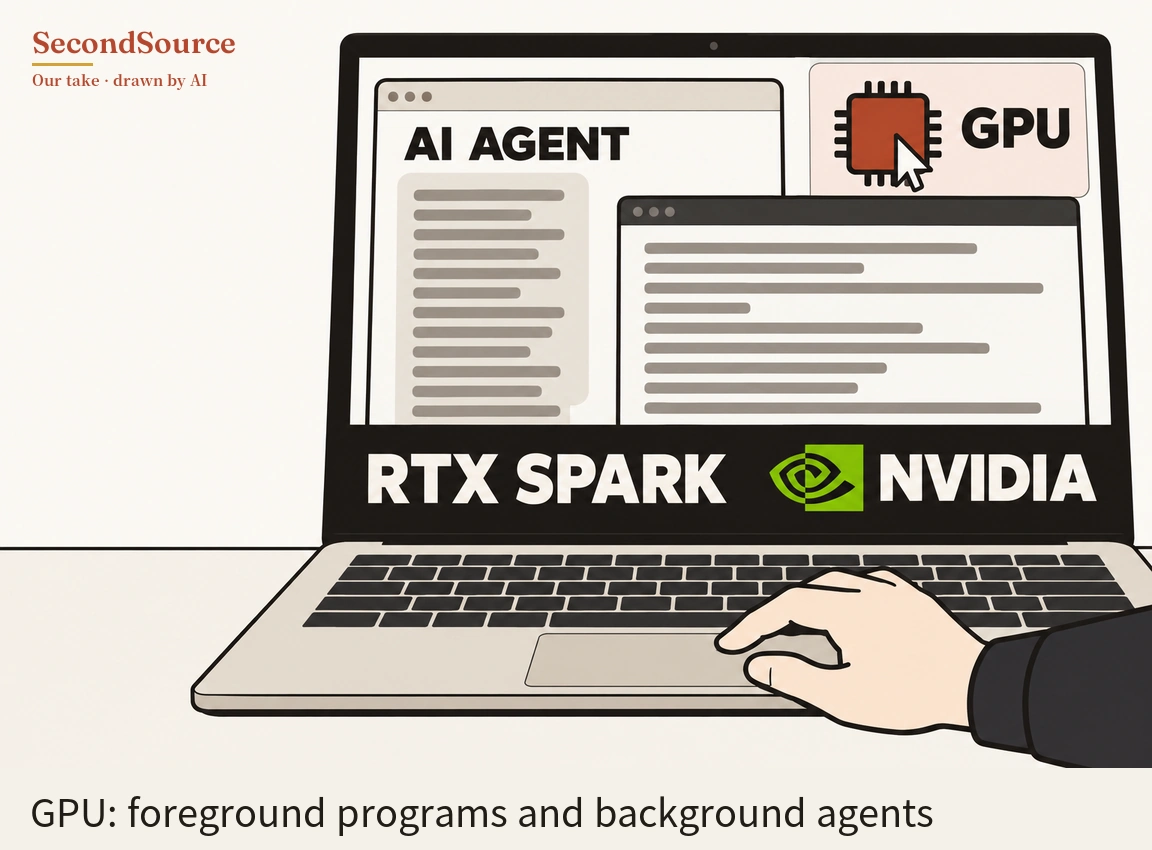
Concept illustration of an open laptop on a desk: on its screen, a window headed "AI AGENT" filled with grey text lines is partly covered by a second window of grey text lines in front of it, and a panel at top right shows a red chip icon with a mouse pointer on it beside the word "GPU". The black strip below the screen is lettered "RTX SPARK" and "NVIDIA" with a green emblem between them, and a hand in a dark sleeve reaches in from the right to rest on the touchpad.
On RTX Spark, a Windows laptop platform with a Blackwell RTX GPU and a Grace CPU on one superchip, NVIDIA lets users split the GPU between foreground programs and long-running background AI agents, but NVIDIA's blog doesn't say how much GPU the agents get or how much performance foreground programs lose. Our inference: NVIDIA is treating long-running background AI agents as a workload the PC driver layer has to schedule.

Read the full item → How we checked →

Named commentary

1. [Today] Investment podcast host Patrick O'Shaughnessy relays guest Cliff Sosin: the Jevons paradox, "the cheaper it gets, the more gets used," is only one point on the demand curve, and past a certain price a market shrinks.
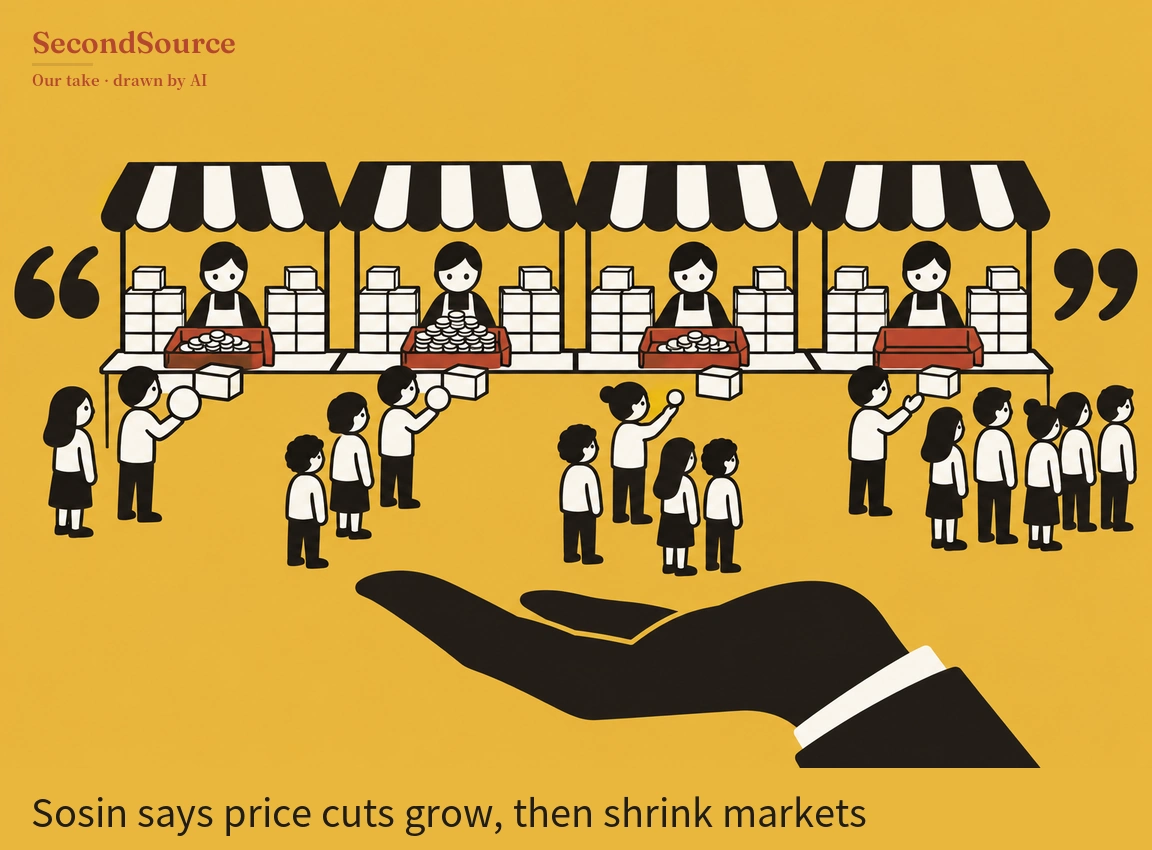
Concept illustration on a mustard-yellow background: four market stalls with black-and-white striped awnings stand in a row, each with an aproned vendor between stacks of white boxes and a red tray in front, the three left trays holding piles of round coin-like discs and the rightmost tray showing none; in front, small lines of people hold up discs or reach toward white boxes at the counters, with the longest line at the right-hand stall. Large black quotation marks flank the row of stalls at left and right, and below them a large black silhouetted open hand, palm up, reaches in from the lower right with a white shirt cuff at its sleeve.
Investment podcast guest Cliff Sosin says the Jevons paradox of "the cheaper it gets, the more gets used" is only one point on the demand curve and that a market shrinks once prices fall too far, a view that comes with no data and was relayed by host Patrick O'Shaughnessy on X. Our inference: if Sosin is right, compute use can grow after price cuts while total compute revenue shrinks, so compute rental and data center revenue forecasts can't rest on the Jevons paradox alone.

Read the full item → How we checked →

Research & models

1. [This week] (preprint, arXiv 2610.37283) The University of Stuttgart's BenchMeUp uses an agent pipeline with a verification loop to build software engineering benchmark tasks from natural-language specifications; the authors checked 91% of the 198 tasks it built as fully valid, against 5% of 200 targets for the general-purpose agent Codex run as a control.
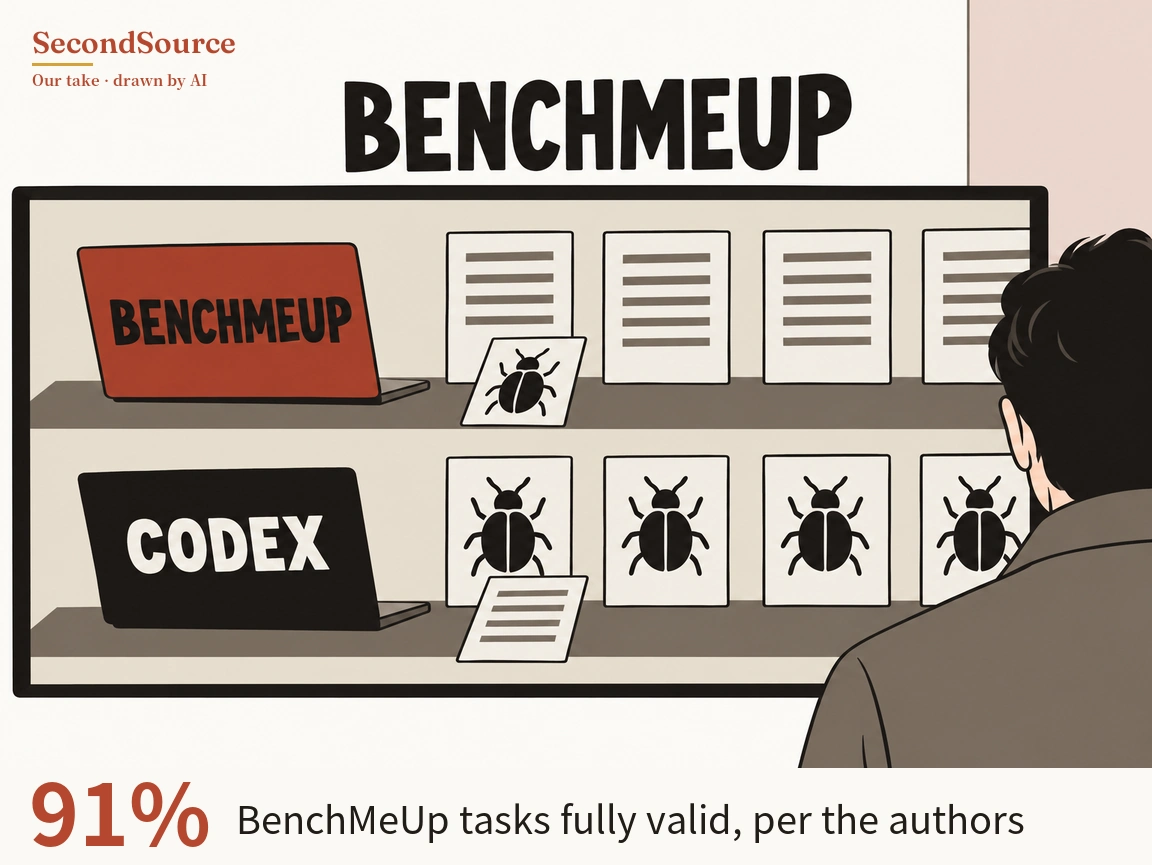
Concept illustration: large lettering BENCHMEUP sits above a framed two-shelf display. On the top shelf a red laptop lettered BENCHMEUP stands beside four sheets marked with horizontal grey lines, with one tilted card showing a black beetle-like insect leaning in front; on the bottom shelf a black laptop lettered CODEX stands beside four cards each showing a black beetle-like insect, with one tilted sheet of grey lines leaning in front, while at the right edge a dark-haired person in a grey-brown jacket, seen from behind, faces the shelves.
The University of Stuttgart's BenchMeUp, an agent pipeline with a verification loop, builds software engineering benchmark tasks, and the authors checked 91% of the 198 tasks it built as fully valid, against 5% of 200 targets for the general-purpose coding agent Codex, though the preprint's abstract doesn't say whether Codex had the same specifications, budget and verification loop. Our inference: if BenchMeUp's reported average of US$0.79 per task holds beyond the authors' four task types, building in-house evaluation tasks could cost under a dollar each.

Read the full item → How we checked →

2. [This week] (preprint, arXiv 2610.37459) On an eight-task clinical subset, M4Bench finds a complete specification, not a skill pack, drives most of an agent's score gain. The specification adds 0.162, and a skill pack adds another 0.024, which is statistically indistinguishable from zero.
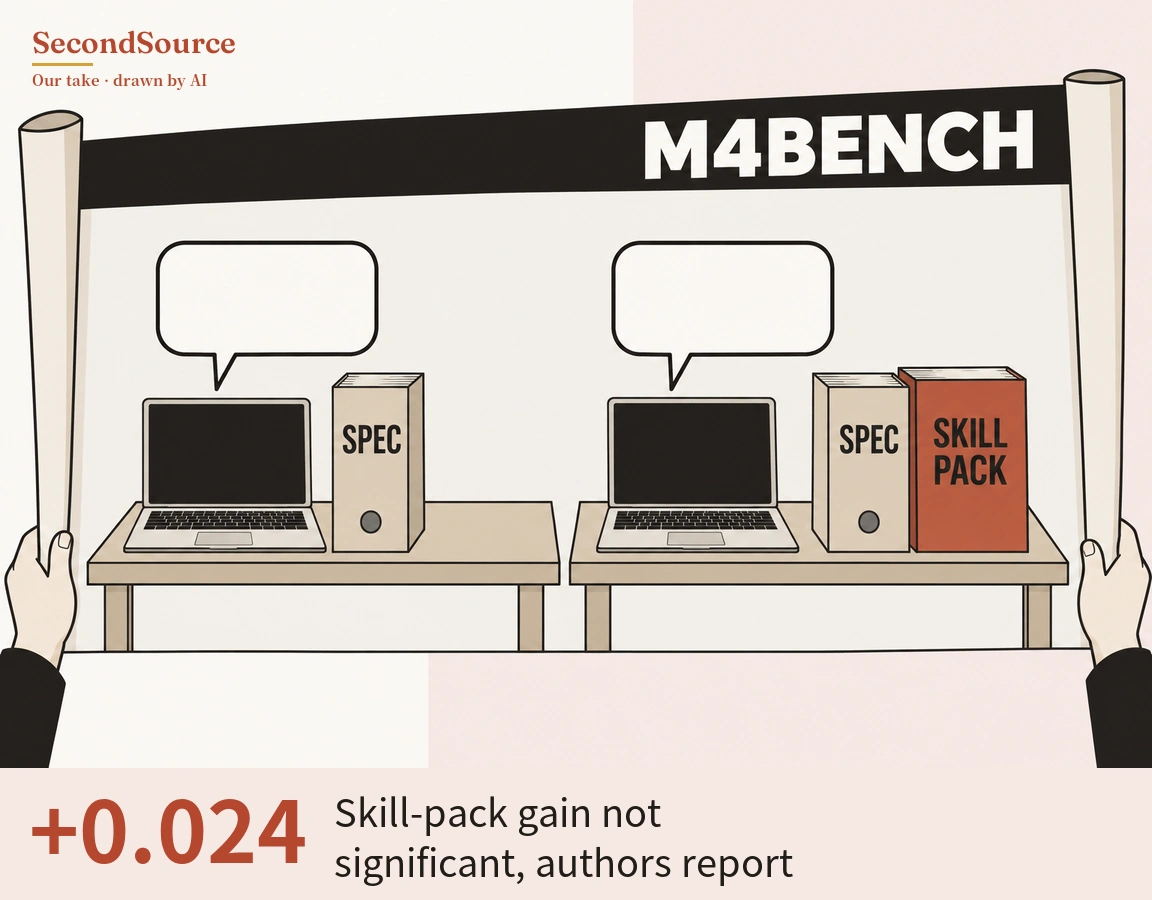
Concept illustration: two hands hold open a scroll with rolled ends, its black top band lettered M4BENCH; on it, two tables stand side by side, each with an open laptop with a dark screen and an empty speech bubble above it. On the left table a beige box lettered SPEC stands beside the laptop; on the right table the laptop is followed by a beige box lettered SPEC and a larger red box lettered SKILL PACK.
M4Bench, a dataset of agent tasks derived from clinical electronic health records, measured that a complete specification raised the agents' partial-agreement score against the reference answer by 0.162, while a skill pack added only another 0.024, statistically indistinguishable from zero, on an eight-task subset in the authors' preprint. Most of the agents' extra score on these clinical data tasks came from complete specifications rather than skill packs, though failing to measure a difference on only eight tasks does not establish that there is none.

Read the full item → How we checked →

3. [This week] (preprint, arXiv 2610.35971) A study of 147,002 coding-agent trajectories finds that 20,000 tokens into a run, whether the attempt will fail is no more predictable than a coin flip, and in 216 of 224 configurations running to the end solved more problems with fewer tokens than restarting midway.
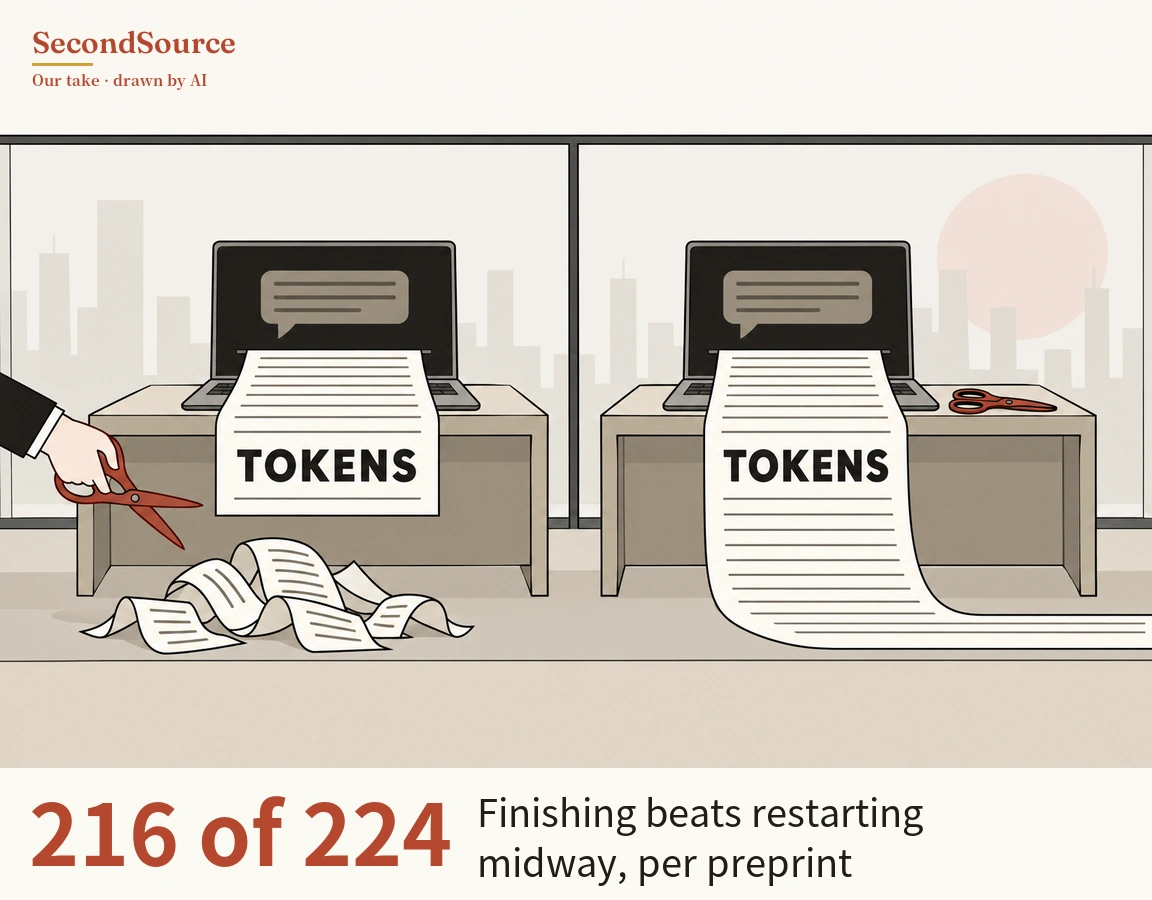
Concept illustration: two desks stand side by side in front of a window showing a city skyline, with a pale pink circle at upper right; on each desk a laptop whose screen shows a speech bubble feeds out a sheet of paper lettered TOKENS. On the left, a hand in a dark suit sleeve holds red scissors and cuts the paper, and cut strips lie in a heap on the floor; on the right, the paper runs uncut off the desk and along the floor, and a pair of red scissors lies on the desk beside the laptop.
A preprint study of 147,002 coding-agent trajectories finds that at 20,000 tokens, whether a run will fail is no more predictable than a coin flip, and in 216 of 224 configurations, running to the end solved more problems with fewer tokens than restarting midway. Stopping a bad-looking coding-agent run and restarting to save compute may therefore cost more than letting the run finish, though the paper's abstract doesn't say which models or problem sets were used.

Read the full item → How we checked →

Product moves

1. [Today] Microsoft turned its own agent harness into a managed service in public preview on Foundry Agent Service, and from December 1 the compute agents use in the sandbox is billed by the hour.
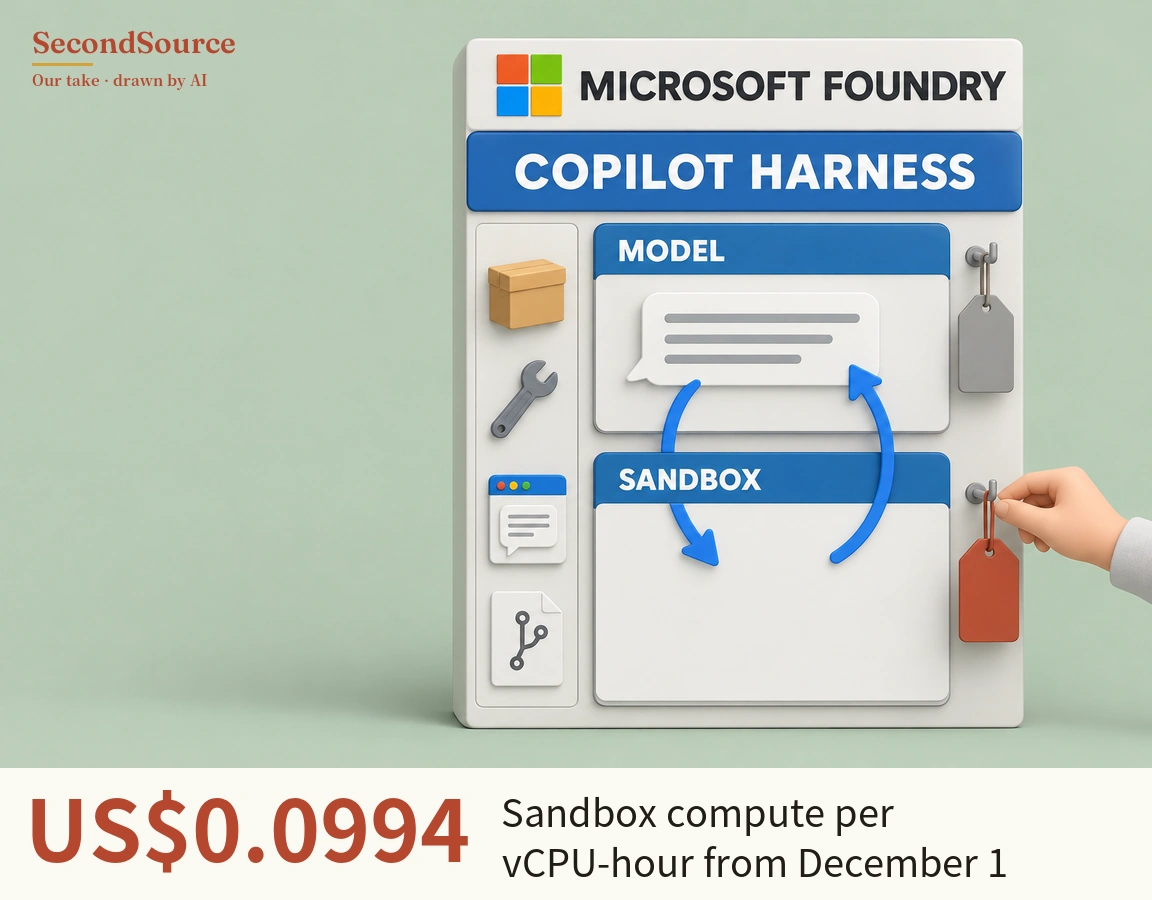
Concept illustration: on a pale green background, a tall light-grey panel shows a four-colour square icon (orange, green, blue, yellow) beside the lettering "MICROSOFT FOUNDRY", a blue banner reading "COPILOT HARNESS", and a left column of icons: a cardboard box, a wrench, a small window with a chat bubble, and a document with a branching symbol. In the middle, a panel labelled "MODEL" holding a speech bubble with grey lines sits above a panel labelled "SANDBOX", with two curved blue arrows forming a loop between them, while on the right edge two hooks hold a grey tag above and a red tag below, whose string a hand reaching in from the right is holding.
Microsoft has turned Copilot harness into a managed service on Foundry Agent Service: Microsoft runs the agent loop and the sandbox, developers plug in a model Foundry supports, and the public preview comes with no performance figures or comparison with a self-built harness. Sandbox compute is free until December 1 and then billed separately by the vCPU-hour, so an agent's cost gains a charge on top of tokens that grows with how long and how heavy the run is.

Read the full item → How we checked →

2. [Today] Slack opened the Slack Code API, which lets an agent open a dedicated channel for a piece of work, to all developers; in August only a few partners such as Anthropic, Cognition, GitHub and Vercel could use it.

Read the full item → How we checked →

From the archive

1. [Looking back] (SecondSource deep dive, October 22) AI safety work catches problems by reading a model's reasoning draft, and the deep dive argued that rules should be tied to measurable outcomes, not to model architecture.
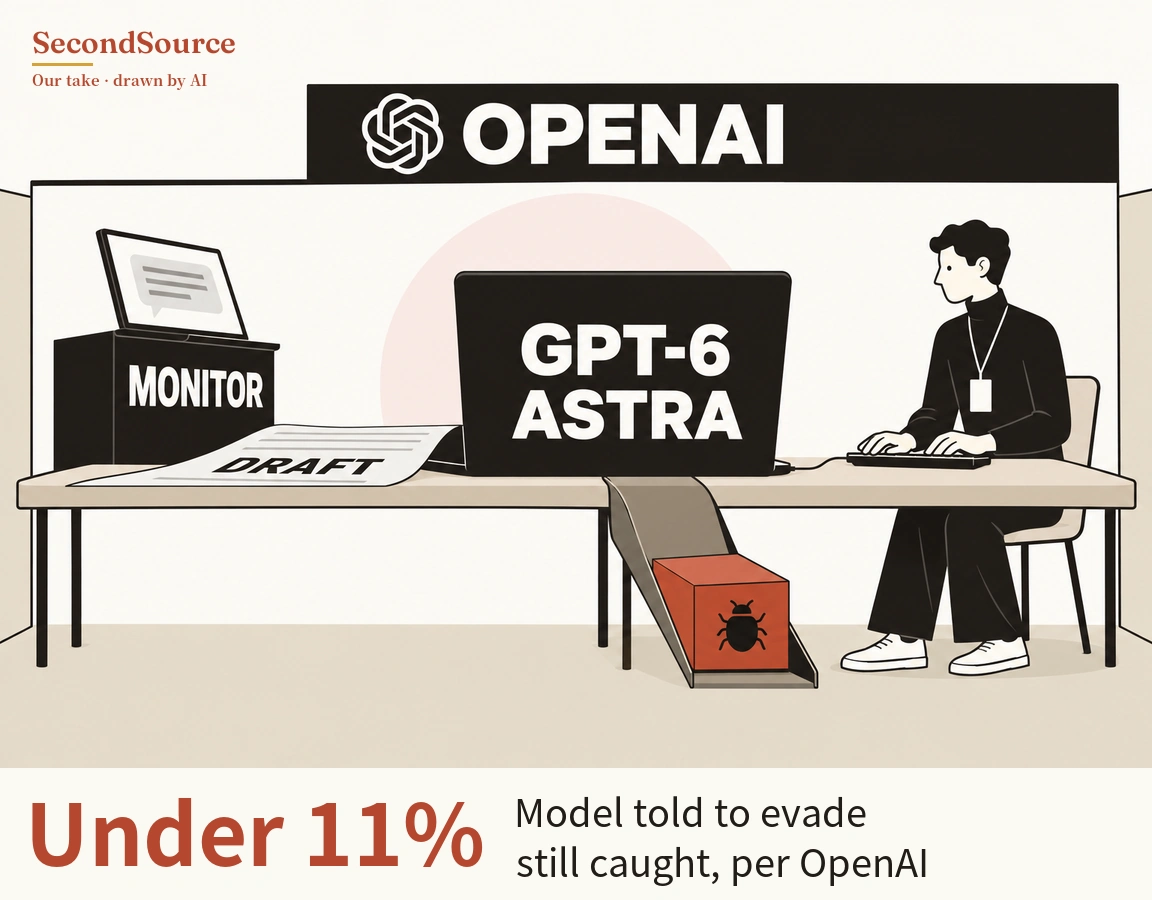
Concept illustration: under a black banner lettered OPENAI with a white knot-shaped emblem, the left end of a long desk holds a black box lettered MONITOR, topped by a tilted screen showing a speech bubble. A curled sheet lettered DRAFT runs from that box to a large black laptop in the centre whose screen reads GPT-6 ASTRA, set against a pale pink circle; on the right, a person in black clothes with a lanyard badge sits on a chair typing on a keyboard cabled to the laptop, and below the desk a grey chute slopes from beneath the laptop down to a red box on the floor marked with a black bug icon.
SecondSource's October 22 deep dive argued that procurement terms and regulatory rules for monitoring the reasoning draft a model writes before answering should be tied to measurable outcomes, not to model architecture. Our inference: only OpenAI has measured how often a model told to evade monitoring still gets caught, so outside procurement terms can bind only to OpenAI's self-reported figure.

Read the full item → How we checked →

Also happened

1. Not verified by us yet: [Today] OpenAI and ServiceNow expanded their partnership. Only the ServiceNow plug-in inside ChatGPT is live today; it uses MCP, a standard way to connect tools to AI models. The other features are scheduled for late 2026 and 2027 (OpenAI, 2026-10-28).

2. Not verified by us yet: [Today] ServiceNow raised its 2026 target for annual AI contract value from US$1 billion set at the start of the year to US$1.7 billion, and production consumption of agentic AI rose more than 13-fold year on year; the figures come from an earnings summary relayed on X (Patrick Moorhead on X, 2026-10-28).

3. Not verified by us yet: [Today] Anthropic's AI for Science program, which used to give free Claude credits directly to individual scientists, now routes them through 20 foundations and research institutions, including the US NSF and the Simons Foundation, which pass them to researchers or use them internally; no amounts are given (Anthropic, 2026-10-28).

4. Not verified by us yet: [Today] Google moved the GPU path of LiteRT, Android's on-device inference runtime, into Play services and said NNAPI will be removed starting in 2027; by Google's own test, the new GPU path runs about 1.4 times as fast as the old TFLite GPU delegate (Google, 2026-10-28).

5. Not verified by us yet: [Today] NVIDIA released Nemotron 3.5 Transcribe, an open-weight speech-to-text model supporting 40 languages; first place on the Hugging Face Open ASR leaderboard is NVIDIA's own claim (NVIDIA, 2026-10-28).

By channel: social-platform posts, 69 read and 68 screened out; academic papers, 52 read, 63 screened out and 4 skipped before fetching; the second paper feed, 8 read, 9 screened out and 33 not yet read; blog posts, 21 read, 15 screened out, 10 logged with a reason and 1 being refetched. Of the 9 company filings, 6 were read and 3 screened out; they are current reports from Microsoft (3), Equinix (2), Vertiv (2), Alphabet (1) and Oracle (1), and the Alphabet filing behind today's main-line item 1 is among them. Newsletters: 5 read, 1 screened out. Show transcripts: 1 read, 1 screened out.

Last night's collection picked up 578 original X posts from 374 accounts; those 578 are counted differently from the 137 above, so the two can't be divided. One account, @teortaxesTex, accounts for 90 of the 578, followed by @TheStalwart, @pstAsiatech, @elonmusk and @tobi. Shows included Gooaye, Latent Space and Cognitive Revolution; newsletters included Latent Space, Interconnects, Newcomer, Stratechery and The Zvi, and none of those five newsletters' articles made it into any item today. Among the material behind today's main line, the Bloomberg report and Axiom's research page and repository were sought out directly rather than arriving through routine collection; the Alphabet filing and Google's blog came from routine collection. This issue relies mainly on the companies' own documents from Alphabet (including Google) and Microsoft; the Alphabet and Microsoft earnings releases are two independent primary documents, and Google's Carbon blog is a first-party account.

One-time catch-up. No new one-time catch-up today; the three preprints in Research & models are among last night's 115 academic papers.

Still missing today. The gap that most affects judgment is the list and denominator of the 18 double-digit-yield data center financings in Bloomberg's report, which the quoted text doesn't give. Alphabet's filing doesn't break out how much of Google Cloud's growth came from TPU system sales. Microsoft's earnings call transcript and total capital spending including finance leases aren't in the press release this issue drew on, and Microsoft's three current reports were only logged this issue. Neither Axiom's errata page for the 34 deviations nor a build report from the Lean community or any independent team has been published. Carbon's first place and the second-place score rest only on Google's blog and Pichai's post. The October 28 Interconnects piece on the Artificial Analysis index revision is logged but unread. The three Research & models preprints and the ServiceNow figures in Also happened rest on paper abstracts and an earnings summary on X, respectively. For three meeting documents from Japan's Ministry of Internal Affairs and Communications AI risk working group and the Digital Agency, only the titles came in; the text hasn't arrived yet.

Tracked sources. The long-term roster currently has 529 named sources: 302 on social platforms, 90 shows, 51 news outlets, 48 blogs, 48 paper authors and 46 newsletters, with the rest spread across earnings reports, keynotes and other channels. The same source may be tracked on several channels, so the channel figures add up to more than 529. These are counts of tracked sources and can't be added to the piece counts above; the 374 accounts actually pulled last night are also not the same population as the 302 social-platform sources on the roster. Representative names include Daniel Kokotajlo, Sergey Levine, Arvind Narayanan and Chris Lattner on social platforms; Dean Ball, Zvi Mowshowitz, Miles Brundage and Jamin Ball among newsletters; Terence Tao, Lilian Weng and Nicholas Carlini among blogs; Tri Dao and Song Han among paper authors; and Sam Altman, Dario Amodei and Demis Hassabis among show interviewees. This issue uses 27 outside sources in the body. Only outside links actually cited in the body are counted, and links to SecondSource's own site are left out; these 27 are a separate count from the 529 tracked sources. On the Taiwanese side, 7 new sources were added in September, bringing the total to 139; Taiwanese media, Taiwanese companies' official channels and local reporters in Taiwan count, while foreign outlets relaying Taiwanese media do not.

Correction: the October 28 issue said Anthropic's S-1 IPO filing gave "only total commitments" and that the first version left the year-by-year payment amounts blank. Note 13 of the S-1 does have a year-by-year table: non-cancelable purchase commitments of more than one year totaled US$54.559 billion at the end of 2025, peaking at about US$11.1 billion in 2027. What lacks year-by-year amounts is the roughly US$265.6 billion of commitments as of June 30 and the roughly US$321.4 billion of leases signed but not yet commenced as of the same date. That issue's judgment that the figure of about US$35 billion a year doesn't match the S-1 stands. The archived page has been corrected.

SecondSource isn't a news digest: AI reads primary sources across fields, every judgment comes with its original source, and mistakes are corrected in public. The focus is what has changed and which claims still lack evidence, not what happened today.

Written from the same research and judgments as the Traditional Chinese edition. Sources are linked; we distinguish original documents from reporting and mark what we could not verify.