Looking back · SecondSource call, October 25
Shrinking the data AI models hold during a conversation hasn't cut AI chips' memory demand; SecondSource's reading is that the demand has moved.
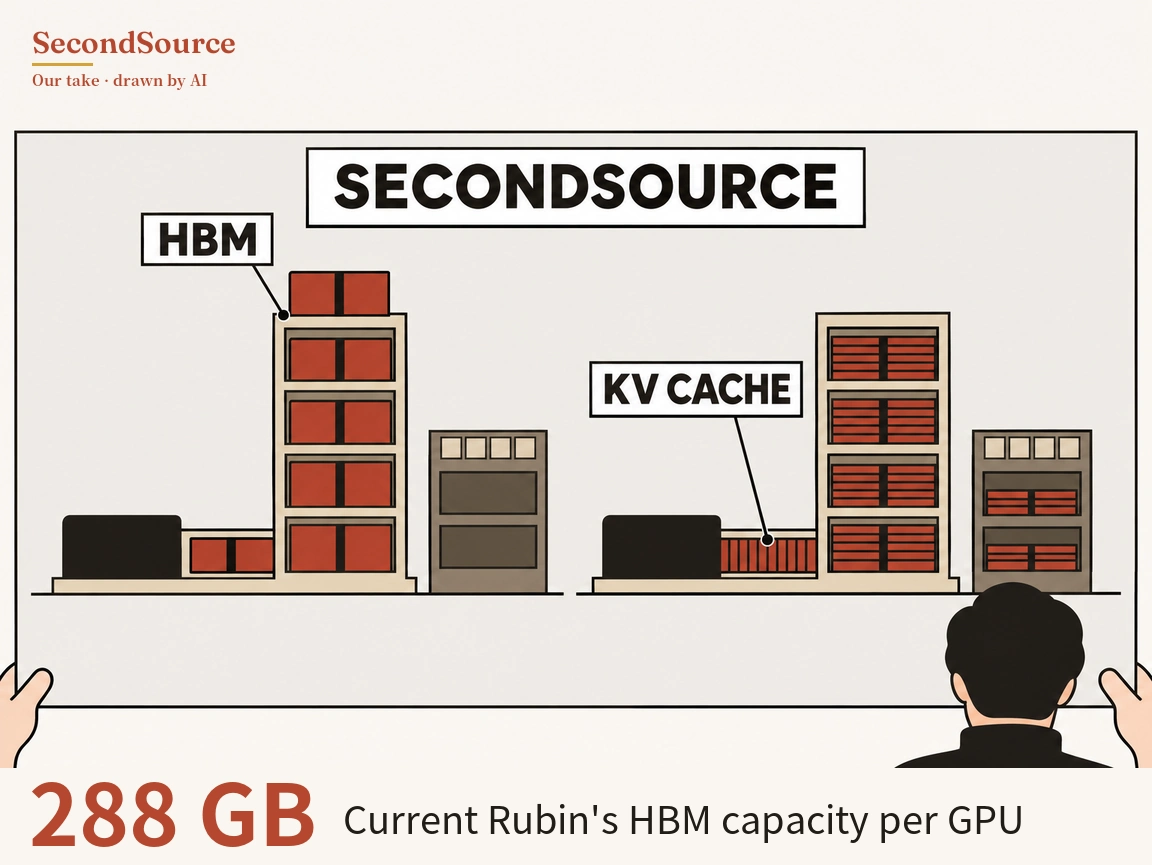
Our inference: the demand has shifted from how much high-bandwidth memory next to the GPU can hold to how much data it can move per second, and to memory off the GPU. HBM is the high-bandwidth memory stacked beside the GPU. The KV cache is the intermediate data a model holds during a conversation, and KV compression shrinks it. The reasoning in the October 25 deep dive was that once that cache shrinks, one GPU can serve more conversations at once. All of those conversations read from the same memory stack, so per-second data movement tightens first. Whatever doesn't fit moves off the GPU (card). The test is one spec: SecondSource expects the officially published HBM capacity per GPU of NVIDIA's next-generation Rubin Ultra to be no higher than the current Rubin's 288 GB. Industry reports say NVIDIA is weighing fewer HBM stacks for Rubin Ultra, and the final spec hasn't been published. If NVIDIA publishes a capacity above 288 GB before March 31, 2027, this call has to be rewritten; that deadline is one SecondSource set. How we checked →
Source and checks
This item ran in the brief of Nov 4, 2026, alongside 10 other items. How we checked it, the quote checks and what was still missing that day are on that issue's How we checked page.
Cite this item
SecondSource (2026). "Shrinking the data AI models hold during a conversation hasn't cut AI chips' memory demand; SecondSource's reading is that the demand has moved.." https://secondsource.io/en/news/2026-11-04-7/. Accessed access date.