SecondSourceJudgment rebuilt from primary sources

SpaceX's Memphis power to fall under half; one firm says so

Source: SemiAnalysis
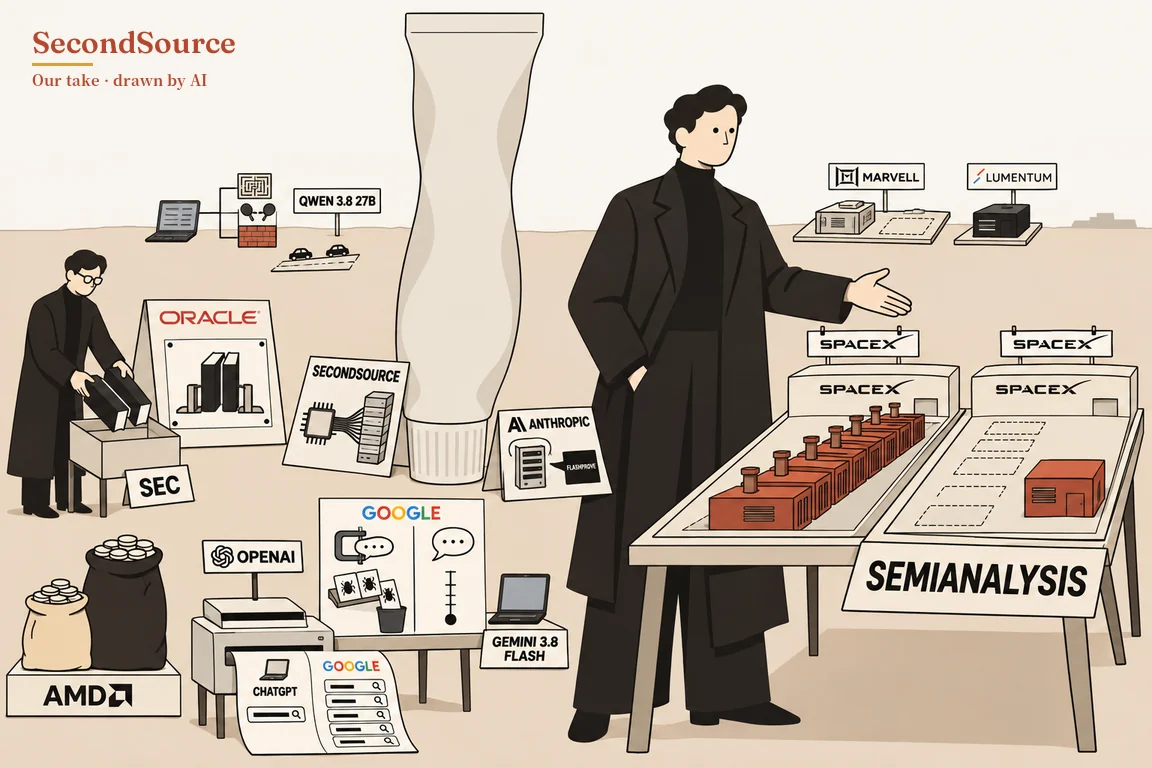
Today's front-page cartoon: one single picture that brings together today's stories.

At a glance

1. SemiAnalysis estimates that because an agreement requires SpaceX's temporary turbines near Memphis to come out, on-site generation at the campus falls from 2.7 GW to 1.24 GW from July 2027; no other firm has published an estimate.

2. Oracle filed to sell US$10 billion of stock and US$10 billion of bonds, US$20 billion in all, the same size as the outside-funding cap Oracle set for itself on October 28.

3. AMD self-reports third-quarter data-center revenue of US$8.5 billion, up 97% from a year earlier, and names Anthropic and four other companies running its first Helios rack-scale AI systems.

Also today: #4 — on a laptop, Simon Willison got an open-weight model to tell from a small network's weights which game it plays; #5 — the figure putting ChatGPT search at a fifth of Google's is OpenAI's own.

Today's main line

1. SemiAnalysis: SpaceX turned a plant into a data center in 91 days, but its Memphis-area campus will keep under half its on-site power from July 2027
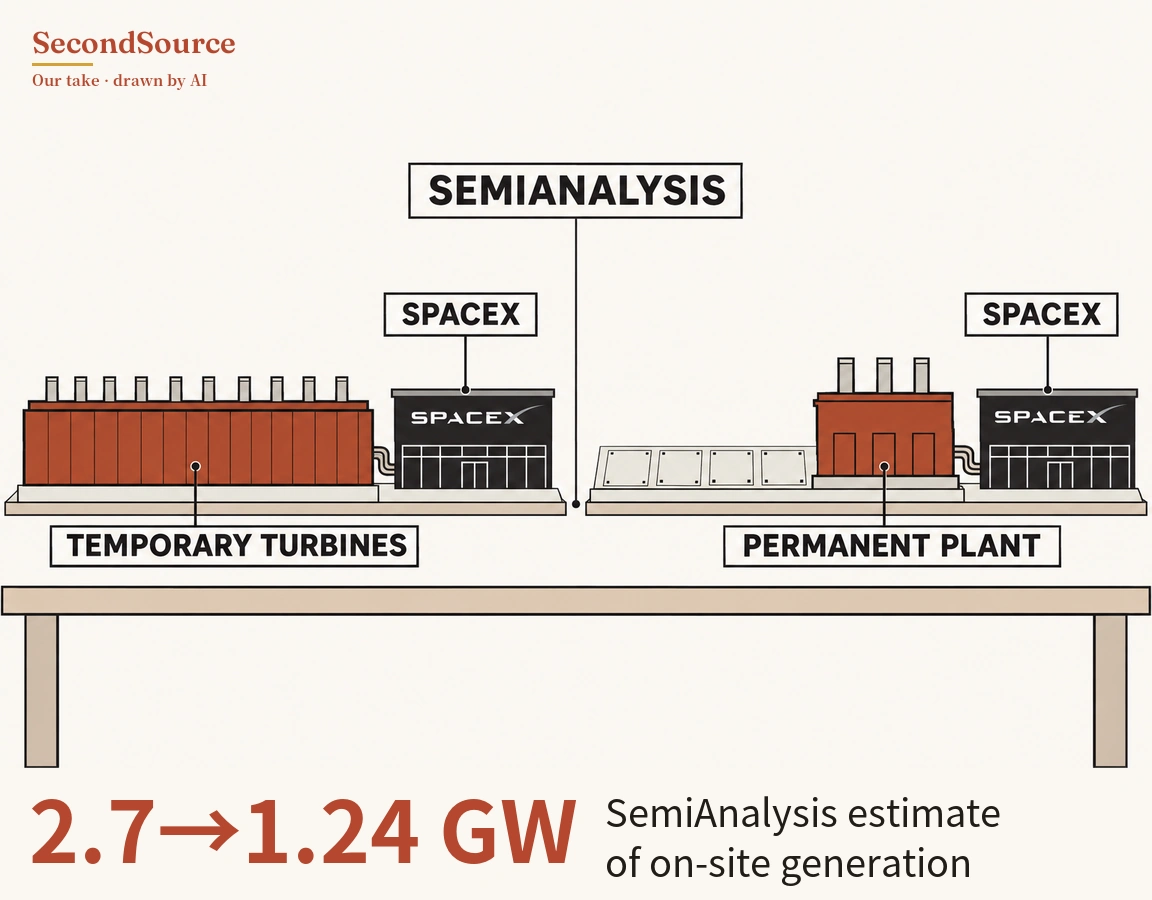
Concept illustration: on a long beige table sit two separate platforms; on the left one, a long brick-red building with ten chimneys, tagged TEMPORARY TURBINES, is joined by wavy pipes to a black glass-fronted building lettered SPACEX, with a SPACEX tag above it. On the right platform, from left to right, are a row of four pale flat panels and a smaller brick-red building with three chimneys, tagged PERMANENT PLANT, joined by wavy pipes to a second black building lettered SPACEX, while a SEMIANALYSIS tag at the top centre has a line running down to the gap between the two platforms. Printed on the image: 2.7→1.24 GW SemiAnalysis estimate of on-site generation.
SemiAnalysis, an analysis firm that tracks AI infrastructure, estimated on November 3 how much on-site generating capacity SpaceX's Memphis-area campus will keep from July 2027, once the campus's temporary turbines are removed. SpaceXAI, SpaceX's AI business, announced an agreement with the Mississippi Department of Environmental Quality to remove all 69 temporary gas turbines before July 2027, with a permanent plant of 41 fixed turbines replacing the temporary ones. The capacity estimate comes from SemiAnalysis alone, with no second source.

Our inference: buyers planning to rent SpaceX compute in 2027 should judge the Memphis campus by its grid power and batteries, not by how fast SpaceX builds data halls.

SpaceX builds data centers faster than the rest of the industry.

On-site generation at the Colossus 2 campus has been shrinking since August.

The grid covers only part of that gap.

Read the full item →

2. Oracle files for US$10 billion of stock and US$10 billion of bonds, the same amounts as the funding cap it announced five days earlier(event date Nov 2)
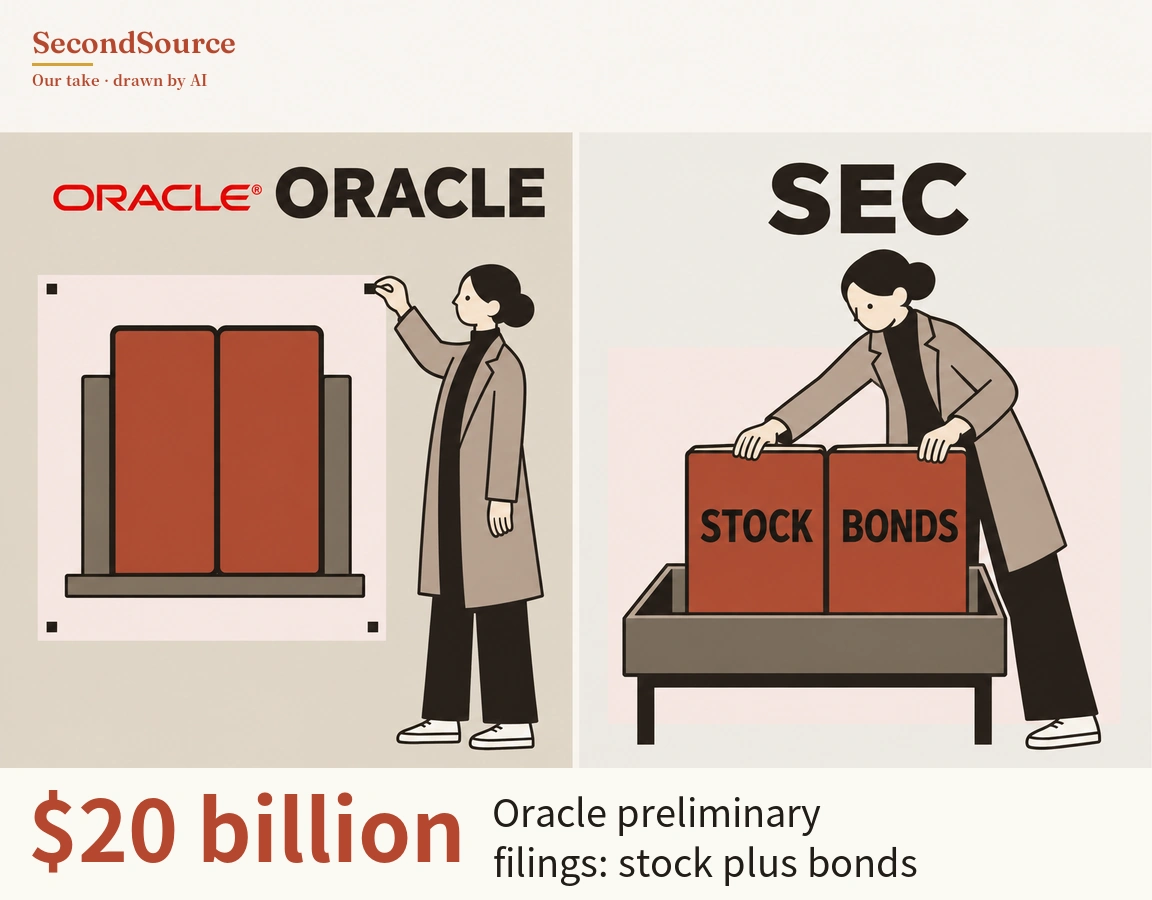
Concept illustration in two side-by-side panels: on the left, under the lettering ORACLE® in red and ORACLE in black, a person with hair in a bun and a long beige coat reaches up to the top-right corner of a pale pink square marked with small black corner squares, inside which two tall red panels stand side by side in a grey frame on a grey ledge. On the right, under large black letters SEC, a person in the same style of beige coat leans over a grey open tray on legs, hands resting on two red blocks lettered STOCK and BONDS that sit side by side in the tray. Printed on the image: $20 billion Oracle preliminary filings: stock plus bonds.
Oracle filed preliminary prospectuses with the SEC on November 2 to sell common stock and bonds, in the same amounts and split as the cap on new outside funding through fiscal 2030 that Oracle set on October 28, a cap with no legal force. The prospectuses don't say whether the offering counts toward the cap; the cap excludes refinancing, meaning new debt that repays old debt, so if any part of the bonds is refinancing, that part does not count toward the cap. The share price, the bond coupons and the final amounts are still blank in the preliminary prospectuses.

Our inference: if both offerings count toward the cap, Oracle's lenders and landlords should stop asking how much more Oracle can raise and watch the leases, customer prepayments and vendor financing outside the cap.

Oracle's financing guidance has already changed once this year.

Outside the cap, Oracle has other routes that don't count as outside fundraising.

Read the full item →

3. AMD's third-quarter data-center revenue rose 97% from a year earlier, and AMD names five customers running its first Helios racks
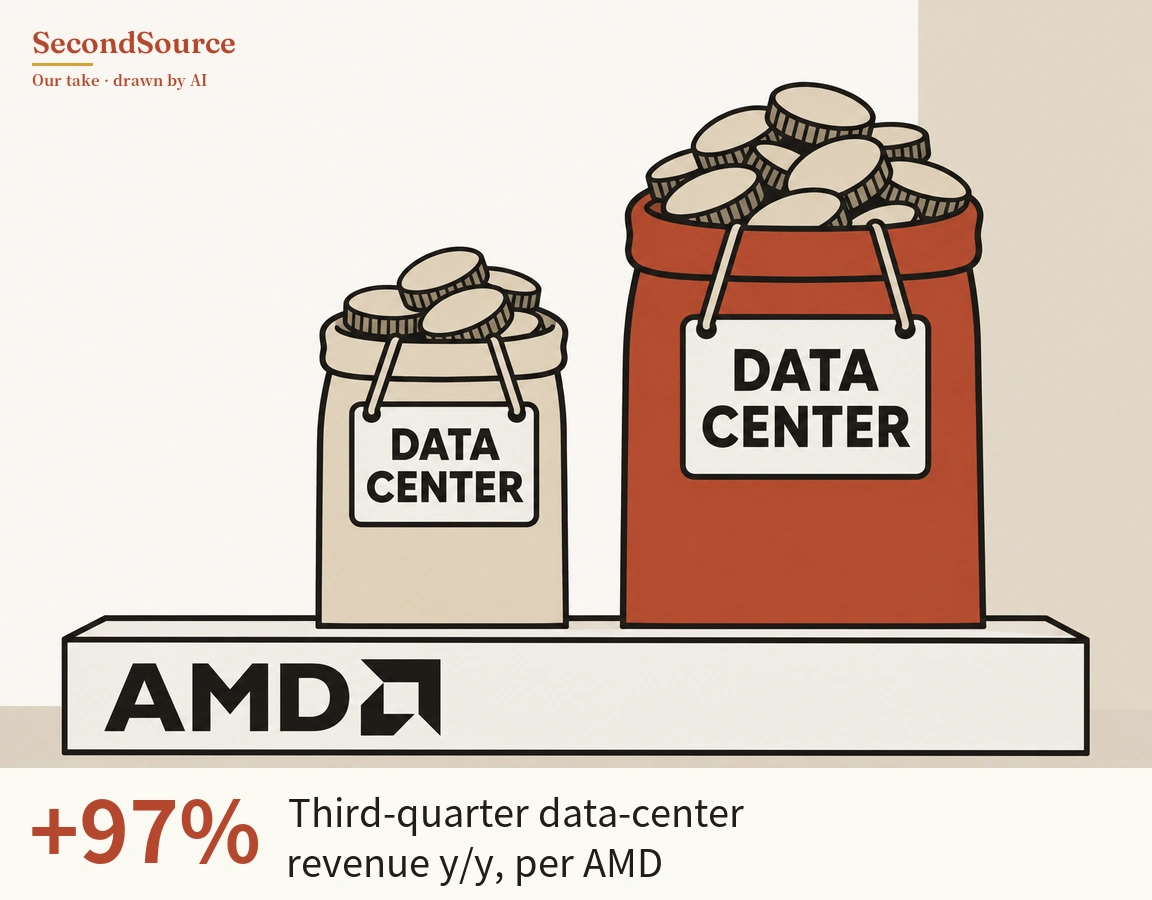
Concept illustration: a long white platform has the lettering "AMD" on its front, next to an angular, arrow-like square symbol. Two cloth sacks stand side by side on it, a smaller beige one on the left and a larger brick-red one on the right; both are heaped with coins at the top, and each has a tag hung on cords that reads "DATA CENTER". Printed on the image: +97% Third-quarter data-center revenue y/y, per AMD.
AMD reported third-quarter results on November 3 and named Anthropic, Meta, Microsoft, OpenAI and Oracle Cloud Infrastructure as running models and workloads on the first Helios rack systems. Helios is AMD's AI system that ships MI450 GPUs and sixth-generation EPYC processors assembled as a full rack. The results and the customer list are self-reported by AMD, and AMD does not say at what scale the five customers run Helios.

Read the full item →

4. On a laptop, Simon Willison got the open-weight Qwen 3.8 27B to name the game behind three of four small networks from their weights
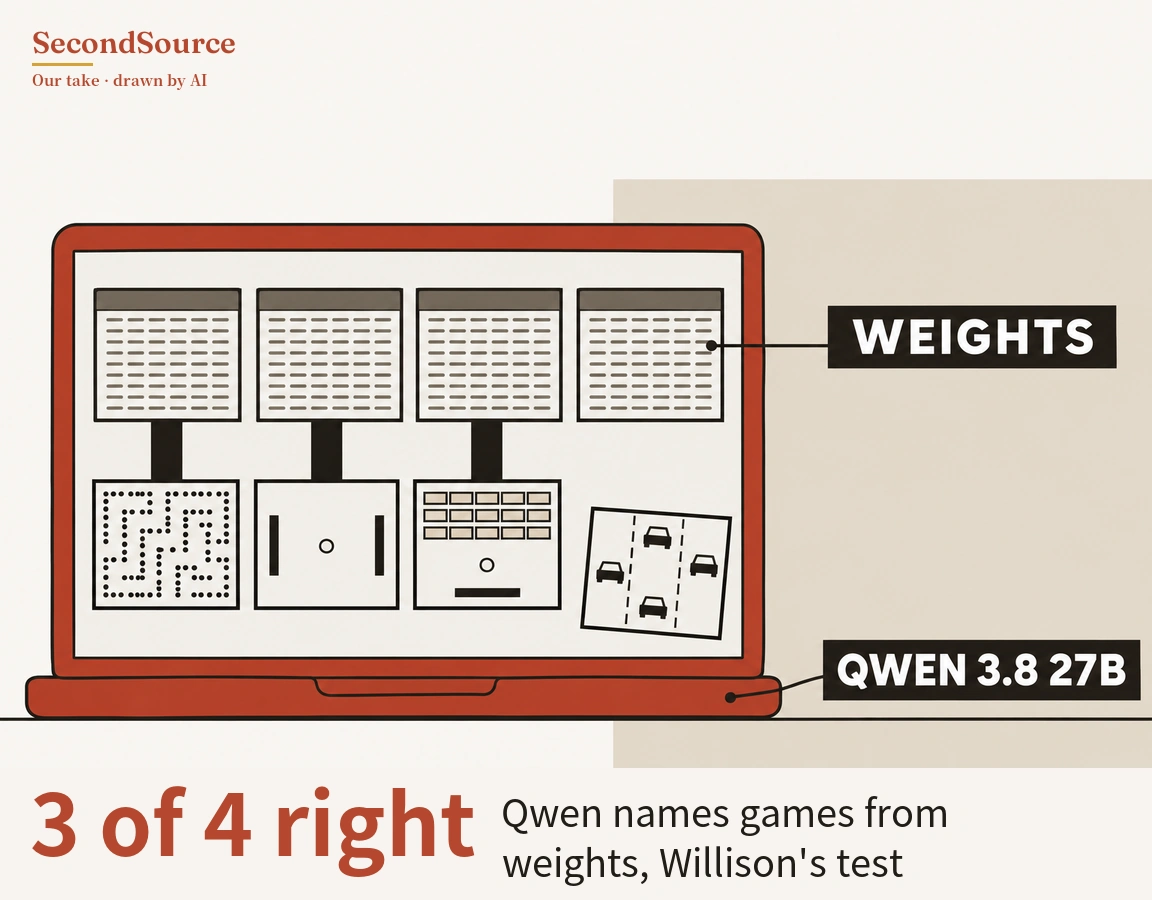
Concept illustration: a red laptop sits on a thin line, its screen showing a top row of four table-like panels, each with a dark header strip and rows of short dashes, and beneath them four small pictures: a maze of dots, two upright bars with a small circle between them, rows of blocks above a small circle and a flat bar, and, tilted at bottom right, a road with dashed lanes and four cars. Thick black bars join the left three top panels to the pictures directly below them, while the tilted fourth picture has no bar; on the right, a black label reading WEIGHTS points by a line to the top-right panel, and a black label reading QWEN 3.8 27B points by a line to the laptop's base. Printed on the image: 3 of 4 right Qwen names games from weights, Willison's test.
Software engineer Simon Willison re-ran only the weight-reading half of a paper's experiment on November 3, using the open-weight model Qwen 3.8 27B on a laptop. Simon Willison tested only the small game-playing networks the paper released and ran each question once. Rikiya Takehi and co-authors say in the paper that OpenAI's GPT-6 Astra can also change weights to lift a small model's math benchmark score, a half that Simon Willison did not test and no one has reproduced yet.

Read the full item →

5. OpenAI tells a reporter ChatGPT search volume is about a fifth of Google's; SEO tool maker Ahrefs put it at about 12% of Google's in February(event date Nov 2)
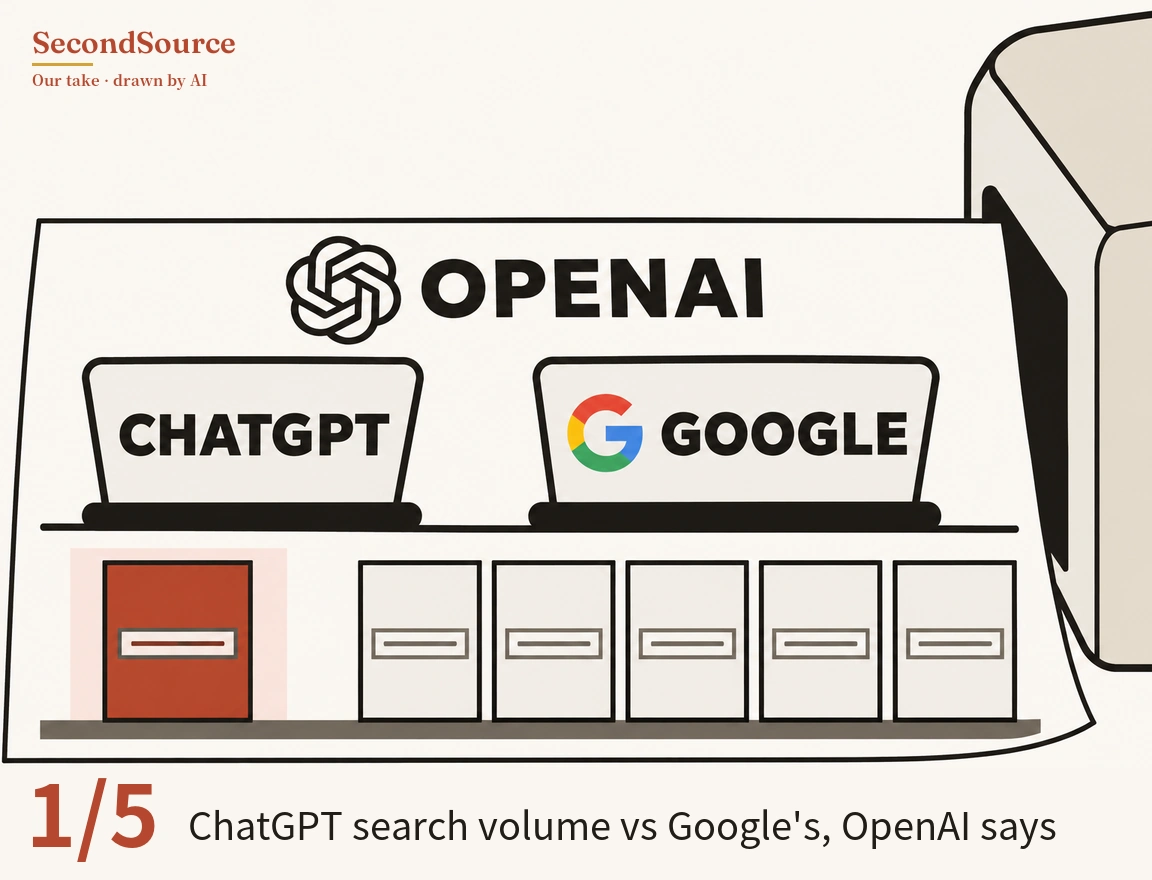
Concept illustration: a large white board is lettered OPENAI at the top, with an interlaced knot-shaped emblem to its left, and below it two screen-shaped placards stand on a ledge, the left lettered CHATGPT and the right lettered GOOGLE beside a multicoloured letter G. Under the ledge runs a row of six rectangular panels, each with a horizontal slot, the leftmost red on a pale pink patch and the other five pale grey, while a large rounded beige block, partly cut off by the frame, sits at the upper right next to the board's right edge. Printed on the image: 1/5 ChatGPT search volume vs Google's, OpenAI says.
OpenAI gave Alex Kantrowitz, who writes the tech newsletter and show Big Technology, a self-reported figure comparing ChatGPT's search volume with Google's, and OpenAI added that the share is growing fast. Kantrowitz's November 2 post on X is the only source, and the post doesn't say how "search volume" is counted. Ahrefs, which makes website-traffic and keyword-analysis tools, estimated in February that ChatGPT's volume was about 12% of Google's, counting only queries people traditionally take to Google.

Read the full item →

Chips & semiconductors

1. Marvell will buy optical-component maker Lumentum in an all-stock deal at an enterprise value of US$115 billion; closing isn't expected until the first half of 2028.(event date Nov 2)
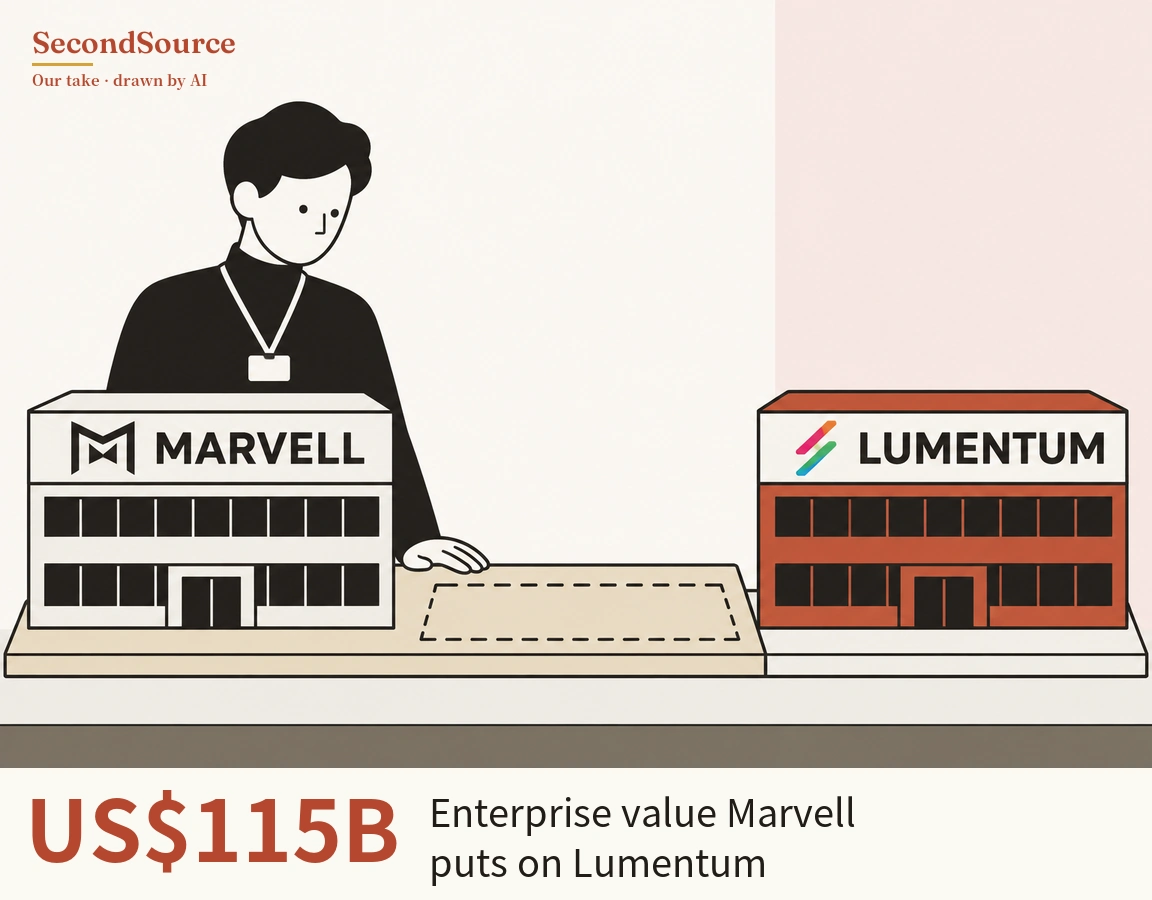
Concept illustration: on the left, a person with short dark hair, a dark top and a lanyard badge stands behind a white building with two rows of windows, lettered MARVELL beside a black emblem, and rests one hand on the beige base that extends to the right of it, where a dashed outline marks an empty rectangle. On the right, against a pale pink background, a red building with two rows of windows, lettered LUMENTUM beside a multicoloured slanted-stripe emblem, stands on a separate white base that adjoins the beige one. Printed on the image: US$115B Enterprise value Marvell puts on Lumentum.
Marvell announced an all-stock deal to buy optical-component maker Lumentum, which makes high-performance lasers and optical transceiver modules, and the deal isn't expected to close until the first half of 2028. Creative Strategies analyst Ben Bajarin wrote about the deal on X: "Only concern in regulatory challenge I think is from China."

Read the full item →

Research & models

1. Anthropic open-sourced FlashProve, a provable-inference prototype, on November 3; a single H100 generates zero-knowledge proofs for a 400-billion-parameter model at about 110 tokens per second.
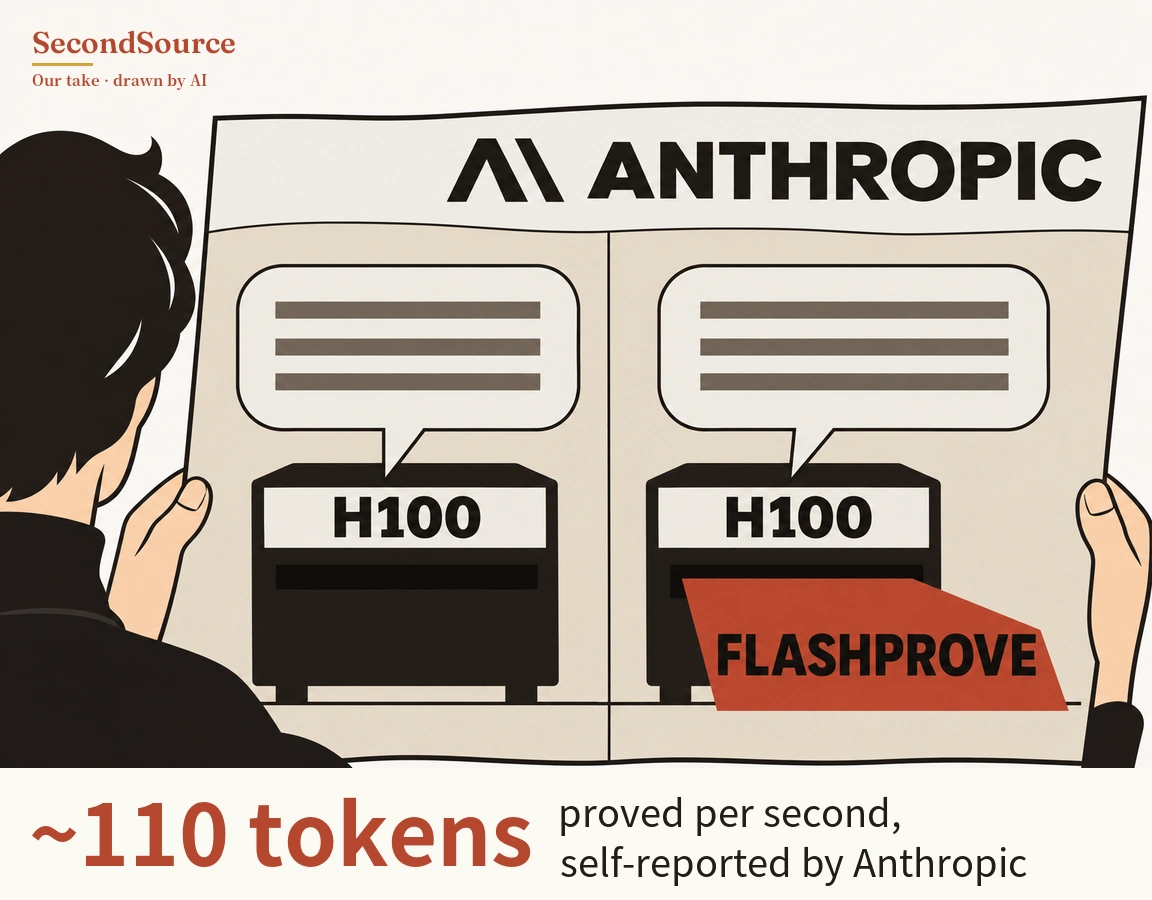
Concept illustration: at left, a dark-haired person seen from behind holds up a large sheet with both hands. Across the top of the sheet are a black mark made of two thick slanted strokes and the lettering ANTHROPIC. Below, a vertical line splits the sheet into two panels, and each panel has a speech bubble with three grey horizontal lines whose tail points down to a black box-shaped machine labelled H100; in the right panel, a slanted red tag lettered FLASHPROVE overlaps the lower part of the machine. Printed on the image: ~110 tokens proved per second, self-reported by Anthropic.
Anthropic open-sourced FlashProve on November 3, a provable-inference prototype that lets a user who can't see a model's weights verify that a response was computed by the committed weights. No third party has re-run the figures Anthropic reports for the 400-billion-parameter Llama 4 Maverick on one H100; FlashProve proves only that an output came from the committed weights, not that the content is correct, and currently covers only a 1,024-token context.

Read the full item →

Product moves

1. In Google's own 50-task test, setting Gemini's thinking level to low saved more money than capping output length.
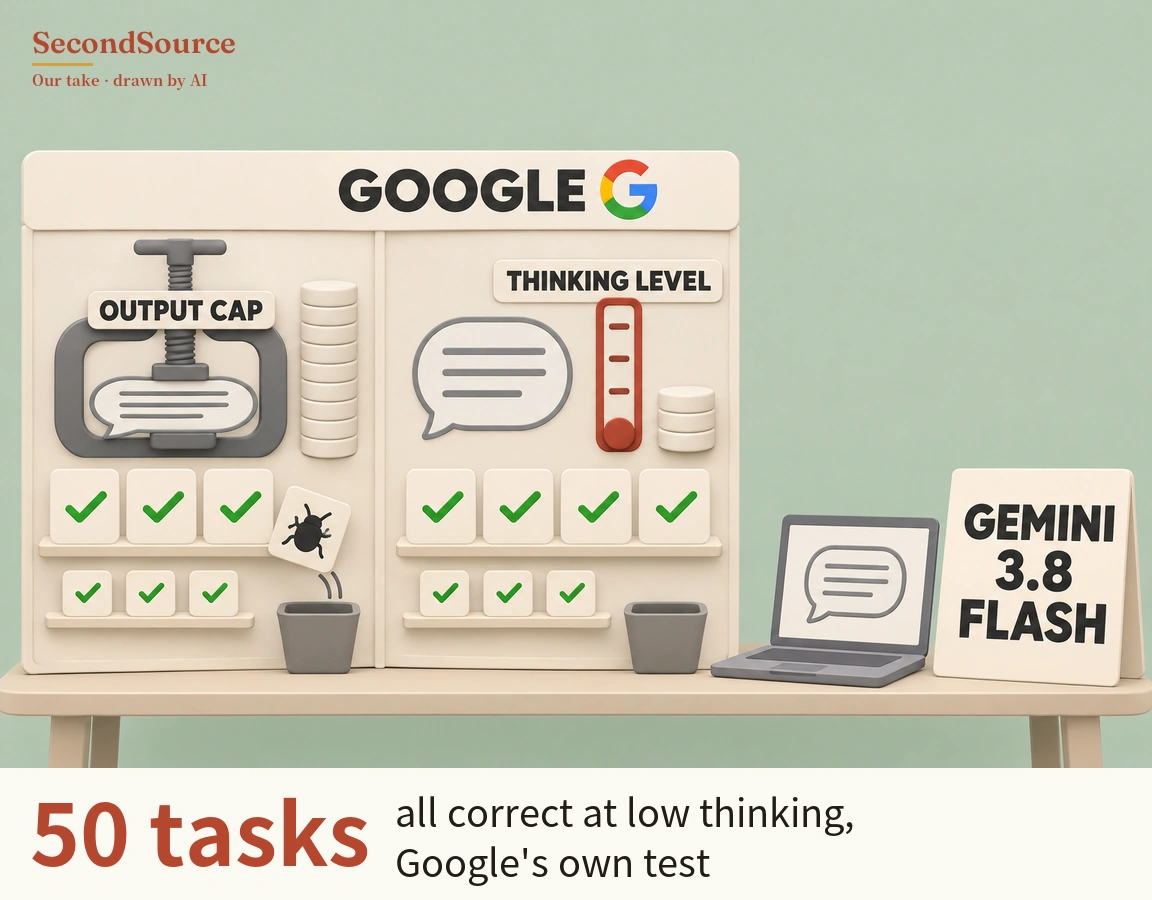
Concept illustration: on a table against a pale green wall stands a cream board headed with the lettering GOOGLE and a multicoloured G, split into two halves — on the left, under a label reading OUTPUT CAP, a grey screw clamp squeezes a speech bubble beside a tall stack of coins, above a shelf of three green-check tiles plus a tilted tile with a black bug whose curved motion lines lead down to a grey bin, and a lower shelf of three small check tiles; on the right, under a label reading THINKING LEVEL, are a speech bubble, a red-outlined thermometer gauge filled red only at its bulb and a short stack of three coins, above a shelf of four green-check tiles, a lower shelf of three small check tiles and another grey bin. To the right of the board on the table sit an open laptop showing a speech bubble on its screen and a standing sign lettered GEMINI 3.8 FLASH. Printed on the image: 50 tasks all correct at low thinking, Google's own test.
Google says in a November 3 developer blog post that agent cost should be measured per successful task, and that setting Gemini 3.8 Flash's thinking level to low saved more money than capping output length in Google's own coding test. Each setting ran only once, and Google hasn't released the benchmark code yet.

Read the full item →

From the archive

1. [Looking back] (SecondSource call, October 25) Shrinking the data AI models hold during a conversation hasn't cut AI chips' memory demand; SecondSource's reading is that the demand has moved.
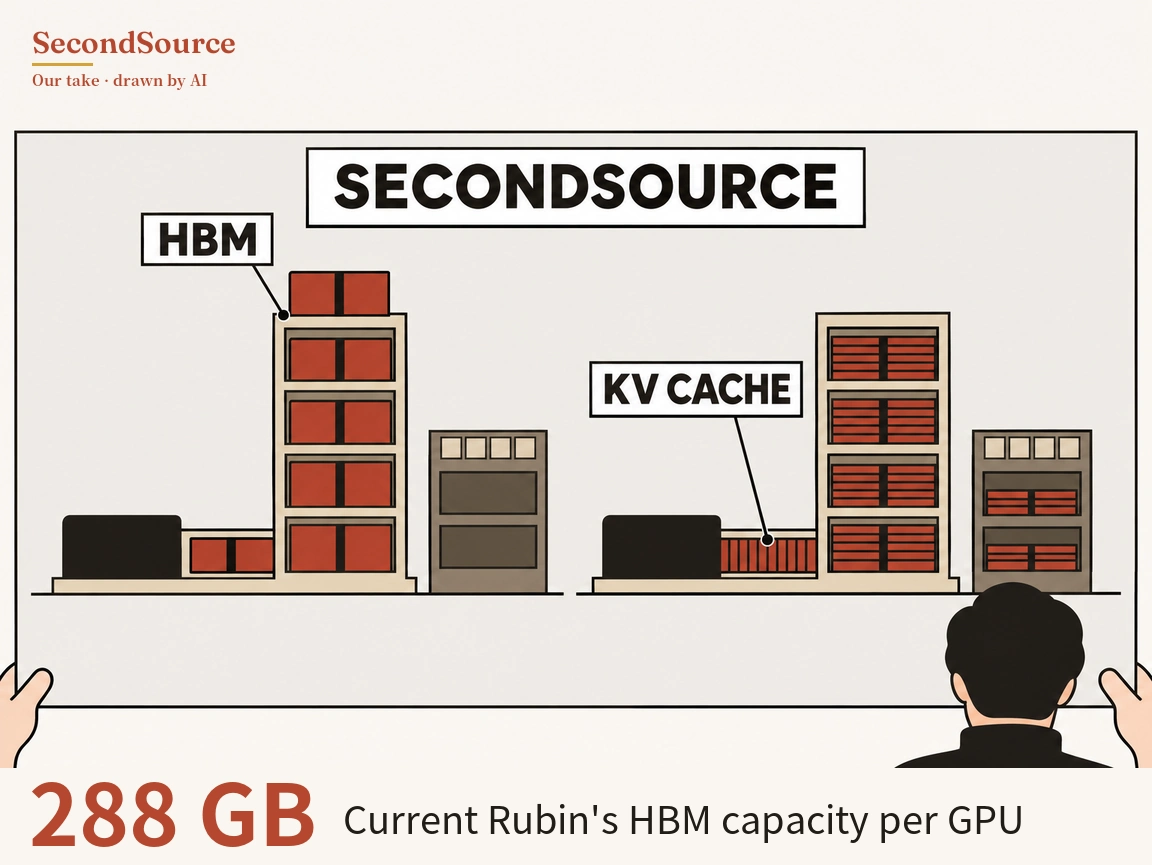
Concept illustration: a dark-haired person seen from behind at the lower right holds up with both hands a large light-grey board with a white label lettered SECONDSOURCE at its top and two side-by-side diagrams below, each showing, on one baseline from left to right, a black block, a low beige strip, a tall four-shelf beige tower and a grey cabinet. In the left diagram an HBM label has a line to the top of the tower, the strip and every shelf hold large red blocks with one more red block on top of the tower, and the cabinet's two slots are plain grey; in the right diagram a KV CACHE label has a line to the strip, which holds many thin vertical red bars, every shelf is filled with stacks of thin horizontal red bars, and the cabinet's two slots also hold thin red bars. Printed on the image: 288 GB Current Rubin's HBM capacity per GPU.
Industry reports say NVIDIA is weighing fewer HBM stacks for the next-generation Rubin Ultra, and the final spec hasn't been published. SecondSource's October 25 call has to be rewritten if NVIDIA officially publishes a Rubin Ultra HBM capacity per GPU above the current Rubin's before March 31, 2027, a deadline SecondSource set.

Read the full item →

Also happened

1. Not verified by us yet: SambaNova says server maker Supermicro will build and sell disaggregated inference systems pairing NVIDIA GPUs with SambaNova SN50 chips, starting with 10,000 SN50 chips (SambaNova, 2026-11-03).

2. Not verified by us yet: Salesforce says Slack handles 127 million MCP tool calls a week, double the previous quarter, and that half of messages come from apps and agents; all figures are self-reported by Salesforce (Salesforce, 2026-11-03).

Academic papers, 418: 140 read, 61 screened out, 217 not yet read; the paper feed was rate-limited last night, and these 418 are the remainder of an earlier unfinished fetch. Social-platform posts, 133: 20 read, 22 screened out, 3 logged only, 88 not yet read. Blogs, 56: 13 read, 2 screened out, 2 logged only, 39 not yet read. Second paper feed, 55: none read yet. Linked articles, 34: 14 read, 20 not yet read. Company filings, 5: 3 read, 1 logged only, 1 being refetched. Newsletters, 4: 2 read, 2 not yet read.

Show transcripts aren't included in the counts above; last night's fetch brought in only one Latent Space episode. The WLBT and WREG reports and the relayed Musk remarks in main-line item 1, and the November 2 documents behind main-line items 2 and 5 and the Chips & semiconductors item, were retrieved separately or are earlier material, and aren't among the 705. Last night's collection pulled 496 original social-platform posts from 374 accounts. These 496 are a separate count from the 133 above and can't be compared with them directly.

One-time catch-up. The database also holds several one-time catch-up batches dated between July 1 and October 30 this year, counted separately from the past 24 hours above. None of it was used in this issue.

Still missing today. The gap that most affects judgment is the full text of the Mississippi environmental agency's agreement and the Tennessee Valley Authority's power-approval records; both are known only through SemiAnalysis, and the power solutions and pricing in SemiAnalysis's paid edition aren't in this issue's material. The transcript of SpaceX's October 20 earnings call isn't in this issue's material either, so Musk's words come only from a summary account. The pricing versions of Oracle's prospectuses aren't out yet; the preliminary versions leave the share price, the coupon on each tranche and the final amounts blank. The abstract of "Sparks of Weight-Space Programming" doesn't describe the method for the weight-editing half. This issue has no macro section.

Tracked sources. The long-term roster currently has 529 named sources: 302 on social platforms, 90 shows, 51 news outlets, 48 blogs, 48 paper authors and 46 newsletters, with the rest spread across earnings reports, keynotes and other channels. The same source may be tracked on several channels, so the channel figures add up to more than 529. These are counts of tracked sources and can't be added to the piece counts above; the 374 accounts actually pulled last night are not the same population as the 302 social-platform sources on the roster, and last night's single show episode can't be compared with the 90 show interviewees on the roster. Representative names include Daniel Kokotajlo, Sergey Levine, Arvind Narayanan and Chris Lattner on social platforms; Terence Tao and Lilian Weng among blogs; and Sam Altman, Dario Amodei and Demis Hassabis among show interviewees. This issue uses 23 outside sources in the body. Only outside links actually cited in the body are counted; these 23 are a separate count from the 529 tracked sources. Sources from Taiwan total 153, with 43 added in October; Taiwanese media, Taiwanese companies' official channels and local reporters in Taiwan count, while foreign outlets relaying Taiwanese media do not.

SecondSource isn't a news digest: AI reads primary sources across fields, every judgment comes with its original source, and mistakes are corrected in public. The focus is what has changed and which claims still lack evidence, not what happened today.

Written from the same research and judgments as the Traditional Chinese edition. Sources are linked; we distinguish original documents from reporting and mark what we could not verify.