OpenAI writes down what its own campuses will give communities and asks states to make large power users bear grid costs, while campuses held by partners stay outside the pledge
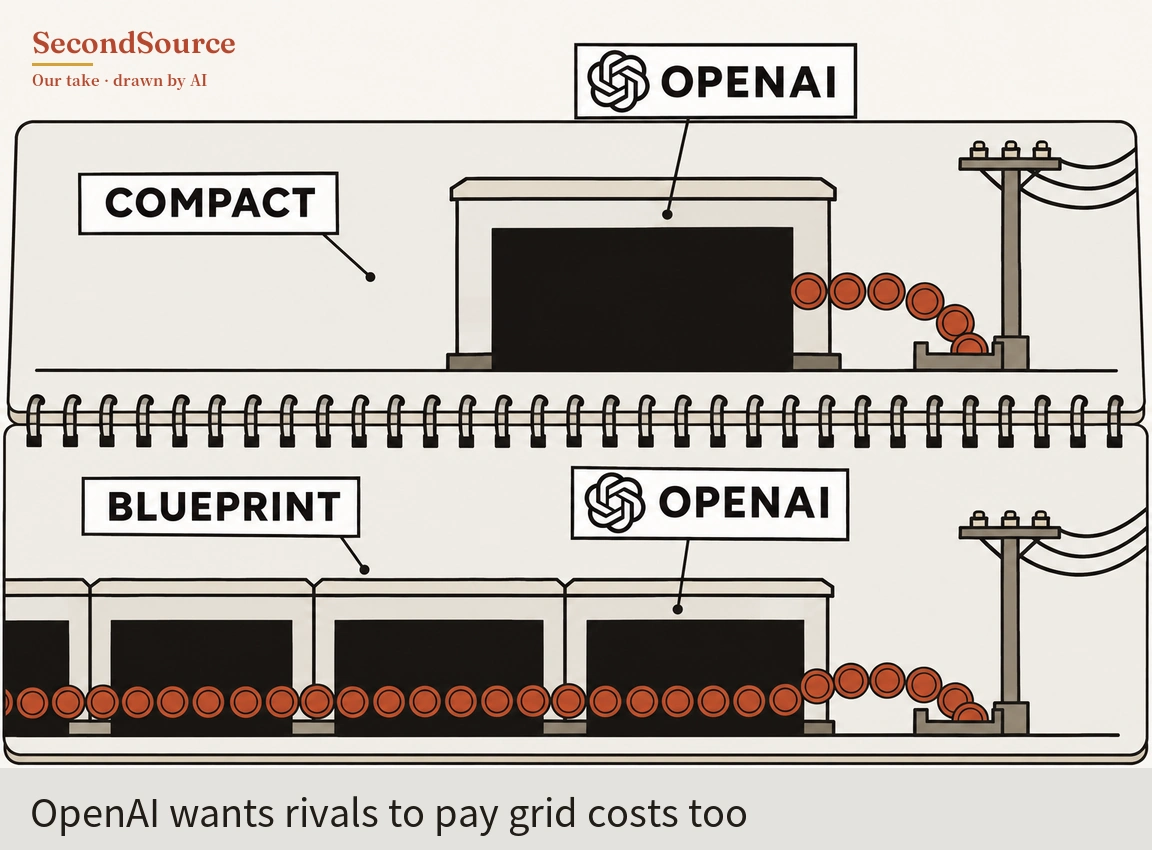
OpenAI on November 5 published a National Community Compact and a Compute Campus Policy Blueprint, setting out what OpenAI will pay to build data centers and asking governments to turn such terms into rules (OpenAI, 2026-11-05). Our inference: if states write OpenAI's blueprint into law, developers of large campuses have to budget up front for the grid costs a cancelled project leaves behind.
OpenAI first puts a specific price on local consent. Future campuses that OpenAI owns and operates will pay their full electricity bills and for new infrastructure, and will provide financial guarantees before major spending, so other customers don't foot the bill if a project is delayed or cancelled. OpenAI will also publish water and power use by site and won't ask officials to sign NDAs. Among the compact's examples, community investment in Effingham County, Georgia is US$80 million excluding local taxes, and in Pike County, Ohio US$40 million (compact PDF).
OpenAI then asks that these terms bind more than OpenAI. The blueprint wants state utility commissions to make large power users bear new grid costs and to protect other customers when projects fall through, and it calls for disclosure of water use, power use, noise and hiring (blueprint PDF). The blueprint also says what it doesn't want. It opposes a blanket requirement that operators bring their own generation. Demand response means large users cutting or shifting load when the grid is tight, and the blueprint wants that kept voluntary.
As long as the pledge is OpenAI's alone, OpenAI alone bears the cost of protecting other customers. Rivals pay too only once state rules take effect. Lambda also advertised paying its power and grid costs in full that same week, but that remains one company's pledge. Neither full document has a penalty clause or a third-party audit clause, only annual public reporting.
Not proven yet: the documents don't say what share of OpenAI's capacity is owned and operated How we checked →
Next to watch: whether any state legislature or utility commission adopts the blueprint's terms in the first half of 2027. SecondSource set that deadline: if no state has proposed similar rules by the end of June 2027, this inference fails.
Source and checks
This item ran in the brief of Nov 6, 2026, alongside 17 other items. How we checked it, the quote checks and what was still missing that day are on that issue's How we checked page.
Cite this item
SecondSource (2026). "OpenAI writes down what its own campuses will give communities and asks states to make large power users bear grid costs, while campuses held by partners stay outside the pledge." https://secondsource.io/en/news/2026-11-06-2/. Accessed access date.