SecondSourceJudgment rebuilt from primary sources

METR: Anthropic speeding up; most key evidence is redacted

Source: METR assessment, 2026-11-05
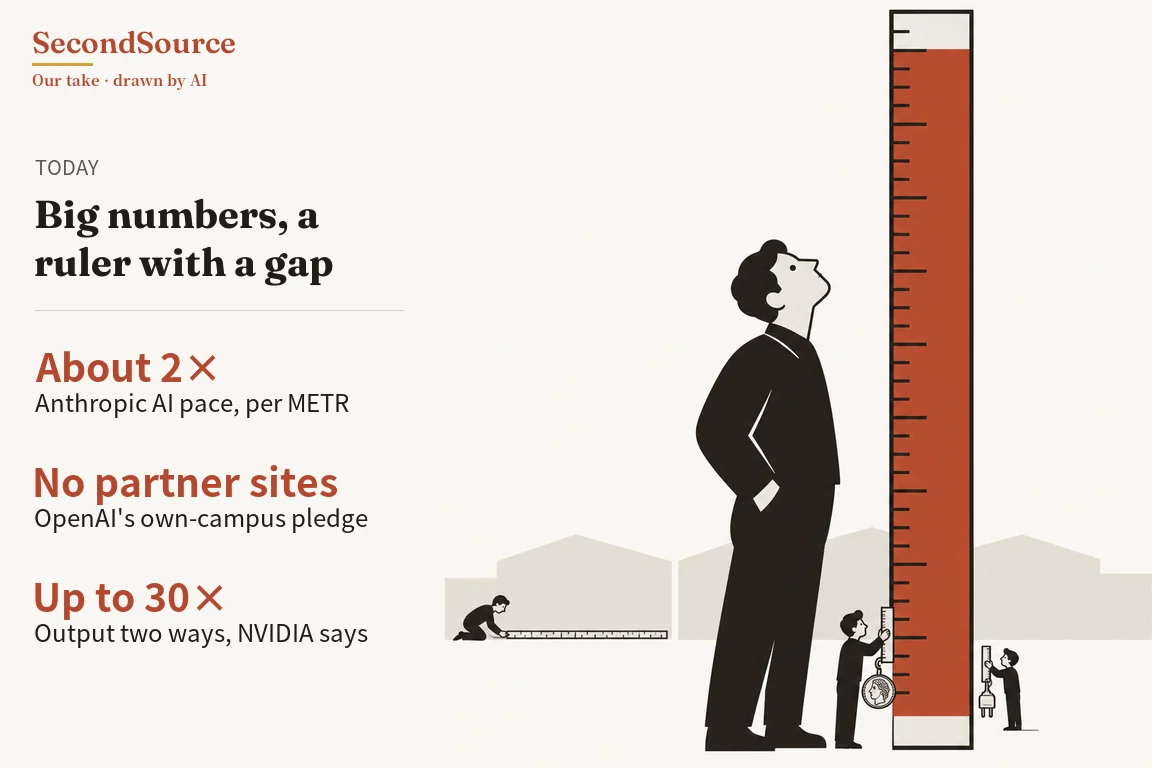
Today's front-page cover: Big numbers, a ruler with a gap; About 2× Anthropic AI pace, per METR; No partner sites OpenAI's own-campus pledge; Up to 30× Output two ways, NVIDIA says

At a glance

1. METR, a nonprofit that evaluates AI capabilities, subjectively estimates that Anthropic's models are gaining capability on well-specified tasks at about twice the rate of March 2024 to October 2025. METR's estimate doesn't specifically address Anthropic's own safety threshold, which asks for double the pace seen without significant AI contributions. METR writes that Anthropic redacted most of the evidence METR found most useful.

2. OpenAI pledges that future campuses it owns and operates will pay their full power bills and publish water and power use, and asks states to make large power users bear new grid costs; campuses held by partners aren't covered.

3. In OpenAI's own test, GPT-6 Cyber scores 48.5% on ExploitGym, which tests exploiting a specified vulnerability, against 32.1% for the previous generation; in three tests by the evaluation firm Irregular, results for Cyber and the general-purpose model Astra were mixed.

Also today: #4 — Lambda's Alabama campus.

Today's main line

1. METR subjectively estimates Anthropic's models are gaining capability about twice as fast as from March 2024 to October 2025, and says Anthropic redacted most of the evidence METR found most useful
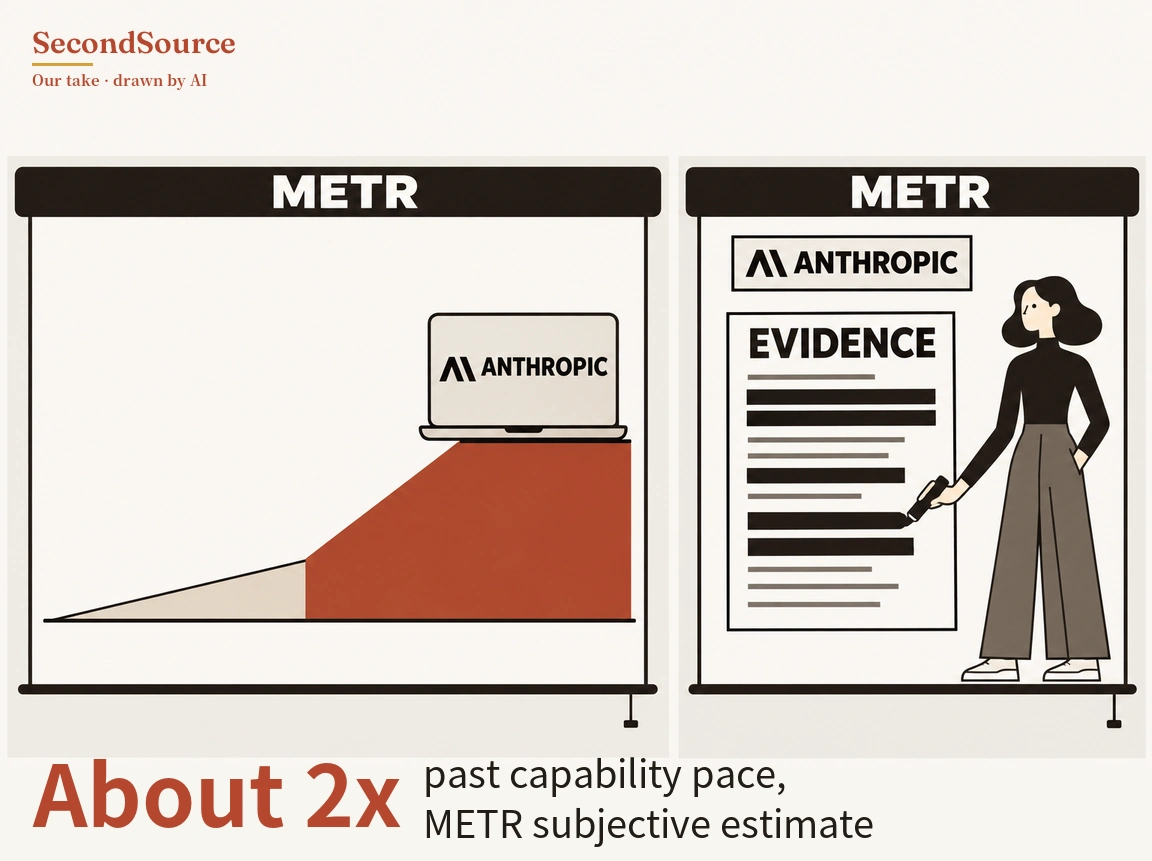
Concept illustration of two side-by-side panels, each framed with a black top bar lettered METR. In the left panel, a slope rises from left to right along a baseline, a shallow beige wedge up to the middle and then a steeper brick-red section ending in a flat top on the right, where a laptop lettered ANTHROPIC sits; in the right panel, below a sign lettered ANTHROPIC, a sheet headed EVIDENCE shows thick black bars among thin grey lines, and a standing person with dark wavy hair, to the right of the sheet, holds a black marker with its tip at the right end of one of the bars. Printed on the image: About 2x past capability pace, METR subjective estimate.
METR, a nonprofit that evaluates AI capabilities, subjectively estimates how fast Anthropic's models are gaining capability, and writes that Anthropic redacted most of the evidence METR found most useful, on the grounds that the evidence could help other developers. Most METR staff on the project judge that 1.3 times or 3 times the March 2024 to October 2025 rate of capability growth would not be a surprise, for well-specified tasks as of October. METR states that the assessment doesn't pay special attention to the threshold for AI-driven R&D speedup in the Responsible Scaling Policy, Anthropic's safety rules, and the two METR reports share one set of authors, with no second independent line of evidence so far.

Our inference: METR says Anthropic redacted most of the evidence METR found most useful, so companies vetting Anthropic currently depend on METR's word on whether Anthropic's models crossed the company's own threshold for AI-driven R&D speedup.

METR's roughly twofold figure measures capability growth, which is not yet the number Anthropic's threshold asks for.

Anthropic assessed whether its models had crossed this threshold as of July 15.

These multiples can't be recomputed from public data, because Anthropic holds unilateral redaction rights over non-public information.

Read the full item →

2. OpenAI writes down what its own campuses will give communities and asks states to make large power users bear grid costs, while campuses held by partners stay outside the pledge
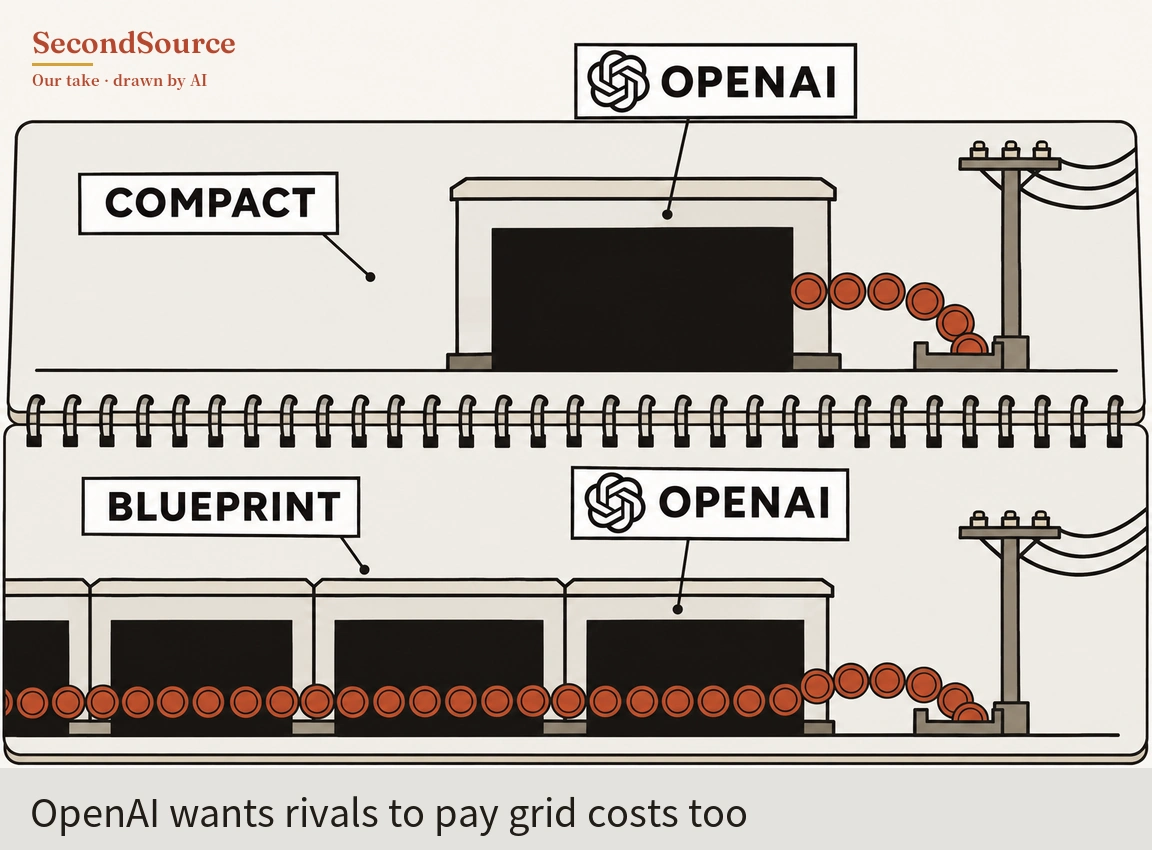
Concept illustration of two pages, one above the other, joined by a spiral binding; the upper page has a tag lettered COMPACT and a single building with a large black opening, linked to a tag with a knot-like symbol and the lettering OPENAI, and a line of red coins runs right from the opening and curves down into a small tray at the foot of a utility pole with wires. The lower page has a tag lettered BLUEPRINT and a row of three whole buildings plus a fourth cut off by the left edge, the rightmost linked to the same OPENAI tag, and a line of red coins runs right from the left edge across all their black openings and curves down into a small tray at the foot of a second pole. Printed on the image: OpenAI wants rivals to pay grid costs too.
On November 5 OpenAI published a National Community Compact, pledging that future campuses OpenAI owns and operates will pay full electricity bills and provide financial guarantees before major spending. OpenAI published a Compute Campus Policy Blueprint the same day, asking state utility commissions to write such terms into rules. Campuses held or run by partners are outside both documents, and neither document says what share of OpenAI's capacity is owned and operated.

Our inference: if states write OpenAI's blueprint into law, developers of large campuses have to budget up front for the grid costs a cancelled project leaves behind.

OpenAI first puts a specific price on local consent.

OpenAI then asks that these terms bind more than OpenAI.

As long as the pledge is OpenAI's alone, OpenAI alone bears the cost of protecting other customers.

Read the full item →

3. OpenAI releases GPT-6 Cyber and says the model beats GPT-6 Astra on most security tasks, while one third-party test in the system card has Astra slightly ahead
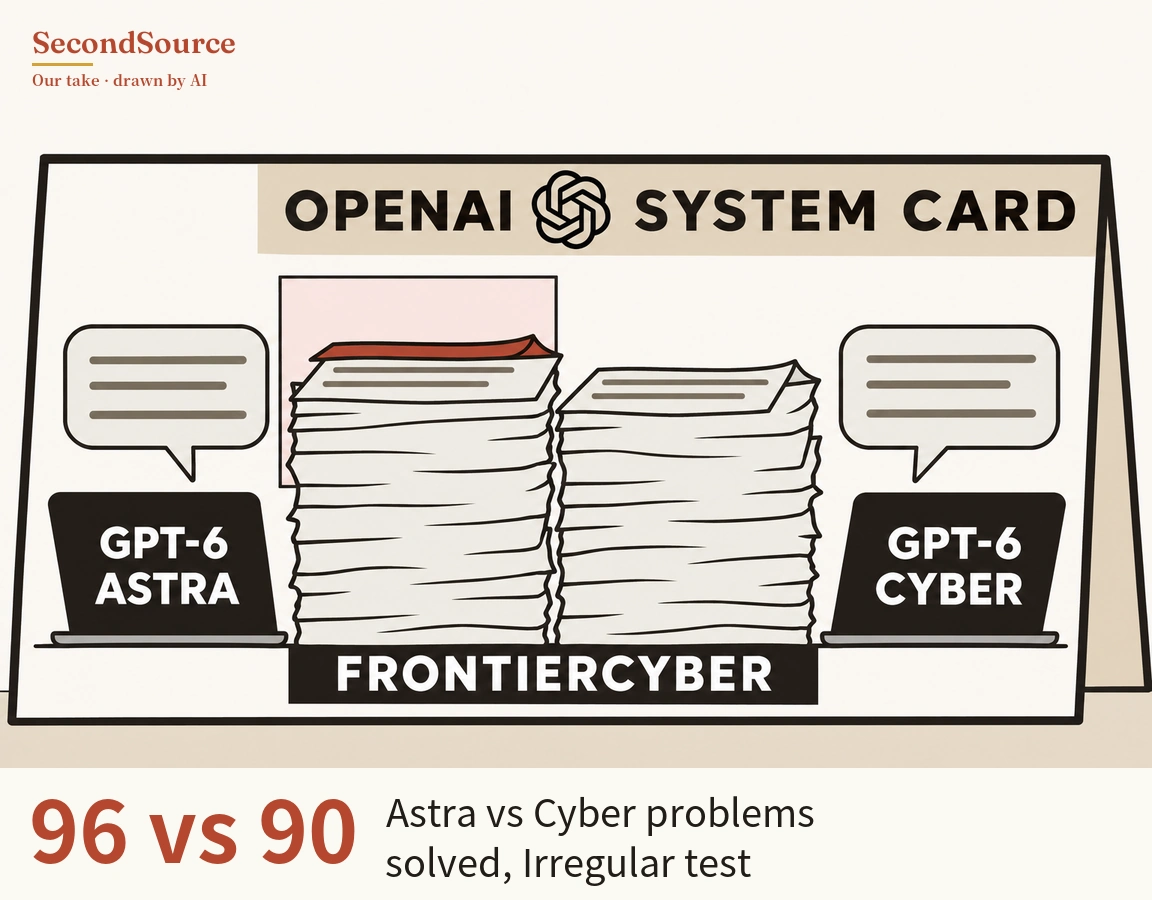
Concept illustration of a standing folded tent card with a beige header band lettered "OPENAI SYSTEM CARD", with an interlaced knot-like emblem between the words. On the card, two stacks of paper stand side by side on a black band lettered "FRONTIERCYBER", the left stack slightly taller, topped with a red sheet and with a pale pink square behind it, while a dark laptop lettered "GPT-6 ASTRA" at the far left and one lettered "GPT-6 CYBER" at the far right each have a speech bubble of gray lines above them. Printed on the image: 96 vs 90 Astra vs Cyber problems solved, Irregular test.
OpenAI released GPT-6 Cyber, a security model available only to vetted customers, and self-reports 48.5% on ExploitGym, a benchmark of whether a model can exploit a specified vulnerability, against 32.1% for the previous-generation GPT-5.6 Cyber. The security-evaluation firm Irregular ran three tests, including the 288-problem FrontierCyber on finding and exploiting vulnerabilities in real software and hardware, and concludes that Cyber and the same-generation general-purpose model GPT-6 Astra are broadly comparable, with higher success for Cyber on long-horizon tasks. The ExploitGym and Irregular figures appear only in OpenAI's announcement and system card, and whether Irregular has a commissioning relationship with OpenAI is unclear so far.

Read the full item →

4. GPU cloud provider Lambda says it will move into an Alabama campus with an estimated US$33.1 billion investment, with power still awaiting regulatory approval(event date November 4)
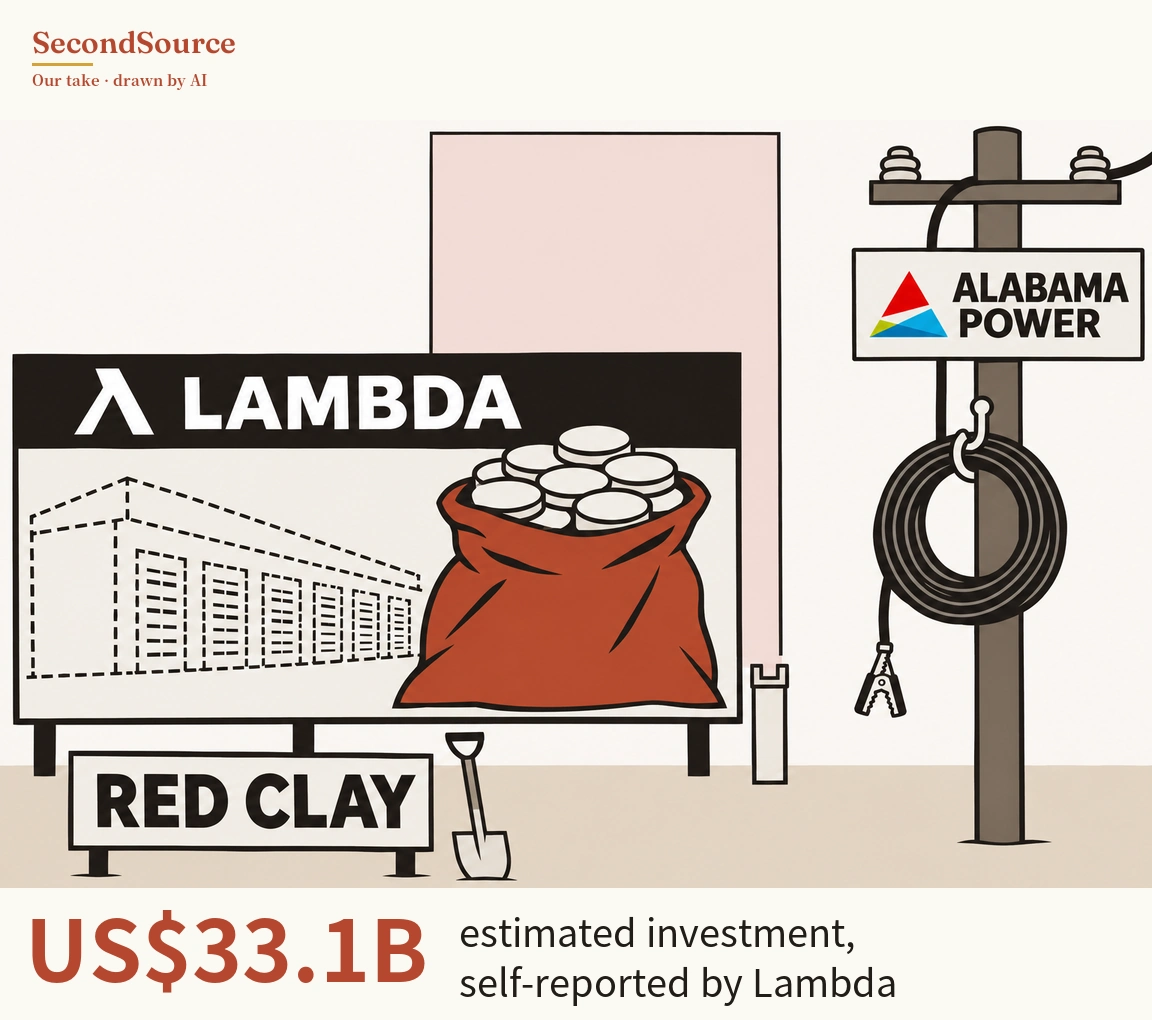
Concept illustration: on the left, a large billboard on three posts has a black header with a white angular mark and the lettering LAMBDA, and its white panel shows a long building outlined only in dashed lines on the left and an open rust-red sack with coin-like discs piled at its mouth on the right; a tall pale-pink rectangle rises behind the billboard, a short notched post stands to its right, and in front are a low sign lettered RED CLAY and, to that sign's right, an upright shovel. On the right, a utility pole with a crossarm and two insulators has one cable running from the right insulator off the picture's edge and carries a sign lettered ALABAMA POWER with a red, blue and green triangle mark, while another cable runs from the crossarm behind that sign down to a black coil hung on a hook on the pole, whose loose end hangs in the air with an alligator clip at its tip. Printed on the image: US$33.1B estimated investment, self-reported by Lambda.
On November 4, GPU cloud provider Lambda announced plans to move into the Red Clay campus in Lowndes County, Alabama, with power from Alabama Power still awaiting regulatory approval. The investment estimate and the expected first-quarter 2027 construction start come only from Lambda's announcement, with no third-party check. Lambda's announcement gives no capacity.

Read the full item →

Chips & semiconductors

1. NVIDIA argues that inference can scale with almost no added HBM capacity, and its two same-day posts put Rubin at up to 30 times GB300, per dollar in one and per megawatt in the other.
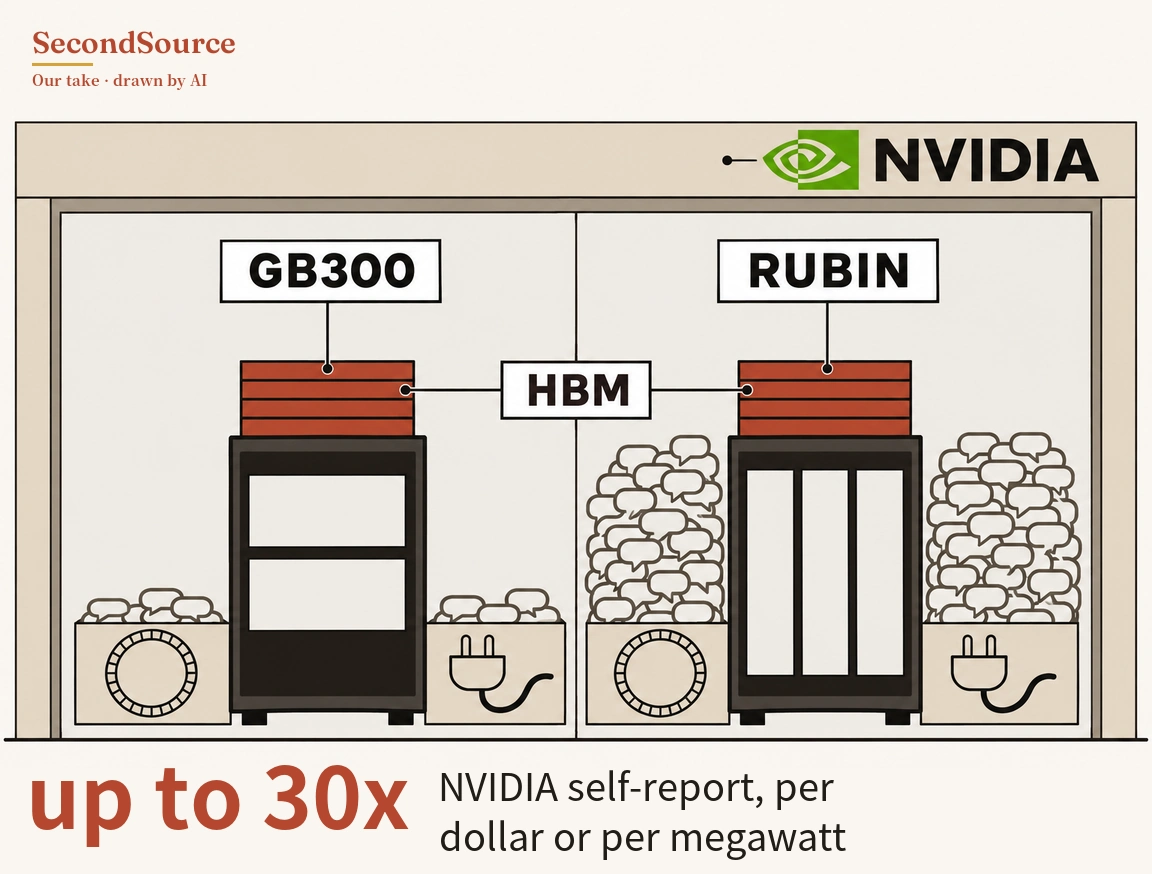
Concept illustration: a wide frame whose top band is lettered NVIDIA beside a green emblem is split by a vertical line into two halves, each holding a dark cabinet topped by a stack of four red layers; the left stack is joined by a line to a sign reading GB300, the right stack to a sign reading RUBIN, and a central sign reading HBM is joined by lines to both stacks. Each cabinet has a box showing a ring on its left and a box showing a plug with a cord on its right, both with speech bubbles piled on top: low heaps in the left half, where the cabinet has two white panels one above the other, and tall heaps in the right half, where it has three tall white panels side by side. Printed on the image: up to 30x NVIDIA self-report, per dollar or per megawatt.
NVIDIA argues in two November 5 posts that inference can scale with almost no added HBM capacity, while Rubin also changes the GPU, the interconnect and the CPU and neither post breaks out how much of the gain comes from memory. NVIDIA self-reports Rubin's top multiple over GB300 at 125 tokens per second per user for throughput per dollar and at 160 tokens per second for throughput per megawatt, and the two metrics can't be converted into each other.

Read the full item →

2. In Microsoft's internal test of Cobalt 200 on chip-design software, Xcelium, the tool that simulates chip designs, reaches 4.15 times the per-logical-core throughput of Cobalt 100.
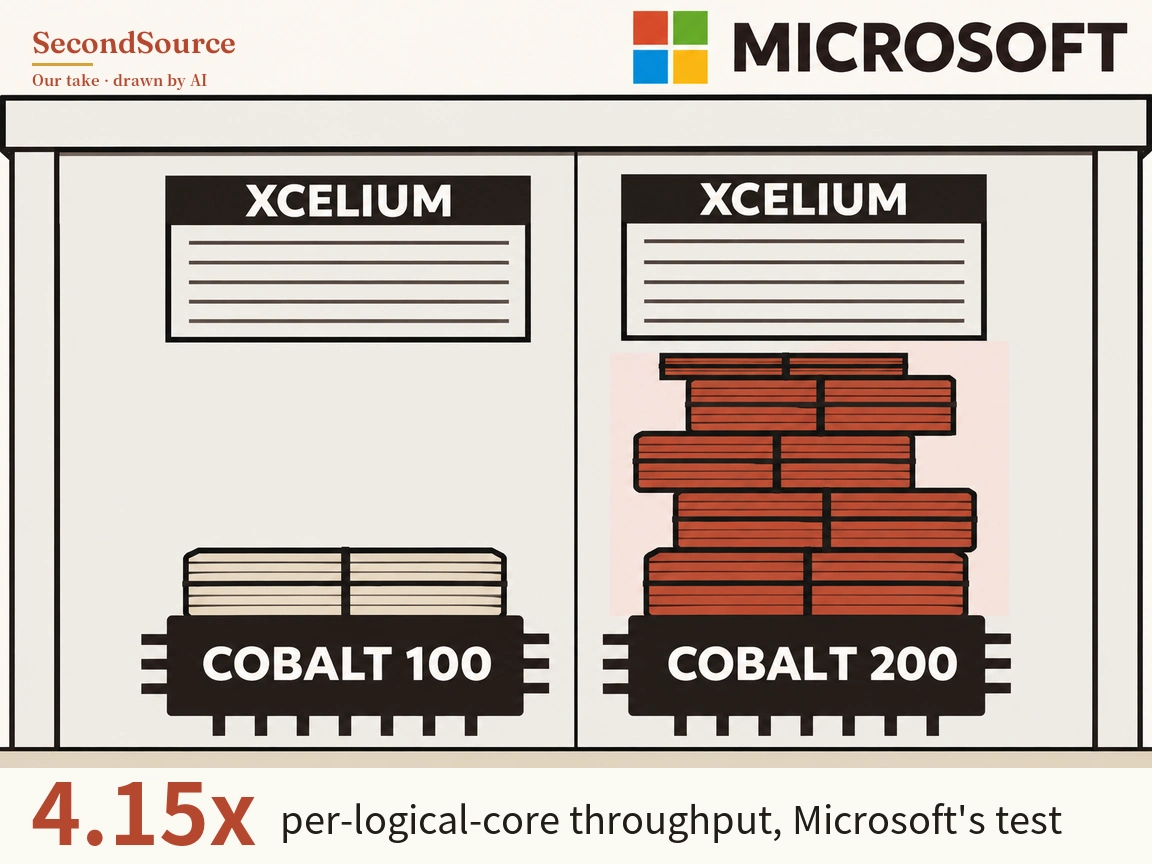
Concept illustration: at the top right are an emblem of four coloured squares and the lettering MICROSOFT; below them, a frame with a flat top beam and side columns is divided by a vertical line into two bays, each with a panel near the top that has a black header lettered XCELIUM above several ruled lines. At the bottom of each bay sits a black chip with pins: the left one, lettered COBALT 100, carries a single layer of pale cream striped blocks, and the right one, lettered COBALT 200, carries five layers of brick-red striped blocks reaching almost to the panel above, against a pale pink patch. Printed on the image: 4.15x per-logical-core throughput, Microsoft's test.
Microsoft ran Cobalt 200 on Xcelium, the tool that simulates chip designs, in an internal test against Cobalt 100, with tools from Cadence, Synopsys and Siemens running unmodified. The results are normalized per logical core, which favors machines without hyperthreading, and no per-dollar performance was published.

Read the full item →

Named commentary

1. Ryan Greenblatt roughly estimates that AI software R&D already runs about 4.5 times as fast as with no AI automation at all, and admits being wrong to expect 1.15 to 1.3 times for this year.
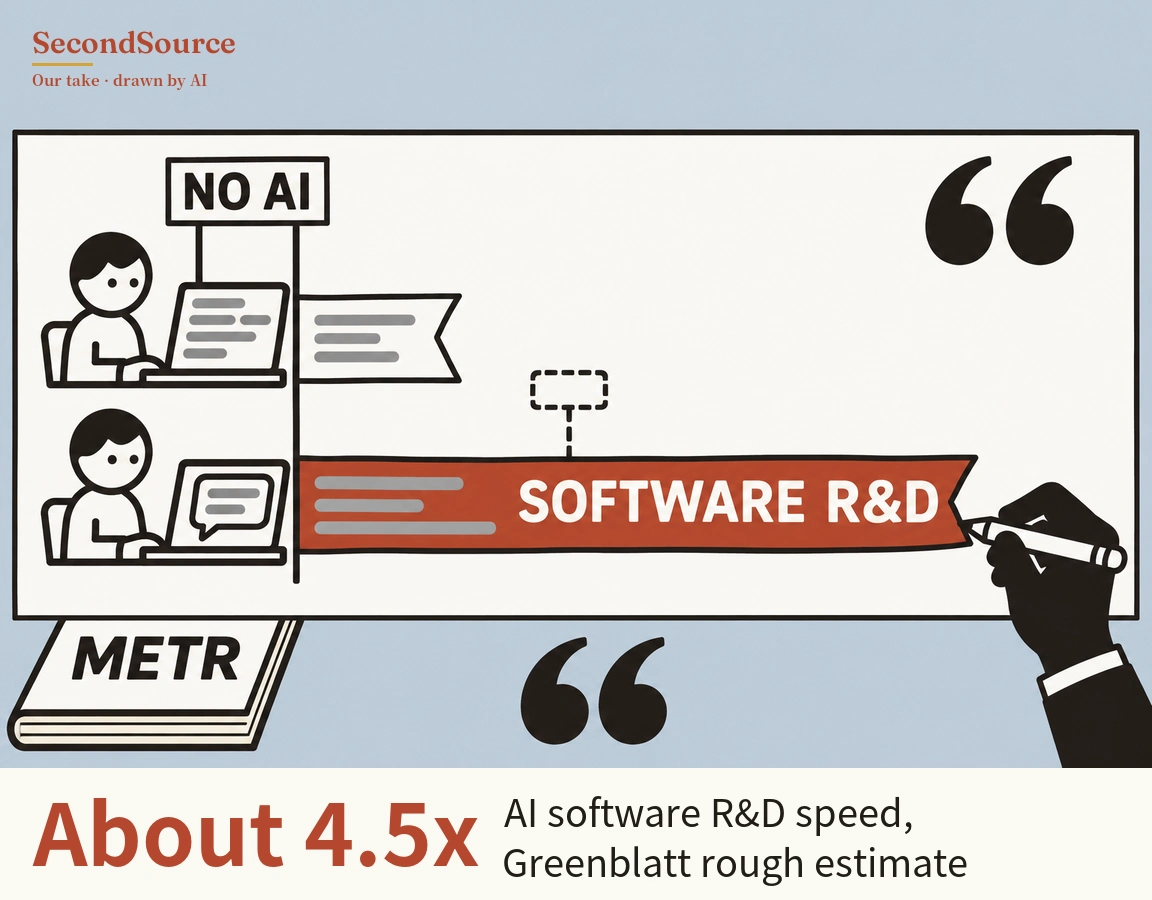
Concept illustration: on a pale blue background, a black-framed white board shows at left two identical cartoon figures seated at laptops, one above the other (grey bars on the upper screen, a speech bubble on the lower), and to their right a long vertical line topped by a sign lettered NO AI, whose second post reaches the upper laptop; from that line a short white banner with grey bars runs right in the upper row, and a far longer red banner with grey bars at its left and the lettering SOFTWARE R&D runs right in the lower row, with a blank dashed box on a dashed stem above it. A hand with a black sleeve and white cuff enters from the lower right and touches a pen to the red banner's right end, large black quotation marks sit at the board's top right and below the board at bottom centre, and a book lettered METR lies below the board's lower-left corner. Printed on the image: About 4.5x AI software R&D speed, Greenblatt rough estimate.
Ryan Greenblatt gives a rough personal estimate of AI software R&D speed against no AI automation at all, writes that only the public report was used, and admits being wrong to expect 1.15 to 1.3 times for this year. The input is METR's figure for model capability growth, so the estimate doesn't count as a second independent source; the three conversion assumptions are Greenblatt's, and Greenblatt discloses working at METR.

Read the full item →

2. John Burn-Murdoch, chief data reporter at the Financial Times, says many people cite a productivity chart as proof that AI is showing up in the data, though the reporter made that chart to rebut exactly that claim.(November 1)
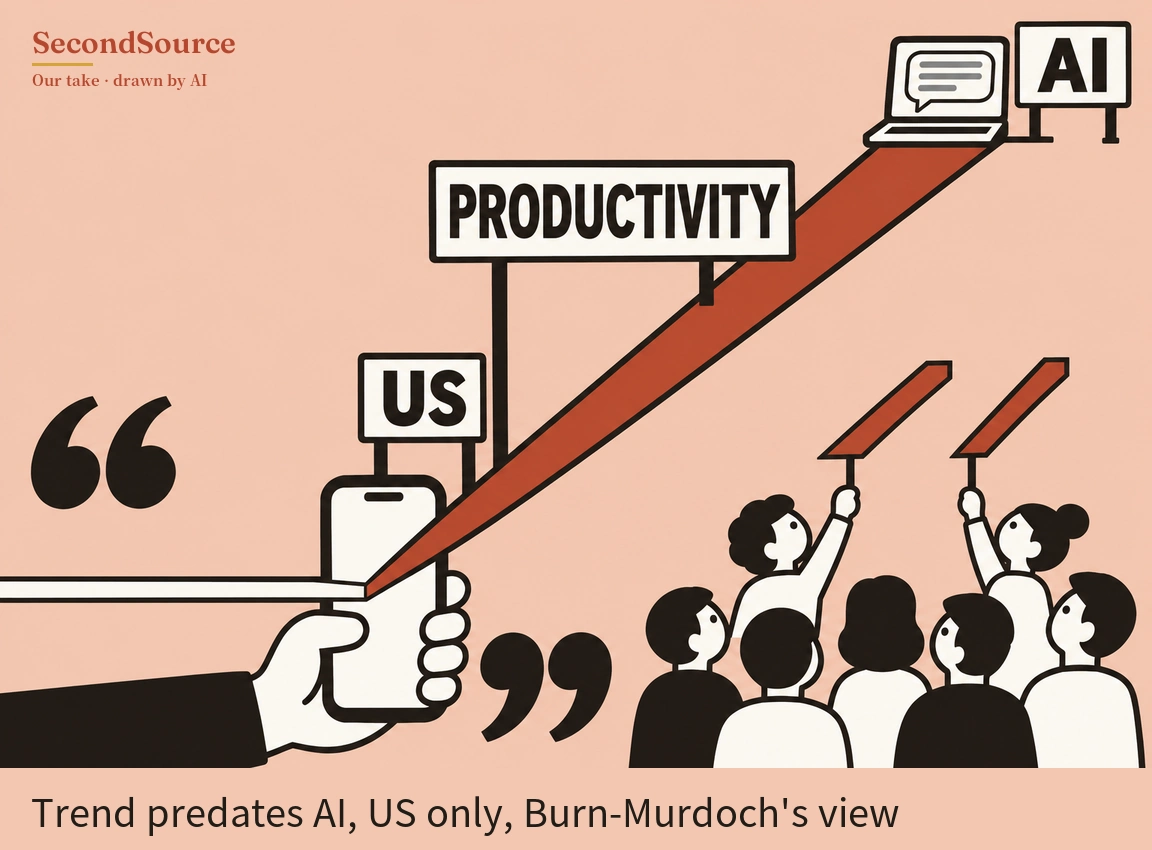
Concept illustration: at lower left, a hand in a dark sleeve grips a smartphone with a sign lettered US rising behind it, a large black opening quotation mark to its left and a closing one to its right; a cream bar runs in from the left edge to the phone, where a red band starts as a point and widens as it climbs to the upper right, with a sign lettered PRODUCTIVITY above its middle and, at its top end, an open laptop with a speech bubble on its screen beside a sign lettered AI. At lower right, seven people are gathered, two of them raising thin sticks topped with short slanted red bars. Printed on the image: Trend predates AI, US only, Burn-Murdoch's view.
John Burn-Murdoch, chief data reporter at the Financial Times, says in a November 1 post that many people cite a productivity chart as proof that AI is showing up in the data, though the reporter made that chart to rebut exactly that claim. All of this comes from Burn-Murdoch's post, and the figures in the chart attached to the post haven't been checked.

Read the full item →

Research & models

1. Anthropic analyzes 207,000 research conversations and projects that, once existing capabilities spread, research output on a fixed budget reaches about 1.96 times in computer science and about 1.35 times in the arts.
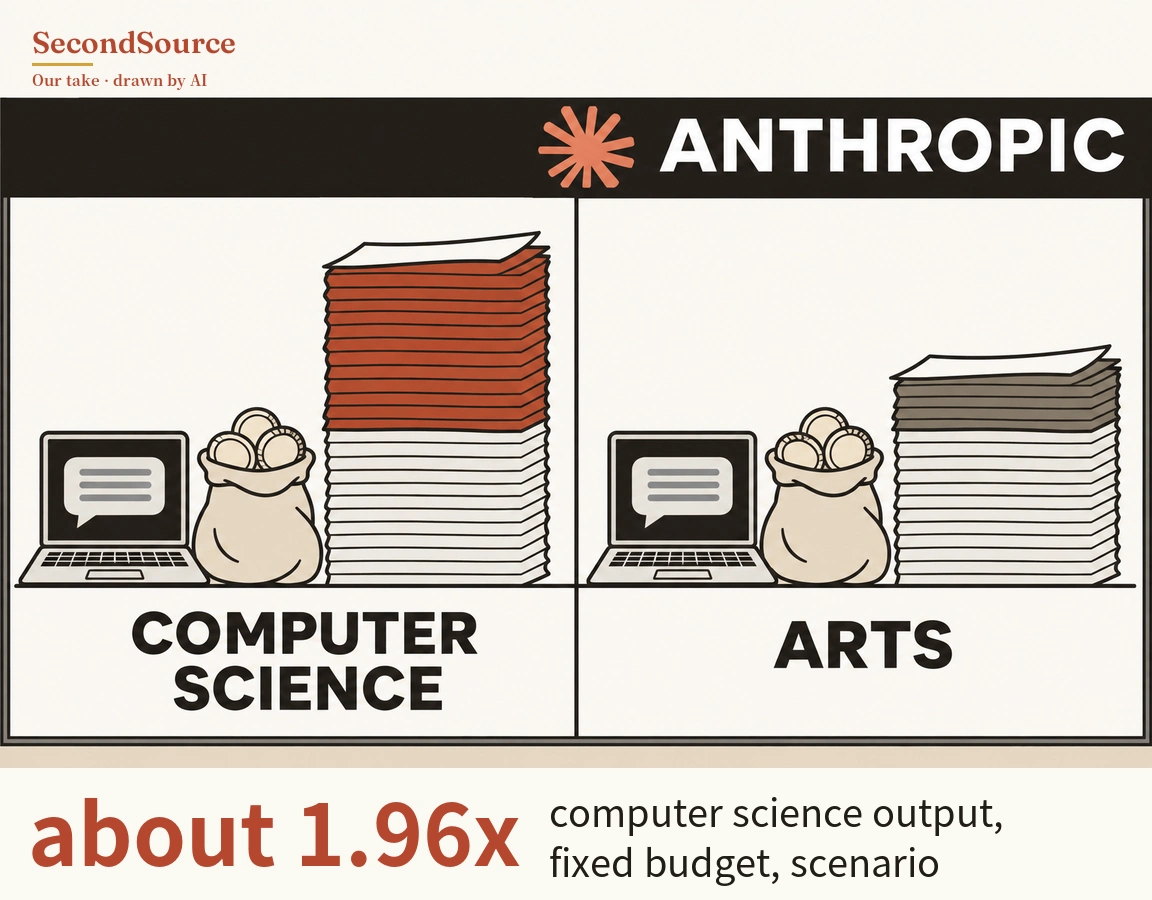
Concept illustration: a black band across the top has an orange-red starburst and the lettering ANTHROPIC at its right, above two side-by-side panels, each with a laptop whose screen shows a speech bubble, a tied sack with coins at its mouth and a stack of paper, standing left to right on a horizontal line. The left panel, lettered COMPUTER SCIENCE below the line, has the taller stack, with a thick brick-red layer on white sheets and one white sheet on top; the right panel, lettered ARTS, has a shorter stack, with a thin grey-brown layer on white sheets and one white sheet on top. Printed on the image: about 1.96x computer science output, fixed budget, scenario.
Anthropic analyzes 207,000 research conversations and projects research output on a fixed budget at about 1.35 times in the arts, below computer science, once existing capabilities spread. The projection is a scenario, not observed output, and a different thing from METR's twofold figure for model capability; the authors state the scenarios are illustrative, not forecasts, and Anthropic also sells the product being measured.

Read the full item →

2. According to a preprint's abstract, a finance evaluation the authors built requires passing 15 checks and satisfying a simulated user, and four coding agents plus one model without tools failed all 150 runs. (arXiv 2611.07464, 2026-11-05)
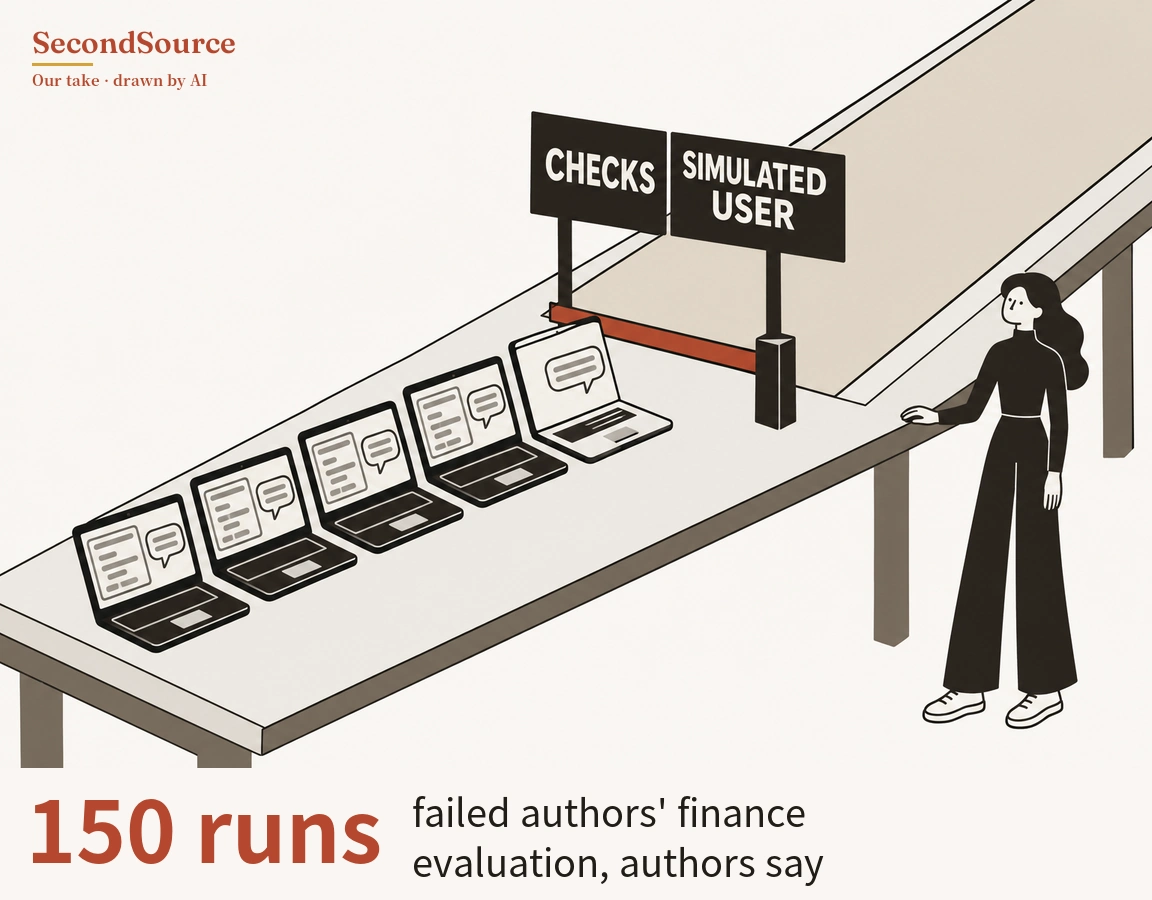
Concept illustration: five open laptops stand in a row on a long table running from lower left to upper right; the first four are black, each screen showing a panel of gray lines and a speech bubble, and the fifth, nearest a red bar across the table, is pale, its screen showing only a speech bubble. The bar spans two posts bearing black signs lettered CHECKS (left) and SIMULATED USER (right), a beige lane continues beyond it to the top-right corner, and a long-haired person in a black turtleneck and wide black trousers stands to the right of the table with one hand on its edge. Printed on the image: 150 runs failed authors' finance evaluation, authors say.
According to a preprint's abstract, four coding agents and one model without tools ran a finance evaluation the authors built, which requires passing 15 checks and satisfying a simulated user. The evaluation and the results both come from the authors.

3. Thinking Machines, the AI-model company founded by Mira Murati, releases Inkling 2 Small, says the model was trained entirely in NVIDIA's 4-bit floating-point format, and plans to release the weights after outside safety testing. (Thinking Machines, 2026-11-05)
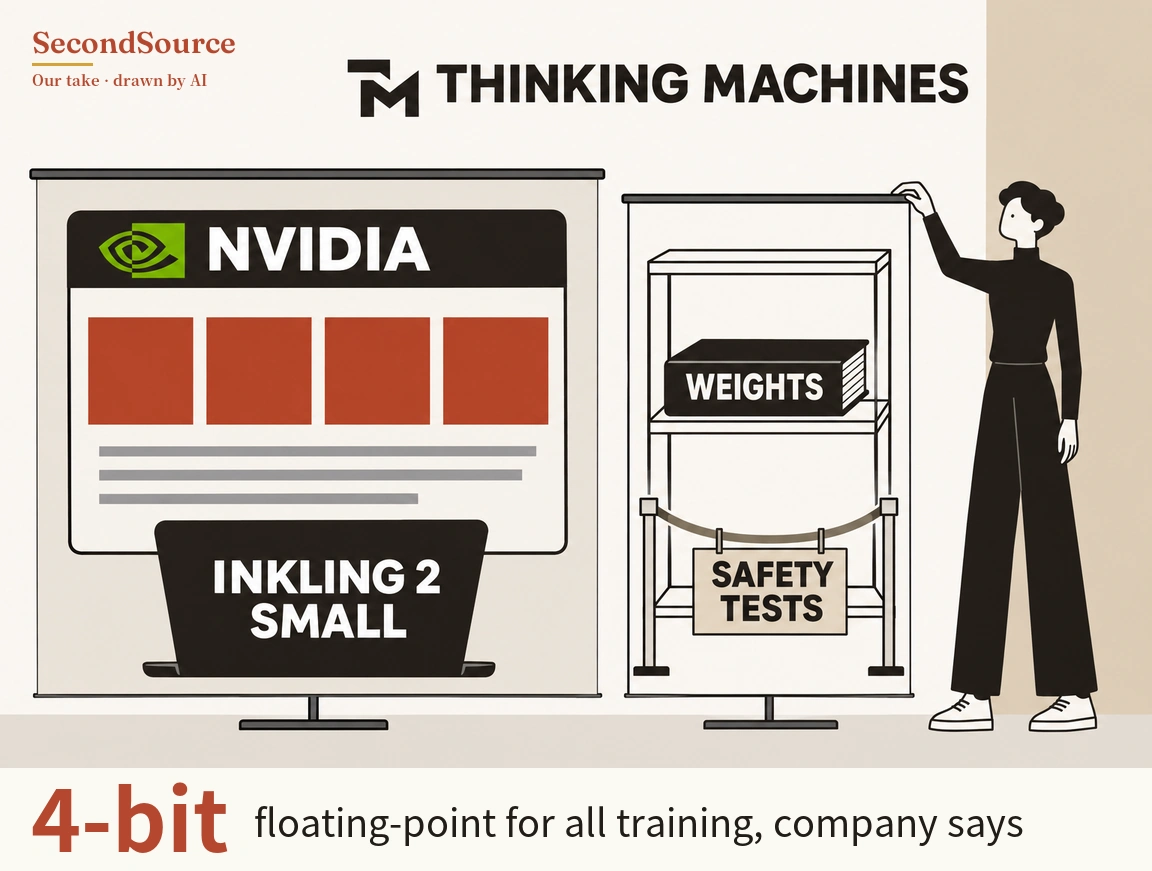
Concept illustration: at the top a black geometric mark sits beside the lettering THINKING MACHINES, and below it two framed panels stand side by side on small feet; the left panel shows a window with a black header bearing a green emblem and the lettering NVIDIA, a row of four red squares, three grey lines, and a black trapezoid block lettered INKLING 2 SMALL overlapping the window's lower edge. The right panel shows a shelf unit with a thick black book-like block lettered WEIGHTS on one shelf and, below it, a rope strung between two posts with a sign lettered SAFETY TESTS hanging from it, while a person dressed in black stands at the far right with one raised hand on the panel's top rail. Printed on the image: 4-bit floating-point for all training, company says.
Thinking Machines, the AI-model company founded by Mira Murati, releases Inkling 2 Small and plans to release the weights after outside safety testing. The statement that the model was trained in NVIDIA's format comes from Thinking Machines.

Product moves

1. In Perplexity's own test of the medium effort level of its Agent API, the score on the public research benchmarks BrowseComp plus DSQA rose from 55% to 77% while cost fell nearly 90%.
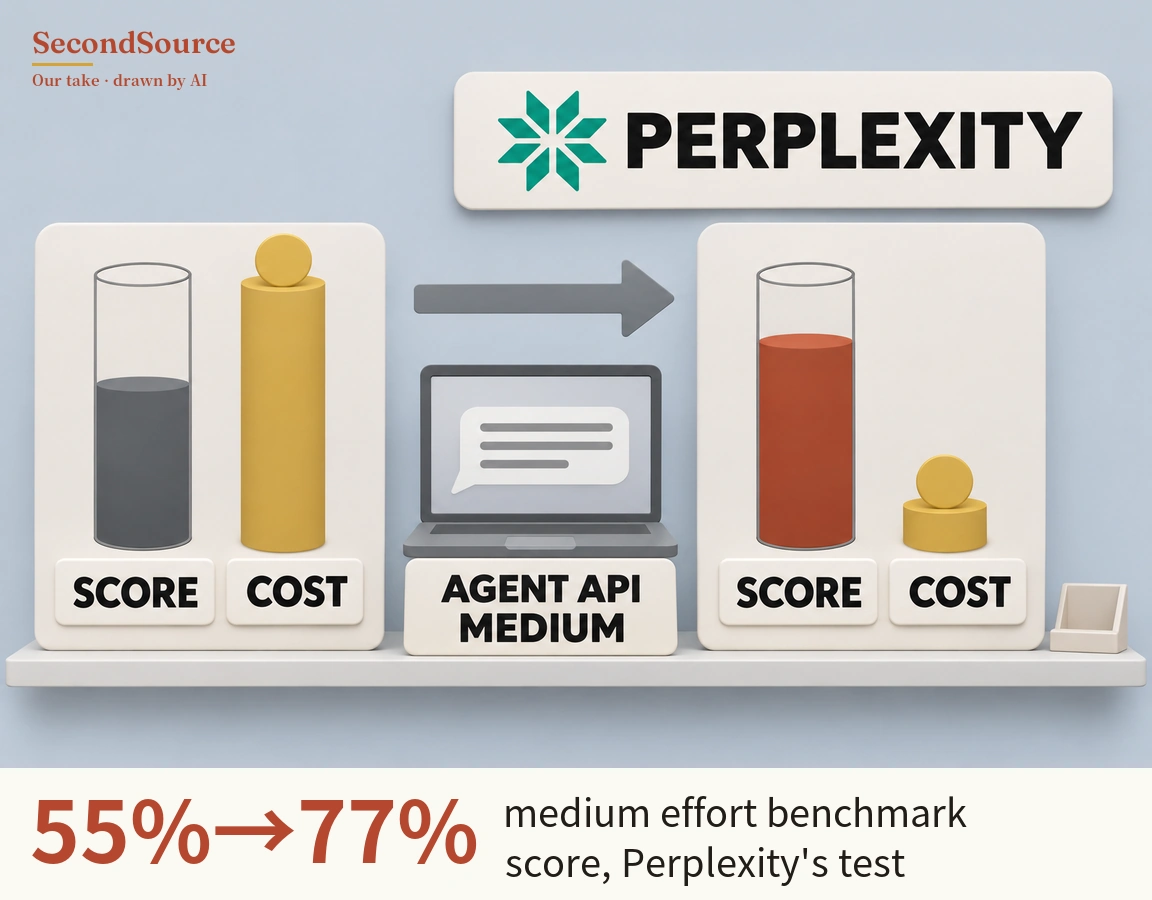
Concept illustration: on a long shelf stand a left and a right white panel, each with a clear cylinder labeled SCORE and a mustard column topped by a coin labeled COST; the left cylinder is partly filled with dark grey, the right one is filled higher with brick red, and the mustard column is tall on the left and short and squat on the right. Between the panels a grey arrow points right above a laptop whose screen shows a speech bubble, set on a block lettered AGENT API MEDIUM, while at the upper right a sign is lettered PERPLEXITY beside a green star-shaped mark, and a small beige holder sits at the shelf's right end. Printed on the image: 55%→77% medium effort benchmark score, Perplexity's test.
In Perplexity's own test of the Agent API on the public research benchmarks BrowseComp plus DSQA, cost at the medium effort level fell nearly 90% from before, with no third-party rerun. Agent scores and costs swing widely with the step limit.

Read the full item →

2. Google makes Gemini Omni 1.2 Flash generally available, raising the single-clip limit from 10 seconds to 15 seconds and pricing 720p 30% below 1.1 Flash.
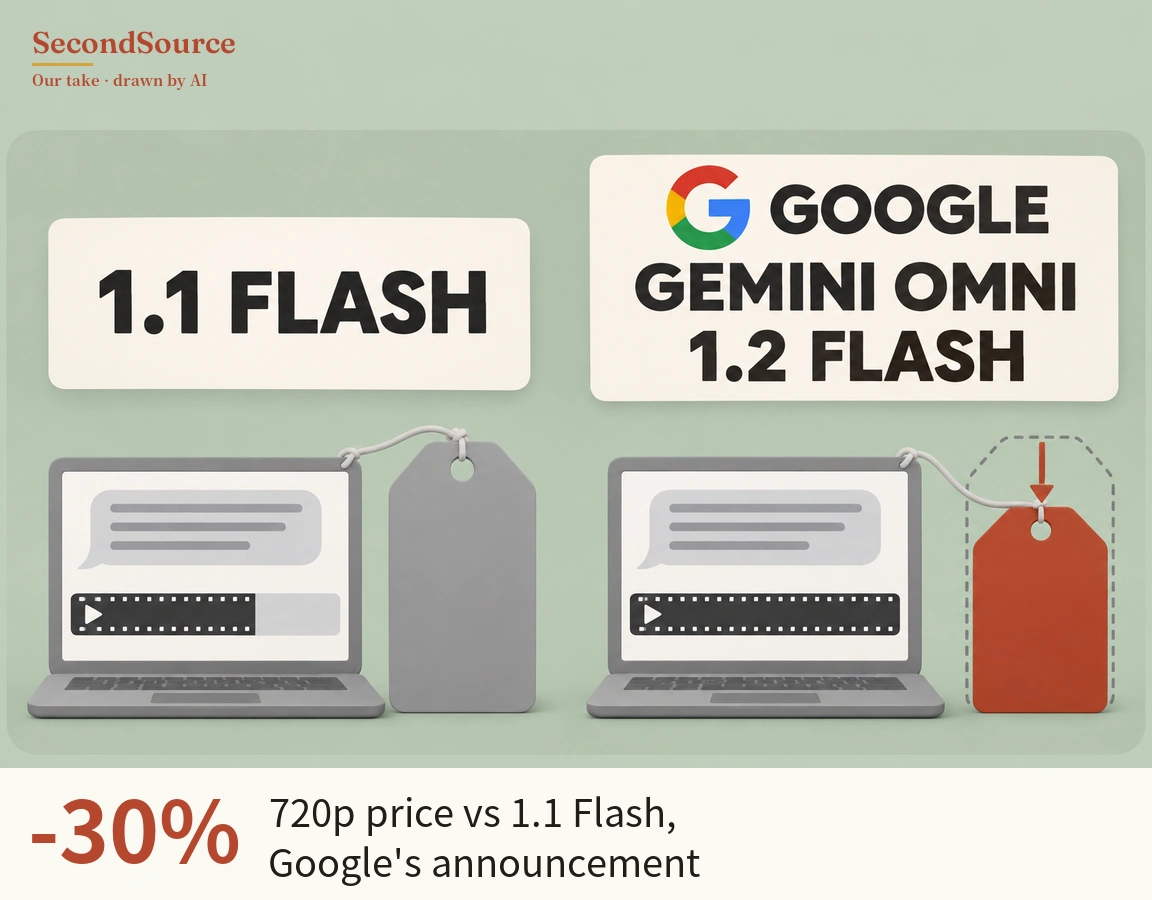
Concept illustration with two groups side by side on a pale green background: on the left, a panel lettered "1.1 FLASH" sits above a laptop whose screen shows a speech bubble with grey lines and, below it, a dark film strip with a play triangle filling about two-thirds of a lighter bar, and a string ties the laptop's top corner to a tall blank grey tag standing to its right. On the right, a panel with a multicoloured G mark and the lettering "GOOGLE GEMINI OMNI 1.2 FLASH" sits above a matching laptop whose film strip fills the whole bar, and a string ties it to a shorter blank red tag standing to its right, inside a dashed outline of a taller tag, with a red arrow pointing down at the red tag's top. Printed on the image: -30% 720p price vs 1.1 Flash, Google's announcement.
Google makes Gemini Omni 1.2 Flash, a video model that apps reach through an API, generally available, raises the single-clip limit from 10 seconds to 15 seconds and lists 720p at US$0.07 per second, with 1.1 Flash as the price comparison. The only evidence on quality so far is Google's chosen demos and customer quotes.

Read the full item →

From the archive

1. [Looking back] (SecondSource call of August 2, settled October 3) Investor Bill Gurley predicted analysts would spend eight straight quarters asking how much of CoreWeave's unsold compute NVIDIA has committed to buy, and on the first call no one asked and the company gave no figure.
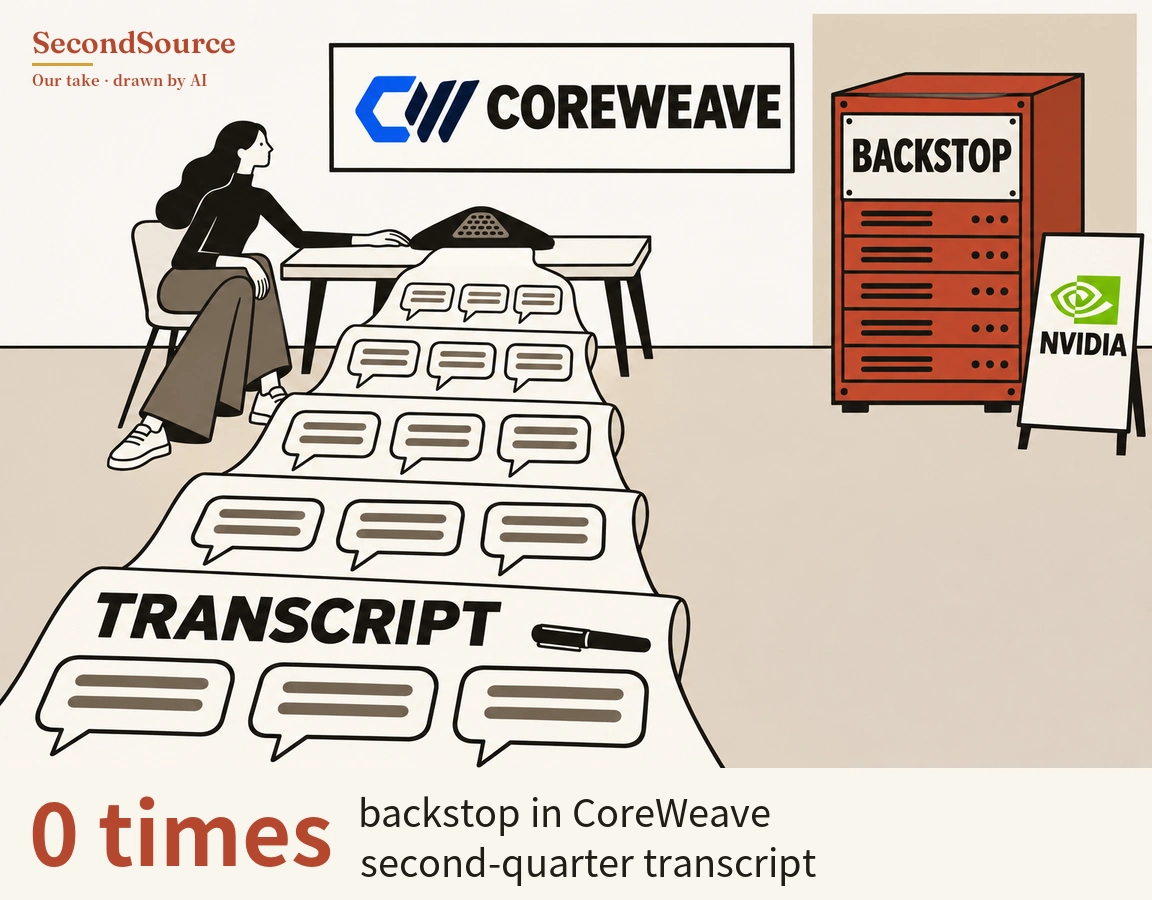
Concept illustration: a long-haired person seated at the left rests one hand on a table beside a black triangular conference speakerphone, and from under that device a long paper strip runs over the table's edge and widens across the floor toward the viewer, carrying rows of three speech bubbles with grey bars inside, with the word TRANSCRIPT and a black pen lying beside it near the foreground. On the back wall hangs a sign lettered COREWEAVE next to a blue mark, and at the right stands a red server rack labelled BACKSTOP, with a white A-frame sign lettered NVIDIA under a green mark standing beside the rack's lower right corner. Printed on the image: 0 times backstop in CoreWeave second-quarter transcript.
Investor Bill Gurley predicted analysts would spend eight straight quarters asking how much of CoreWeave's unsold compute NVIDIA has committed to buy; on the first call, the August 11 second-quarter earnings call, no analyst asked and CoreWeave published no data-center utilization or volume bought by NVIDIA. SecondSource counted the word "backstop", a promise to buy what can't be sold, in the English transcript, which a financial-data vendor corrected.

Read the full item →

Also happened

1. Not verified by us yet: Investor Gavin Baker relays that Texas governor-elect Hinojosa said already-permitted data centers can all be finished and only new projects will face conditions; the original words haven't been checked (Gavin Baker, 2026-11-05).

2. Not verified by us yet: According to the Taipei Times, citing sources, Micron has nearly halted construction at its Taoyuan fab over a union dispute; the Taoyuan city government says it received no notice (Taipei Times, 2026-11-06).

3. Not verified by us yet: According to a Reuters report relayed by Dan Nystedt, an X account that tracks semiconductors and Taiwan's supply chain, about 600,000 H200 chips are sitting in Hong Kong awaiting Chinese approval; the source of the count is unclear (Dan Nystedt, 2026-11-06).

4. Not verified by us yet: According to TrendForce's relay, an Intel packaging director says EMIB packaging, which links chips with small silicon bridges, uses over 90% of the silicon wafer, against about 60% for silicon-interposer designs; that is Intel's own account (TrendForce, 2026-11-05).

Academic papers, 530: 165 read, 154 screened out (3 of them before fetching), 211 not yet read. Social-platform posts, 149: 48 read, 35 screened out, 3 logged only, 63 not yet read. Linked articles, 70: 38 read, 29 screened out, 3 not yet read. Blogs, 64: 16 read, 7 screened out, 3 logged only, 37 not yet read, 1 being refetched. Second paper feed, 55: none read yet. Newsletters, 8: 6 read, 2 screened out. Company filings, 7: 1 read, 1 screened out, 5 not yet read. Show transcripts, 2: both read.

The Marketplace report in item 4 was retrieved separately that day, and Anthropic's amended IPO filing is older material collected on November 2; neither is among the 885. Last night's collection pulled 661 original social-platform posts from 374 accounts. These 661 are a separate count from the 149 above and can't be compared with them directly.

One-time catch-up. The database also holds several one-time catch-up sets dated between July 1 and October 30 this year, counted separately from the past 24 hours above. None of it was used in this issue.

Still missing today. The gap that most affects judgment is the original text of Anthropic's August risk report and Responsible Scaling Policy: the sentences in main-line item 1 all come as quoted in METR's review, and what must happen after the threshold is crossed isn't in this issue's material. For Hinojosa's original words on already-permitted projects, Baker's post attaches a video and a screenshot, whose contents haven't been checked. The list of company filings for the November 5 round is incomplete, and current reports from Micron, Alphabet, Meta and others appear only as list entries. SemiAnalysis's "TPU strikes the king" and Zvi's "AI #193" aren't in this issue's material. This issue has no macro section.

Tracked sources. The long-term roster currently has 529 named sources: 302 on social platforms, 90 shows, 51 news outlets, 48 blogs, 48 paper authors and 46 newsletters, with the rest spread across earnings reports, keynotes and other channels. The same source may be tracked on several channels, so the channel figures add up to more than 529. These are counts of tracked sources, so they can't be added to the piece counts above. Last night's pull and the roster are also different lists. The 374 accounts actually pulled can't be compared directly with the roster's 302 social-platform sources. The shows behind the 2 transcripts can't be compared directly with the roster's 90 show interviewees. The 8 publishers behind the 8 newsletters can't be compared directly with the roster's 46 newsletter sources. Representative names include Daniel Kokotajlo, Sergey Levine, Arvind Narayanan and Chris Lattner on social platforms; Terence Tao and Lilian Weng among blogs; and Sam Altman, Dario Amodei and Demis Hassabis among show interviewees. This issue uses 25 outside sources in the body. Only outside links actually cited in the body are counted; these 25 are a separate count from the 529 tracked sources. Sources from Taiwan total 167, with 43 added in October; Taiwanese media, Taiwanese companies' official channels and local reporters in Taiwan count, while foreign outlets relaying Taiwanese media do not.

Correction: main-line item 1 of the November 4 issue said on-site generation at the Colossus 2 campus "has been shrinking since August." The reports it cites describe a plan: under the agreement, removal of the temporary turbines was to start as early as August this year and finish by July 2027. No report was found saying removal has begun, and public material doesn't yet show how many have actually been removed. The archive page has corrected this sentence, and the item's conclusion doesn't change.

SecondSource isn't a news digest: AI reads primary sources across fields, every judgment comes with its original source, and mistakes are corrected in public. The focus is what has changed and which claims still lack evidence, not what happened today.

Written from the same research and judgments as the Traditional Chinese edition. Sources are linked; we distinguish original documents from reporting and mark what we could not verify.

This issue arrived about 1 hour later than usual today — apologies for the delay.