After three straight weeks of falling AI stocks, Creative Strategies' Ben Bajarin finds the median P/E of 30 AI suppliers dropped about 15% in two days, with revenue forecasts unchanged
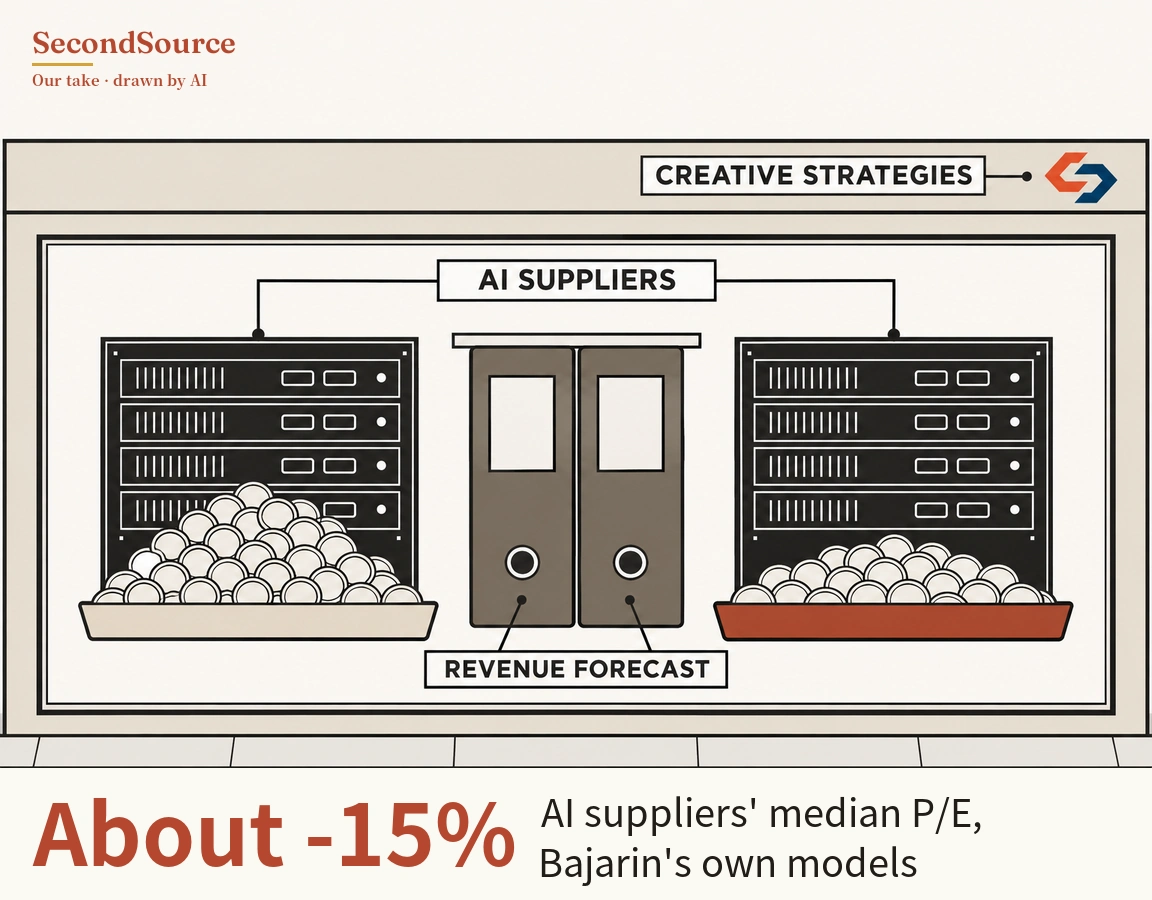
Ben Bajarin, CEO of Creative Strategies, a firm that has long tracked the semiconductor supply chain and sells paid research, published a note on November 6 analyzing the selloff that followed the US midterm elections (Ben Bajarin, 2026-11-06; Creative Strategies note). For the 30 AI infrastructure suppliers Bajarin tracks, the P/E fell about 15% in two days, and revenue forecasts didn't move. Bajarin's judgment is that investors are pricing in a slower, more expensive path to power in the US. Our inference: with forecasts unchanged, the two days of losses priced in the timing of data-center power and permits, not weaker AI customer demand. Lenders and developers backing projects that don't yet have permits are the ones whose assumptions change.
AI demand figures were still high through this week, with growth slowing. According to the Wall Street Journal as relayed by Latent Space, an AI engineering newsletter, Anthropic's annualized revenue passed US$80 billion in October; annualized revenue is the recent rate multiplied by 12 (Latent Space, 2026-11-06). Venture investor Tomasz Tunguz observed on November 6 that AI stocks had fallen for three weeks while AI usage kept hitting new highs (Tomasz Tunguz, 2026-11-06). Tunguz didn't say what usage means or give a number. The same Latent Space issue writes that one-year H100 lease prices have risen about 21% since March.
Payments to non-AI software companies through Stripe were still accelerating as of September. That figure predates the stock drop and does not measure AI suppliers. Stripe's economic research unit publishes a SaaS index of weekly payments collected through Stripe by an average of 72,000 non-AI subscription software companies. On September 10 it put year-over-year growth above 30%, faster than at the end of 2025 (Stripe Economics, 2026-09-10). Payments collected are not the same as these companies' revenue. Stratechery relayed the figures on November 6 in a segment sponsored by Stripe (Stratechery, 2026-11-06).
Bajarin's note says the selloff changed valuations, not forecasts. Across those 30 suppliers, the median forward P/E fell about 15% over November 4 and 5, to 17.3 times, lower than the S&P 500's multiple was before the selloff. The suppliers' revenue forecasts didn't move. Both the multiples and the forecasts come from Bajarin's own models.
According to Azeem Azhar of Exponential View, US voters passed 43 of 44 local measures aimed at slowing data centers (Exponential View, 2026-11-06). Stratechery's Andrew Sharp judged the same day that regulatory uncertainty around the AI buildout is higher than ever.
A SemiAnalysis estimate, relayed by Latent Space, puts at most 2 to 3 GW of the roughly 50 GW of capacity due online in 2027 at risk from tighter financing (Latent Space, 2026-11-06). It is a single relayed estimate, so it shows only the rough scale.
Not proven yet: the separate declines of data-center stocks and software stocks weren't measured How we checked →
Expert view · Josh You (analyst at Epoch AI, a research group that tracks AI compute and industry data; interests: no public disclosure found): "growth definitely slowed further over the last three months. They added $16B, or ~25% growth, which would naively compound to 2.4x over a year." (Josh You, 2026-11-07) Josh You also writes that August and September were slower and October picked up slightly; the base of the increase is in the attached chart, not in the post's text.
Next to watch: the quarterly revenue Anthropic discloses when it next updates its IPO filing with the SEC before mid-December, and the AI cloud guidance at the next earnings calls of Alphabet, Amazon and Microsoft. Josh You's 25% is growth in annualized revenue, not in quarterly revenue, so it is only a reference line. If by December 15 Anthropic's latest quarterly revenue grows less than 25% over the prior quarter, or any of the three cuts its AI cloud growth guidance, this reading changes to politics and demand weakening together. December 15 is a deadline SecondSource set.
Source and checks
This item ran in the brief of Nov 7, 2026, alongside 13 other items. How we checked it, the quote checks and what was still missing that day are on that issue's How we checked page.
Cite this item
SecondSource (2026). "After three straight weeks of falling AI stocks, Creative Strategies' Ben Bajarin finds the median P/E of 30 AI suppliers dropped about 15% in two days, with revenue forecasts unchanged." https://secondsource.io/en/news/2026-11-07-1/. Accessed access date.