TeraWulf's US$710 million third-quarter net income came entirely from revaluing warrant and derivative liabilities, and Google's conditional backing of Anthropic's 20-year lease begins only when rent starts
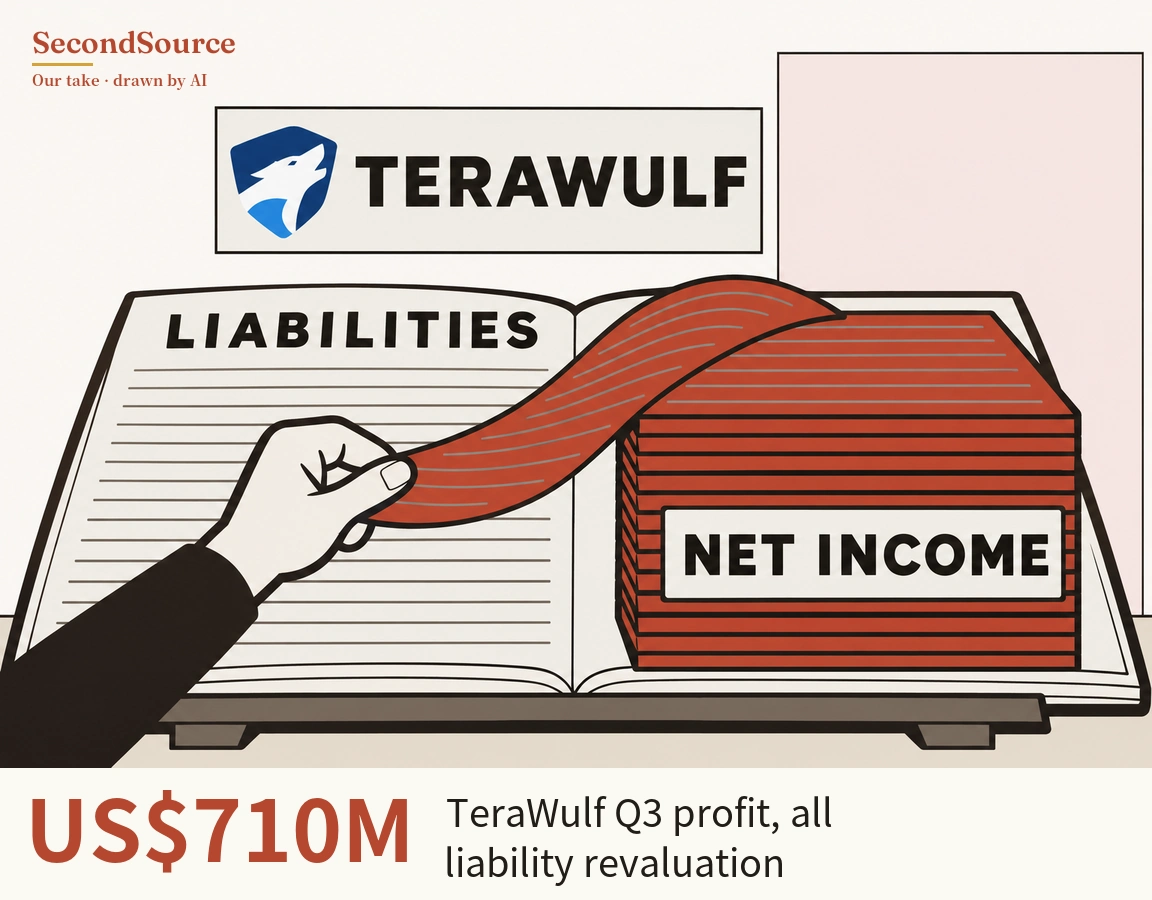
TeraWulf, which leases out AI data centers, filed its third-quarter report with the SEC on November 6 and released its earnings press release (TeraWulf 10-Q, 2026-11-06; TeraWulf 8-K, 2026-11-06). Lenders weighing Anthropic's Hawesville lease get Google's backstop only after rent starts on each building. TeraWulf's US$710 million quarterly profit is a liability revaluation, not cash.
Google's credit support is this week's new fact; the lease itself was signed in July. Raylan Data, a TeraWulf subsidiary, signed a 20-year lease with Anthropic in July for about 401 MW of IT power capacity at the Hawesville campus in Kentucky, with three data buildings due in stages from late 2027 to the second quarter of 2028. A November 4 current report says that if Anthropic can't pay rent or enters bankruptcy, Google can pay the rent due and take over as tenant, or in certain cases pay a termination fee and take equity in Raylan. The support takes effect only once rent starts on the last data hall of each building. The support ends once Anthropic obtains and holds an investment-grade credit rating for more than three months (TeraWulf 8-K, 2026-11-04). Bond investors judge this kind of arrangement by whether the backstop carries conditions and whether it still stands if construction slips or the tenant defaults (ArentFox Schiff).
The 10-Q puts third-quarter net income at US$709.5 million. The same statement carries a US$728.4 million "change in fair value of warrant and derivative liabilities," which is larger than the whole profit. A fall in a liability's fair value is booked as a gain without any cash coming in. Revenue was US$76.23 million, up from US$50.58 million a year earlier, with 83% from leasing HPC data-center space. For the first nine months TeraWulf still shows a net loss of US$659 million. Interest expense was US$53.55 million for the quarter, up from US$9.83 million a year earlier. Cash stood at US$1.60 billion, down from US$3.27 billion at the end of last year.
Not proven yet: the current report gives no rent, no cap on Google's support and no termination fee How we checked →
Next to watch: whether the first Hawesville data halls are delivered and start rent on schedule in late 2027, whether Anthropic's credit rating rises to investment grade, and the cash and interest expense in TeraWulf's next quarterly report. If the rating comes first, Google's backstop ends, and the rent rests on Anthropic's credit alone.
Source and checks
This item ran in the brief of Nov 7, 2026, alongside 13 other items. How we checked it, the quote checks and what was still missing that day are on that issue's How we checked page.
Cite this item
SecondSource (2026). "TeraWulf's US$710 million third-quarter net income came entirely from revaluing warrant and derivative liabilities, and Google's conditional backing of Anthropic's 20-year lease begins only when rent starts." https://secondsource.io/en/news/2026-11-07-2/. Accessed access date.