In Google's own 50-task test, setting Gemini's thinking level to low saved more money than capping output length.
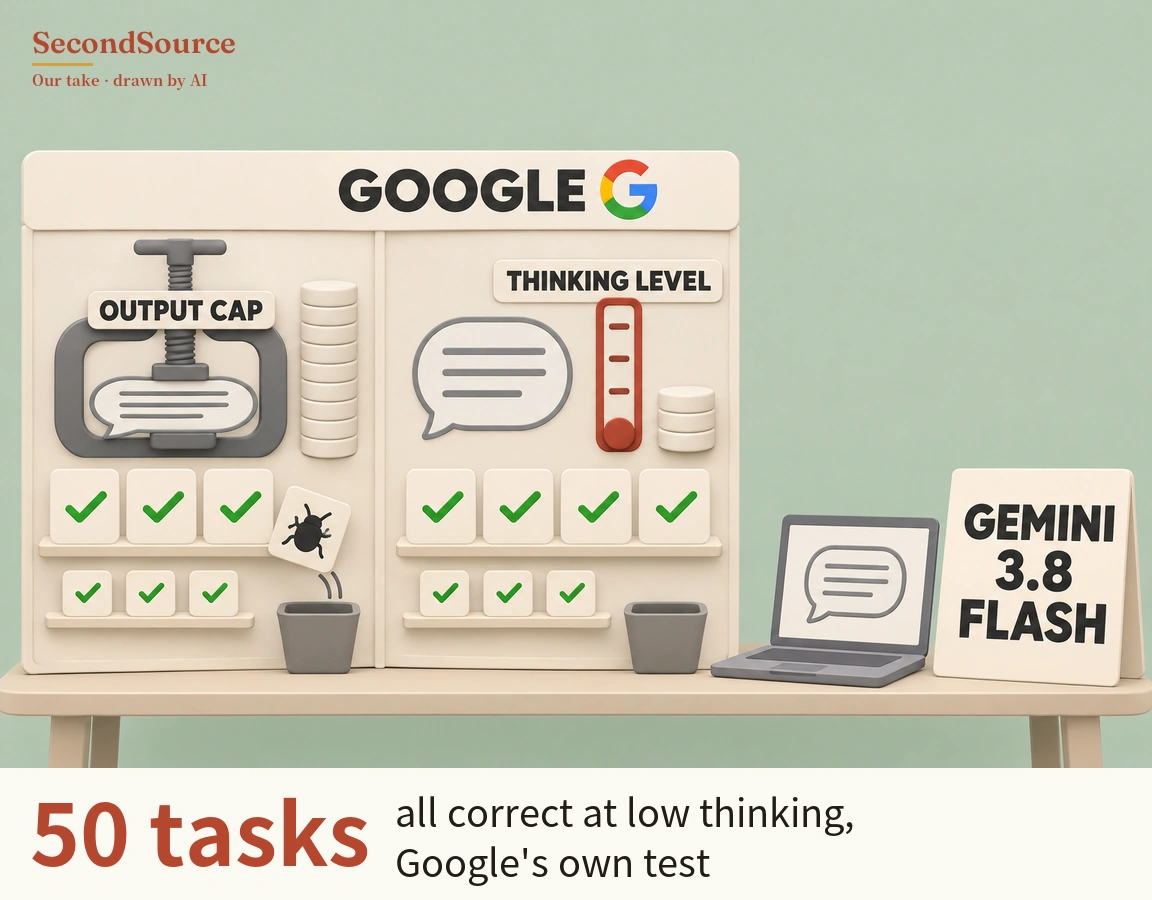
Google's November 3 developer blog post says agent cost should be measured per successful task. The basis is Google's own 50 coding tasks, each run once per setting, and the benchmark code isn't released yet. Google defines that metric as the total spend on every agent loop, tool call, retry and internal reasoning step, divided by the number of tasks that pass verification. Capping output at 300 tokens, down from the default, barely changed reasoning tokens on easy tasks, broke 7 of 25 hard tasks, and cost slightly more. Setting Gemini 3.8 Flash's thinking level to low instead got all 50 tasks right at far less than the default cost. Google then used Jev, a classifier from the company TypeSafe, to send easy tasks to the cheaper Flash-Lite and keep hard ones on the stronger Flash; that also got all 50 right and cut latency further. Google states it has no partnership with TypeSafe. The baseline was a rule that judges difficulty by keywords and length. Tuned on 16 tasks and tested on the other 34, it got 70.6% right, while Jev got all 34 (Google for Developers, 2026-11-03). Absolute costs and latencies appear only in charts. Google's caching makes resending the same content 75% to 90% cheaper, but the cache works only within one model, so switching models loses that discount. Google therefore recommends routing only short, self-contained tasks. How we checked →
Source and checks
This item ran in the brief of Nov 4, 2026, alongside 10 other items. How we checked it, the quote checks and what was still missing that day are on that issue's How we checked page.
Cite this item
SecondSource (2026). "In Google's own 50-task test, setting Gemini's thinking level to low saved more money than capping output length.." https://secondsource.io/en/product/2026-11-04-1/. Accessed access date.