Google Cloud lets Kubernetes join TPU capacity into larger slices or split it into smaller ones at scheduling time, and Google says startup is up to five times faster.
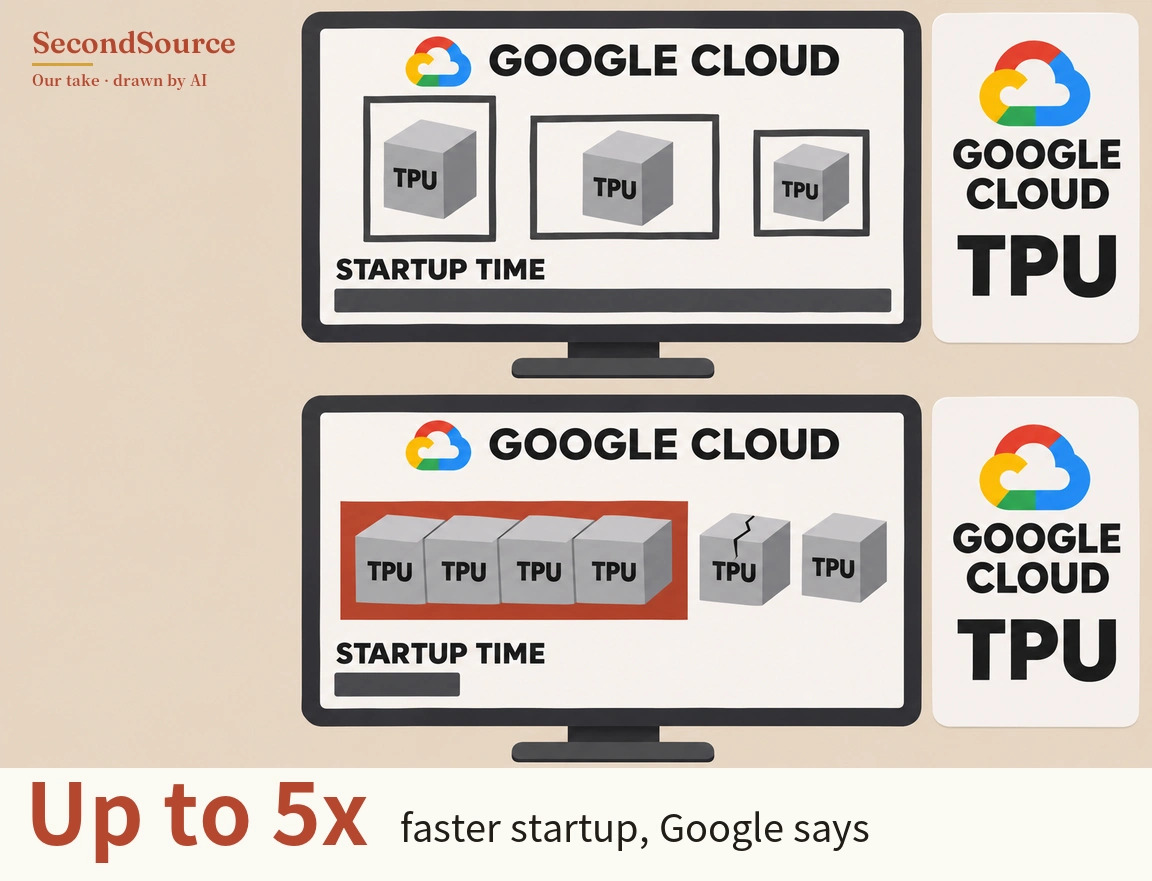
Platform teams on reserved TPUs no longer need a separate node pool for each topology, though the startup and recovery multiples come without test settings and only reserved capacity is supported. The comparison is with building a fixed node pool for each TPU slice. The new feature divides all TPU capacity into cubes of 16 virtual machines each. At scheduling time it uses optical circuit switches, which switch connections with optical signals, to join cubes into large slices or split them into small ones, so no machines have to be set aside in advance for each shape. Google says job recovery is about 4.5 times faster, and a failure replaces only the broken cube, in about 1 to 2 minutes (Google Cloud, 2026-11-09). On-demand capacity and discounted Spot capacity can't use the feature. How we checked →
Source and checks
This item ran in the brief of Nov 10, 2026, alongside 12 other items. How we checked it, the quote checks and what was still missing that day are on that issue's How we checked page.
Cite this item
SecondSource (2026). "Google Cloud lets Kubernetes join TPU capacity into larger slices or split it into smaller ones at scheduling time, and Google says startup is up to five times faster.." https://secondsource.io/en/product/2026-11-10-1/. Accessed access date.