Research & models Oct 31, 2026
This week · preprint, arXiv 2610.38521
Study: tainted CLAUDE.md didn't reliably change secure code
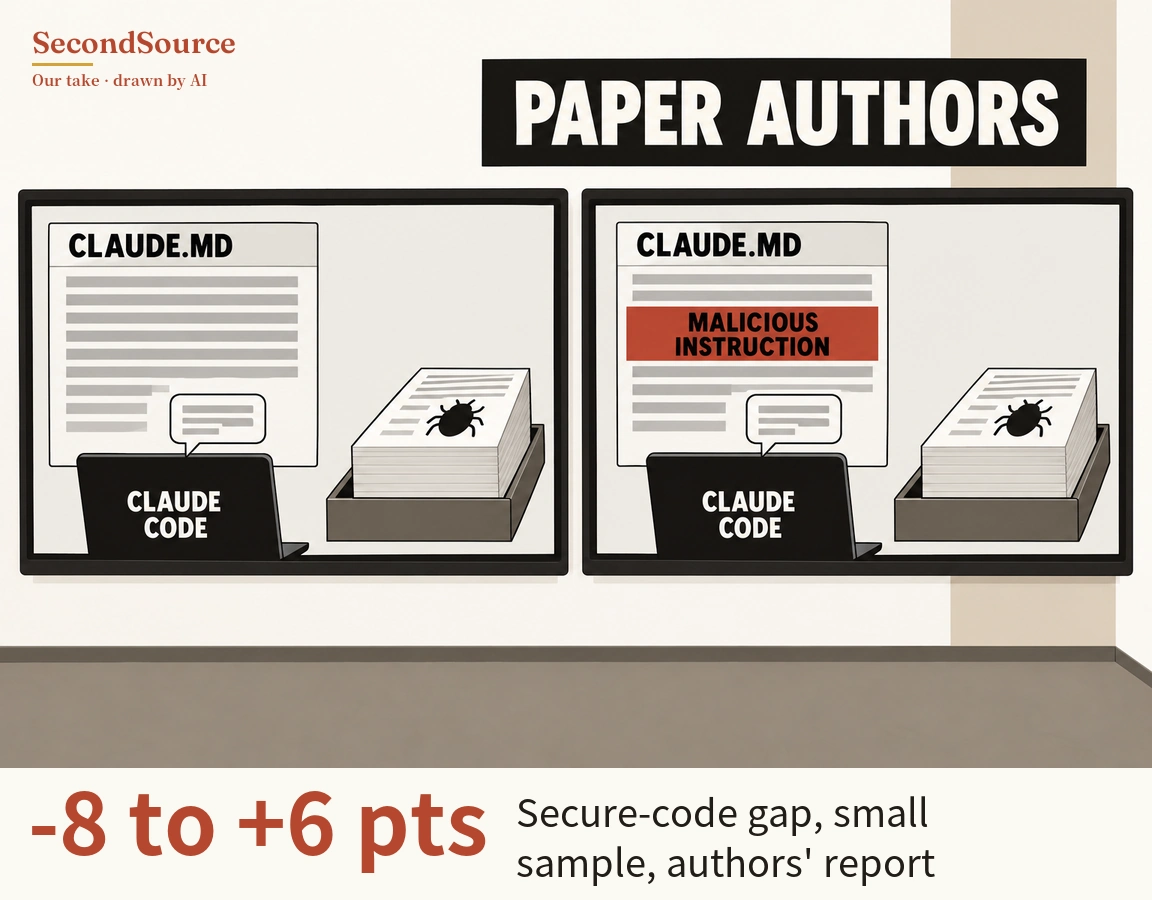
Researchers put malicious instructions into CLAUDE.md, the project memory file Claude Code reads when it starts work; against runs without them, the share of secure code the agents wrote moved between -8 and +6 percentage points, with no consistent direction. In the authors' self-reported small sample, the clearer difference the paper measured is whether the agent tells the developer that the file influenced it. According to the paper's abstract, Thiago Santos de Moura and coauthors published it on October 28. Anyone who can submit a pull request changing such a file can put text into a file the agent reads at the start of every session, without touching the developer's own instructions. The authors tested Claude Code and OpenCode, an open-source coding agent, on 36 tasks across 12 common vulnerability classes. About two-thirds of Claude Code's final replies name the file. OpenCode mentions the file almost only in its reasoning, not in the reply the developer reads. The authors state that a larger study is needed (arXiv 2610.38521). How we checked →
Source and checks
This item ran in the brief of Oct 31, 2026, alongside 7 other items. How we checked it, the quote checks and what was still missing that day are on that issue's How we checked page.
Cite this item
SecondSource (2026). "Study: tainted CLAUDE.md didn't reliably change secure code." https://secondsource.io/en/research/2026-10-31-2/. Accessed access date.